

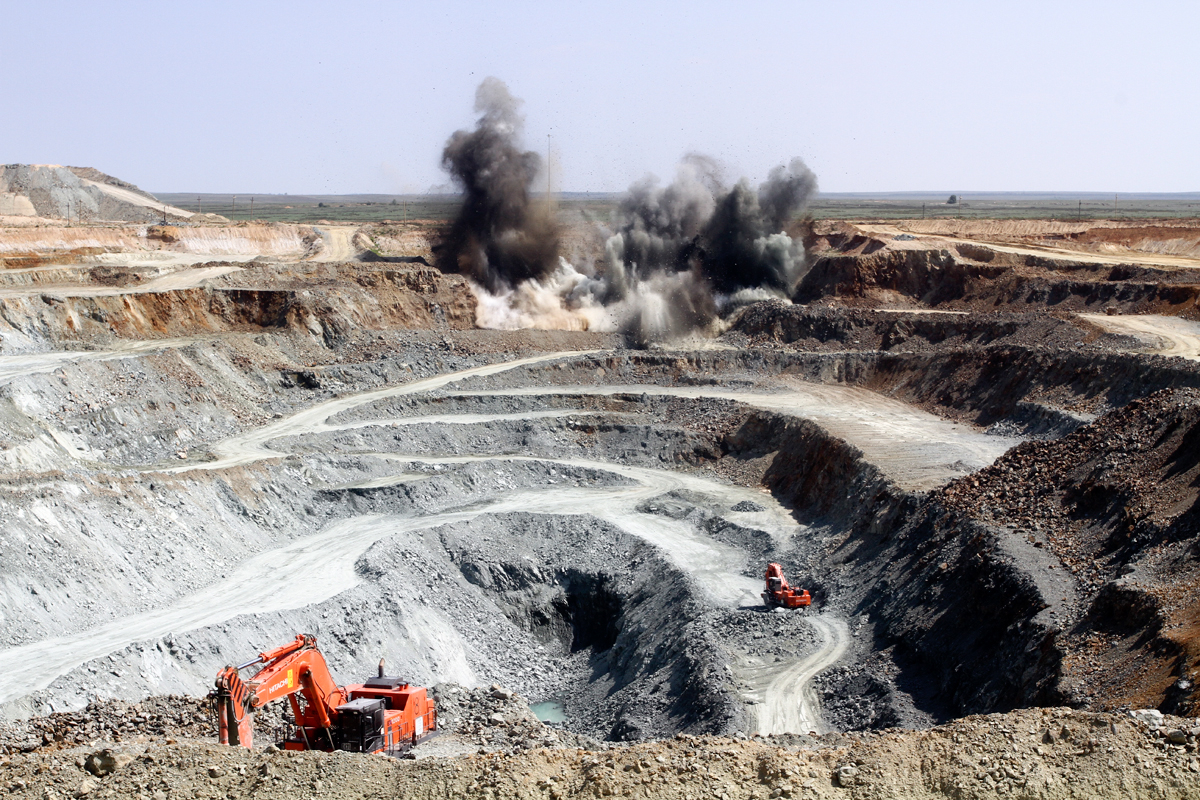
“The fact that there is no Indigenous word for mining clearly demonstrates how it is a completely alien and unwanted practice,” Simione Sevudredre, Indigenous Fijian cultural consultant and scholar, said to the Fiji Times in May.
All land was Indigenous once. Soon we started mining.
In his memoir of Yanomami life, The Falling Sky, Davi Kopenawa recalls with disgust the first gold miners who arrived on their Amazonian territory. “They were frenetically searching for an evil thing that we had never heard about and whose name they repeated unceasingly: ‘Oru, gold, oru, gold, oru, gold’,” he wrote.
Mining destroys the land, destroys the mountain, the river. The land. Indigenous people belong to the land. Respecting and caring for the land is as essential as breathing. No ownership or forced obligation. Only a sense of duty and guardianship. To protect. To leave the land better than when you found it. This is the Indigenous way.
Once you start mining the land, the mountain, the river, you become extractivist. You are now an invader, colonizer, imperialist. Europe was once Indigenous land, now the Sámi are among the few remaining Indigenous peoples formally recognized, and they face intense pressure as their lands are further invaded and plundered. Below ground they rip out their supposedly ‘green’ metals and above ground they plant their wind factories, scarring the land, intimidating, poisoning, destroying. And in the cities across the Global North, mining oligarchs are celebrated as pioneers of the great green transition as they roll out more ‘Green Sacrifice Zones’, polluting local communities in the name of progress, innovation, and saving capitalism.
Over half of the global mining projects for ‘green’ metals are happening on Indigenous land. In the Andes, Indigenous communities face ecosystem collapse due to lithium mining. In the US, more than 100 lithium mines are planned across the U.S., many of them on or near Indigenous lands and sacred places such as Thacker Pass.
In Indonesia, the uncontacted Hongana Manyawa and the Bajau communities are under severe threat from nickel mining. In Myanmar, rare earth mining poisons the once-pristine mountains, while Chinese silicon smelters cut down 14,000 football-field-worth of tropical forests every year for charcoal. In Laos and Cambodia, Indigenous lands are also being devastated by rare earth mining, where harvesting one ton of rare earth causes 2,000 tons of often radioactive waste. In the Congo, Zambia, Guinea, and Ghana, companies arrive in pursuit of copper, cobalt, and aluminum.
Indigenous communities who oppose the ‘green’ metal mining surge in the Philippines are systematically red-tagged — a form of political repression where individuals, often Indigenous leaders and environmental activists, are labelled communists or socialists, exposing them and their families to targeted violence. This is a pattern. As mining surges around the world, so too do the criminalization, torture and murder of Indigenous people as ancestral territories are stolen and desecrated.
“For most Indigenous peoples in the world, identity is rooted in territory,” said activist Edson Krenak in an interview with journalist Katie Surma. “In Brazil, we say: ‘We are biome.’ We are people of the biome, people of the territory. Who we are is so deeply tied to the land that when we lose our territory, we lose our languages, our traditional ways of eating, praying, dancing, performing rituals — everything.”
What does being Indigenous mean to the late environmentalist and activist Roberta Blackgoat? In his book, No Spiritual Surrender, the sadly missed Diné Navajo musician and activist Klee Benally quoted her as once saying:
“This land is a sacred land. […] Our great ancestors have been buried all over. They have become sand. They have become the mountains and their spiritual presence is still there to guide us.”
You cannot mine the mountain; you cannot shove giant wind turbines into its flesh and claim that you respect it, that you consider it sacred. More mining only builds more Green Sacrifice Zones to feed the bottomless belly of the Growth Death Cult. Demanding more and more and more.
“The Earth has given us everything,” Robin Wall Kimmerer, author of Braiding Sweetgrass, said when she spoke at the Kiewit Luminarium in Omaha, Nebraska, in 2024. “What will we give in return? The Earth doesn’t need us to dominate her.”
Mining is domination and destruction of the land and the memory. Australian author Tyson Yunkaporta, who is Aboriginal from the Apalech clan, describes the importance of memory in his book, Sand Talk: “An Indigenous person is a member of a community retaining memories of life lived sustainably on a land-base, as part of that land-base,” he explains.
Modern mining gets more destructive every year. In the early‑20th‑century, extracting one ton of copper damaged around 70 tons of earth. Because of declining ore ratios, in 2026, extracting one ton of copper produced between 500 and 600 tons of mine waste. Copper mining is a major source of environmental pollution, harming nearby communities. Still, copper is widely used in technologies that support the global transition to so‑called ‘clean’ energy. For this, we’d need to mine more copper over the next 25 years – with demand estimated to grow by 350%. Think of the environmental damage caused solely by our demand for copper.
Benally also expressed this deep connection to land shared by Indigenous communities, writing, “We locate ourselves in the springs where our ancestors’ footprints have worn a path like an umbilical cord. On greenwashing the energy transition, he wrote, “Green futures are still dead futures for Mother Earth. If we start considering “necessary sacrifices” and “harm reduction” in the face of ecocide and genocide, we’ve already lost.”
I’m old enough to remember when environmentalists stood up for animals, protecting the birds and the bees. But with digital technology, younger generations spend more time on screens and revere machines. A teacher I spoke to recently told me that she believes teenagers are afraid of their environment. When they look at a mountain now, she observed, they don’t see a mountain; they see “beautiful” wind turbines instead.
We live in a shockingly Orwellian world where the dirty has become green and the poison has become clean, where nonrenewable copper and nonrenewable lithium and nonrenewable nickel are added up and, with great marketing and branding, are made to equal ‘renewable’ energy. But it is the same old world. Colonialism, imperialism, extractivism. Green colonialism now. All for a good cause, they say. They used to come to these lands seeking gold and silver, planting Christian crosses and spreading the ‘good word ‘. Now, they seek rare earths, lithium, nickel and copper, as they spread the new good word about the Green Transition. In this digital culture, how can wild nature survive? How can the Indigenous survive when they are in the way of progress?
There has never been any meaningful energy transition. It’s always an energy addition. More coal, more oil, more gas, more hydro, more nuclear, more wind, more solar. To supply the Global North with the myth of clean and green energy, the Hongana Manyawa and the Bajau Communities must suffer the worst of all worlds. Right this very moment, there is a coal and nickel mining boom in Indonesia.
Words still matter. They carry weight. As they expand AI data center development, each with the hunger and thirst of large cities, the maintained narrative is that incorporating ‘renewable’ energy use would make them sustainable. This is a crude capitalist play. For these fake renewables — made from nonrenewable lithium, copper, nickel and others — companies have achieved license to consume without guilt. These abhorrent AI data centers, with their monstrous demands for land, water and energy, with their noise and air pollution that devastates the communities that they were imposed on, with their exorbitant demands for metals, chemicals, plastics and ultrapure water for their super-intense chips, all of these incessant demands and consequences are concealed behind a puffy cloud of branding smoke and mirrors, once that transformative word ‘renewables’ is played.
Because the propaganda is effective: Renewable energy has cracked the code – infinite growth can continue on a finite planet. Creating in the minds of the public that this not-so ‘Green Transition’ is now not just morally justified but morally necessary. The logic of the Growth Death Cult: For it would be a sin if we did not speed up the mining on Indigenous land so that we can have renewable AI data centers.
Green colonialism. Clean imperialism. Renewable extractivism. Sustainable mining.
We must radically slow down. In the Global North, we must degrow our appetites, or they will be degrown for us. We must face the real problem, not its symptom. We do not have an energy production problem. We have an energy consumption problem. In the Growth Death Cult, we consume vastly too much and produce substantially too much toxic waste. The only transition that gives us any hope for survival is from high-energy societies to low-energy ones. And the only way we can do that is through a moral and cultural transition from patriarchal and consumption-based cults to guardianship and matriarchal, nature-based societies. There will be no abundance during this transition, but there is a chance of equality and fairness.
Chickasaw poet Linda Hogan, who authored Intimate Nature: The Bond Between Women and Animals and shares my love of the Earth and the life on it, said it best when she wrote:
“It is through our relationships with animals and plants that we maintain a way of living, a cultural ethics shaped from an ancient understanding of the world.”


Comments
We changed commenting systems on September 10, 2026 as part of a site-wide functionality and security upgrade. Your past comments have not disappeared, and you can still log in with your old Disqus account credentials if you wish. Contact us with any questions.
For about a decade, living in the US, I have promoted renewables. In the last 5 years or so, though, reading pieces like McGovern's, I've come to realize "clean energy" is adding to fossil fuel energy, rather than replacing it, & is itself unsustainable. I've continued in the same quest, though, thinking that renewables offer the best available compromise for colonizers & extractivists since, to me, they seem unwilling to give up their modern conveniences & comforts made possible by extraction (whether fossil fuels or renewables). Indeed, the needs of me & many of my associates cannot be met but by modern civilization; we depend physically on the pharmaceuticals that 20th & 21st Century medicine provides. If I don't take my daily blood anticoagulant, I'll quickly die a painful death. I feel trapped. Any advice?
For what it’s worth I’m pro renewables.
I think opposing them is the worst possible strategy.
At the same time I’m committed to reducing consumption.
"There will be no abundance during this transition, but there is a chance of equality and fairness."
This is refreshing honesty. And I think we need this kind of honesty. But we also need to make clear that the world we could have, if we chose that austere, equal, fair world–unlikely as that is–would be a better, happier, more satisfying world. Antidepressants and and antianxiety meds might not be available–but there would be a great deal less demand for them in a world where the hared goal was to see everyone's needs met, where–sorry! work is not abolished but more necessary than it's been for a century, especially actual physical labor–but work that needs doing, that calls on people's strengths and gifts, not bullshit jobs.