

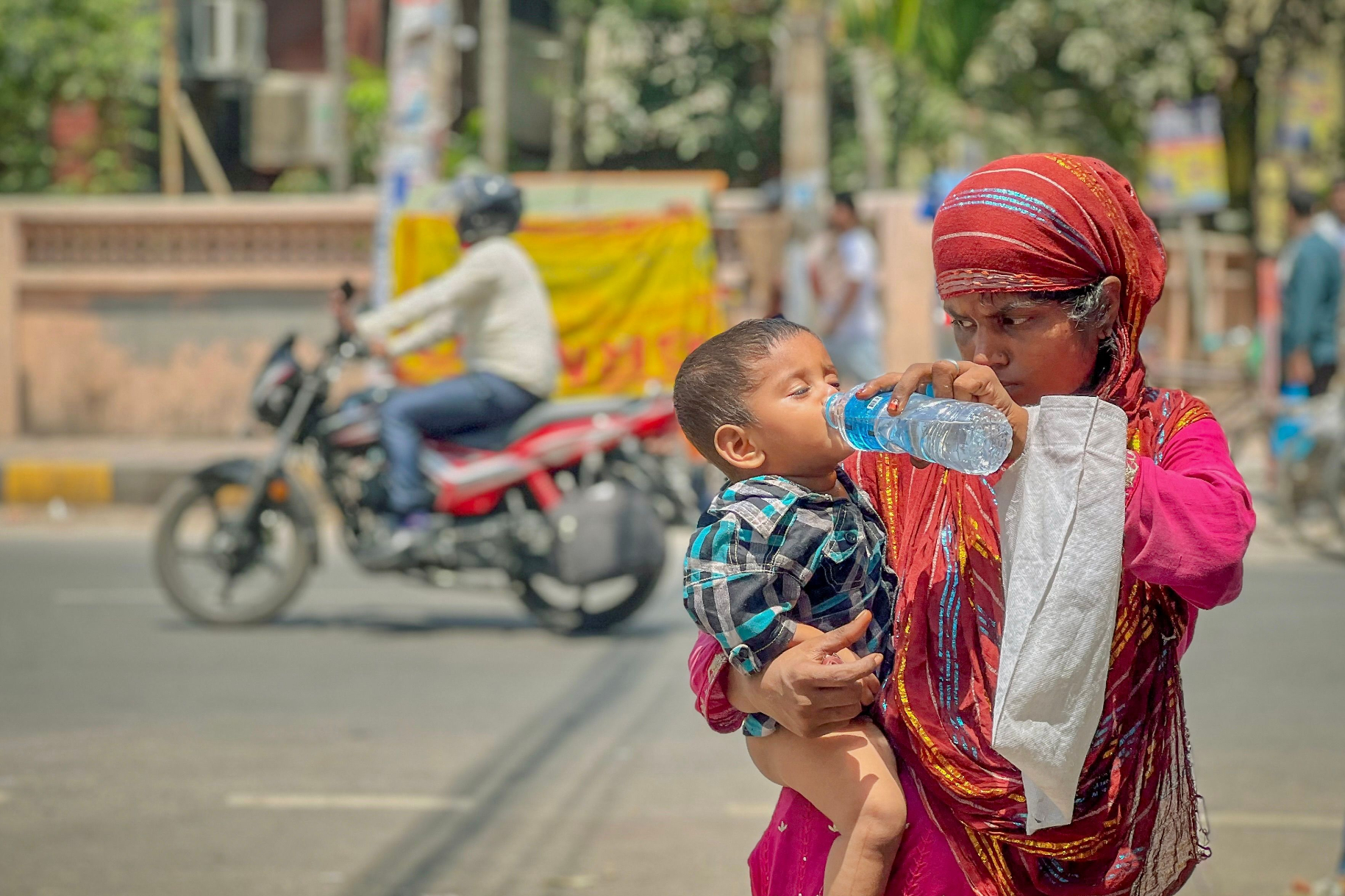
In the fall of 2025, The Washington Post reported on a nursery worker in Florida who began experiencing headaches and nausea under extreme heat and eventually collapsed while working. Shortly after, NOAA’s Climate Prediction Center released its summer 2026 outlook, projecting that large parts of the United States would experience above-normal temperatures.
Both are stories about extreme heat, yet the two scenes are not easily understood as part of the same narrative. One is depicted with red maps and numbers, while the other is conveyed through an individual’s collapse and illness. Advances in extreme heat mapping have evolved through the use of warning signs and other tools. But we’re still missing a clear picture of who cannot escape the heat and how unevenly the risk is spread. This gap matters because extreme heat is a core feature of the climate crisis, which affects an increasing number of people every year.
Even before summer arrives, many first encounter heat through forecast maps and abnormal temperature figures. Those visual tools are certainly essential: they turn risk from an abstract forecast into a problem that can be addressed. But as extreme heat grows in frequency and severity, it becomes just as important to ask what narrative those visuals support. Seeing extreme heat more clearly doesn’t necessarily mean understanding it better. Who appears in our heat coverage helps inform whether extreme heat is treated as just another weather story or a public threat we can’t ignore.
What the maps show — and what they do not
It is not that better tools do not exist. The Centers for Disease Control and Prevention (CDC) and NOAA’s HeatRisk and Heat & Health Tracker applications, which go beyond simple temperature maps to show health-based risks, provide a more detailed picture of the possibility of heat-related illness and represent an effort to treat extreme heat not merely as weather information but as an actionable health risk. The problem is not the absence of technical progress either. It’s that public attention and news coverage still tend to linger longer on the question of “how hot it is.”
According to a review by Canada’s National Collaborating Centre for Environmental Health (NCCEH), media coverage of extreme heat tends to emphasize record-breaking temperatures, extremity, and impacts on infrastructure, while explanations of health impacts, high-risk groups, and protective measures remain underreported.
Headlines about extreme heat tend to emphasize broken temperature “records,” while giving far less attention to why certain populations are more vulnerable to its effects and face higher risks of death. Imbalanced reporting can also shape how audiences come to see extreme heat, at times, as a spectacle rather than a disaster. People experience the heat, but it becomes harder for them to understand the structures that turn that heat into unequal harm. The public may recognize the hazard as a seasonal phenomenon, while viewing harm as a series of scattered tragedies.
From warning to action
More precise warnings do not naturally guarantee protection. Recent research by NOAA/NWS finds that tailored heat communication can increase people’s knowledge and risk perception, but this does not necessarily translate directly into concrete protective action. The reason is simple. Anyone may be able to see a heat alert, but not everyone can adjust their daily life. Not everyone has access to air conditioning, and not everyone can move to a safer location. Information can spread widely, but the conditions needed to act on that information differ from person to person.
According to the Occupational Safety and Health Administration (OSHA), millions of workers in the United States are exposed to heat on the job, and thousands become ill each year from occupational heat exposure, with some cases becoming fatal. The CDC’s National Institute for Occupational Safety and Health (NIOSH) also warns that outdoor as well as indoor workers exposed to extreme heat or working in hot environments may be at risk of heat stress and other heat-related illnesses. These figures lay bare a harsh reality: the deadliness of extreme heat depends as much on the choices or resources a person can access to reduce that risk as on temperature itself. While for some people, extreme heat remains a matter of discomfort and heat records, for others, it is also a matter of work that cannot be stopped, housing where cooling cannot be achieved, and delayed medical care.
When public agencies and the media communicate about extreme heat, they have a responsibility to address not only numerical indicators such as temperature and records, but also the conditions that amplify risk and the people positioned in the blind spots of protective measures. Merely showing temperature maps colored in red is not enough. Alongside them, we should also see residential areas with limited access to safe indoor temperatures, urban heat island zones with insufficient tree shade, and areas with high concentrations of outdoor workers.
Reporting needs to move beyond “how hot it is” to the question of who is exposed to that heat the longest. Only when exposure, not just temperature, is placed at the center of how we measure and report heat can extreme heat be seen not simply as just weather, but as a social risk.




Comments
We changed commenting systems on September 10, 2026 as part of a site-wide functionality and security upgrade. Your past comments have not disappeared, and you can still log in with your old Disqus account credentials if you wish. Contact us with any questions.