

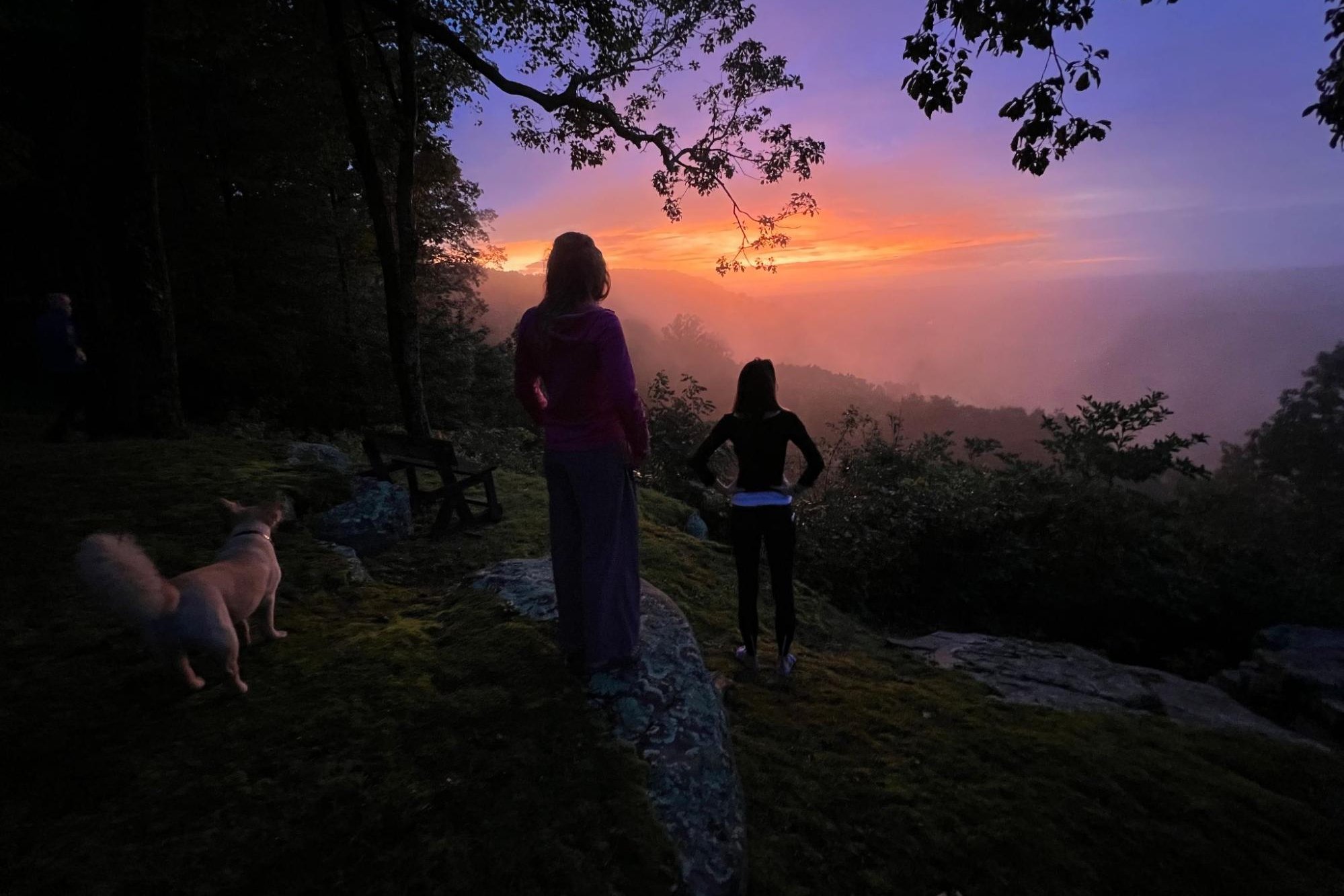
A cliff’s edge is the perfect place to feel small. I count on that sensation each time I visit my mother in Tennessee. She lives on a sandstone bluff of the Cumberland Plateau, rock that was formed in the shallows of an ancient sea. Some 300 million years later, it is our perch to watch the evening sky turn to gold, then pink and streaking red. Both time and space feel unbounded there. One human life is tiny by comparison.
Having studied and written about climate change for more than two decades, I know that feeling small isn’t always a good thing. Too small to make a difference. Too small to matter. Especially now, in a movement under duress. Given the scale of planetary disruption and the losses we face, that reaction is rational. But if we want public progress—on climate or anything else—we must embrace the role that smallness plays. Small spaces that form, connect, and renew us are essential infrastructure for change.
When we imagine a social movement, we picture its most visible moments: civil rights activists marching from Selma to Montgomery, the 20 million Americans who participated in the first Earth Day, protestors camping for weeks in Zuccotti Park. These are the scenes that fill history books and command media attention. But they are the crescendo, not the origin.
What we witness in the streets begins in modest enclaves, where the people who lead change come together. Rosa Parks trained at the rural Highlander Folk School before sparking the Montgomery Bus Boycott. Second-wave feminists raised consciousness in living rooms before legislatures ever debated their demands. Abolitionists organized in Quaker meeting houses.
Movements depend on churches, retreat centers, classrooms, and community halls because our work isn’t just strategic. It is creative, emotional, relational, and often spiritual, and that kind of work requires such spaces to take root.
Uncharted Territory: Finding Clarity and Purpose in Your Climate Journey
To find our way in our climate journey, we don’t need more information, we need orientation. Join us for a conversation with Katharine Wilkinson about Climate Wayfinding.
My own path as an environmental activist began at such a place. At sixteen, I spent a semester at an experiential outdoor school that connected us to land and one another. There, encounters with ecological loss in the Southern Appalachians shook me, but I had space and support to process the ache and to envision alternatives. Within that community, my concern grew into a clear calling and alarm became energy to act. The experience set my inner compass in a way that still holds.
For the majority of Americans who worry about the climate crisis, my experience is an outlier. Most people have no such container. Many never even discuss the topic with family or friends. Despite a willingness to engage, the very worry we feel can produce paralysis. Isolated from others who care, concern curdles into overwhelm. We get stuck on the question: What can I do?
For the small minority who step off the climate sidelines and into engagement, burnout is a real risk. I know from personal experience how it can squelch a sense of purpose. Without places to metabolize what we are witnessing and reimagine what’s possible, the draw to disengage swells. And without sustained, spirited participation, no collective mission can succeed.
We need spaces where people can gather to grapple with fear, share grief, test ideas, build trust, and stoke courage. Such rooms are not peripheral to social change. They are its heart.
Consider last year’s landmark climate ruling of the International Court of Justice (ICJ). The world’s biggest problem reached the world’s highest court thanks in no small part to a classroom. At the University of the South Pacific, a group of law students brainstormed ideas to help their island nations, increasingly inundated by rising seas. They landed on pursuing an ICJ advisory opinion, in hopes of binding all countries to act on climate. That classroom birthed a world-shifting vision.
Leaders at the highest levels of climate diplomacy have recognized the need for intimate spaces, too. Christiana Figueres, the former United Nations climate chief who helped secure the Paris Agreement, has partnered with Plum Village, the engaged Buddhist community founded by Thich Nhat Hanh. Together, they offer retreats for climate and nature leaders. I attended one last fall, where we dropped discussion of science and policy in favor of silence, insight, and renewed mutual commitment.
The work of my own organization, The All We Can Save Project, follows a similar vein. Through a network of climate educators, our Climate Wayfinding program is helping university students across the U.S. and Canada move beyond information to orientation and gain clarity on their roles in planetary healing. A new book by the same name makes the experience available to climate seekers of all ages, as we find our way in an increasingly mapless world.
A classroom or a retreat may appear small compared with planetary disruption. Most things do. But that is how nature functions—through trillions of minor links. Without the underlying web, an ecosystem weakens. The same is true for a movement. Efforts like these are the mycelial network of change caring for itself.
Big swings for the future of our shared home are certainly needed, as urgency grows and too many gains are lost. We should stage protests, run campaigns, and prepare to seize the next political opening. But we must invest equally in nurturing the people who make all of it possible. If the future lives anywhere, it must be within and between us.
As I stood on that sandstone bluff on a recent visit, watching day yield to night, I did not feel insignificant. I felt connected—one being knitted into life on Earth, one person among many who care deeply about what comes next. No individual carries change alone. Movements endure because communities tend them. If we want sustained engagement on climate, democracy, or any of the challenges ahead, we will need more than big moves. We will need small rooms that can hold us.
Within them, we realize: Small is not the opposite of power. It is often where power begins.
Uncharted Territory: Finding Clarity and Purpose in Your Climate Journey
To find our way in our climate journey, we don’t need more information, we need orientation. Join us for a conversation with Katharine Wilkinson about Climate Wayfinding.
This essay originally appeared in The Ink. Republished with permission of the author.




Comments
We changed commenting systems on September 10, 2026 as part of a site-wide functionality and security upgrade. Your past comments have not disappeared, and you can still log in with your old Disqus account credentials if you wish. Contact us with any questions.