

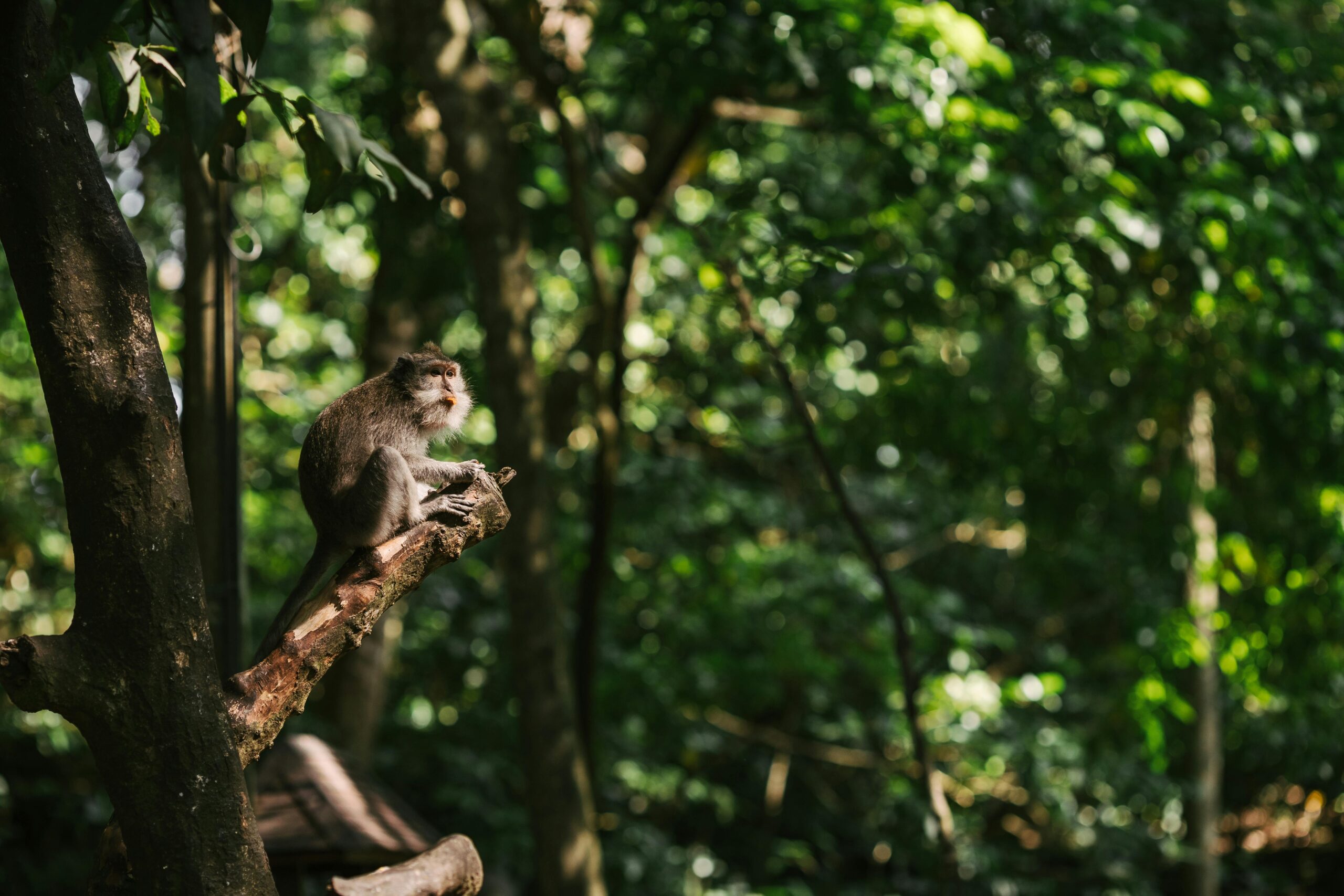
Every breath we take, every thing we feel, every hope we hold, every wound that heals. Every birth that starts, every death that ends, we are a part of nature.
For thousands of years, however, we have claimed ourselves to be not a part of it, but better than nature. In many cultures, we gave ourselves an assumed position at the top of an imagined hierarchy, above the mountains, the ants, and the apes. We were human. We were better than the animals. Some people took this a step further, proclaiming themselves to be racially better than others.
Our widespread cruelty towards animals is enabled by our self-importance. So is our general ignorance about nature, and our willingness to permit her destruction. All of these things are enabled by our belief that we are special, nay, exceptional, as Christine Webb shows in The Arrogant Ape – The Myth of Human Exceptionalism and Why it Matters.
We are just one thread in the mystery of nature
Our hunter-gathering ancestors knew they were just one thread in the mystery of nature. They knew that the wolves, the ravens and the mountains merited respect. They lived amid nature, not apart from her.
Maybe it was the flint-tipped spears, and our increasing skill at hunting. Maybe it was when we settled down in villages and towns, fighting off the rats and keeping the birds off the crops. Maybe it was the constant acts of aggression against other tribes. Maybe it was fear of the evils that lurked in the dark forest, beyond the safety of the village. Maybe it was the loss of shamans, who could talk to the plants and the ravens. Or maybe it was the pleasurable feeling of control that came from growing crops in a good year, when the sky-gods smiled on you.
Either way, most non-Indigenous people came to believe that they were better than the animals. Didn’t the Bible tell its readers to go out and subjugate nature? Didn’t the French philosopher René Descartes justify his dissection of live animals by declaring that they had no spirit, no ability to feel pain? They were things, not beings.
The Enlightenment had its romantic side, with poets and painters immersing their souls in nature, but it also had its rational side, which encouraged people to see the world as a machine, to be understood and controlled. Add fossil fuels, chainsaws, pesticides, ocean bottom trawlers, and the self-importance of homo economicus, who wants only to gain, never to love, and it’s not looking good for nature.
Maximize capital gains, regardless of the cost to nature
Since the 1980s, we can add the self-importance of many – but not all – shareholders and investment fund managers who want to maximize their capital gains at 15% a year, regardless of the cost to nature. All we need to do now is to conquer space before Earth becomes a wasteland. For the full story of how our ancestors justified their desire to dominate and subdue nature, I recommend Philipp Blom’s Subjugate the Earth: The Beginning and End of Human Domination of Nature.
Today, we totally dominate Nature. You’ll need to toughen your heart before you read this list, because it is horribly overwhelming:
- Every year, we cut down 15 billion trees and destroy 20 million hectares of forest.
- Every day, we kill 20 million cows, sheep, goats, pigs and ducks, and 200 million chickens, most of whom will have lived in cramped or crowded cages for all of their time on Earth.
- Every year, we kill two trillion marine mammals, including 300,000 whales, dolphins and porpoises, and 100 million sharks.
- Between 1970 and 2018, we and our machines wiped out 69% of the world’s mammals, birds, fish, and reptiles.
- A fifth of the world’s economies are at risk of ecosystem collapse.
- Almost every country is missing its global targets for biodiversity protection.
- Because of our ignorance and lack of regulation, we have breached seven of Earth’s nine critical planetary boundaries. We are living in a planet-wide danger zone.
- Because of our use of fossil fuels and our desire to eat beef, we are destroying 12,000 years of climatic stability, inviting catastrophe.
What then must we do? We have to build a new ecologically centered civilization.
Step One: Measure nature’s world
We need every level of government to engage volunteers and professionals in local ecological mapping to create what we could call Nature’s Book of Hope, showing the losses and gains over time, and where restoration is needed. The Shifting Baseline Syndrome makes people normalize the world in which they grew up. We need to know what we are losing, so that we can work to restore it.
Step Two: Understand nature’s world
We need to overcome our massive ignorance. We need our schools to teach Climate and Nature 101 to every student, giving them immersion in nature … the ocean, the stars, the microscopic … inspiring them to continue learning about nature for all their lives. We need colleges to make it a prerequisite for admission. We need civil servants to take a similar course, as France is doing for each of its 5.6 million staff. We should expect every banker, CEO and candidate for political office to do the same. We can’t afford to have leaders who can’t explain the carbon cycle, or who don’t know what a keystone species is.
Step Three: Protect nature’s world
We need to follow through on the commitments nations made to protect at least 30% of the land and ocean by 2030, 50% by 2050. We need to look for every opportunity to create new parks, wildlife corridors, and marine protected areas.
Step Four: Restore nature’s world
We need legislation asking or requiring every landowner of more than 1,000 acres – 400 hectares – to submit an annual scorecard on their impact on nature, and their plans for restoration, offering tax breaks to those who score high. We need ecological restoration projects everywhere, from the urban streets to the ecological barrens caused by the uncontrolled grazing of sheep and goats. There are many inspiring examples we can learn from.
Step Five: Restrain nature’s destroyers
We need legislation that would require every business and bank to adopt a Social Purpose Charter within five or ten years, or lose its license to operate. The new charter would require, among other things, that the primacy of social purpose should supersede the primacy of capital maximization; a written plan to become 100% nature and climate friendly by 2040; a representative for Nature on the Board; and, for larger companies, an appointed board of public trustees who would be accountable for the public good.
To end the assault on nature, we need to go one step further. We need legislation ending immunity for the owners and directors of corporations who break the law. No more blaming the corporation and giving it a fine. Only people have agency. We need to make it clear, in law, that a corporation is not a person.
We also need to stop subsidizing the destroyers. In 2023, the world’s governments gave $700 billion to farmers, 90% of which supported activities that harmed nature. They gave $620 billion to fossil fuel companies; $320 billion to harmful water management practices; $155 billion to harmful forestry practices; and $20 billion to harmful fisheries practices. This all needs to end.
Step Six: Join nature’s economy
In nature’s economy, there is no such thing as waste. It is circular. We need a circular economy scorecard for every product line, starting with those that produce the most waste, and legislation requiring repairability, reduced packaging, and increased recycled content, with companies being required to report on progress, as Scotland is doing. We need a circularity tax on all major products graded by their scorecards, using the revenue to build a circular economy. Products that are easy to repair or recycle would carry no tax.
Step Seven: Regulate to protect nature
We need regulations to ban greenwashing advertising, end air pollution, end water pollution, accelerate the transition to 100% renewable energy, protect animals from all forms of cruelty, and so much more. We need to be well-prepared so that much can be achieved in the first 100 days in office.
We also need a new way to track progress. GDP is not a useful measure of progress – it is more a measure of Gross Depletion of the Planet. There’s a solid argument for degrowth, but economic growth is the result of our troubles, not the cause. The cause is the primacy of capital gain, driven by selfish investors who want more growth because it brings more profits. It makes no sense to blame an impersonal reality like ‘growth’ for harms caused by people. It is we who are to blame, and the behaviors that we must change. We should replace GDP with ECP (Ecological Civilization Progress) as our scorecard, showing our progress towards just that – a new ecological civilization.
Step Eight: Use ecological tariffs to protect nature
The argument for border carbon tariffs is well-advanced, so that a country which charges a carbon tax is not flooded with cheaper imports from one that does not. The way to start might be for 20 nations to form an Ecological Tariffs Treaty, levying a 20% tariff on goods from nations that are making little effort to reduce their climate pollution, prevent animal cruelty, stop the trade in exotic animals, or prevent the import of threatened tropical hardwoods.
Step Nine: Craft treaties to protect nature
There are global treaties, such as the Global Convention on Biodiversity, but with the exception of the Montreal ozone hole treaty, they are not really working. They have no enforcement, no reliable funding, and no accountability if a nation ignores them. We need treaties that are specific and measurable, with sanctions for breaches. Most trade treaties have clauses that allow a disgruntled corporation to sue for millions in private courts, but when it comes to being kind to Nature, it’s all voluntary. We also need to give legal rights to Nature, and to make ecocide a crime.
Step Ten: Celebrate nature
We need regular celebrations of nature, gathering in the woods, by the rivers and on the shores with dancers, music, meditations, and commitments to become champions for nature. We need to reverse several thousand years of human self-importance and domination, and reestablish the obvious truth that we are part of nature. We breathe her air, drink her water, eat her food. Our very bodies have been formed by her cellular evolution. We share kinship with all living beings, and indeed, with all existence.
We need to practice the art of surrender, in place of conquest. Humility and surrender in the face of the wonders of nature and the Universe will create a strong foundation for our future. It will be a marked improvement over the self-importance we have displayed for the last few thousand years.
Every breath we take, every thing we feel,
Every hope we hold, every wound that heals.
Every birth that starts, every death that ends,
We are a part of Nature.


Comments
We changed commenting systems on September 10, 2026 as part of a site-wide functionality and security upgrade. Your past comments have not disappeared, and you can still log in with your old Disqus account credentials if you wish. Contact us with any questions.
I agree with most of this but there are a couple bits I disagree with. One is taxing owners of more than 100 acres of land. Instead I think we should break up large farms so that new farmers have a chance. And I agree that corporations are not people but I think we should recognize that they are machines, and have been empowered to make decisions in pursuit of the singular goal of maximizing profits, and the humans associated with them have no choice but to follow that directive or be terminated. So we need to disempower corporations–which is advocated here. Finally, we don't need lists of good ideas for rules we could install if we had political agency–we need to figure out how to gain that agency. There have been good ideas proposed for half a century but they "can't" be adopted if they interfere with the flow of wealth to the wealthy.
How would anyone make a living on small farms? Virtually impossible here in Australia.