

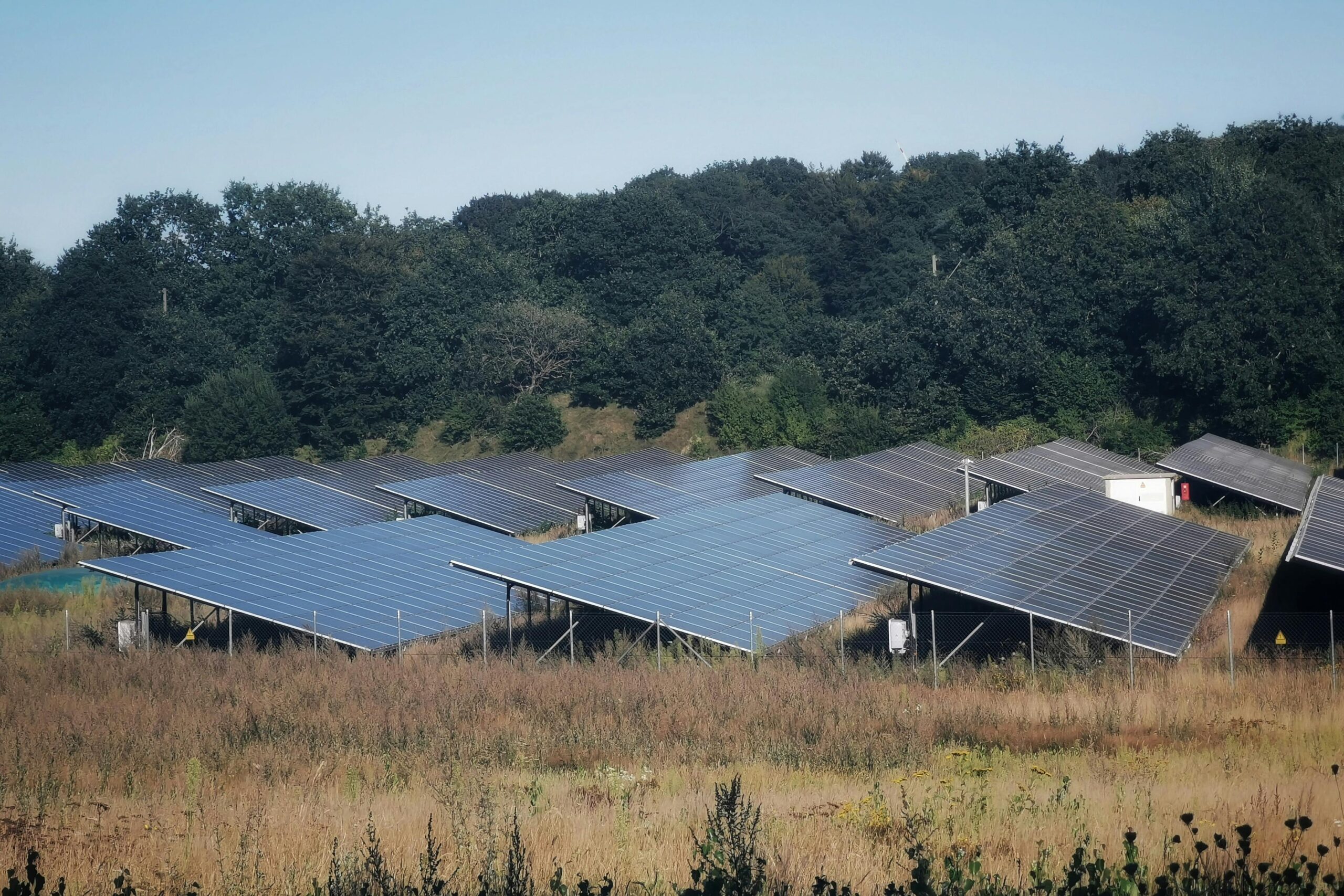
I recently saw someone online wax poetic about how solar panels are so benign because they don’t leak oil or emit air pollution or make noise like machinery running on fossil fuels. “They just sit there,” he said, doing their thing. While I agree that we must reduce fossil fuel use for the good of the planet, I must point out that solar panels are not benign.
Like any technological product manufactured by industrial processes from raw materials extracted from the earth, solar panels have an ecological footprint that negatively impacts the more-than-human world.
Currently, the subject of these impacts is most often ignored or when it’s not, is usually hand-waved away. After all, the carbon-centric narrative goes, with the climate crisis being such an existential threat, we must do anything we can to “decarbonize” and that means scaling up solar, wind, etc., as fast as possible. As regular readers will know, I have long advocated for cutting overall energy use and consumption rather than trying to sustain current levels with alternate means. To emphasize: my critique of “green” or “clean” energy is from an environmental perspective, and be assured I’m far from a climate denier.
I’ll also add that I personally appreciate solar power in my own life. As someone who doesn’t have a permanent home and who has regularly ended up in off-grid situations, I own portable solar equipment to keep my gear charged. It’s amazing technology that has allowed me to do my writing and photography in remote places and I’m grateful for that. Especially since I visit some of these locales because they are under threat from expanding development and I want to document them in the interest of their defense.
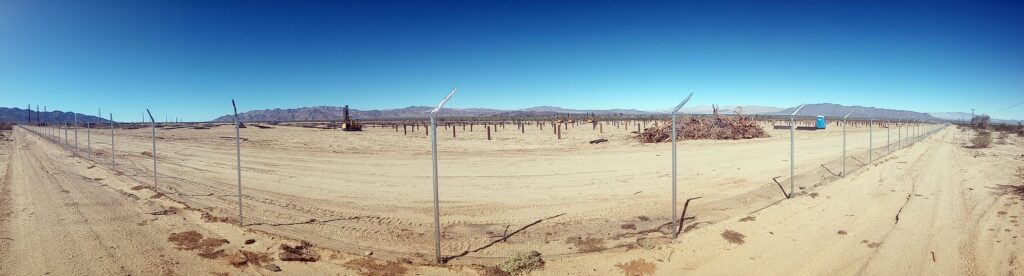
My main concern is with the utility-scale photovoltaic plants (colloquially known as solar farms) because of the large amount of wildlife habitat they wipe out. I love the western deserts and their flora and fauna, and I’m opposed to them being sacrificed. Rooftop, brownfield or parking lot installations are preferable in this way, though there is still the impact of manufacturing and disposing of the panels themselves, which is not trivial, and which I aim to highlight here.
The three main types of solar panels used in utility-scale plants are monocrystalline, polycrystalline, and thin-film. The crystalline types are by far more common. Monocrystalline panels are the most efficient, last the longest and have the highest cost. Polycrystalline panels are more affordable, but are no longer the standard in utility-scale operations. Thin-film is less efficient (and less expensive) than both but can tolerate higher temperatures, which is advantageous in desert regions. Currently, thin-film panels comprise only ~5% of those in use, so I’ll be skipping over them here.
Quartzite to sand to silicon
Silicon is the key material needed for crystalline panels. (Thin-film panels may or may not use silicon, so more on those later.) Silicon is made from quartzite sand, which is in turn from quartzite ore. Quartzite ore is extracted from open-pit quarries or underground mines. As far as habitat degradation goes, mining is a nightmare. Besides the literal loss of land, there’s all the pollution including toxic dust and fumes, chemicals, emissions, noise, etc. Local water sources are often depleted or tainted. Restoration of such spaces to their original states is impossible. Yes, another mix of flora and fauna can thrive there in time—and I’m the last person to throw shade on novel ecosystems—but the loss of the original is permanent. The “green” and “clean” monikers applied to technology like solar panels ignore the mining step, even though it’s absolutely essential.
Transforming the quartzite ore into sand is a multi-step process involving specialized industrial equipment, high temperatures, lots of water and of course copious energy.
First the ore is crushed, screened, washed, and “calcined” (heated to 1800-2000°F to purify it).
Next steps include magnetic separation (to remove ferrous impurities), air classifying (which separates the particles by size), and surface treatment (to improve various properties like water repellency).
To finally get to pure silicon, the sand is mixed with a carbon source (like coal) and put in an arc furnace. As the oxide burns away, silicon is left behind, though still with some impurities, which are removed using hydrogen and hydrochloric acid. The final result must be greater than 99.9999% silicon to be solar grade.
Purified silicon to panels
For monocrystalline panels, this nearly 100% silicon is made into ingots through a fascinating process called the Czochralski Method. A “seed crystal” on a shaft is lowered until it just touches the surface of a vat of molten silicon, and then is slowly raised and rotated. A crystalline structure of silicon forms in a cylinder up to six feet long, vaguely like growing sugar crystals on a string. (For polycrystalline panels, molten silicon is cooled in molds.)
The ingot is sliced into thin wafers (180–300 micrometers thick) with a diamond-coated precision saw. The wafers are cleaned in baths of acidic and alkaline liquid and with ultrasound. Then they are treated with an alkaline solution that roughens the surface at the microscopic level, reducing reflectivity so more of the light hitting the wafers is absorbed. Next they are “doped” to maximize their conductivity. “Doping” uses phosphorus oxychloride to infuse the surface with minute impurities, which is what make the wafers functional as electrical components. Yes, after all that complicated refining, the wafers won’t function until purposefully made less pure in a very particular way. The doping step requires temperatures of 1475-1650°F.
A few more coatings are applied to the wafer: on the front, silicon nitride for anti-reflectivity and silver for conductivity, and on the back, aluminum to complete the electrical circuit. The front of the wafer is the positive side, and the back is the negative side. At this point, the wafers are finished solar cells, and are tested to ensure efficiency and output.
To manufacture a solar panel, individual cells are strung together with metallic “busbars” and “bus ribbons” to carry the current (lots of soldering at this step), and the resulting grid of cells is sandwiched between layers of encapsulation (usually an ethylene vinyl acetate film) with glass on top and a weatherproof plastic “backsheet” underneath. After being laminated with heat, the now joined layers are affixed in a frame with a junction box on back.
Recycling
The International Renewable Energy Agency estimates that by 2050, the world will have to deal with ~78 million metric tons of solar panel waste. There’s no coordinated plan or regulations to deal with this. Currently, the rate of recycling is around 10% but the number of solar panels reaching their end of service life now is much lower than it will be in the future due to the great number of panels being manufactured and installed. That is, if the current number of panels being recycled didn’t change, then in a couple decades the percentage would be lower than 10. So if we’re serious about recycling solar panels, we have a lot of work ahead of us.
The challenges might be primarily logistical and economical. Technically speaking, the glass panes and aluminum are fairly simple to sort out and the silicon wafers can be melted down and re-purified, though dealing with the encapsulation layer is “not straightforward.” Also, as with any industrial processes, recycling will itself require machines and energy and will generate waste.
Logistical challenges include building recycling facilities, setting up systems of collection, and legislating the policies to make it all happen. Economically, whether recycling “pencils out” or not will depend on a number of circumstances, such as whether profit motive is the deciding factor.
At the moment, though, solar panel recycling is barely a thing, and we can’t just count on the hope that “we’ll work that out later.” It really needs to be prioritized right now, if only to clean up the mess we’ve made so far.
Picture the big picture
It’s true that a solar panel does not leak oil or emit air pollution or generate noise. But its manufacture and disposal are not benign. Next time you see a utility-scaled photovoltaic plant in person or otherwise, try to picture the footprint it left elsewhere, from the gaping hole of the quartz-ore mine, to all the factories and industrial machines involved along the way, to the piles of old panels that may or may not be recycled.
I don’t know how big of a role solar energy will play in the years and decades ahead, but I hope it is small because our overall energy consumption ends up declining. My personal best-case scenario is no new energy infrastructure because we reduce that much that fast.



Comments
We changed commenting systems on September 10, 2026 as part of a site-wide functionality and security upgrade. Your past comments have not disappeared, and you can still log in with your old Disqus account credentials if you wish. Contact us with any questions.
True enough, but new solar technologies, in particular a kind of thin film solar cell material called Perovskite, offer substantial improvements over established silicon technologies. This article should at least have mentioned them.
It's a really difficult topic because few are exposed to mining and extractive metallurgy technologies, or industrial refining processes (all of which are heavy polluters) that have to happen just to get simple semi-refined ores and raw materials, let alone the high tech that goes into those ores and raw materials afterward. Technooptimist disinformation also don't help.
Thank you for all the illuminating details of how solar PV panels are made. I've added your article to my energy notebook.
The dirt on "clean" energy is even worse than depicted here.
Because solar is intermittent and disbursed, grid infrastructure, which was designed for compact, centralized, 24/7 generation must be upgraded to accommodate it. Solar generation plants are in new locations, requiring new grid transmission infrastructure to carry it to customers. In addition to the mining & heavy industry of grid infrastructure hardware, it also imposes a land use footprint, including transmission line easement widths from 25 to 180 feet! New transmission grid towers are 60-150 feet tall. I don't know how much concrete & steel per tower, the depth of a tower's foundation, or the spacing of the towers, but that's a heckuva lot of concrete, steel, and land, and doesn't even include new service roads or transmission substations.
Since solar is intermittent, and our entire economy, from residential to industrial sites depends on 24/7 power, it must be supplemented with either utility scale energy storage or with natural gas. You'd need another detailed essay to go into the harms of utility scale battery storage, but also remember that you would need at least 3-7x solar PV build-out just to charge the batteries.
What a nightmare!
Good to read about the solar panel types.
I think many of us support solar power, but are not too evangelical about that, being able to still think and talk about limits.
One big issues is what was coined the 'Energy Trap', explained by physicist Tom Murphy in his blog 'Do The Maths'. Simply put: Most of the energy and resource inputs into solar & wind are at the front end (resource extraction, manufacture, transport and installation). While these installations have been growing exponentially the net energy output over time has barely exceeded the input energy. The outputs being delivered over the service life of the panels or turbines.
This partly explains why, after 3 decades of rapid renewables growth, there's been almost no dent in world carbon emissions and fossil fuel growth.
The other thing that strikes me is that the shiny little solar panels sitting my roof do look very comforting and pollution-free, but as the renewables slice of energy pie keeps increasing major works have to be undertaken to buffer our electricity grids. Some of these are anything but benign.
Here in Australia massive machinery is creating the $7 billion Snowy South pumped hydro project, entailing moving mountains of dirt to create an underground power generation facility and 27km of under mountain tunneling. Almost a decade in the making, all the while using massive diesel earthmoving equipment.
https://en.wikipedia.org/wiki/Snowy_2.0_Pumped_Storage_Power_Station
I have to ask about the net energy and resource inputs there and the benefit over time. As many other people are.
* * *
Whenever talking about limits it is necessary to re-assert where we are coming from. I'm not as an antagonist, but do see the need to get away from the romantic "clean & pollution-free" lingo that accompanies so many commentaries on renewable energy. Owing to its basic dishonesty.
Enthusiastic wind & solar hype in the past decade or so has totally overwhelmed what core of what used to be central to conservation thinking – the limits to growth and the need to curtail consumption as the highest planning priority. Not as a meek wishful thinking adjunct that it has shrunk down to in this supply-side energy arms race.