One night every October, after the sun sets over the island of Vanua Lava in the southwestern Pacific nation of Vanuatu, the surrounding reefs become the scene of an extraordinary spectacle: The palolo rises.
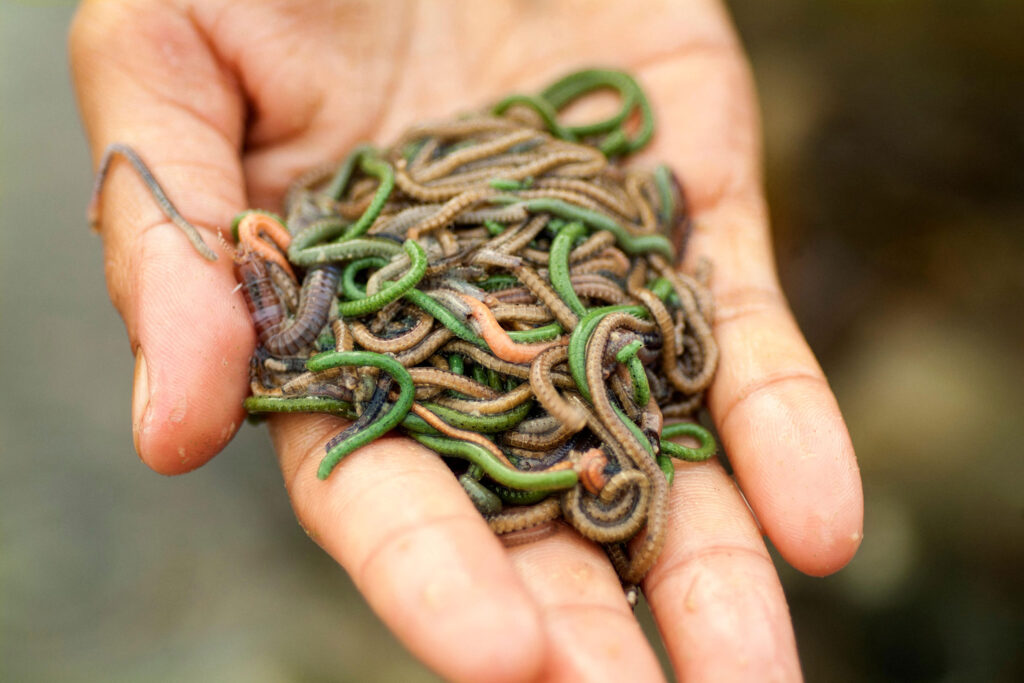
Palolo worms, spindly grey invertebrates that can grow longer than a ruler, rarely venture from the crevices of coral rubble at the base of the reefs where they spend most of their lives. But once or twice a year, the sea worms simultaneously cleave their bodies in two. Their anterior parts continue life as usual on the reef, but the posterior ends undergo a transformation—growing rudimentary eyes and preparing to procreate by developing either greenish-blue eggs or orange-hued sperm that changes the color of their bodies. These so-called epitokes use their eyes to navigate to the surface, spiraling upward until the ocean briefly becomes a tangle of green and orange. Then each epitoke bursts open, destroying its body to free its eggs or sperm into the water.
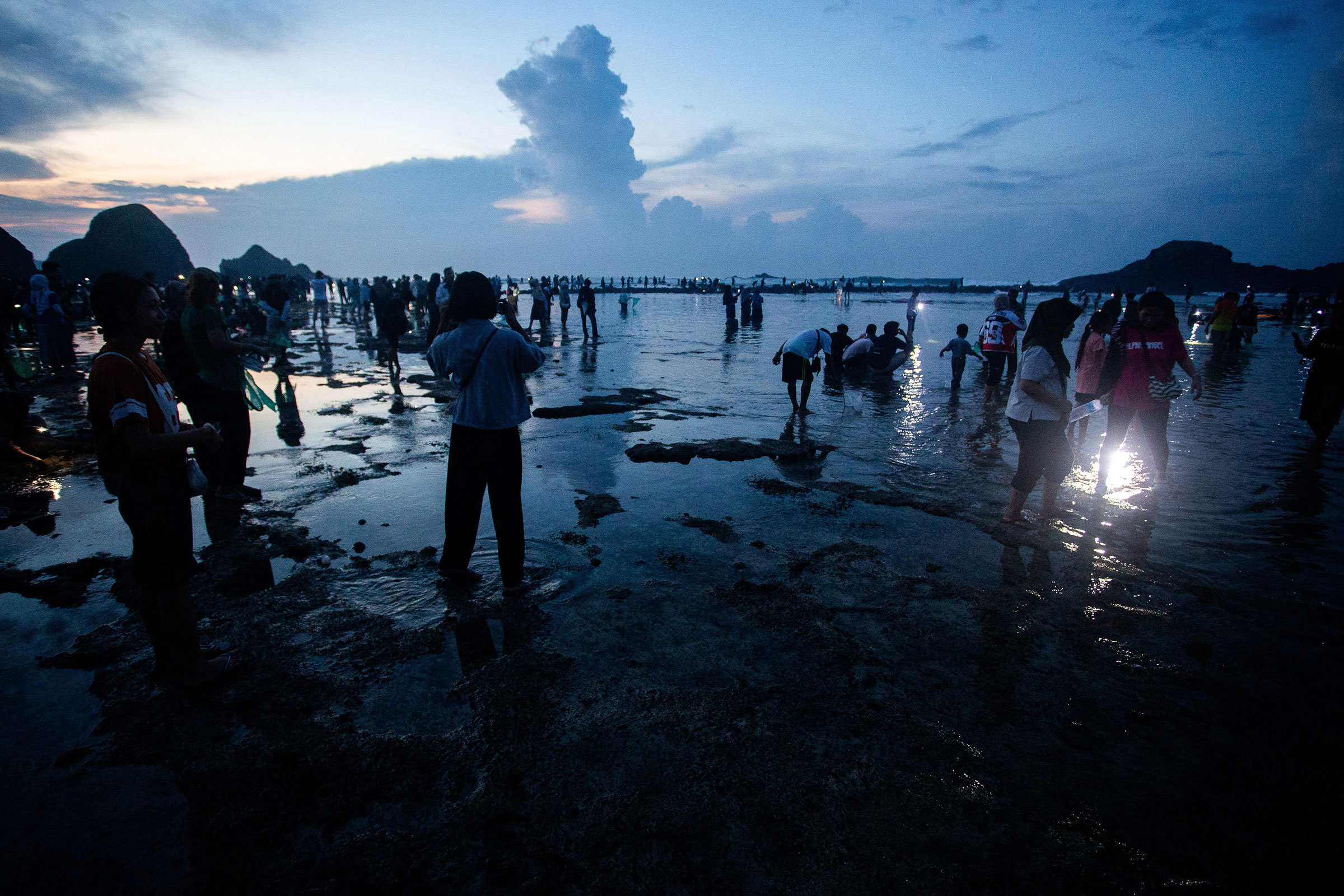
On shore, families from Vanua Lava’s Wasaga Village wait eagerly, coconut palms and other trees lining the coast behind them. They light fires or use flashlights to attract the worms, recalls Charlie Bride Paul Vusqal, who participated in the festivities as a child and more recently has been helping to document these traditions. Some people sing songs in their native Vureas language to call the worms to land: “Palolo, swim home to us. … We really want you; you really want us.”
Similar scenes unfold in places as scattered as Samoa, Fiji, Timor-Leste, Papua New Guinea, Indonesia, and other parts of the southwestern Pacific where palolo worms (Palola viridis) live. Though the exact time varies by region, in each place the sea worms spawn at the same time every year—a strikingly regular event that has made a lasting mark on Indigenous cultures for millennia. Today, the palolo—a word derived from the Samoan language that’s sometimes also used to refer to other sea worm species—remains a beloved delicacy. And just as importantly, it’s a basis for rituals that shape communities’ sense of time.
In contrast to many Western societies, many Indigenous peoples often look not to fixed calendars but to their environment to keep time. To predict the best periods for planting, harvesting, hunting, and fishing, they follow the rhythms of animals, plants, and celestial bodies—ancient time-reckoning systems known as ecological calendars. Across the southwestern Pacific, people have learned to predict the rising of the palolo with such accuracy that the event anchors their ecological calendar, as predictable as the summer solstice. It marks a night of celebration that in turn portends more seasonal changes to come.
“It’s one of the most cross-cultural elements in ecological calendars in this part of the world because … it’s something that happens so regularly,” says ethnobiologist Neal Kelso of the University of Hawai‘i at Mānoa, who with Vusqal and others authored a 2023 article on the palolo’s role in southwestern Pacific time-reckoning systems. Today, as rising oceans and more intense cyclones threaten to wipe out crops and drive people from the region, “palolo worms remain important markers of biocultural resilience,” Kelso adds. They not only provide a pulse of food but also help locals stay connected to their homelands and traditions—“a reliable predictor of health and well-being” that can help communities weather the challenges of a changing planet, he says.
Scientists are still puzzling over how palolo worms coordinate to spawn in concert every year. In Samoa, for instance, the worm is said to rise about a week after the full moon in October and November, while in Timor-Leste they appear five to six days after the full moon in March. Marine biologist Anja Schulze at Texas A&M University at Galveston suspects the creatures somehow sense the tidal changes that accompany the lunar cycle, ensuring that they all spawn on the same night, similar to the way tropical corals simultaneously release their own sperm and eggs in response to lunar cues. As for how the worms determine the right month, Schulze speculates that they may also detect the change between dry and wet seasons, when water temperatures and rainfall changes alter the water’s salt concentration. “Maybe there’s some way that they sense the salinity changes,” she suggests.
While it remains a mystery how the worms know when the time is right, many Indigenous communities know exactly when they’ll spawn. Carlos Mondragón, an anthropologist at Mexico’s El Colegio de México, has been studying the village of Loré in Timor-Leste, where locals are reviving palolo-harvesting traditions that were suppressed under Indonesian rule. He says that in Loré, the task of predicting the precise four-hour annual spawning window falls to ritual calendrical specialists and spiritual guides who are part of a family lineage said to be descended from the worms.
The stakes are high; the guides’ predictions are announced over the radio, drawing thousands of people from up and down the coast on buses, motorcycles, and bikes to Loré for a worm-calling ritual. A designated person lights a torch and scatters burning embers over the reef to attract the animals to the light, then others chant to the worms. Finally, people wade into the water to scoop the animals into specially made baskets. The spiritual guides haven’t told Mondragón what clues they use to anticipate the worms’ arrival, but they’re usually right. “The locals knew exactly when it was going to happen—I mean, almost to the minute,” says Schulze, who attended the Loré festivities in 2018 with Mondragón.
Further east, in Vanuatu, Vusqal’s community likewise watches for environmental signals to gauge the worms’ arrival. When the leaves of the wehr tree—the oak species Casuarina equisetifolia—turn reddish-brown in October, “that’s the sign we are nearly ready to harvest,” explains Vusqal. Seeing a particular seabird circling over Wasaga Village is another clue. After noticing these signs, locals begin a countdown based on the lunar cycle: On the night of the sixth day after the moon first becomes visible in daylight, they know it’s time. “That’s when the palolo worm will swim to us,” says Vusqal.
After families gather and collect the worms—at this point a fishy-tasting mix of epitoke remains, eggs, and sperm—they carry baskets back to the village. They wash their harvest and collect the rinse water, which they use to treat fever, scabies, wounds, and other ailments. Then they wrap the strained palolo in leaves and bake it in underground earth ovens with hot rocks and coal. That way “it can last for weeks,” Vusqal says. Importantly, they give some palolo to other communities of Vanua Lava; in return, they receive meat from wild pigs and other hunted animals. “We use it for trading and also to keep our relationship … between us and them,” Vusqal says.
Just as the palolo forms a key link between communities, it also creates a critical bond between the fertility of the ocean and that of the land: On nearby islands, locals use water from the palolo-rich reef to fertilize crops. Similarly, people in Loré scatter worms onto the soil of cornfields. “It’s really important that you fertilize the soil with it because it renews this marine and terrestrial relationship,” Mondragón says.
Islanders elsewhere attribute different symbolic meanings to sea worms, says anthropologist Cynthia Fowler from Wofford College in South Carolina, who wrote a 2016 book about people’s interactions with sea worms in Sumba, an island in Indonesia. (There hasn’t been a systematic study of the sea worm species harvested there, but they likely include palolo worms.) There, the appearance of the invertebrates—which locals call nyale—represents the return of the sea worm goddess, a beautiful Sumbanese woman who became a deity after throwing herself off a cliff to escape pursuit by suitors. In parts of Papua New Guinea, the palolo harvest is linked to the return of spirits from the underworld, forming a link between the living and the dead. Fowler marvels at how sea worms retained their cultural importance as contemporary Pacific Islanders’ ancestors spread across the Pacific. “Even though the patterns vary, there’s still this heightened symbolic significance,” she says.
The palolo harvest is also critical to keeping time itself going. Not long after the November spawning on the island of Loh in Vanuatu, summer solstice dawns in the southern hemisphere and the sun reaches its lowest position on the horizon. According to Mondragón, locals believe the sun risks getting stuck there and that the palolo harvest is critical to ensuring the sun returns northward. People chant as they flip the animals from worm-catching nets into food baskets. The ritualistic transformation from animal to food is said to turn the sun back in the sky, Mondragón says. “That’s meant to be a really important ritual which will anticipate the intended movement of the sun back to its northern horizon.”
In parts of Vanuatu and Fiji, the rise of the palolo reminds people of the upcoming cyclone season. It’s a sign that people must prepare by building or repairing traditional cyclone houses made out of forest plants and storing up food and drinking water. As climate change intensifies tropical cyclones, Kelso expects that such reminders will become increasingly important.
Some experts worry that young people aren’t learning ecological timekeeping from elders as more move to other regions to find work and become less interested in traditional practices. There are also anecdotal reports in Samoa and Fiji that palolo worms themselves are declining, perhaps because of coastal development or ocean acidification, though Vusqal blames people who aren’t respecting traditional harvesting practices. Still, Mondragón believes that ecological-calendar traditions are largely holding strong in the southwestern Pacific and that resilience to climate change is one of many reasons to protect these ancient calendar systems. “These are forms of traditional knowledge that—it seems to me—are going to continue being relevant,” Mondragón says.
While many Pacific peoples measure time in the weeks, days, and hours leading up to the palolo harvest, they often stop counting the weeks afterward and only observe the lunar cycle, allowing time to relax back into months. As the cyclone season comes and goes and the wet season shifts back into dry, Vusqal’s community will once again wait for the leaves of the wehr tree to brown and the palolo-heralding seabird to return. Meanwhile, inside the coral rubble on the reef bottom, the palolo worm will once again regenerate its epitoke, waiting for the right moment to return to its people.