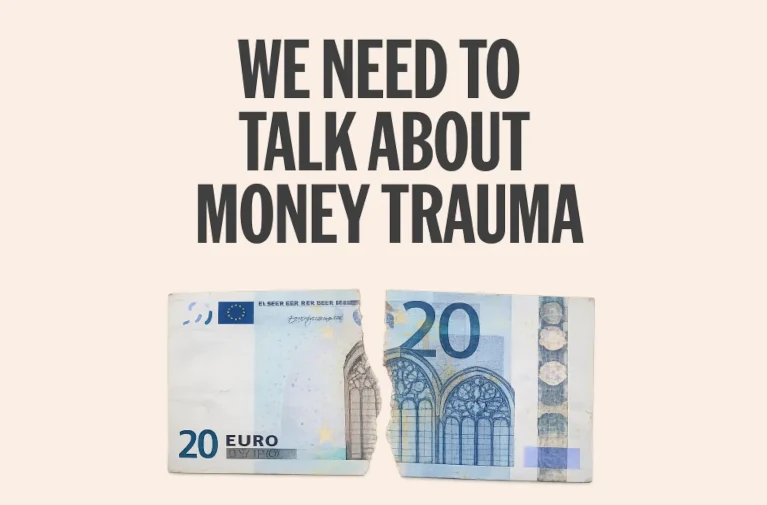
When most people hear the term ‘money trauma,’ I see something light up in them. They think of themselves, someone they know, and suddenly the distant concepts of money and emotions come together.
It’s curious that money trauma hasn’t gone into the mainstream yet. It’s one of the most fundamental forces shaping how we move around in our lives, and yet it remains incredibly taboo. When looked at deeply, it’s almost impossible to divorce how we interact with money from class, culture, and politics — the factors that ultimately determine how money shapes our lives. Yet mainstream conversation has been separating these for years. Money is treated as a topic we have to learn how to be ‘good’ at — and it is spoken about separately from the experiences and beliefs that may have shaped them. Beyond the realm of managing your money personally, many cultures are faithful to codes of silence around how much you earn, how you behave with money, and how to feel about it. So no wonder the subject is heavy, intimate, and deeply charged.
The majority of people in the most affluent countries in the world today are financially stressed. Recent studies cite how 80% of Germans report being worried about their financial situation in the next 12 months, 73% of American adults reported the economy as a significant source of stress, and 88% of British adults say that the biggest issue their country is facing is the rising cost of living. If that is the case, imagine what happens in the Global South.
It’s not surprising that people tense up when talking about money — there is quite literally survival energy underneath it. The wealthy don’t get to shield themselves from this either — they, too, are at mercy of the fact that 90% of all financial behaviors are made emotionally (Kahnemann). Because money is rarely just money. It’s a proxy for safety, identity, belonging, power, love.
As someone who has been looking at this topic from a socio-cultural, political, and somatic lens for the past few years, I believe the rigidity of these boxes and binaries need to be broken. Money has been my challenging mirror for where aspects of my own powerlessness and power lie. But it’s also been a great teacher. I believe unearthing conversations around it gives us great potential for healing, realignment, and social change.
The fortress of the taboo
Let’s tap into this collective taboo. Americans think money is more taboo than politics, religion, or body image. Only 20% of women in the UK said they would be comfortable talking about finances, compared with 28% of men. Only 46% of Germans would feel comfortable telling a family member — one of the most intimate relationships in our lives — their earnings or asking about theirs.
There is variation in how different cultures discuss and explicitly incorporate money in various routines and rituals in life, but in most capitalist societies, some codes remain remarkably consistent. Friends are unlikely to check in about each other’s financial wellbeing unprompted, unless there is already a crisis. An employee is unlikely to ask their employer how much they earn. The more obvious the invisible hierarchy, the more likely the taboo to become stronger.
These social codes arise from individualism, not solidarity. Silence around money can be traced back, according to many historians, to European aristocracy and colonialism. It was (and is) considered improper to discuss wealth among upper classes, as it would make their assets and resources visible and explicit. As colonialism enforced extreme inequality, cultural and moral justifications became essential to maintaining status quo. The late economic anthropologist David Graeber opens with this concept in his book Debt: The First 5,000 Years. On the first page of the book, he talks of meeting a lawyer in upper class circles where his position on trying to abolish the IMF and Third World Debt was challenged. “But they borrowed the money!” The lawyer said, referencing all the countries where extreme austerity was imposed on. “Surely one has to pay one’s debts.” Being astonished by how this was said with such unflinching resolve and certainty, Graeber uses the moral lens of “one has to pay back their debts” to trace back the history of modern money. A story where slave trade, indentured labour, inequality and colonialism was used to claim indebtedness — no matter what unforgiving circumstances a person was put through.
Sometimes, these dynamics show up with one another in overt ways. But other times they’re messier and nuanced, as human relationships are. We feel there are conversations that are too dangerous or tender to breach, but we also want to be close with and help each other. In most of our lives, there is a dance between this complexity, and much of life is lived in that tension.
Consider the classic example of two friends paying for a bill — one person struggling financially while the other is better off. It’s implicit that the person with more money should pay for the bill, but both are also aware that there is a codependent dynamic emerging, both financially and emotionally. Both are aware that it is coming in the way of the relationship and silently breeding concern. Often, it’s easier to stay quiet, avoid naming what is happening and to look away — until one day the dynamic becomes unbearable. Money as a taboo in relationships “isn’t harmless; it fuels stress, conflict, and disconnection in relationships.” If we had more courage, more language, and more experiences of having positive and constructive conversations around money that felt honest, many of these ruptures might become places of honesty, closeness, and mutual help rather than shame.
All this is difficult to imagine when money is still treated as a purely rational topic. When it remains taboo, and when we have few healthy experiences of talking about it, it becomes a vicious cycle.
The myth of rationality
Most of us grow up being taught that money is just numbers. We learn to approach it through a rational lens, as though it is just about logic, discipline, and calculation. This kind of thinking can be traced back to classical economics, where human nature was framed as selfish and competitive — reducing our buying behavior to rational, predictable choices, so that the entire discipline of economics can become a logical science. This kind of thinking permeates everywhere today — in how the economy is explained, in the financial industry, and even personal finance.
Financial literacy is often framed as the way out of being poor or having a good life. It emphasizes mastering concepts and becoming ‘good’ at them: budgeting, saving, borrowing, investing. Someone is considered ‘literate’ when they can perform these tasks effectively. Always save a third of your income and you’ll be able to save for retirement and therefore have permanent financial wellbeing — one plus one always equals three! It completely leaves out the cases in which patterns like emotional spending, gambling, avoidance, or shame emerges. At the same time, for many people, these supposedly simple financial behaviors are structurally difficult — or impossible — within the constraints of debt, discrimination, rising living costs, insecure work, or the fabric of reality being continually destabilised by war, technology, and political breakdown. As financial trauma researcher, Chloe B Mckenzie, points out, “financial literacy is just a social narrative that places the burden of ending or overcoming wealth inequality on the people who suffer from it most.”
What actually affects our relationship with money?
As with all things in life, stress can greatly impact the way we interact with money. When the nervous system is under stress for too long — stuck in fight, flight, freeze, or fawn — the brain begins reallocating resources toward survival. The prefrontal cortex, the part of our brain that plans, implements impulse control, and long-term decision-making, becomes less available. In that state, the ways we think about money becomes rigid, security focused or distorted. Managing it can also become overwhelmingly difficult.
“Someone tries to set a goal with money and (often times) there’s a little bit of perfectionism in that.” Chantel Chapman, author of The Trauma of Money, tells me in my podcast pilot. She describes how people can feel ashamed when they fail to reach that goal, and how that shame can quickly become its own feedback loop where emotional spending, avoidance, or hyper-fixation happen, quite literally to help the body soothe itself. The Trauma of Money method that Chantel and many other educators teach offers ways of helping people come out of those loops. “For me,” she says, “financial literacy is nervous system literacy.”
Equally, because of that measure, wounding with money comes from more than just chronic financial stress and poverty — money is simply a medium where dysregulation can show up. It is where our adaptations and unresolved pain often become visible.
Relational trauma can shape this too. Experiences of abuse, enmeshment, instability, or emotional inconsistency can all leave an imprint on the way we handle money. We may learn to associate money with control, danger, secrecy, or guilt. We may repeat familiar dynamics from childhood or from intimate relationships without even realising it. And then there is what is taught more broadly by the culture around us. I think of my own experience working in the crypto industry and feeling deeply uneasy about how easily consumerism and extractive technologies are sold as liberation. Entire systems are now designed to pull on our impulses and harvest our attention. It becomes very difficult to talk about “healthy” money behavior as though it happens in a still neutral environment.
Our experiences with money aren’t personal. They’re collective. Men are still taught that they should be breadwinners, even though it is enormous pressure to be the sole earner in today’s world. Race and political violence produce economic marginalization again and again, such as through the historical exclusion of Jews in Europe, the dispossession of Palestinians under occupation, and the precarity forced onto immigrants and refugees today.
I hear a shared context all the time. I hear it in people who come to my workshops from China, whose families lived through the tumultuous change and scarcity of the communist revolution, and then the industrial revolution and ascent at break-neck speed. I hear it in people from Lebanon— those who have been subjected to repeated economic crises and constant violence from Israel — when they talk about money. I see the reckoning and the difficulty of facing what being wealthy means in Germany through the Nazi regime and the liquidation of the East. These stories show up in the tales that families narrate to their children about what kind of person one must become in order to survive.
But what if economic change came and people were lifted out of hardship — was that mobility used to serve a collective uplift, or it was used to solely to feed the self and repeat similar patterns of accumulation?
What if we started talking about money trauma?
Our psychologies are not our destiny. They shape us, but they do not determine us. One of the most hopeful shifts of recent years is that more people are beginning to challenge the old fictions that depoliticize our personal sufferings. Through books like Decolonizing Therapy and The Myth of Normal, we are slowly being given better language for how pain is not merely individual, but structured by the world around us.
If this is true, then the question is not only whether individuals can heal their relationship with money (which you definitely can, by the way.) It is also whether we are willing to build the conditions that would allow people to relate to money differently in the first place. Do we believe there are new ways of organizing economic life, beyond the well-worn binaries of capitalism or communism? Is there political will — and funding — to support experiments to do things differently? Or will those possibilities continue to be dismissed before they begin, written off through the familiar moral language of debt, deservingness, productivity, and laziness?
To talk seriously about money trauma is also to reckon seriously with power. In families, in friendships, in workplaces, in activism, and in society at large — what do we owe each other? How can we be in right relationship to one another, when we exist so unequally and all of us are entangled somehow in this system?
These are extremely difficult questions without any easy answers. There is definitely too much to unpack in one essay, in one sitting. I know for myself that I’ve had to challenge my deeply worn out story that money is evil — because I want to imagine myself, and us, changing course with money. And perhaps that is the deeper invitation in talking about money trauma: to heal our relationship with money, and to reclaim our relationship with each other. To tell new stories about enough with each other and to live a good life.
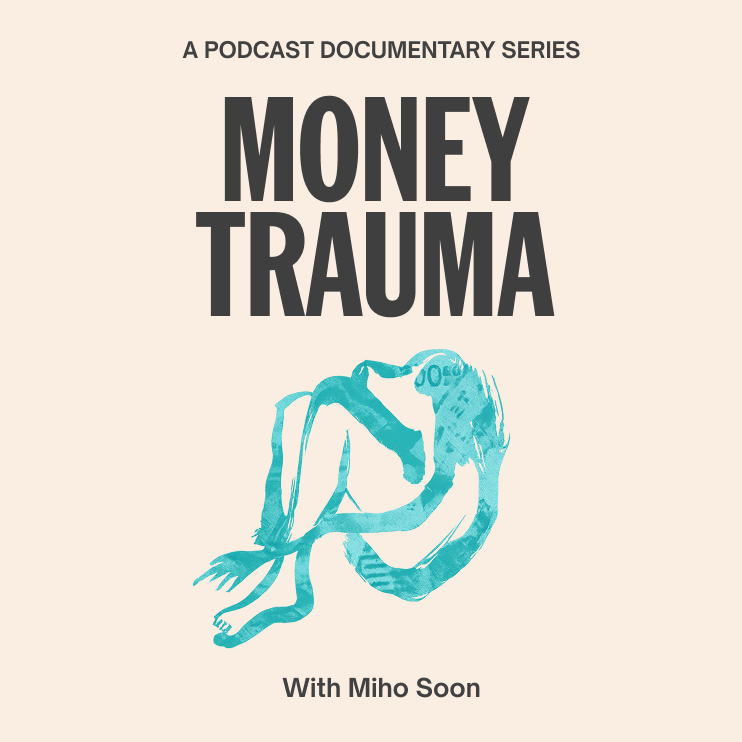
Inspired by this article? Here’s what you can do next:
- Check out Miho’s podcast, Money Trauma, on Spotify, Apple Podcasts, Youtube, Soundcloud, or Pocket Cast.
- Follow Miho’s work on Instagram.
- Read more about money trauma in The Trauma of Money by Chantel Chapman. If you’re a mental health professional or an educator and would like to be trained in trauma and money literacy, you can take The Trauma of Money Professional Certification Program. Miho is an alumni of the course and highly recommends it. Find a licensed financial therapist through the The Trauma of Money Alumni Network or The Financial Therapy Association.