Why water scarcity is not a climatic inevitability, and how nature-based solutions can rebuild life in landscapes under stress.
Introduction: Water scarcity is not inevitable
Water scarcity across the MENA region and the Global South is often presented as an unavoidable consequence of arid climates. This narrative, widely circulated in institutional discourse, frames water shortages as natural or climatic, diverting attention from the human and systemic factors at play.
Yet international research shows a different picture: the crisis is not primarily about rainfall. It is a crisis of land management, governance, and broken hydrological cycles. Across arid and semi-arid regions, water scarcity results less from absolute shortages than from the disruption of natural processes caused by development and planning choices that have fractured the balance between soils, vegetation, surface waters, and aquifers.
When conventional water management fails
For decades, water policies have focused almost exclusively on “blue water”: large dams, inter-basin transfers, deep wells, and heavy, centralized infrastructure. While these interventions can temporarily meet immediate demand, they undermine the foundations of long-term water security.
Soil degradation, deforestation, land sealing, extractive agriculture, and rapid urbanization have reduced the capacity of landscapes to:
- absorb rainfall,
- store moisture in soils,
- recharge aquifers,
- regulate floods and droughts.
The result: overexploited aquifers, unstable rivers, stressed reservoirs, while intense rainfall events produce runoff, floods, and massive water loss. Water falls but does not stay.
The limitations of large dams
Large dams occupy a central place in the political and technical imagination of water management. They symbolize control, security, and modernity. Yet research across arid regions shows their structural limits:
- Bigger reservoirs lose more water through evaporation,
- Sedimentation reduces effective storage,
- Centralization disconnects upstream landscapes from their hydrological functions.
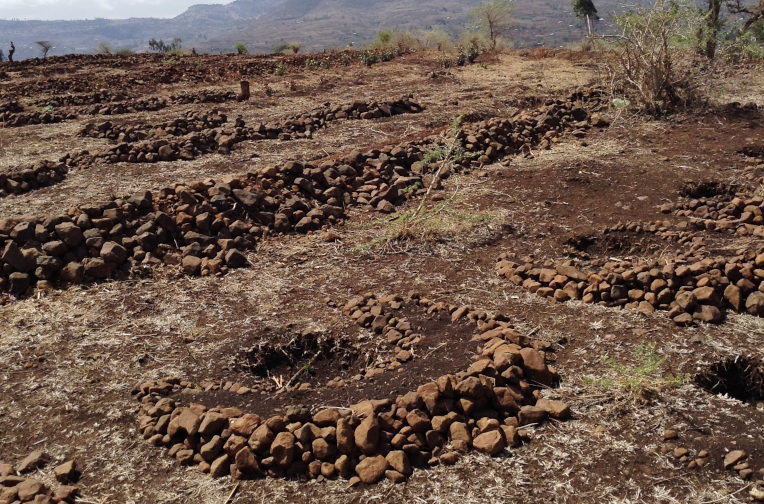
Comparative studies show that smaller, distributed water structures—weirs, check dams, infiltration basins, temporary ponds—often produce more usable water than single monumental dams. By slowing flows, they increase infiltration, recharge shallow aquifers, and sustain vegetation.
The greatest reservoir we ignore: soil
The largest freshwater reservoir on land is living soil. Soils rich in organic matter function like sponges, storing water and releasing it gradually. Degraded soils—compacted, chemically treated, over-plowed—repel water, turning rainfall into runoff, erosion, or loss.
Globally, soils have lost massive volumes of water in recent decades. This is often attributed solely to climate change, yet it is largely the result of industrial agriculture, deforestation, urban sprawl, and centralized hydraulic management.
A paradigm shift: restoring water to landscapes
The emerging consensus from international research is clear: water security cannot rely solely on increasing supply. It requires restoring water cycles at the landscape scale.
Key strategies include:
- Restoring soil permeability,
- Slowing surface water flows,
- Recharging aquifers through floodwaters,
- Regenerating degraded ecosystems.
Nature-based solutions (NbS) integrated into agriculture, urban planning, and climate policies are central to this shift. Across arid regions, these approaches have proven that water availability can be sustainably increased without new extractions.
Watersheds as strategic units
Planning must focus on watersheds, where agricultural, urban, energy, and ecological uses intersect and conflicts can be resolved. This approach:
- Breaks sectoral silos,
- Empowers local communities, farmers, and users,
- Makes ecosystem restoration a core condition of water security.
Conclusion: escaping the hydraulic illusion
Water scarcity in the MENA region and the Global South is neither a climatic curse nor a geographical inevitability. It is the result of cumulative political and technical choices rooted in the ideology of centralized control.
Restoring water cycles restores the capacity of landscapes to produce life, stability, and sovereignty. The question is no longer how much water can be stored behind dams, but how long water can remain alive in the landscapes themselves.