There are certainly many things to criticise in agriculture and the food system (I have written a whole book on the topic, Global Eating Disorder). Unfortunately, the extremely simplistic narrative that plants are good and animals are bad has been given far too much prominence in the public debate. For sure, industrial livestock production has a number of serious flaws, but so does industrial crop production.
One of the major criticisms of animal production, and in particular the keeping of ruminants such as cattle, buffalo, goats, sheet and camels, is that it requires so much land. In a subsequent step, that land use is supposedly bad for the climate and for biodiversity. For sure, ruminants do need a lot of land. But there is no reason to portray that fact in such a negative way. Obviously, if humans would survive on ruminant milk or beef alone, that would amount to an environmental disaster as that would require a transformation of most of the land mass to pastures, or alternatively, convert a lot more land into croplands, none of them desirable.
But the land use argument, as currently used, has many weaknesses. First, it is based on erroneous calculations, grossly exaggerating the land use. Second, it is based on translating this land use into ‘carbon opportunity costs’, grossly exaggerating the climate impact of ruminants. Third, it disregards that ruminants provide many more services to humans than meat and milk and their value in the farming system as a whole. Fourth, it disregards that most pasture lands are multifunctional eco-systems, where the domestic ruminants are only appropriating a smaller part of the primary production. Fifth, it spreads the view that grazing domestic ruminants are responsible for the extremely low numbers of wild animals.
All of these matters are complex and there are many things to say about them. I can’t do justice to all the nuances involved – but I can convey a much more nuanced picture than what is conveyed by World Resource Institute (WRI) and Our World in Data (OWID). There are certainly many others making similar, often even more exaggerated claims, but as WRI and OWID are respected and referenced by many, I keep my criticism to how they present the case.
1. How much land is used by domestic livestock?
OWID claims that 3.2 billion hectares are grasslands used by livestock and 0.6 billion hectares cropland are used for the production of animal feed. The 3.2 billion figure is from FAO statistics. But the FAO doesn’t say that that area is grazed by livestock. There is no totally reliable figure of how much land is grazed by domestic livestock. I believe the figure is most likely in the range of 1.6 billion hectares, which is used in this these scientific articles, https://www.nature.com/articles/s41467-020-20406-7 and https://www.nature.com/articles/s41467-023-43452-3 – none of them having a ”pro-cattle bias”, rather the opposite.
As for use of cropland, there are fewer uncertainties but more methodological issues to consider. First, many crops are processed into two or more components of which one component might be used as food or for biofuel and another for feed or for biofuel. Typically, in major oil crops the oil is used for food or biofuel while the by-product is used as feed. For soy, one can look at it the other way round and consider the feed to be the main product and the oil a by-product. More realistically, they should both be seen as co-products as most soy bean cultivation is dependent on the market both for the oil (the second most important vegetable oil in the world after palm oil) and the meal. Without the oil market, no soy would be grown as feed and without the feed market, no soy oil would be produced.
Second, the use of crops as feed doesn’t always mean that they were grown for feed. Wheat grown for the market is mostly aiming at the food market because it pays better, but when the quality is low it will be diverted to the feed market. The same applies to some of the production of barley and oats and many pulses.
According to one of the best estimates, some 210 million hectares of cereal production is used for livestock feed, in addition 66 million hectares are used for the cultivation of hay, silage and other fodder crops. Together that makes 275 million hectares of land used for crops dedicated to feed production, slightly less than 20% of all arable land. If you add the proportion of feed coming from other crops (e.g. the straw or chaff from grain grown for food or oil seed cakes) one could consider that another 260 million hectares are used for feed production*. But in the context of “people could eat what is eaten by animals” it makes little sense to add these as the alternative use of these residues and by-production is as energy, industrial raw materials or fertilisers and not food for humans. Notably, a big part of the feed from croplands is used for chicken and pigs.
The WRI claims that land use per kg of protein from ruminants in Europe and the USA varies from roughly 500 m2 in Europe to 1,400 m2 in the USA, of which most is grassland. If we divide all grazed grasslands in the world, 1.6 billion hectares with the amount of meat from the animals that graze, cattle, sheep, goats, buffalo, camels, horses and mules, 94 billion kg (of which cattle is 70% and most of the rest is sheep and goats) we get 59 kg of meat per hectare of grasslands which in turn means 311 m² of grasslands per kg of protein. Much lower than the WRI figures. Considering that both Europe and the USA have much more intensive production systems with a higher proportion of crop feeds than the global average, it is an indication that there are considerable shortcomings in the WRI figures. My own research from Sweden shows a land use for beef of around 300 000 hectares of grassland and 100 000 hectares of grain and 360 000 hectares of feed crops (mostly ley) and some 20 000 hectares for concentrate feed etc. In total less than 800 000 hectares. From that is derived 110 000 tons of edible meat. This equals 72 m2 per kg of meat or 380 m2 per kg of protein.*
It should also be noted that the conversion of human-edible protein is positive for many livestock systems, i.e. they consume a lot less human-edible protein than they produce. That is particularly the case with grazing animals – basically they eat no human edible protein at all. Traditional backyard systems for chickens and pigs are also protein-positive while industrial chicken and pigs (which clearly are most common these days) get a lot of human edible protein.
2. The dubious metric carbon opportunity cost
WRI has championed the concept of carbon opportunity cost (COC), by which is meant the carbon that could be captured on the land if we weren’t using it to grow crops or raise livestock – it could then be ‘restored’ to forest or wild grasslands. The impact of applying this to food production is huge in the context of greenhouse gas emissions and the COC for beef corresponds to more than four fifths of the total emissions. This also means that any production system that use more land always will be worse than those that use less.
The COC has many shortcomings and methodological issues. One is over how long period you allocate the increased carbon sequestration and the assumption that this carbon will be stored continually. Another flaw is the notion that grasslands should/could be converted to forests or ‘wild grasslands’, and that those would sequester a lot more carbon. To begin with there is no indication that a ‘wild grassland’ (whatever that is) in general sequesters more carbon than a managed grassland. As for conversion to forests, a huge share of the grasslands of the world can’t be converted to forests, because of climatic reasons. But even if they could, the carbon benefits are not assured. For sure, trees store a lot of carbon in their trunks, but they, mostly, store less carbon in the soil than grasslands. In addition the carbon in grasslands that is grazed is fairly well protected, while the carbon in tree trunks is easily lost through fires, storms, bugs and even more by logging. There is not sufficient data available to make any bold claims here.
Even IF forests would store more carbon than grasslands, the COC concept is based on that landscapes would not be exploited by humans any more. It is thus based on that we live in a degrowth eco-socialist society where all spared land would become nature reserves. I don’t mind, but until then, we need to base the calculations of the realities on the ground. In Sweden, a few million hectares for farm land and grasslands have been afforested over the last 100 years. On most of that land, intensive forestry is practised and most of the carbon sequestered is thus released back to the atmosphere. As biomass use globally is constantly increasing and organic feedstock is needed to replace fossil fuels in many processes, the notion that land ‘saved’ from livestock would not be exploited, is simply naive and misleading. Now, some will argue that this use of forest biomass will replace fossil fuels, e.g. in biofuels, but the substitution argument is very complex and subject to a lot of debate (in Sweden, substitution is the major argument used by the forestry industry against calls to reduce logging).
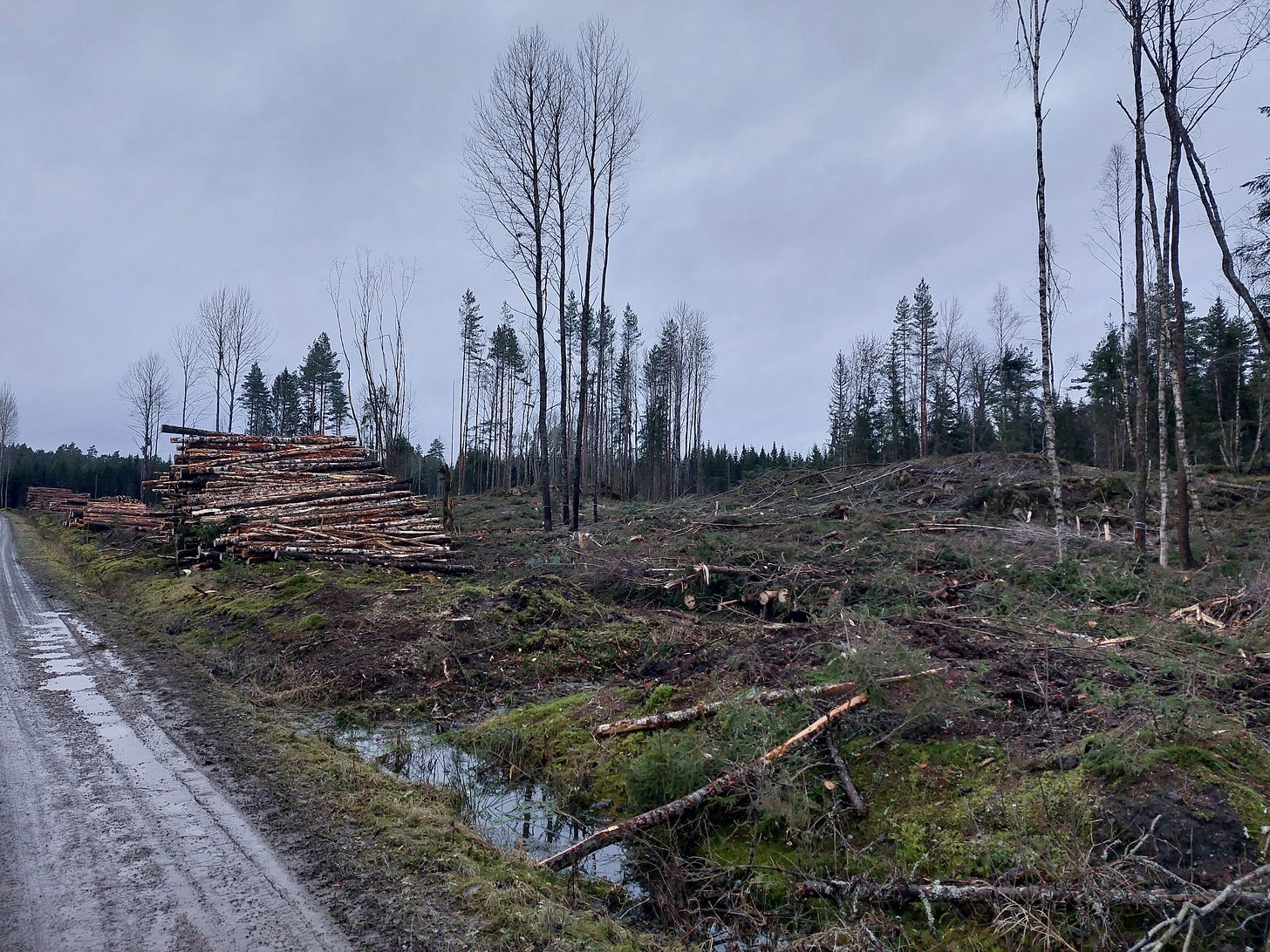
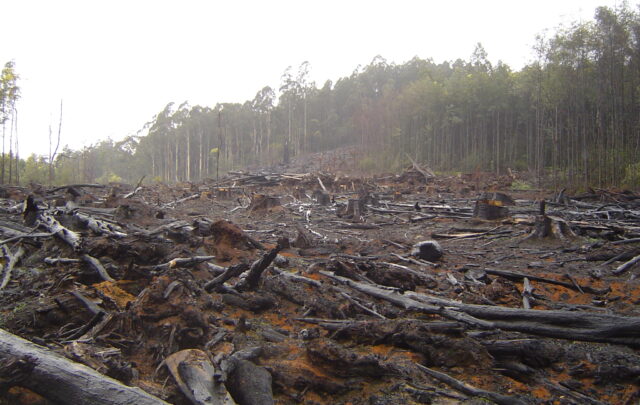
This land, along the road to my place, was agriculture land to the mid 1970s, when they planted spruce. Now it has been logged. Image: Gunnar Rundgren
As for forests, there are huge uncertainties in the global datasets for changes in forest areas as well as the data from how much forest there actually is today, caused both by deficient methodologies as well as how forests are defined. In many parts of the world, the strict classification of land in one category such as forest or grassland is simply not reflecting what the landscape looks like.
In general, the binary classification of land in broad categories such as grassland, forest and cropland is not helpful and doesn’t reflect historical patterns of land use. Some claim that Europe was mainly forested before the spread of agriculture, while others state that it was a mosaic landscape with woods, wetlands and meadows.
Just over 100 years ago, almost all “forest” in Sweden was grazed by domestic ruminants as well as used for hunting, picking of mushrooms and berries, charcoaling, providing fibre and firewood as well as building materials. On my own little farm, our small herd (five mother cows with offspring), graze on some cropland, which is in permanent grass as it is poorly drained, wetlands, wooded grasslands, grasslands, thinned forest and forest, more or less in equal shares. Wetlands are actually often grazed either by wild or domestic livestock.
Apart from the flaws from a carbon balance perspective, the conversion of grasslands to forests have many disadvantages for biodiversity and livelihoods. In Europe and North America, grasslands were first converted to arable land during the period of agriculture expansion while today grasslands are already converted to forests. The process has actually started long time ago in Europe and is now a global phenomenon. The net result is that grassland area has shrunk considerably – 62 percent of the central North American grassland biome has been lost, and restoring grasslands is a conservation priority in Europe. On my own farm we have got government grants to restore former grasslands, basically to deforest the land.
There are many claims and counterclaims about the potential of grasslands to sequester more carbon, my own assessment is that we don’t know enough to make bold claims. Still, if we look into some of the major agriculture production areas in the world, such as the American prairies, the black soils of Ukraine and Russia and the Pampas, all of them were grassland and they apparently sequestered enormous amounts of carbon over millennia. You can read more on the topic here.
3. Livestock are not just meat or milk.
While commercial livestock keeping is commodity oriented, livestock provides many more services than just meat and milk. Leather, skin and wool are obvious. Draught power and transportation is also important, financial services as well. In many pastoral systems livestock provides almost everything needed, including identity, meaning and culture. Considering that around 200 million households live as pastoralist, and that they manage a considerable share of all that grassland, this is nothing that can be disregarded.
The huge value of livestock manure as a natural fertiliser should also be considered. The use of clover grass, mostly used as livestock feed in crop rotations, is a centuries-old practice that improves arable soils and allows farmers to grow more and better human food in the fields. Animals are also very good at upcycling agriculture and food residues or leftovers into nutritious food and valuable manure.
4. Pasturelands are multifunctional ecosystems.
Grasslands are rich ecosystems with a lot of biodiversity. Compared to croplands they harbour many more species. Arable farming systems are oriented to one crop at the time and many efforts are made to combat weeds, pests or animals to compete with the desired production. Almost all Net Primary Productivity of the land is with the crop and of the crop typically half is taken away from the field as harvest (the rest is roots, exudates, litter etc). On grasslands, on the contrary, typically less than 15 percent of the Net Primary Productivity is consumed by livestock, and of that around half is recycled into the field as manure. This means that there is a lot more space and feed for all kinds of species in grasslands and that it is mistaken to consider them just being a production area for livestock.
Pasture lands are primary habitats for a large number of birds and wild mammals. In my own grazing land, there are deer, the odd moose, voles, hare, fox, boars, beaver, the occasional lynx and many different birds, such as cranes, gees, waders, hawks, owls and eagles. The number of insects, plants and trees is huge. To view the pasture lands as just livestock grazing is simply not reflecting the reality. In addition, grazing is what keeps the biodiversity.
Having said that, in some parts of the world there is a process of intensification of grazing, with seeding of “improved grasses” and the use of fertilisers. Those systems represent a simplification of the ecosystem similar to arable farming. The increase of production comes with a reduction of bio-diversity.
5. Competition between domestic livestock and wild mammals.
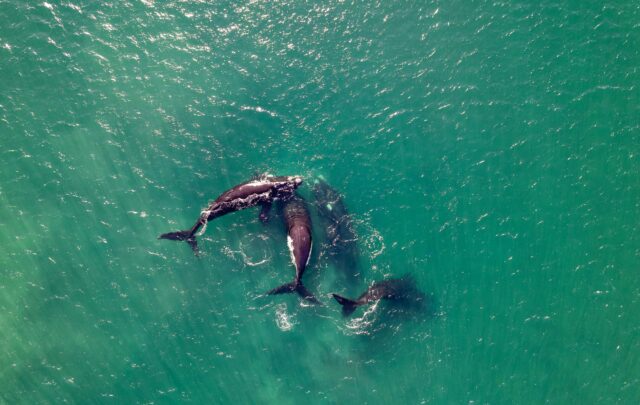
Here I refer you to this article I wrote a while ago, demonstrating that there is no direct causation between the increased number of domestic livestock and the vanishing of wild mammals.
The obsession of land use is also negative from an animal welfare perspective. Industrial chicken production is undoubtedly the animal production that uses the least land. Both WRI and OWID portray chicken at almost at par with pulses from a greenhouse gas emission perspective. WRI shows that chicken uses slightly less land per kg of edible protein than lentils. As animal protein is nutritionally superior to plant proteins chicken is thus far superior than lentils – from a narrow land use perspective that is. Meanwhile, industrial chicken production is the most problematic production from an animal welfare perspective. Also within the various sectors, a more intense production will always come out as superior from a climate perspective. As WRI writes; ”For example, previous WRI research found that the total carbon costs associated with grass-fed beef were more than double those of feedlot-finished beef, per kilogram. Organic beef’s total carbon costs were 28% greater than conventional beef.”
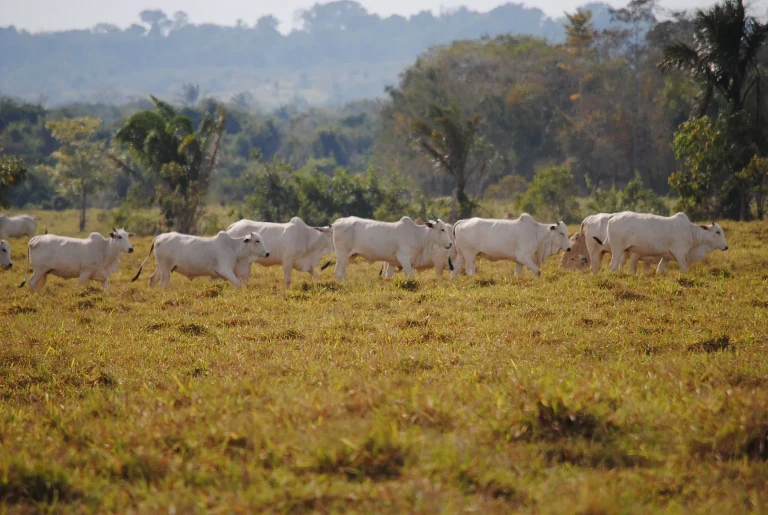
One aspect of cattle grazing is that cattle are now grazing considerable areas which earlier was tropical rainforest, such as in the picture from Matto Grosso above. While one can discuss exactly how much cattle is to blame for deforestation, it is a fact that global grassland area has not expanded at all since 1860: the expansion of grasslands in some parts of the world is offset by reductions in other parts. For example, in Europe, more than 50 million hectares of pasture has been abandoned. Even in Brazil itself the area of pasture has actually decreased considerably over the last 25 years. While grazing has expanded into the Amazon, considerable areas have been converted to arable lands, forests or been abandoned.
There are, obviously, many more aspects of ruminant livestock production that can be analysed from various perspectives. Once you have cleared the land use argument, people will pull the methane card, water, health, racism or what not. But most of them are either outright wrong or at least very biased, or they lump together totally different production systems to make general statements devoid of any context.
Since the infamous Cowspiracy film there is the notion that there is a meat lobby trying to divert attention to the climate impact of meat. If you are to look into economic interests from industries, I would claim that the chicken industry, which is the main beneficiary of the vilification of beef, is even more consolidated and controlled by a limited number of huge firms compared to the beef industry. One should also consider how much money some of the extremely wealthy tech bros and venture capitalists have invested in plant based alternatives. Even within the beef industry the mindless carbon calculations strongly favours the kind of feed lot production associated with the big companies at the expense of traditional and indigenous ways of keeping livestock. The main beneficiary of the narrative is obviously the fossil fuel industry which welcomes any possibility to divert attention from the impact of their products.
*It should be noted that in many countries there are considerable linkages between milk and beef production and the choice of allocation method has a significant impact on any indicator.