Reflections from Ukraine’s Ecovillages in a Prolonged War
War is often described as a sequence of events: an invasion, battles, shelling, blackouts. But for those who live inside it, war quickly becomes something else — a long condition. A stretched-out reality in which the usual assumptions about infrastructure, safety, and continuity quietly stop working.
In Ukraine, this shift happened early. Centralized systems — energy, heat, transport — proved vulnerable. What surprised us was not their failure, but how long that failure persisted. Months turned into years. And resilience stopped meaning “getting through the emergency.” It began to mean something more mundane and more difficult: continuing life under permanent instability.
Across a network of ecovillages, we did not set out to ‘build resilience’. We were simply trying to keep living systems alive — households, workshops, soil, water, relationships. Looking back, several concrete experiences now stand out as markers of what resilience actually looks like when war becomes the background rather than the headline.
Energy as Predictability, Not Independence
In the village of Velykyi Byshkyn in the Kharkiv region, daily power outages last anywhere from five to twelve hours. Five people live permanently on site, including three children. Around a hundred chickens depend on electricity for water and basic care. Three people work daily in a small workshop producing essential goods for the community.
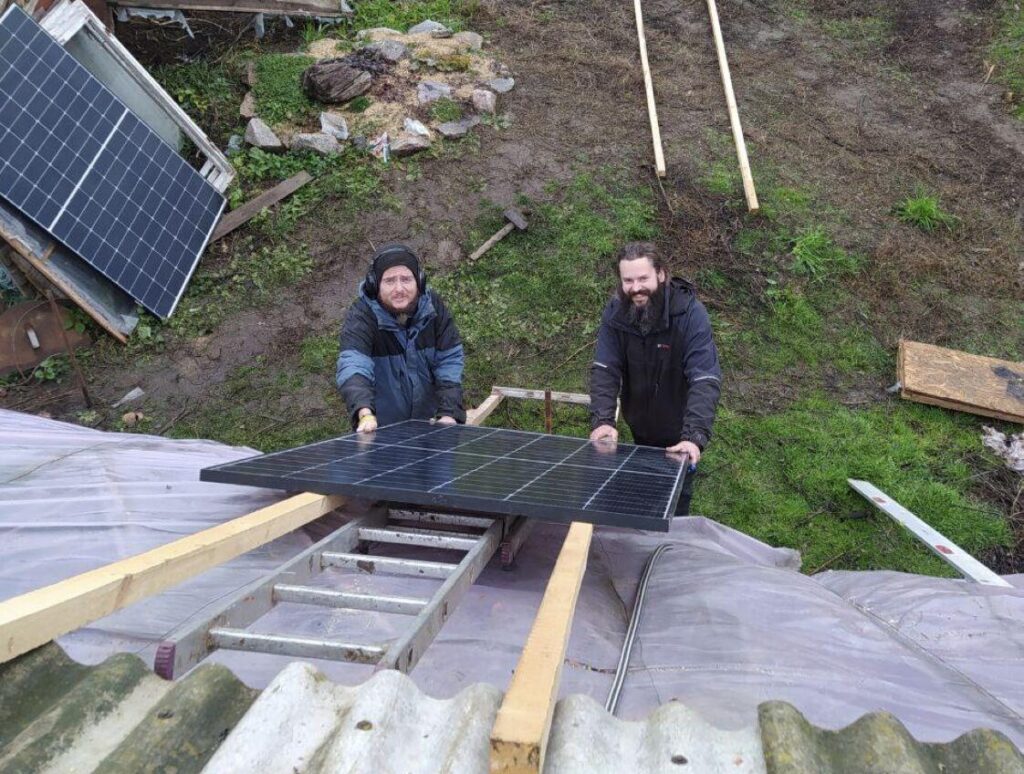
A modest 5 kW solar system was installed on the workshop roof — panels, inverter, battery — carefully configured so that critical loads remain operational during outages, while non-essential ones wait for grid power. It is not a “perfect” energy system. It does not cover all the needs.
What it provides instead is predictability.
Water pumps work. Basic heat remains. Work schedules are no longer dictated by the grid’s mood. The battery and inverter create a small island of autonomy where life can be planned again. Products are made, sold, and shipped. Grant applications are written. Children do their homework.
In simple terms: life continues.
Resilience here is not independence from the system, but the ability to function sensibly inside a broken one.
Soil After Shelling: Can Life Return Without Chemicals?
In the village of Kukhari, Kyiv region — once part of the defensive line during the battle for Kyiv in February 2022 — the land itself bears the scars of war. Shell craters remain visible. Soil was thermally damaged at explosion epicenters, stripped of nutrients, compacted, partially contaminated.
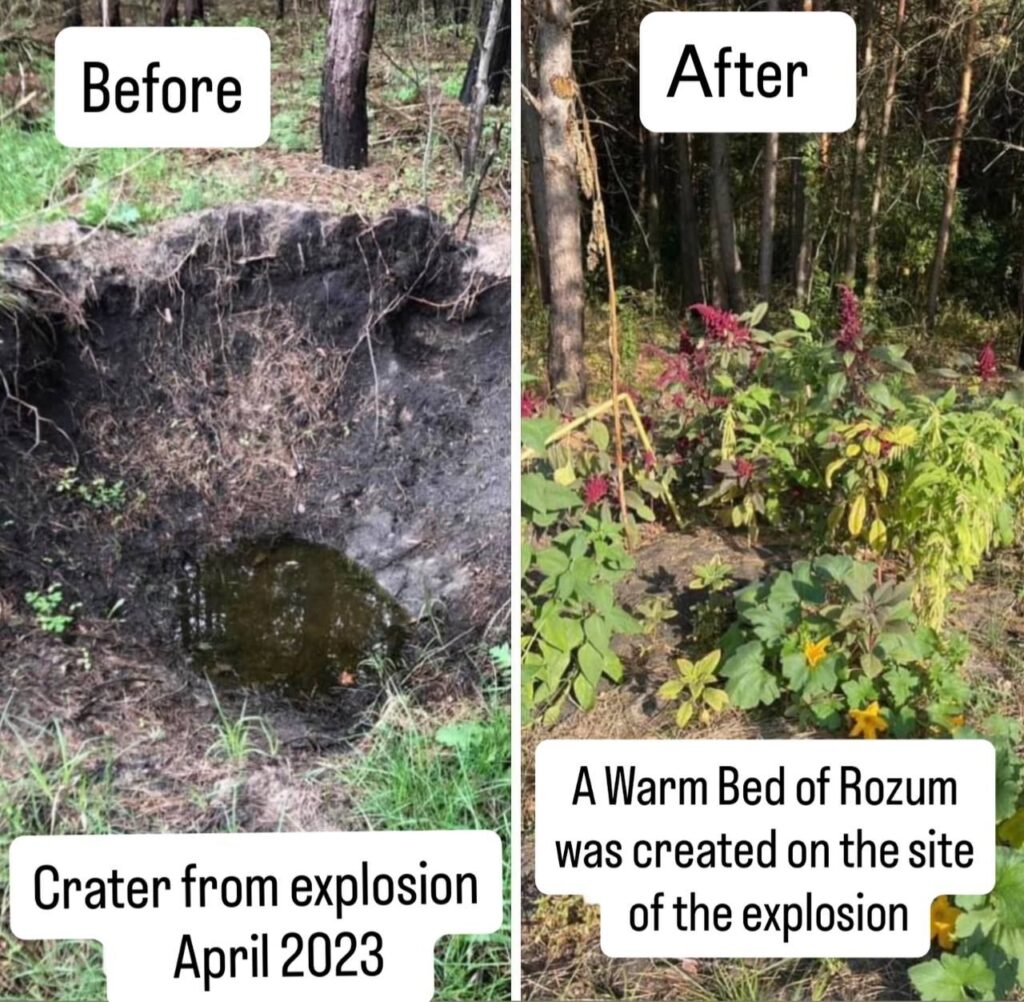
At the Radaria Permaculture Demonstration Center, together with Ukraine’s State Soil Protection Institute, students, and restoration practitioners, we asked a simple question: can bomb-damaged soil recover without chemical remediation?
Initial soil sampling showed severe degradation at crater centers, while nearby areas with dense vegetation suffered far less. Plant cover, it turned out, acted as a buffer even against explosions.
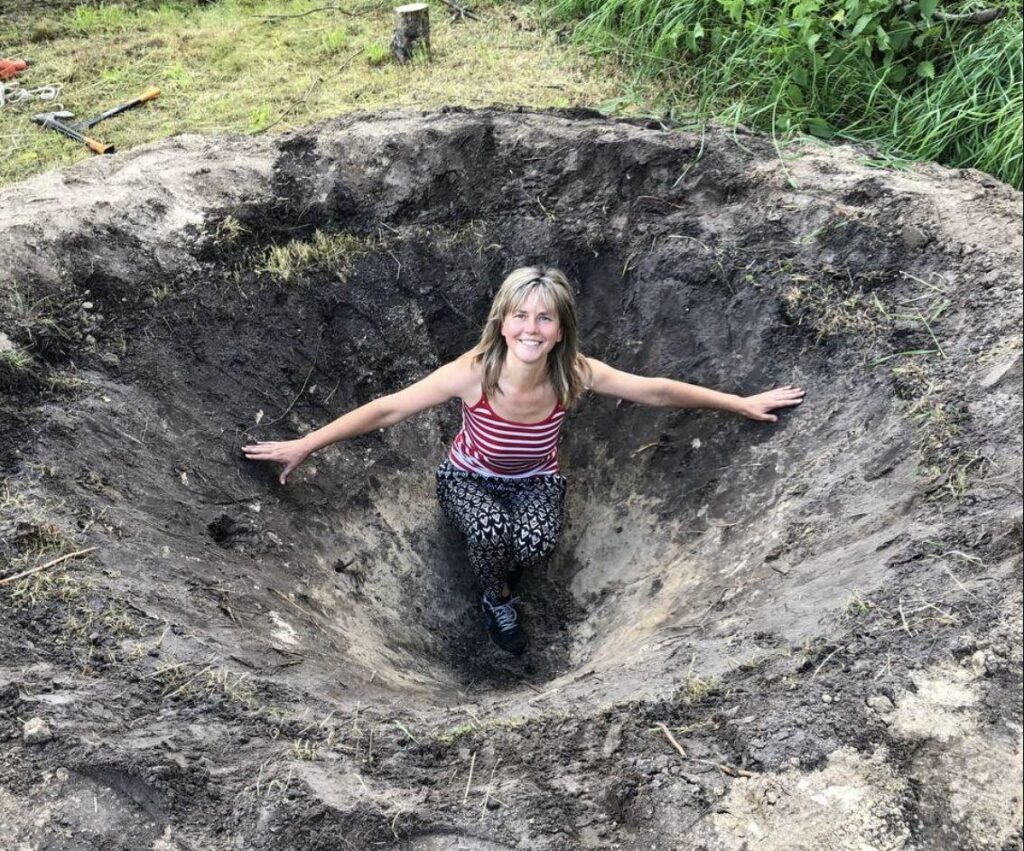
Inside one crater, we installed a biological regeneration system known as the “Warm Rozum Bed” — a compost-based trench combining biochar, organic matter, local soil, humic acids, and microbial inoculants, with deliberate aeration to activate decomposition and detoxification. Around the crater, a circular system was planted with hazelnuts inoculated with truffle mycorrhiza and supporting species.
After fifty days, not everything grew. Some seeds failed. Others — amaranth and clover — emerged only after forty days. But the fact that life returned at all signaled something important: detoxification had begun. Soil biota was re-awakening.
Resilience here was not speed. It was patience, biology, and the refusal to declare land “dead” simply because it was damaged by war.
From Evacuation Routes to Shared Living Spaces
Three years ago, at the start of the full-scale invasion, our network created what we called the “Green Road” — an informal map of shelter routes through ecovillages. People fled on foot, with suitcases, with children. Volunteers picked them up along highways, brought them to villages, fed them, let them rest, and helped them continue westward.
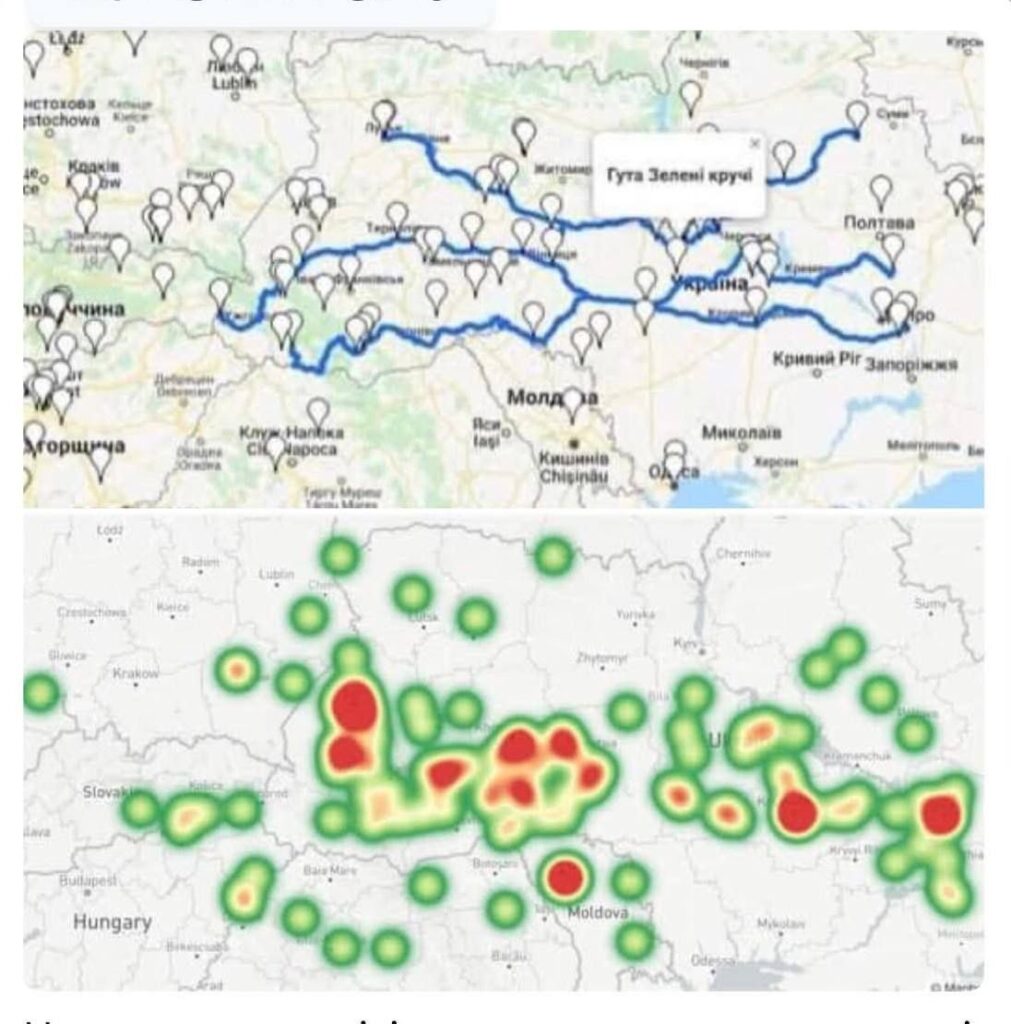
We overlaid click data onto the ecovillage map. Demand peaked in the Western part of Ukraine and close to the big cities under attack. At its height, the map received tens of thousands of daily views and connected more than sixty locations in Ukraine with hundreds across Europe.
That phase eventually ended. But the network did not dissolve.
When Russia began systematically targeting energy and heating infrastructure — particularly in Kyiv — the same network quietly transformed. Instead of transit shelters, ecovillages opened seven shared living spaces for city residents facing prolonged blackouts and lack of heat.
These were not state shelters. They were living communities, with shared kitchens, rules, responsibilities, and rhythms. People did not merely stay — they participated. Cooking, chopping wood, caring for children, maintaining systems.
Resilience, once again, was not about services delivered to passive recipients. It was about inclusion into living systems.
Climate Stress Does Not Pause for War
In Vasylivka, Dnipropetrovsk region — about 80 kilometers from the front line — climate stress adds another layer to instability. The steppe zone is drying rapidly. Long periods without rain compact the soil, preventing water retention and accelerating desertification.
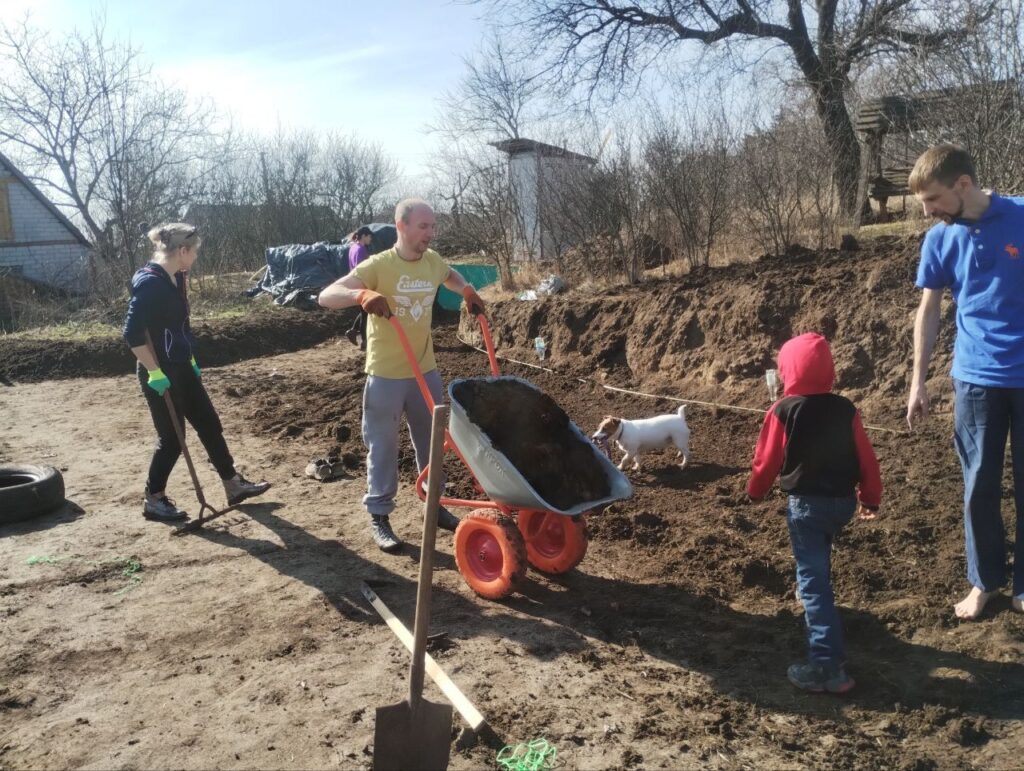
At a children’s and educational eco-hub, community members continue working on land restoration even as rockets land nearby. The work is simple and replicable: reshaping land to prevent erosion, planting drought-resistant grasses, initiating rewilding, building wind-protected gathering spaces for education and camps. A small solar system and water-saving infrastructure support daily operations.
This is not denial of war. It is acknowledgment that climate degradation does not wait for peace treaties. If adaptation is postponed, post-war recovery will have nothing left to recover.
Here, resilience stretches across time — beyond survival into the question of whether a territory will remain habitable at all.
Mobility as the Invisible Connector
In Salintsi, Vinnytsia region, a bicycle workshop called VeloSelo operates as part of a wider network of five such workshops across ecovillages. Used bicycles arrive from Denmark and the Netherlands. Some are repaired. Others are converted into electric bikes using locally assembled batteries — the same batteries sometimes used to power routers during outages.
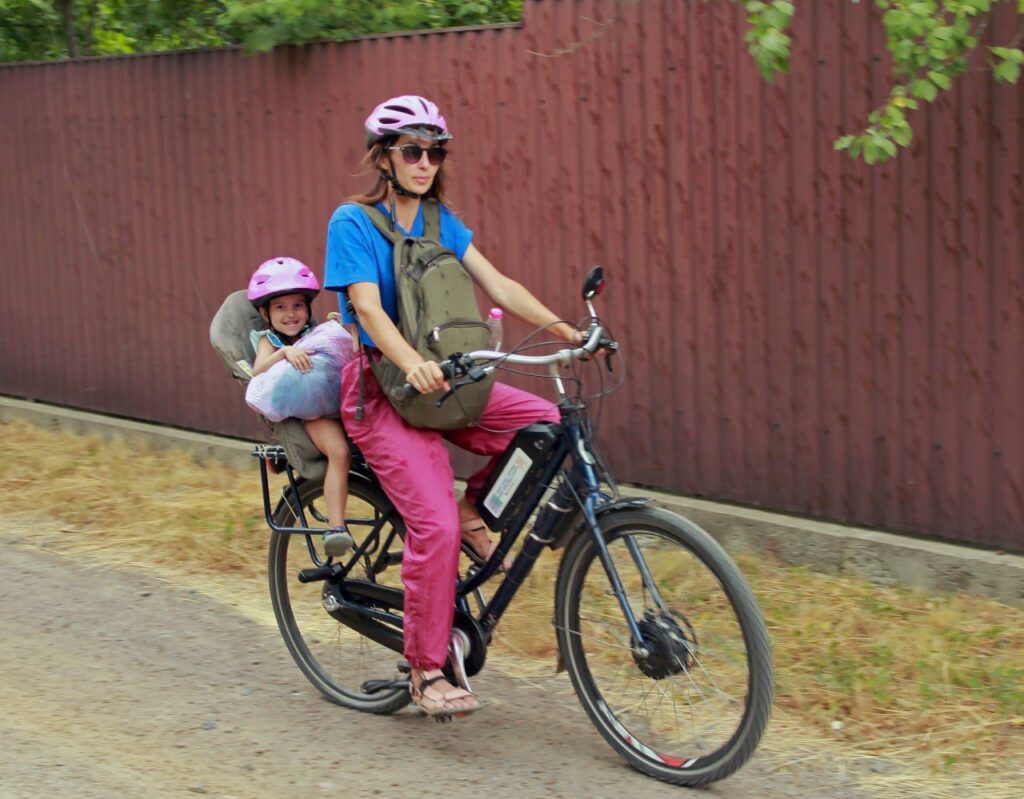
“Almost every day I ride sixty kilometers to bring my child to kindergarten and back,” says Viktoria, one of the coordinators.
In places where fuel is expensive, transport unreliable, and distances long, bicycles become more than transport. They connect workshops, shared spaces, fields, and households. They move tools, food, people, and information.
Resilience depends on movement — and often on the simplest technologies available.
Community Kindergarten That Keeps Families Home
In the Kyiv region, the night sky over the ecovillage of Zeleni Kruchi is often filled with the hum of drones. Yet, beneath this tension, eight families with children call this community home, some having found their way here through the “Green Road” initiative.
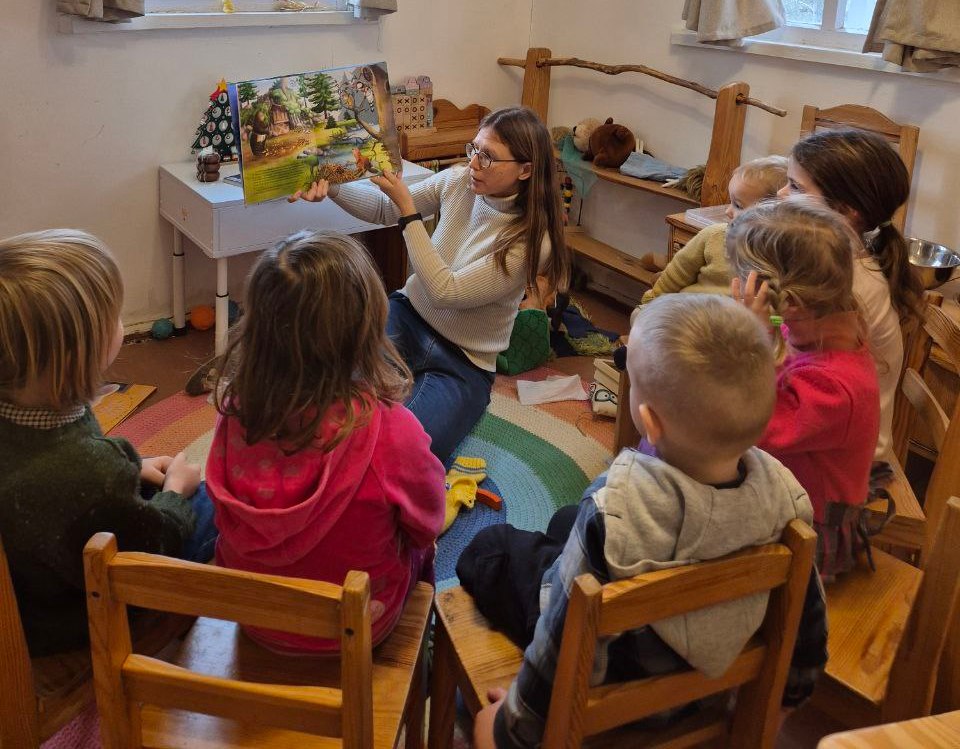
While teenagers go to school at least every second day (as the bomb shelter of the local school is not big enough for all pupils), for more little ones it’s a challenge as the closest kindergarten is 10 km away. The solution is a community kindergarten that functions all year long and has a summer and a winter location.
6 children of the ecovillage families attend it three times a week, have a great time and education while parents have some time for themselves. It became possible with the infrastructure support provided by different programs of GEN Ukraine. And what is most important is that it prevents families from leaving abroad as absence of facilities for children combined with insecurity is the most strong reason for immigration. And this creates an additional strong glue for the community.
Resilience here is about building a parallel reality that prioritizes growth over despair.
What These Experiences Suggest
None of these examples were designed as “best practices.” They emerged from necessity. Yet together they point to a pattern.
Resilience under prolonged crisis is not built through heroic acts or perfect systems. It grows from networks, from biological processes allowed to heal, from appropriate technologies, from communities that remain open rather than retreat inward.
Ecovillages, in this sense, are not alternatives to the state. They are living laboratories for what sustains life when centralized systems falter. Not through withdrawal, but through adaptation.
In Ukraine, war has stripped away many illusions. What remains are living systems — fragile, imperfect, and capable of recovery if given the chance.
That, perhaps, is what resilience really looks like.