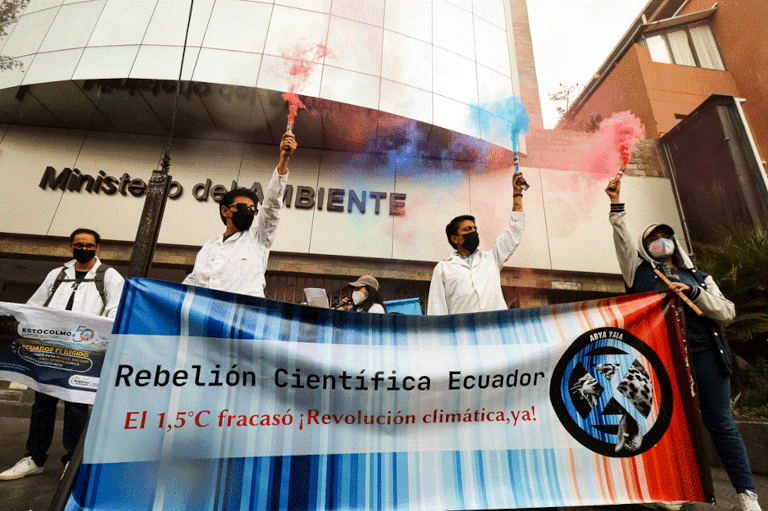
Should scientists and academics strive to be “neutral” deliverers of facts about rising greenhouse gasses, glaciers melting, and the collapse of biodiversity – or should they take to the streets and confront the political powers perpetuating these crises? And what happens when they do?
The following conversation is an edited version of a talk at the Center for Applied Ecological Thinking, University of Copenhagen held on December 17, 2025. The talk was organized as part of the book launch of Fernando Racimo’s Science in Resistance: The Scientist Rebellion for Climate Justice (2025).
Racimo’s book is part account of the movement Scientist Rebellion, its members and actions, and part argument for scientist climate action. In the conversation, Racimo and Appel Olsen discuss the origins of Scientist Rebellion, how direct action can challenge the myth of scientific neutrality, and how activism can be part of shaping science anew amidst ecological and societal breakdown.
Fernando Racimo is active in various social movements, including Scientist Rebellion, and works as Associate Professor of Ecology and Evolution, University of Copenhagen.
Frederik Appel Olsen is a postdoc at the Center for Applied Ecological Thinking, University of Copenhagen, working with scientist activism.
Dawn of a New Scientist Social Movement
Frederik Appel Olsen (FAO): We’ve seen rapid development in climate movements from around 2019 until today. There were climate movements before this period, of course, and radical ones too. But in the last five years or so, the sense of failure and urgency of climate politics has intensified – and movements have been created and transformed radically in this short span. Your book tells one part of this climate movement story, namely that of Scientist Rebellion, of which you yourself are a part.
Can you say something about how and why SR started?
Fernando Racimo (FR): Scientist Rebellion is a collective of scientists and academics who recognize the gravity of the situation that we’re in: Climate and ecological breakdown, but also increasing societal breakdown, and rising fascism. And they believe that it’s not just enough to publish papers and reports about the crisis that we’re in; we also need to embody the truth of our words. SR very explicitly features scientists engaging in activism, particularly direct action but also many other tactics, in their role as scientists.
It was back in 2018-2019 that the big mass climate mobilizations of Fridays for Future, Sunrise Movement, and Extinction Rebellion drove a lot of people to the streets. Although, at this time, there was less focus on intersecting climate justice with other types of social justice or decolonial justice issues, these movements were very good at driving a lot of people to the streets and really putting climate on the political map. However, scientists were nowhere to be seen in these mobilizations. I don’t mean that the scientists were not there, a few were, but most that participated in these mobilizations initially were reluctant to flag their identity as scientists. And this was something that several academics called out: Where were all the people that made all these reports that drove the people here? Why are we not shoulder to shoulder with all these people, some of whom are taking on a great risk?
FAO: Yes, and a specific handful of scientists, as I understand it, were instrumental in calling out scientist passivity.
FR: Specifically some scientists based in the UK: Charlie Gardner and Claire Wordley published a call in Nature for scientists to act on our own warnings to humanity and join social movements. This contributed to the emergence of a collective in the UK called Scientists for Extinction Rebellion (XR).
Two physicists also based in the UK, Mike Lynch-White and Tim Hewlett, argued that scientists should not only support social movements engaging in direct action but ought to take on some of the same risks as other climate activists. They then went to the most prestigious scientific institution in the world, The Royal Society of London. They posted a letter on the institution’s entrance saying that scientists must embrace tactics like direct action and join social movements, and that we should embody the truth of our words. They also threw paint at the facade and chained themselves to the stairs. Predictably, they got arrested and detained overnight, together with the people taking pictures of the action.
Eventually, this got picked up on social media. Different groups started to imitate this in different countries, in Germany, France, and Switzerland. Tim and Mike started spamming hundreds or thousands of scientists with e-mails – the nice thing about scientists and academics is that our e-mails are very easy to find and we’re very internationally connected! They got a lot of angry replies, but some people also really wanted to replicate what they had done. And that led to the formation of several international chapters of what is now Scientist Rebellion by early 2021. The movement has grown to over 30 chapters of around the world.
Challenging Neutrality
FAO: Since then, SR has organized and carried out a range of actions across the world. The book mentions a handful of them, and you interview many of the scientists taking part. From Mike and Tim’s inaugurating direct action at the Royal Society, to blocking a bridge at the COP28 in Glasgow, to occupying the Autostadt pavilion in Munich and a Volkwagen showroom in Berlin, to blocking the runways for private jets, and much more.
There is always some push-back when this happens: From the media, from politicians and pundits, from corporations, from university leadership, and, indeed, from colleagues. There are some familiar arguments against what you do: Scientists should be “objective”, and therefore stay “neutral”; it will “damage the credibility” of scientists to do activism; and so on. How do you respond to this push-back in the book and in your activism?
FR: The argument about neutrality – that scientists should be detached from the world that they’re studying – is an argument that has been attacked by many fields of scholarship before this movement even existed. Feminist and anti-colonial scholarship has argued that scientists are never detached from the social-political milieu in which they practice their science. Decisions about who gets to do science, what kind of science gets done – they’re all political decisions that depend on whatever the status quo happens to be. Appeals to a sort of universalizing objectivity is often really just the defense of a particular subjectivity, which is that of the Western white man. I think this needs to be called out because it’s also important that we understand that science is never neutral.
FAO: One might say that SR fights the neutrality myth by re-connecting science and the body. Doing so in disruptive direct action goes not only against powerful interests but against many people’s intuition about science.
FR: Yes, the figure of the scientist as separate from the world is not philosophically sustainable but it’s also not real in the concrete. Scientists and academics have been part of social movements for many decades, in many social struggles, such as human rights struggles, pacifist struggles, anti-colonial struggles.
FAO: A different argument against scientist-activism is about credibility: It might be that it is impossible to stay neutral, and that scientists ought to do more to challenge the causes of climate breakdown – but activism reduces public trust in the scientific community, undercutting the premise for making such a challenge in the first place.
FR: We see this argument all the time. What’s interesting is that social scientific research on this question tends to indicate that scientists don’t lose credibility when they engage in societal issues, even as activists. If anything, credibility increases! This has also been my personal experience when I engage in actions. People come to me and they ask me about issues related to climate change even though I’m an evolutionary geneticist.
Going back to the neutrality question, I think that we need to drop the idea that scientists are objective, in the sense of being able to detach from the milieu in which we practice our science, and I think Scientist Rebellion is a very concrete way to do so. Obviously, when you’re blocking a road calling for climate action, you can’t see yourself as separate from the world around you. And that’s fine! It’s good to recognize that we are embedded in this world, that we are not these separate entities floating and studying the world around us.
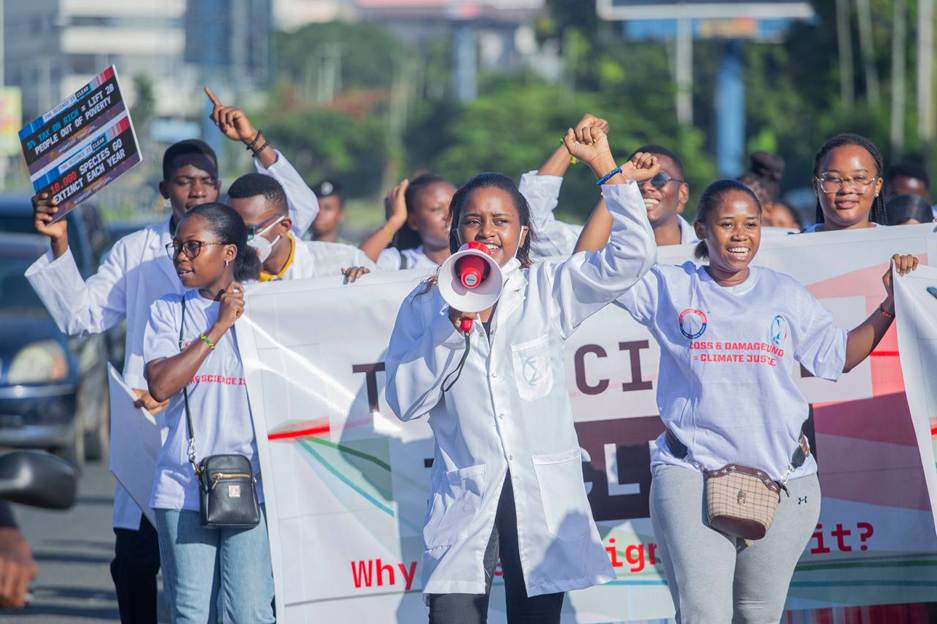
Photo: Gloria / SR Tanzania
“Line Must Go Up”
FAO: Although SR has seen a rapid growth, why do you think that it is often so difficult to mobilize scientists for radical climate action?
FR: In the book, I argue that there are deeper structural issues that prevent more scientists and academics from engaging in activism and joining social movements. Through the last four or five decades, academia has gone through a process of neoliberalization. It has been increasingly attached to systems of profit-making and extraction, increasingly conceptualized as this thing that is supposed to increase economic growth and serve corporations. This has also led to an increase in hypercompetition and obsession with metrics in academia, as well as proliferation of managerial logics: People at the top telling people at the bottom what to do instead of people collectively deciding what academia is and how it’s run.
All this prevents scientists, especially early-career scientists, from engaging in the things that matter to them. They feel that they’re forced to follow the “line must go up” mantra. And in the case of scientists, “line must go up” means we need to produce more papers in whatever journals are seen as more prestigious.
FAO: One of the scientists that you interview in the book, Lou, studies glaciers. She ends up leaving her field altogether because of the disconnect between what institutional science tells us and the institutional barriers to even having critical conversations about it.
FR: Yeah, Lou is a very classic climate scientist, she studies glaciers for a living but as you say, she can’t even talk about her climate activism in her own lab. She’s been part of these amazing actions in Lützerath, Germany against a massive lignite coal mine. But she can’t even talk about this in her own research group which is supposed to be about climate change.
Another example is a postdoc, Sanja, who wants to organize an event in her university featuring an activist. She almost can’t do it because the dean is opposed to it, resulting in an argument with her own dean about academic freedom. I think we feel it in our everyday activities in the university. And I think this is something that we need to be mindful of when we try to build our movements, encouraging more scientists and people in general to join social movements. We need to look more at the deep structures that prevent engagement and how they’re there and how we can undo them as well – not just undoing the fossil economy but undoing all these other pillars of the fossil economy that keep the fossil economy running. Science as it exists today is, sadly, often one of these pillars.
Disrupting the Illusion of the Science-Policy Bridge – and Going Somewhere New
FAO: This perspective is very present in the book. In chapter 3 on “Education as Resistance”, you write: “The extraction and combustion of fossil fuels is, after all, made possible by science and technology, just like the Bomb”. I think this is an oft-neglected point when scientists’ responsibility in the climate and environmental emergency is discussed. It so often hinges on scientists as the diagnosticians of the crisis – and thus on the “good” side only, heroes that no one listens to – and not also as systemic perpetuators of it. In the previous wave of scientist activism during the nuclear arms race and general militarization in the 1960’s and 70’s, however, scientists were seen as more imbricated in the technologies of destruction.
Perhaps there is a case to be made that the current militarization and geopolitical conflict and warfare will bring this ethical implication back at the center again?
FR: That’s a very good point. I often think about a quote from anarchist writer Peter Gelderloos from his book The Solutions Are Already Here:
“Not a single one of the industries responsible for destroying our home has developed without the integral participation of academically trained experts. Not a single oil well, not a single gold mine, not a single fracking site.”
So, firstly, not only are we implicated in destruction in a structural sense, we are also not the experts that we think we are. A running theme of the book is scientists taking on a more humble perspective, realizing: look, we don’t know everything. Often, a lot of knowledge about societal transformation does not originate within the ivory tower. A lot of it is knowledge that movements have, that local environmental defenders have, that indigenous defenders have. My experience with activism has been that we urgently need to learn from people who are not within the academic structure.
Secondly – and this is something, again, that the movement has been addressing more and more as it has evolved – in the beginning of scientist-activist mobilization around 2019-2020, we were mostly just going to the XR protests and saying “look, the scientists are here, look at us, we are here as well!” I think doing so is a bit problematic because it sets the scientists apart from everybody else. Increasingly, however, the strategy has changed. And halfway through the book I try to point out that a lot of what scientists were doing between 2021 and 2023 is about building counter-hegemony and sort of disrupting this idea that, like you said, that the scientists are in communication with the policy-makers, and the policy-makers are listening to them, and so climate action will happen, magically. Saying “listen to us, listen to the sciences” is insufficient, because maybe they were never actually trying to listen to us. A part of the work of SR, then, is disrupting the illusion of the science-policy bridge.
So, at the same time we try to talk to people about how we need radical change because political elites are driving us toward an abyss, there’s also an internal process where the scientists sort of deconstruct themselves: What are the structures that propel me to be here at the top, or at least at the top of the academic institution, to have such a loud voice, and why is that the case? I think we need to be critical of science in the sense that, as you say, just as it has been complicit in the making of the nuclear bomb, it has also been complicit in climate breakdown.
FAO: So, scientists’ resistance to the status quo of climate politics can actually be part of envisioning science anew?
FR: Yes, I think it’s important that we reframe and reclaim “science”. Often what we mean by science is Western dominant modes of science. There’s a lot of decolonial scholarship that has been doing a lot of work trying to reclaim science to mean a process of learning or exchanging knowledge with the world around you, but from a much more humble position, and being very mindful of what happens, what you destroy, as you carry out this process. And what you give back as you carry out the process of gathering knowledge.
There are other ways of doing science – convivial sciences, or anti-colonial sciences, that we need to be revisiting and reclaiming. Forms of science that are less destructive and more conducive to wellbeing and mutual respect, but that are different from the dominant Western mode of science, which often implies extracting massive amounts of resources from a position of purported authority, when publishing papers in Global North journals, and pretending like politicians are reading these papers and listening to us.
Scientist Rebellion, then, also tries to open spaces for new understandings of what science is or claims to be in the context of climate and ecological breakdown.
FAO: So, fundamentally, using activism to open these spaces also means both knowing and acting differently?
FR: Yes, we really need to rethink how we relate to the world around us, what we take and what we give back when we make claims around knowledge, who knowledge belongs to, whose knowledge is valid, and perhaps most importantly, whether it is just knowledge that is needed right now.
Knowledge is important, sure, but if we don’t do anything with that knowledge, if we don’t organize for collective action, then all claims that science is a positive agent for change are just empty talk. Science can help us transform society, but only if we dare to transform science itself.