The Pattern Book for Regenerative Design is written for ‘engineers (and other humans)’ who want to “transform the built environment industry into a force for good.” Despite coming into the “other human” category here, I found its mental models and some of its thinking devices useful.
The book builds on a previous book that Oliver Broadbent co-wrote with James Norman, which makes the case for regenerative design in structural engineering, and also draws on his work in the Regenerative Design Lab, which he founded in 2022 and co-convenes. The Lab has been running extended training and leadership courses, and The Pattern Book has partly emerged from this experience of teaching and learning.
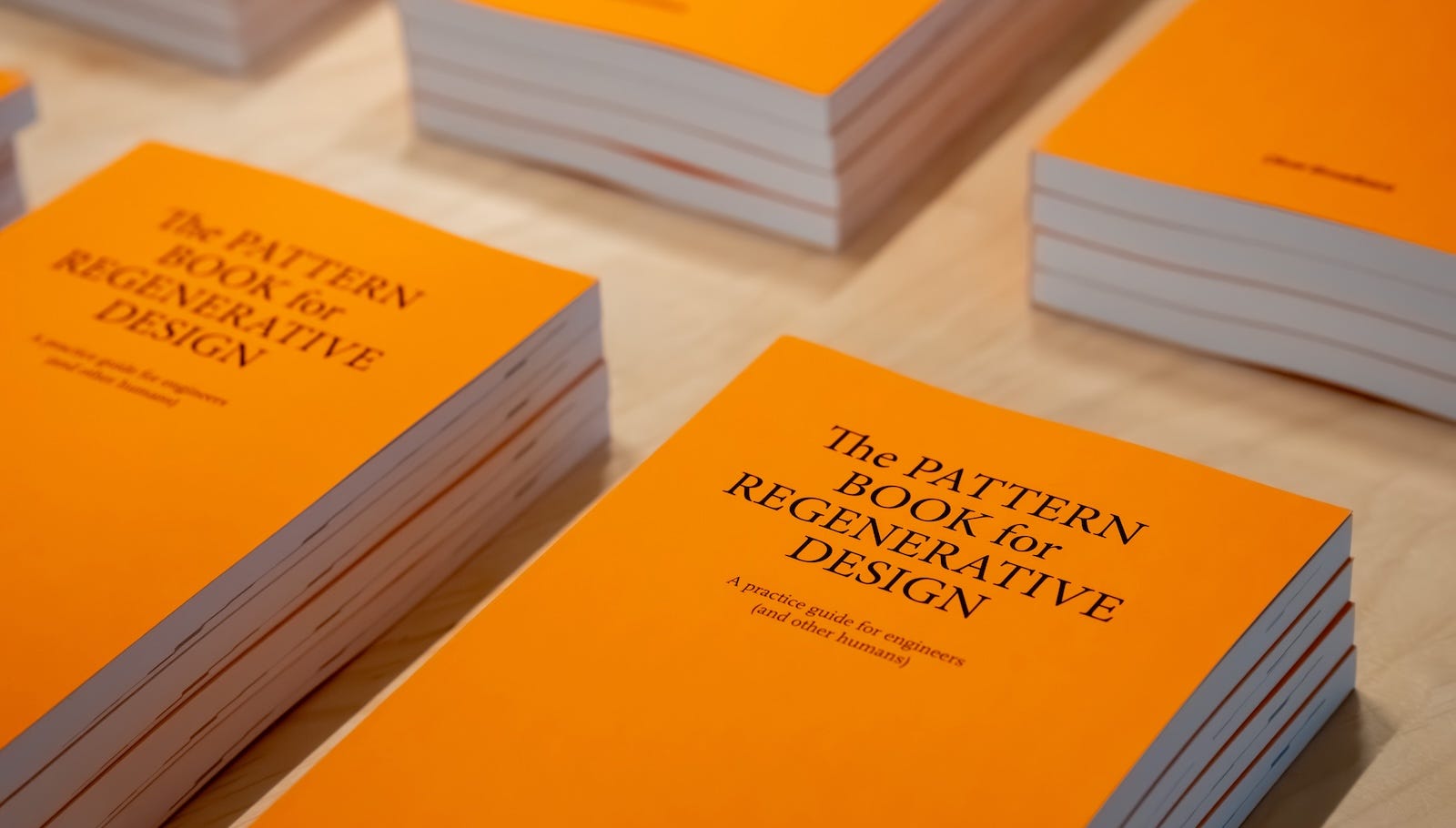
(Source: The Constructivist)
Weaving
Early on, he makes the case for the metaphor of patterns, maybe with a nod to the work of Christopher Alexander?
We see patterns./ We think in patterns./ We create patterns./ A pattern is something that repeats./ A drum beat./ An oscillation.
The line breaks here are designed to show how this is all laid out on the page. I couldn’t help but wonder if Oliver Broadbent had stumbled into Stafford Beer’s writings somewhere along the line (it seems likely) and internalised Beer’s complaint that the conventional layout of text on the page is not good for comprehension.
The metaphor of patterns, in Broadbent’s case, goes to a specific metaphor drawn from weaving, which was once a family business. His grandfather, in Bradford, was a cloth designer. And I liked this extended metaphor, drawn from Harold Broadbent’s life:
Once, when driving north from home in Gloucestershire to the factory in Bradford, he saw the shoots of winter wheat pushing through rich red soil. This image became the inspiration for a popular cloth he designed – a rust brown weave with flecks of green in.
He had a picture in his mind of what he wanted to make, but then he had to negotiate with the factory owners to figure out how it could be made with the materials available to them.
And for me this is a strong metaphor for creating change. We need an image of the future. But we have to build it with the materials we have today.” (p.20)
Warp and weft
This cloth metaphor runs right through the book. We get deep into warp and weft, those fine Old English words that describe the weaving process. The warp threads take the weight of the material, and are held under tension during the weaving process; the weft threads take almost no strain. So the warp threads need to be stronger. (Oliver Broadbent doesn’t explain any of this in much detail, but Wikipedia was my friend).
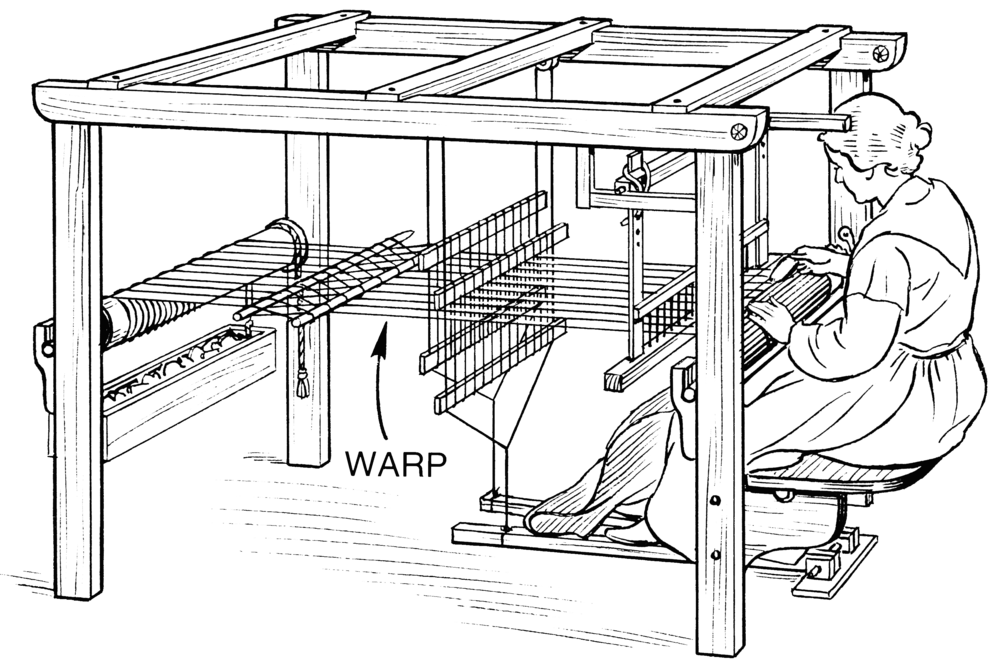
(Image: Pearson Scott Foresman, Public Domain, via Wikimedia)
The warp threads in the Pattern Book are “complexity”, ”time”, and “iteration”. These represent the links between present and future. Complexity connects “the character of the present and the future”; time is “the amplifier of change”, and iteration is “the means of navigating complexity over time.”
The weft fibres create the pattern, though. These draw on the Living Systems Blueprint, developed in the earlier book, which connects “interconnection”, “symbiosis”, and “capacity for change”. These aren’t quite tangible enough to represent threads, but from them Oliver Broadbent pulls out “feedback”, “circularity”, and “adaptability”.
Cloth metaphor
So these six elements are found in each of the 12 patterns in the “pattern catalogue” that makes up the front part of the book. The cloth metaphor goes a bit further, though, because the book also contains “motifs”, which draw on the learning and teaching the Lab has been doing.
Good teaching is rarely about setting out the whole picture. It’s about creating moments of tension when we show something new, and moments of release, when the learners see the relevance to the problems they want to solve.
We create tension through stimuli, provocations, metaphors and experiments arranged in different orders to create different effects.” (p.23)
These are the motifs, and they make up the back part of the book—more than half of it, in fact. As we’ll see in a moment, the motifs are the building blocks that make the patterns usable, in the book, if not in weaving.
Patterns
But I should spend a bit more time on the patterns, which again draw on the metaphor of fabric. Pattern 01, for example, which is designed for “intuitive exploration”, is canvas, “for creating large fabrics for a wide range of journeys”. As you go further in the pattern catalogue, you get to more specialist cloths.
Pattern 07 is pinstripe, for “developers and asset managers”, a critical part of of the built environment ecosystem, while Pattern 12 is damask, for “government and industrial regulation.” These go beyond names to being properly metaphorical.
As Oliver Broadbent notes, only a little drily, damask is a
richly woven fabric, originally created on a Jacquard loom, one of the earliest machines to be ‘programmed’ by punch cards. Rich fabrics are synonymous with power, a good metaphor for government and the regulations that control industry. A striking feature of damask is that the stitch looks good on both sides, making the fabric reversible – a reminder that even powerful institutions can change their mind.“ (p.60)
Sequencing
Each of these patterns runs for three pages, and each follows the same pattern on the page. There’s a section on who the pattern is for, and why you might use it. For example, in Pattern 02, twill, which is for “systematic exploration”, Broadbent notes that he and James Norman used this pattern to help structure their book, but that more intuitive researchers might prefer Pattern 01.
And then there’s a section on how to sequence the pattern, usually under between three and six headings (the pattern about culture in more complex), with a set of motifs gathered under each heading. So, in effect, the idea of the Patterns is to help structure the journey, and the motifs tell you what to do with each step.
Again, just to illustrate, the headings in Pattern 05 (‘felt’), which is about regenerative personal journeys are: Grounding; Tune in to your inner personal client; Space for rest and reflection; and Create a new practice. The three motifs that help you tune in are called Wildwork, Changing Mindsets, and Catalytic Style, and these are all found in the Motifs section of the book, which is arranged alphabetically.
Toolkits
As someone who has spent time in the past working on toolkits to help people apply futures thinking and tools, I have to say I admire this approach and the metaphor, and the separation of the Patterns and the Motifs, and I’ll certainly draw on it in the future.
It solves two related problems in an elegant way: that when you put the details of method into the overall idea of the steps of the journey, it both appears prescriptive, rather than inviting the reader to try something out, while also drowning them in detail.
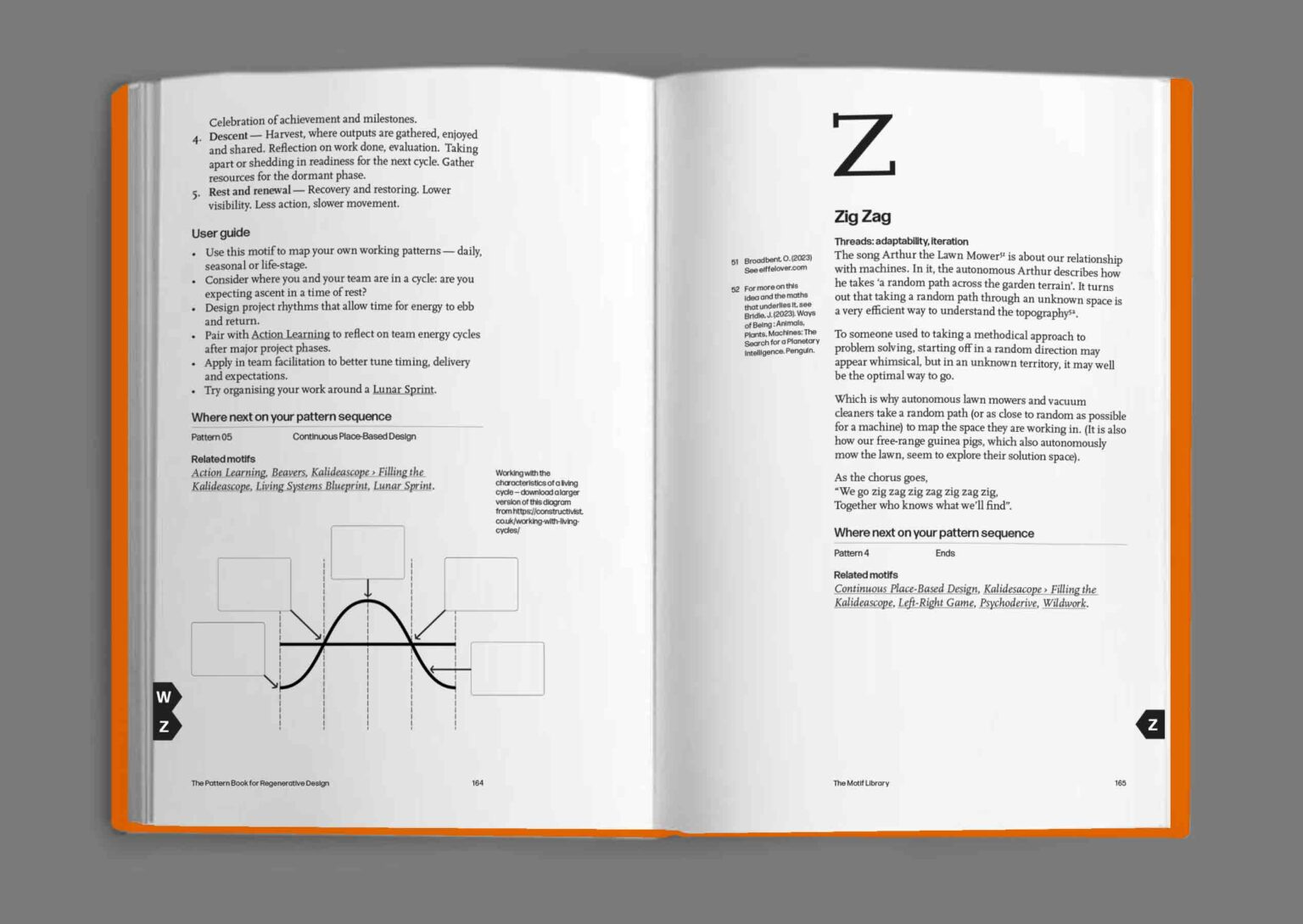
(Photo: The Constructivist)
The Motifs section is a mixture of methods, concepts, metaphors, and frameworks. That makes it sound like a bit of a jumble, and it is. But It’s a rich jumble where the different types of approach create an ecology rather than confusion.
Tuning in
For example, Wildwork, which I mentioned above, is a set of observational questions that help you tune in to the world: it’s “like homework, but done in the wild: a wood, a park, or a garden.” Some are just stories: Autumn Surprise, for example:
An alien visiting the northern hemisphere of Earth from June to December might be surprised to see the leaves fall in autumn, and might wonder why no one else seems bothered. An alien who stays for longer will discover it’s a cyclical event.” (p.70)
This particular motif is a reminder that our period of observation may be shorter than the period of change.
Regenerative practice
Dave Snowden’s Cynefin model is in here, as is Three Horizons, though it is consistently and wrongly attributed solely to Bill Sharpe, when Anthony Hodgson did almost all of the original thinking: it should always be credited to both of them. (I hope that Broadbent will correct this when he does a second edition, and online.) I liked the very short entry on Practiiice (no, this is not a typo), which feels like it could be adopted by futurists as a motto:
Regenerative practice has three eyes.
One eye for the future.
One eye for the present.
One eye for how we change what is going to happen next. (p.135)
In short, even for other humans, this is a rich resource book. If you are a facilitator, or work with systems, or in futures, you will be able to draw on it.
The book has a complicated copyright structure, which ensures that the motifs and exercises are all published under a generously open Creative Commons licence. Some of the tools in the Motifs section are also online at Constructivist. As far as I can tell, you have to buy it direct from Constructivist, which is fine if you’re in the UK but may not be so helpful elsewhere. Maybe a digital edition is a possibility.
—
A version of this article is also published on my Just Two Things Newsletter.