In this essay, I will focus on food and agriculture. I had planned to also write about human-nature interaction in this post, but it is already too long, so that will be the next one.
The romantic view of self-made pioneer farmers breaking up virgin land all by themselves doesn’t hold when scrutinised. Agriculture is predicated on iron-making, knowledge production, exchange of seeds, animals, goods etc. There is, therefore, a strong interplay between industry, in a wider sense, and agriculture. On the one hand you need a surplus in agriculture in order to develop mining, industry and other sectors. On the other hand you need tools from an “industrial sector” to increase agriculture production, from basic hand tools to wagons and more. The status of agriculture is thus very much part of the “complex” of energy, technology and capital which I discussed in my previous post. There is also a strong connection between this complex and the social, economic and cultural development. Keep that in mind.
I reiterate my assumption that we will end up with a great degree of simplification in a post-collapse world. My assumption is also that there will be enough steel and energy to forge useful tools for agriculture and that the auxiliary energy needed over and above human muscle power will be a mix of animal traction, biomass, electricity from renewables as well as limited use of fossil fuels, at least where they are regionally available.
The baseline
Let’s first establish some basic facts about the current food system. As an average, we currently have approximately 1800 m2 of arable land per person and more than 4000 m2 of grasslands. Most of that grassland is not currently used for food production and it might be a good thing to let wildlife recover on parts of it, so say we can each utilise some 2000 m2 of grassland for domestic livestock. It is important to realise that the average is just an average and that the actual composition and area of arable land and grassland will vary very much. There is simply no way a Mongolian herder can survive on 1,800 m2 arable land and 2,000 m2 grasslands. It is too cold and dry to grow almost any crops and the productivity of the grassland is low so a considerably bigger area is needed to feed a person. Meanwhile, in tropical countries with good rainfall where one can get two or three harvests of paddy rice, as well as horticulture crops, 1800 m2 will be sufficient to feed three or even four persons.
The global plate
The global plate (i.e. the average food per capita) looked like this in 2009 and it has not changed much since:

Note that the global plate doesn’t reflect the production, which is a lot higher. The gross crop output in energy per capita increased from 4,500 kcal 1961 to 7,600 kcal 2020, an increase with 68 percent. The biggest increase came from oil crops while the total contribution is still dominated by cereals. The gross output is 2.5 times bigger than what is made available to humans. One could be tempted to claim that we could feed 20 billion people on the vegan diet. But then humans can’t really eat all those crops even if they wanted to. Of the gross output in weight, 6% is lost in the production, trade and processing, not including consumer waste, 2% is used as seed, 14% is used directly as feed and 37% is processed into various products such as biofuel, beer, spirits, candy, cosmetics, starch, biodegradable plastics, cotton, vegetable oil and sugar – of which biofuels, vegetable oil and sugar are most important. https://gardenearth.substack.com/p/food-and-agriculture-number-crunching_30
Energy and farming
There are many figures thrown around about the energy need for food production, supposedly demonstrating how dependent our food system is of fossil fuels. And it is. Still most of the energy use is in post-agriculture stages. The excellent USDA ERS report, Energy Use in the U.S. Food System, by Patrick Canning and colleagues from 2010 states that the whole food chain consumes around 16% of the total energy use in the United States and that delivering the average American’s 3,000 calorie diet requires nearly 32,000 calories of energy inputs. Farm operations in the United States consume 14% of the total energy used in the food chain, while handling, processing and retail on the one hand and preparation and consumption on the other, use more or less equal shares of the rest. That means that farming consumes 16%*14%=2.2% of the total energy use in the USA. Swedish figures point to a total energy use in agriculture, including energy embedded in inputs, primarily fertilisers of 8TWh compared to the total energy use of 353 TWh, i.e. also 2.2%. Globally, my estimate is that the share of energy use in agriculture is higher than from these two highly industrialised countries. I made some calculations in this paper: https://gardenearth.substack.com/p/eating-oil
The global baseline is basically a situation of overproduction, which is the driver of food waste, biofuels and the use of grain as feed. The good news is that there is considerable slack in the system. The bad news is that this situation is very dependent on the use of chemical fertilisers and pesticides as well as large scale irrigation which is depleting water resources.
The basic principles
I will first outline a few principles for agro-ecosystems to be sustainable. Thereafter, I will outline a typology of production systems showing what the principles might mean in reality, focusing on the key determinants: labour, energy and technology, nitrogen and ecological intensification.
Work on the land
I estimated in my previous essay, that one quarter of all work will be directed to food, fibre, energy, and mining. Of this, most will be agriculture work. I also envision a society where people will engage in several kinds of work. This means that some people will perhaps direct more than half of their energy towards agriculture, producing food for their families as well a considerable surplus for others. Some will spend 5-10 percent of their work on self-provisioning and some will do no agriculture work whatsoever. Note that in my vision, also domestic work (both care and reproductive work as well as mending and maintenance of clothing, home, appliances) is expected to take a considerable time as more of such work will, once more, take place in households or local communities.
Energy and technology
In my estimate, a lot of the post farmgate processes and distribution in the food sector will simply wane as people will be closer to food and eat less processed products. Energy use there will shrink considerably. Cooking will, however use a lot of energy, again a mix of different energy sources depending on local conditions. This has been the case historically and still today, cooking is the most prominent energy use in many poor countries.
We can run a fairly mechanised farm sector with a fraction of today’s energy use. I expect that draught animals will be used in many parts of the world, but also that some tractors and 2-wheel tractors will be used, either powered by fossil fuels, bio-fuels or electricity from renewable sources. In some intensive horticulture situations almost all work might be manual (which is the case also today). My assumption is that we will have to do more or less without chemical fertilisers, which are very energy hungry. This is probably the biggest challenge for farming, but also one of the best news for nature.
Crop nutrition
Crop nutrition, and in particular nitrogen (N) will be a perennial challenge, as it has been all throughout history. Supply of nutrients will depend on a mix of strategies including, but not limited to:
- minimising losses;
- integration of humans, livestock and plants. This includes recirculation of nutrients from all stages in the food chain back to the land or to animals as feed;
- Recirculation of human waste;
- import of nutrients to the agriculture system from other eco-systems, through grazing animals, hay or leaf harvests from natural areas; collection of materials such as grass, wetland mud, waterway sediments) for compost, mulching or bedding; extraction or harvest of natural sources of fertilisers, such as guano, bat guano, fish, seaweed; irrigation with nutrient rich water etc.;
- biological nitrogen fixation through leguminous plants and other natural nitrogen fixing processes; and
- activating nutrients stored in soils through plant composition, mycorrhiza, cultivation practices.
Ecological intensification
As I speculated in the collapse interlude, the ‘lost’ complexity in the man-made technosphere might be matched with an increased complexity in human-nature relationships and in the social web. I am quite sure that we can find out ways to further improve organic, regenerative agriculture, once they are unchained from the imperatives of the market. Having said that, I recommend some scepticism towards the ’marketing’ of certain methods that are portrayed as silver bullets. We can do better, but as little as we can negotiate the laws of thermodynamics can we change photosynthesis and the simple fact that the more we take out from a system the less there will be left for other species and for the processes of that system.*
Many of the practices listed above are also examples of ecological adaptation. By growing many different crops and by integrating livestock into the operations, agriculture becomes more diverse and more resilient, both economically and biologically. There will be fewer and less severe pests and when they hit, the consequences for the farm will be smaller than in industrial monoculture. By growing many different plants and keep many kinds of animals, one can increase net primary production as well as capturing a higher share of the net primary production.
Livestock
There is a rather strong myth that domestic livestock is almost by definition wasteful because animals need x kg of feed to produce y kg of food. But that is an utterly simplistic and mistaken argument. Already the fact that nowhere on the planet Earth has there ever been a purely “vegan” diet and a purely vegan agriculture system is proof enough that there are some benefits in keeping livestock. The fact that industrial animal keeping systems are inhumane, polluting and wasteful is no argument against livestock as such. Industrial crop production is also polluting and wasteful and harm bio-diversity. Properly managed, integrating domestic livestock in the agri-food system is good on farms, in the food chain and on the plate. Animals and their products can make the system better, more efficient and more resilient all the way from the field to the plate. I have expanded on this in many articles, such as Feed use in Swedish livestock production and Are Pigs Eating Our Food?
While livestock should be integrated in the agro-ecosystems, the kind of animals and the number of them will be determined by the local conditions. Discussions about a global average of meat or milk consumption is just pointless and based on a model of a global food system totally dislocated from local ecological conditions. This is the antithesis of sustainable.
From foraging to grain farming
Below I sketch a handful of typical systems for provisioning.
Fishing/hunting/foraging
This is the most time-tested way of food supply. In areas where the potential for farming is limited, there is often possibilities for fishing, hunting or foraging, depending on the climate. I envision that in a post-collapse world, the possibilities for local small-scale food provisioning can increase considerably if large scale fisheries are discontinued or abolished, wild life can recover and nature be rejuvenated.
Extensive livestock
Ranching or pastoralism is a method of production which hasn’t been so radically changed in most settings. It is still mostly based on animals grazing under the supervision or guidance of herders or fences. In many cases, grazing has been pushed to the margins when crop farmers have taken the areas with the best rainfall and best soils, close to markets. This means that pastoralists have been marginalised. The productivity of grasslands vary a lot, but a global average production from natural grasslands is something like 12 kg of meat and 60 litres of milk per hectare. Under harsh conditions, such as in Mongolia the production is just 3 kg of meat per hectare. Huge tracts of land is thus needed per capita fed on a primarily animal diet. One will expect that pastoralists will have regular exchanges with grain producing areas and that they will fish, hunt and forage to complement their diets. Honey production and some perennial crops can sometimes add to the diet.
Productivity in grasslands can probably improve with better grazing management, such as holistic management of grassland and Adaptive multipaddock (AMP) practices, and without any major external inputs needed. But I should not bank on any pastoral regenerative revolution by which natural grassland productivity is dramatically improved. We also need to consider that the stock of wild herbivores is really low and we need to allow the populations to recover. It is hunting and loss of habitat, not competition with domestic livestock that is the main reason for decline in the number of wild animals. In fact, wildlife and domestic livestock can and have co-existed well (the exception is predators which pastoralist and ranchers — mostly, but not always and everywhere — have hunted ruthlessly). Grazing on arable lands is quite a different story, see under “mixed farming”.
Mixed farming
Mixed farming as practised in Europe (and many other places) involves a farming system with a variety of crops and livestock that is integrated in the production system. By the cultivation of perennial forage crops (for grazing or silage/hay production), primarily leguminous plants in crop rotation with food crops, productivity can be high and the need for external inputs can be low. For example, in Sweden around 45% of the arable land is used for perennial forage and that is the main reason for why the soil health and organic matter content of Swedish soils are increasing.
It is essential to limit losses and that organic matter is recirculated within the fields, within the farm and with the wider human food system. Mostly these systems are complemented by seasonal grazing, grazing natural ecosystems such as wetland, forests and other ways to utilise non-croplands, such as pigs eating acorns, hickory nuts or beechnuts.
Intensive horticulture
In certain areas, especially if there is a high population density, the production might be more oriented towards intensive cultivation of horticulture crops including root crops and tubers. They are most likely to be dominating in village or city settings and perimeters. Such systems will mostly be deficient in protein and in particular of fat, and will need some exchange with other areas to provide full nutrition. In most cases they will import grain and/or oil seeds from other areas which might also be turned into milk, pork or eggs or import animal products. Because they are net food importers, their productivity can quite easily be maintained through the re-circulation of human waste as well as animal manure from livestock eating feed from other places. The problem here is not the productivity of the net food importing area, but rather to maintain productivity in those supplying it with some staples (see more under grain farming).
Paddy rice**
Agro-ecosystems built around paddy rice have been extremely successful and allowed very high population densities already before the introduction of chemical fertilizers. In densely populated river valleys of Asia it has been combined with meticulous recirculation of organic matter. Mostly pigs, ducks and chickens have also played an important role as upgraders of leftovers. In most rice growing areas, buffaloes have been kept for draught power and transportation with milk, leather and meat as secondary products. The buffaloes graze rice fields after harvest and during the growing season they graze hills, roadsides, eat rice straw etc. Thereby, they also bring in nutrients to the arable lands and human food systems from non-farmed land.
Forest Gardens***
In many tropical areas a system of forest garden has developed. They are permanent poly-cultures in multiple layers, stretching from tall trees to roots. Some annual crops are also grown. Staple food will be plantains, yams, cassava and other starch rich crops. Forest gardens are to a large extent mimicking a natural forest and will mostly remain highly productive without external inputs, subject to that nutrient exports are not too high. The main “disadvantage” of forest gardens is that they are virtually impossible to mechanise, which is why they are not competitive in a modern economy.
Swiddening
Swiddening, also called slash and burn agriculture, has somewhat of a bad reputation, which is unwarranted. There are mainly socio-economic reasons for the bad-mouthing of swiddening. In a similar way as for pastoralism, swiddening is not based on permanence and private land ownership. This makes it hard to control and extract surpluses from. In addition, swiddening farmers may compete with others’ interests in firewood, game or other forest resources.
Anyway, from a sustainability perspective, swiddening is well adapted to many ecological conditions and it can be practised in the same area for centuries and maintain high productivity. While it involves the cutting of forests, the resulting mosaic is a very diverse and rich landscape. Yields are often high in swiddening, but of course, if you include the vast areas needed for the rotation of swiddening, yields per hectare of total area affected are low. Also in Europe, swiddening has been practised in many places and continued in some places until the middle of the 20th century.
Swiddening share the same limitation as pastoralism, it can’t feed so many people per area unit. But that is not necessarily a problem. The landscapes used for both swiddening and pastoralism are rich and diverse and leave a lot of biomass production and niches for other species.
Grain farming?
My last typology of farming is grain farming. With this I mean broadacre farming oriented towards surplus production. Grains will obviously be grown in other farming systems as well. I envision that there will be some remnant rainfed broadacre grain farming in plains with limited rainfall, possibly fairly mechanised. I am talking about areas that also today are dominated by grain farming, such as the US Midwest, Ukraine, Russia, Mato Grosso and Australia. The three main limiting factors here are: 1)who needs the grain? and 2)how to ensure sufficient nutrient availability for crops and 3) how to supply them with energy.
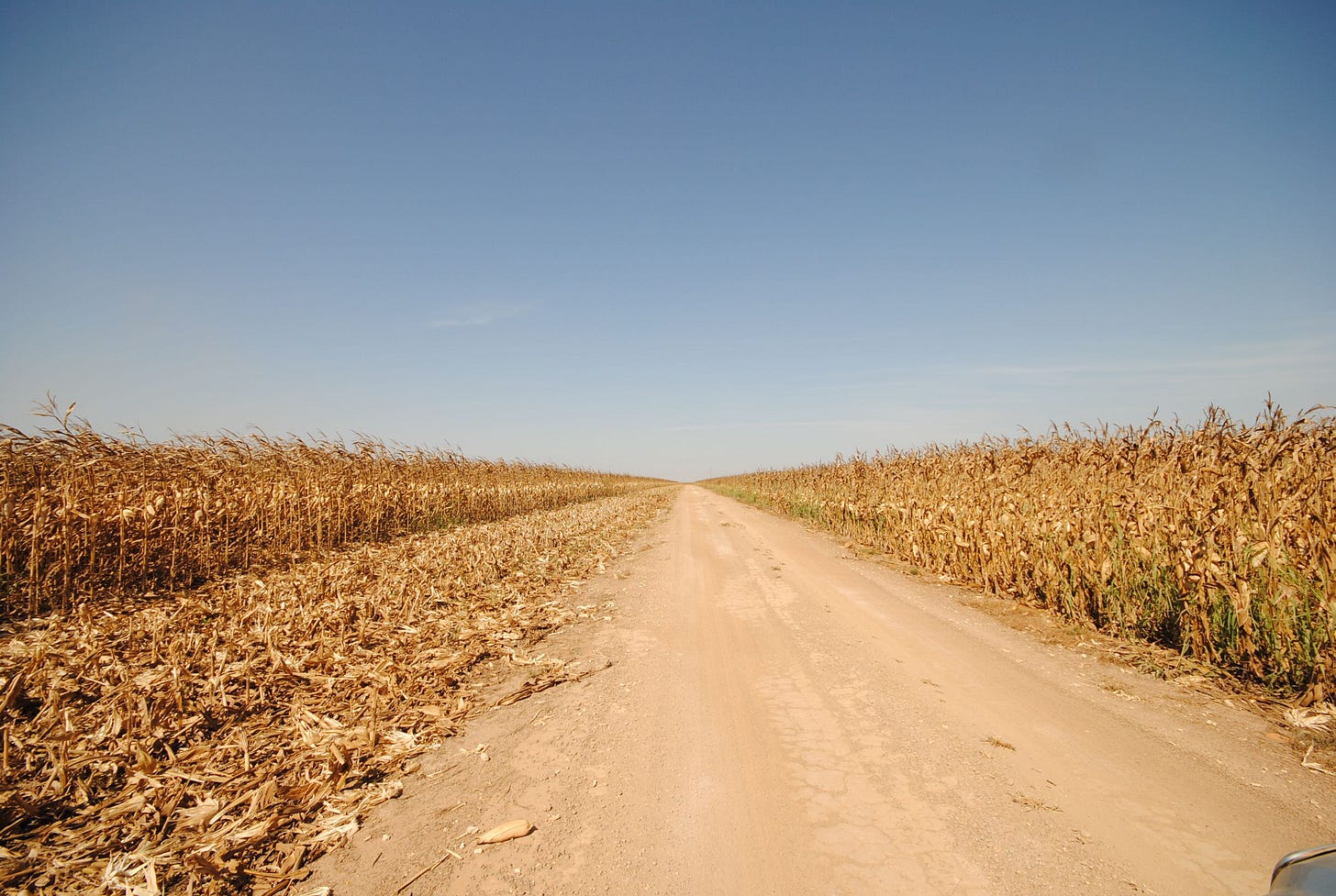
Corn in Mato Grosso, Photo: Gunnar Rundgren
The first question is very much linked to what extent there will be a regional or global food demand, something I am not very convinced there will be. The second is tricky and linked to the demand. If the system is just exporting nutrients it is basically mining the soils. That can work on very good and virgin soils for a while, but sooner or later the soil will be depleted. Most of the huge grain areas today are on steppes (prairies) and savannahs which were ploughed since the late 19th century and from which nutrients have been exported. When you hear that the soil has lost half of its organic matter (which in the talk of today often is reduced to carbon), the reality is that it has also lost half of its storage of nutrients. Another option is to convert grain to meat, eggs or dairy products. In that case considerably fewer nutrients are exported from the land. This was the logic between the rise of the pork meat industry in the US Midwest.
The energy needs of broadacre farming could be taken care of by horses and oxen, as was the case all until the 20th century. Or perhaps there will be tractors.
Probably, it will be more sustainable to repopulate huge swathes of these areas and introduce some versions of mixed farming with grazing ruminants integrated into the systems as well as inspiration from the historical land use e.g. by Native Americans. I am sure they will figure it out.…
Combinations
There are some systems that interact with each other quite a lot. There are plenty of examples of pastoralists and farmers working more or less side-by-side and where pastoralists feed and rest their animals in fallow fields or after harvest. The farmers gets manure and perhaps some milk, wool, leather or meat in exchange. Pastoralists might get grain, other crops or pottery in return. In many countries in Africa and Asia, the systems are even managed by different ethnic groups.
Similarly, grain farming and intensive horticulture are often complementary and based on cooperation. Swiddening is often combined with forest gardens, horticulture or paddy rice farming. The possibilities for combinations are immense. Most of these combinations are made without any formal trade or markets involved but can be organized in many different ways.
Will people follow farming?
By and large, I envision a ruralisation of societies as well as migration from parts of the world where populations are exceeding the local carrying capacity. This might sound dramatic, but is clearly not more dramatic than the mass migrations of the last century. These have mainly been driven by the economic opportunities, decoupled from ecological conditions. In the future, ecological conditions will be more important than economic conditions. More people in the countryside, many more people engaged in farming, fewer people in cities and considerably fewer people engaged in intermediation, trade, science, education, administration and other typical complexity occupations.
Will there be enough food?
It is often said that half of the global population is fed by chemical fertilisers, or that half of the world’s population would starve without N-fertilisers. That is simply not correct from a number of perspectives. As noted earlier, there is a lot of slack in the current food system, or formulated differently, there is an immense overproduction. In addition, the reason for why some starve has nothing to do with shortage of production, but is caused by poverty. It is true that fertilisers, and in particular N-fertilisers have played an enormous role in the agri-food system and their use has shaped both production and consumption in a similar way that fossil fuels have shaped our energy use, transportation and industries. But as been indicated above (under crop nutrition), there are numerous ways that farmers can cope with a nitrogen shortage, as they did all through history. For sure, none of them are as easy as spreading pellets of N-fertilisers.
There is also another misunderstanding that large farms produce more food than small farms. Obviously, a big farm produces more food than a small farm, and they also produce more food per person working. But they don’t produce more food per area unit. More often it is the opposite. An intensification of food production with more people on the farms will most likely produce enough and better food than the current system.
Changes in production will be reflected in changes in consumption. Diets will revert back to historical patterns with big differences between countries, towards ecologically adapted diets. Industrial farming of livestock, and in particular of chicken will disappear. While chicken is a very good feed converter, for industrial scale production, they are dependent on high-quality of feed, feed which to a large extent could be eaten by humans. Pigs are better adapted to eating leftovers and rougher feed, but also for them, the industrial scale favours high-quality feed. Having said that there is still space for some chickens and even more laying hens in a future food system. Meat, milk and wool from ruminants will play a big role in many farming systems.
Others claim that global trade is essential to allow for the shipping of food to areas subject to natural disasters etc. There is some merit in that argument, but trade also creates dependencies and often reduces local food production, which makes it much more likely that there will be regional food shortages. With a diversified agriculture system, crop failures will be fewer and the effect on failure of one crop will be limited as other crops might do well. Obviously, with a once in a century flood it doesn’t matter if the agriculture system itself is resilient or not. But even there, a spread out population in many ecological niches will be a lot more resilient than densely packed populations or cities in the low land. It should be noted that there are few indications that famine was reduced by the development of international trade and that famines tend to occur even when there is plenty of food.
* There are both high-tech versions of this such as vertical farming and GMO-crops and low-tech versions such as exaggerated claims for perennial grains, regenerative grazing or market gardening.
** Admittedly I am leaving my comfort zone when discussing paddy rice as this is one system I have very little own knowledge about and certainly no practical experience.
*** Permaculture can be seen as a modern interpretation of most of the principles of forest gardens. Syntropic farming is also very close to forest gardening. Agro-forestry is a wider concept that also includes field scale cultivation of crops and trees in rows.