


Recent posts have compared belief in a space future to belief in Flat Earth, and also compared living in space to hijinks like keeping a crewed airplane flying for over two months straight. Indeed, a number of insights might be gained by comparing the quest for flight to the space ambitions that followed.
Long before fuel-powered flight was demonstrated in 1903, human-powered flight had been a perennial dream of early inventors. It wasn’t until decades later that the much harder task of human-powered flight became possible—aided by modern lightweight materials. Yes, it can be done, but only if you’re a world-class athlete and content to travel at running speed a meter or two off the surface (remaining in ground-effect). Likewise, supersonic commercial flight is possible but not practical enough to remain an option. And it is possible to keep two people up in an airplane for 65 days.
Just because something can be demonstrated as a stunt does not mean it is destined to become normal practice. In particular—as I pointed out in an earlier post—occupation of a space station shares a lot in common with sustaining people in continuous airplane flight, which was once quite the enterprise. But after 1959, people stopped even trying. The exercise had crossed the line from meaningful to a silly waste of effort.
In the first half of the 20th Century, few (in techno-industrial cultures) would question the merits of attempting to keep people airborne as long as possible. It was exciting—proof of man’s greatness and progress into the novel. Given some degree of technological development since that time, we could presumably beat the 65 day record by a large margin, perhaps even demonstrating indefinite airborne capability—if sufficiently driven and provided adequate funds. But the proposal would likely—and fittingly— elicit shrugs and questions as to what the point would be. From my perspective, similar responses should accompany proposals for living in space. The question, then, is: when will we collectively become comparably dismissive of proposals for humans in space?
Becoming Bored
Other outsized feats of exploration peppered the past era: polar expeditions, conquest of un-climbed mountain peaks, diving into the depths: records, records, records. Part of the fuel is a quest for the superlative: to be unambiguously marked as “the best” in some narrow category. The psychology is fascinating. But it’s not just the fanaticism of expedition personnel; public engagement and enthusiasm also speaks to a shared sense of accomplishment for the human race (race to what?). Impressive stunts serve to reinforce and validate human supremacy. It’s almost as if modernity needs the psychological reassurance of novel conquests—even if pointless—to keep the doubts at bay.
Our culture seems to remain enamored of the “frontier” derring-do of humans in space, even if we have lost the zeal for treks across ice plains. And it’s not because ice treks have become part of daily life that a sizable fraction of humans now experience, routinely. We just lost interest in something that is really hard and seems to have no purpose, other than pushing limits for the first time. Can’t we imagine the same fate for space: of being bored by the stunts?
In fact, I used to poll students—all born well after 1972— as to how far humans have traveled from Earth’s surface in their lifetime. I would draw, to scale, the five choices on the chalkboard relative to a circle representing Earth:

- 0.1 Earth-radii (600 km; hugging the globe);
- 1 Earth radius;
- 6 Earth radii (geosynchronous);
- 60 Earth radii (moon; far end of chalkboard);
- Beyond the moon.
About two-thirds of students would distribute among the last two choices, even though the first answer is correct (only about 5% would pick this). Students bordered on anger—certainly shock—when they learned that we hadn’t even been as far as the moon since 1972, asking what the Space Shuttle was even good for (back when it was even still a thing), and imagining the Space Station to be beyond the moon, like it would naturally be in movies or TV shows.
To them, even traveling to the moon had become passe: already boring. Given that farther steps may forever remain out of reach, we may have reached “peak stunt” over 50 years ago! Sure, we may see repetition of humans on the moon, but will humans actually ever make it to Mars? While I have serious doubts, I wouldn’t rule it out. Even so, I would strongly expect it to be another short-lived stunt—this time more likely holding the “forever” title.
As mentioned in the 8 Billion Will Die post, Mary-Jane Rubenstein experienced a similar disconnect in her class (as she discussed at the end of this podcast episode): students had a harder time imagining realistic/demonstrated modes of human living than fantasy space scenarios. We’re really whacked!
The Flight Craze
It is instructive to look at a plot of flight duration records to get a sense of the “craze” period and the bored stagnation that followed. The first is on a linear vertical scale, showing lines for both the no-refuel flights (blue) and refuel-on-the-go operations (green). Shortly after refueling practices began, the records left single-fuel metrics in the dust. In fact, no-refuel attempts essentially ceased (having become silly/pointless), until the 1986 event when Rutan and Yeager circumnavigated the globe in 9 days.

A logarithmic plot better reveals the early history and also displays a characteristic curve that applies to both lines. The appearance is of a reversed, upside-down exponential (1 − exp(−t) form): an initial flurry of record-breaking as low-hanging fruit is plucked, followed by stagnation as it gets ridiculously hard and increasingly pointless and eventually silly.
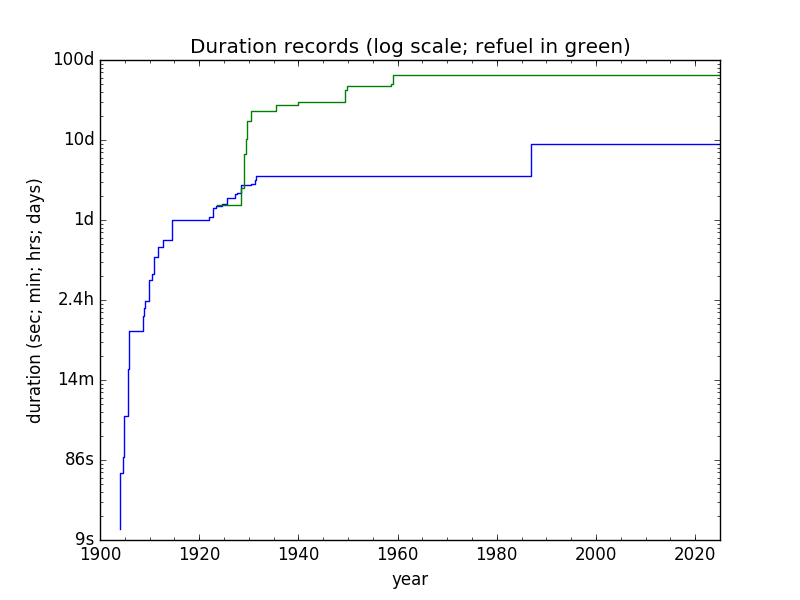
Consider the rapid pace of space superlatives racked up in the 12 years from Sputnik to Apollo. But it’s been over 55 years since the “most distant person” record was broken. [The distance record was in Apollo 13; April 15, 1970; 406,542 km from geocenter.] Even if we do return humans to the moon, we basically only tie the record. It would not be foolish to bet that the most distant human record for all time mimics the flight duration curve. If we ever do take the dramatic step of putting a (living) human on Mars, chances are quite high that it becomes the eternal record—for all sorts of reasons.
The burning question is: why does the airplane stunt strike us (collectively) as silly, while the very similar stunt of maintaining humans on the constantly-refueled space station does not? Especially in the context that the latter is more than 3,000 times more expensive to carry out, is the relative gain worth the expense? Will our space stunts one day also be viewed through the “silly” lens by more than a few heretical individuals?
The answer to these questions hinges on expectations for the future. To appraise intrinsic value in the here and now, we have to evaluate as if the space effort does not proceed. In other words, a primary argument for valuing humans in space today is predicated on a belief that these are crucial and necessary baby steps toward a continued/expanding space presence tomorrow. Take that away—because such an outcome is very far from guaranteed—and what meaning is left for the present-day dead-end stunts? Anything? Does it make sense on its own present merits and at such tremendous cost? Do we learn things that are still “useful” in the absence of a space future, and could not be gleaned (given similar investment) on the surface of the Earth, where the context is more applicable?
Of course—seeing that I value Life on Earth more than I do economic expansion—I would claim that the “advances” deriving from the space effort mainly advance a sixth mass extinction, and therefore have an overwhelmingly negative impact, ultimately. Maybe it’s unfair to claim that space has had zero positive impact. For several seconds in 1968, the image of Earth rising over the moon gave people pause by pointing out our isolation in inky space. But that lesson of treasuring Earth above all seems not to have lasted very long.
NASA’s Case
Presumably, few institutions have made a greater effort to nail down the case for human spaceflight than NASA. A representative resource providing various links to explore is their Why Go to Space page. Let’s look at some of the text pulled from this site.
Since the dawn of humanity, people have explored to learn about the world around them, find new resources, and improve their existence.
Ah—resources and improvement (progress): feeding modernity’s growth imperative and the inevitable suffering such a twisted goal brings about. But this part was preceded by an appeal to mythology. Yes, the statement about exploration contains an element of truth, but only in the context of all kinds of limits. Do we explore what it’s like to sit on a bonfire? Lie naked on the ice for a day? Live in an airless underwater cave? Don’t be absurd. Even though these don’t cost money, we fail to explore them. Blanket platitudes leave out an awfully large amount of relevant context: they’re a poor and lazy substitute for critical thinking. Limits apply!
…and inspiring the world through discovery.
Inspiration is valid: I’m sure people were inspired by the flight duration tests as well. Entertainment and stunts are a form of inspiration, and that’s fair. Viewing human spaceflight as expensive entertainment makes a great deal of sense, and I myself have both enjoyed the spectacle and built part of my career on the activity. But what exactly would be the point of inspiring people—and a young generation—on false pretenses for something that will cease to be a part of the human experience?
Technologies and missions we develop for human spaceflight have thousands of applications on Earth, boosting the economy, creating new career paths, and advancing everyday technologies all around us.
All hail the mighty market! Yes: there’s money to be made (and ungodly amounts to spend). I’m not sure how one would make the case as to whether a human presence in space (setting aside satellites and other uncrewed tech) is a net accelerant or net drag on the economy—pretending for a moment that what’s good for the economy is good for Life (including humans). The companies that benefit are not self-supporting, but rely on federal spending based on tax revenue. The industry doesn’t appear to support itself (or would not need a federal penny). But yes: a big infusion of tax dollars into the economy will create jobs and advance technologies. Yay—if technology is your god, and extinction your goal.
Uninspired
I was not impressed by NASA’s public case. Notably absent from the page is talk of colonization, which is the unspoken driving force. I did find some mention in the Destinations menu item. Even here, two-thirds of the content concentrates on modest goals, and what remains falls short of discussing colonization. NASA does have a colonization page. Its content first acknowledges the sci-fi allure, then talks up the International Space Station, before listing the numerous daunting challenges to living in space. It’s not a full-throated embrace of colonization, despite what NASA Administrator Griffin said in 2003: “For me the single overarching goal of human space flight is the human settlement of the solar system, and eventually beyond. I can think of no lesser purpose sufficient to justify the difficulty of the enterprise…” Maybe since then they’ve cooled their jets? Without that unrealistic goal, their case for pushing the stunt show is considerably weakened. Maybe we’re approaching the boredom stage, which would be a huge relief for the collective good.





Comments
What do you think about things like space telescopes for cosmology research, and satellites that monitor the Earth and the sun and look for unknown asteroids and comets? I guess I'm asking if there are reasons for a space program that seem valid and not grandiose and absurd.
Geez: I think I need a whole new blog post to respond. In short, every tragedy may have some silver lining, even if not enough to compensate for the associated ills. I'm glad for what we have learned from space telescopes and the like, but doubt it's worth the price of extinction. Is it possible to somehow (counterfactually) have the perks without the dire costs? Seems unlikely. For instance, could humans live in ecological reciprocity (e.g., akin to hunter-gatherer) in all ways except maintenance of a space program to look out for asteroids? It seems the space program is hitched to the rest of a techno-industrial society, and could not exist without all that hubbub. Easier said than done, in other words. That's my take, anyway.
makes sense
As far as putting astronauts in space, I am in total agreement. This is an incredibly difficult and expensive enterprise with little to gain except for saying “we did it”.
On the other hand, I fully support exploring the solar system by robotic probes. Our understanding of the solar system has increased immeasurably by the use of these probes which have visited a large part of the solar system. Now we have probes that are retrieving samples from asteroids which is garnering new information about these materials. One immediate bit of knowledge was seeing how quickly meteorites weather when they land on earth.
The Parker Probe is approaching extremely close to the sun giving us fantastic new knowledge about the local star upon which we depend for life.
The two Voyager probes have left the solar system and reached the heliopause giving us hard information about our neighborhood and letting us draw a line in the sand for the furthest we’ve reached from earth.
Moreover, these probes are relatively inexpensive considering how much we learn. Plus they are getting less expensive as our sensors improve and our computers become smaller and faster.
It is not a certainty, but there is some expectation that we may find life in the moons of Saturn or Jupiter and there is still the expectation that we’ll find relics of live that existed on Mars.
Thank you for the article, Tom Murphy.
https://www.univ-msila.dz/site/gtu/
The last sentence suggests that if we've reached the boredom stage on space stunts, it would be a huge relief for the common good. I want to name a a key reason why this might be so: once we accept as fact that humans are never going to live somewhere other than Earth, then solving the problems of what we're doing on Earth swims right up to top center–as long as there's a vague idea that maybe we have a future in space or on some other other planet, where we can start over and do it right, it seems much more acceptable to allow the continuing of the destruction of Earth's systems. Many science fiction novels imagine people living in some distant solar system, thinking back to the now-ruined planet of human origins. Even an unrealistic, doomed attempt to colonize Mars would require tremendous resources stolen from Earth. We can't afford to keep dreaming of Planet B; we need to grow up at long last and act as responsible stewards of the one Earth we have.
I'm delighted you added this super-important point: it nearly baffles me that the original failed to articulate it.