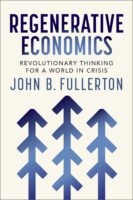
 Ed. note: This excerpt is taken from Regenerative Economics, written by John Fullerton and published by New Society Publishers. The book will be available in the US on 25th November.
The regenerative hypothesis
The regenerative story starts with a single core idea:
We can use the universal principles and patterns underlying stable, healthy, and sustainable living systems, including insights from nonliving systems throughout the real world, as a model for economic-system design.
A regenerative economy also requires a clear statement of purpose. A regenerative system is self-organizing and self-sustaining. It does not “kick the can down the road” as our modern political economy does with respect to inequality, poverty, natural resource limits, pollution, health, deficits, pension plans, retirement, education, and regulatory reform. Instead:
The purpose of a Regenerative Economy is to promote and sustain human prosperity and wellbeing in an “economy of permanence.”
To achieve sustained human well-being in an economy of permanence, we must first study the laws and patterns that the cosmos uses to build healthy networks that actually exist all around us. If the global economy is to become sustainable, we must not simply measure the outputs we desire; we must learn to identify the underlying factors that generate lasting systemic health. We must then design the economy—and the financial system that serves it—to embody those principles.
What qualities make an economy healthy and sustainable? Following the lead of sustainability experts, the first requirement of permanence is to maintain reliable inputs and healthy outputs. Ecologist, and co-creator of the “ecological footprint” concept, Bill Rees explains, “A regenerative system is one that does not deplete or pollute its host and, at best, facilitates its host’s thriving. In other words, consumption by the system must not exceed production by its host; waste production by the system must not exceed the assimilative/ recycling capacity of its host.” Therefore, a regenerative economy maintains reliable inputs and healthy outputs by not exhausting critical inputs or harming other parts of the broader societal and environmental systems upon which it depends.
The next most critical characteristic of health lies in being self-nourishing and self-regulating. So, while many systems, such as tornadoes and lightning bolts, rise up only briefly to diffuse an energy buildup, the systems we care most about—living organisms, ecosystems, and societies—are designed to constantly channel energy into nourishing their internal workings. Living organisms, for example, are designed to turn the food they eat into the energy they need to maintain their own existence. If we are to build healthy human economies, this idea must be applied to human networks.
Just as living systems are sustainable because they are characterized by self-nourishing processes, so must a regenerative economy nourish the human networks upon which its vitality depends.
Yet regeneration also defines the evolutionary process itself. Little known in the West today due to his association with apartheid, Jan Smuts, the South African general and prime minister who later founded the League of Nations, and pen pal of Einstein, was wise beyond his time. He observed that it was the regenerative nature of life itself to evolve into higher levels of complexity in the face of the powerful degenerating law of entropy. Here the term regeneration implies a “continuous process of becoming”—including human and societal potential. This broad form of regeneration implies an indivisible connection among humanity’s physical, psychological, and spiritual dimensions, as well as with the entirety of the energetic whole we call the universe. It is this deep interconnectedness that Smuts referred to when he described holism as the universal principle that defines matter, energy, and spirit.
Can we not, then, view the emergent regenerative economy as a more highly evolved response to the extractive economy it will replace?
Regenerative economies must embrace the continuous process of becoming necessary to sustain life in the natural world.
Critically, however, our understanding of the operating principles common to all natural systems must be informed by an appreciation of the unique qualities that collectively offer insight into what it means to be human. These qualities include higher cognitive function, analytic reasoning, the dexterity of opposable thumbs, morality, a higher potential for conscious awareness, and even the possibility of spiritual enlightenment. And critically, we must integrate the clear reality of the power of human agency itself to affect the outcome of the system. We are not simply passive passengers in the evolution of the human economy. Certainly, these qualities collectively create the potential for highly intricate systems of economy characterized by higher levels of complexity and therefore more advanced function than achievable without the human species.
Some environmentalists claim that the Earth would be fine without human beings. But we must also remember the vast regenerative potential that exists solely because of humanity’s unique qualities. Can we not see that the potential for life on Earth is richer because of the human species, and that it is our purpose to co-create the healthy manifestation of that potential?
Looked at in this light, the great progress that industrialism has brought to the human project is the unfinished business of self-organizing human creativity rather than merely the misguided arrogance and greed that have led to the destruction of the natural world. Rather than leave us trapped in a flawed and outdated ideology, our very unique human qualities must enable us to learn and improve based on the new knowledge we acquire of the nature of economies as healthy human networks.
It is our task, now, to bring our economic system into alignment with the regenerative process. When we do, like turning a canoe downstream after a long struggle against the current, our journey will be lightened, our destination assured.