

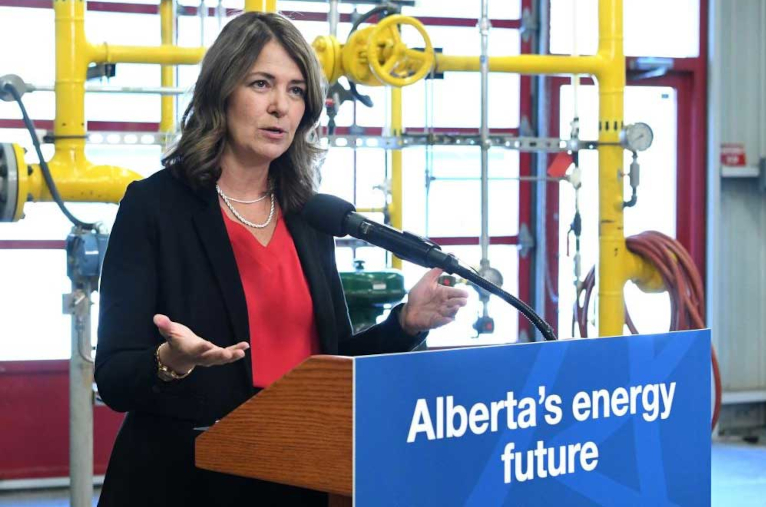
Premier Danielle Smith proposes that nuclear power could be “Alberta’s next energy frontier.” To that end, she recently created a “nuclear engagement survey panel” to figure out how to propel economic growth in her province.
According to Smith, nuclear generators will not only help power scores of artificial-intelligence data centres in rural Alberta but also help to double oil production from the oilsands.
The promise of nuclear power “means affordable power, reliable supply and low emissions that strengthen our grid while fuelling growth,” said the premier. “It means new jobs and opportunities for Alberta workers and communities.”
The province is specifically betting on small modular reactors, or SMRs, because they, as a United Conservative Party release put it, “have the potential to supply heat and power to the oilsands, simultaneously reducing emissions and supporting Alberta’s energy future.”
Smith’s government has already given the oilsands giant Cenovus Energy $7 million to study the matter.
Smith isn’t the only premier with nuclear ambitions. New Brunswick, Saskatchewan and Ontario all think the future lies in splitting atoms. Prime Minister Mark Carney has thrown the weight of the federal government behind Ontario’s Darlington New Nuclear Project. So far the feds have invested nearly $1 billion to advance this experimental small modular reactor.
The industry has new powerful promoters. Tech billionaires are now thirsting for more electricity to feed their data centres and machine intelligence. Everyone from Jeff Bezos to Bill Gates is investing in nuclear reactors.
Unfortunately, these claims that nuclear power can provide cheap energy security or reverse the persistent failure of national and global policies to reduce CO2 emissions is an illusion.
Even the 2024 World Nuclear Status Industry Report offers a reality check. It reports that apart from new reactors built in China (almost all over budget), “the promise of nuclear” has “never materialized.” It adds that there is no global nuclear renaissance and likely won’t be one. Furthermore, the report pours cold water on the ability of SMRs, a nascent technology, to play any significant role in reducing carbon emissions.
That is not to say that nuclear technology won’t play a minor role in our highly problematic energy future. But what nuclear power can’t do is as luminous as a radium dial. Due to its cost and complexity, it will not provide cheap or low-emission electricity in timeframe or scale that matters as climate change continues to broil an indifferent civilization.
“Given the time required to implement small modular reactors,” notes energy analyst David Hughes, “Smith will likely be long gone before SMRs are ever implemented in Alberta to provide power for her dreams of doubling oil production.”
Vaclav Smil, one of the world’s foremost energy ecologists, no doubt concurs. Whenever anyone asks him about the future of SMRs he says, “Give me a call or send me an email once you see such wonders built on schedule, on budget, and in aggregate capacities large enough to make a real difference.” He is not expecting any calls for at least a decade or two.
The first heyday of hype
The nuclear fixations of Smith and Carney are a telling symptom of our Titanic-like predicament. Every energy solution trotted out to solve a growing matrix of issues such as climate change or, in Alberta’s case, doubling oil production just becomes a source of more problems. Or an opportunity for corporate raiders to deplete the public purse.
Smith and other politicians might consider the brief history of nuclear energy and its rousing propaganda.
Nuclear power, after overpromising and underdelivering during its heyday of the second half of the 20th century, remains what Smil calls a “successful failure.”
Its high priests (now they are nuclear bros) promised “electrical energy too cheap to meter” and “nuplexes” that would power satellites, TV stations and desalinization plants. Atomic energy also promised to replace oil.
But complexity and brutal economics buried the techno-hype in piles of radioactive waste. Almost every large reactor ever built has been plagued by delays, technical difficulties, corruption and enormous cost overruns. A recent study that looked at 180 nuclear projects found that only five met their original cost and time goals. These economic realities explain why you don’t find a lot of nuclear reactors in Canada.
By the 1980s, such realities brought the so-called nuclear revolution to a crawl. Since then, more reactors have been retired than brought online. Global production of nuclear power probably peaked sometime around 2006. Today nuclear power accounts for about two per cent of delivered global energy consumption and that’s not likely to change much through 2050.
U.S. energy analyst Art Berman calculates that it would take the construction of 33 new plants per year for the next 27 years to move nuclear from two to four per cent of total energy supply. Smil has done his own math. To provide 10 per cent of its electrical supply, the U.S. would have to build and regulate some 1300 SMRs capable of putting out 100 megawatts per unit, he says.
And who has got the money, scientists and resources to do that in a period of growing political turmoil and economic corruption?
The new pitch
None of these realities have stopped industry lobbyists from designing a new sales pitch. If large, expensive and accident-prone reactors can’t do the trick, then surely small modular reactors are the agreeable solution. There is a need, they told Canadian politicians, “for smaller, simpler and cheaper nuclear energy in a world that will need to aggressively pursue low-carbon and clean energy technologies.”
The suggestion was that these handy reactors could be churned out by the hundreds from robot-filled factories, like electric cars. And then easily planted at communities’ doorsteps.
But the evidence shows that SMRs are not small (they occupy the area of a city block), cheap or, for that matter, any safer than large reactors.
As for those larger ones, consider the Plant Vogtle Generator in the state of Georgia. Billed as part of the nuclear renaissance, Georgia Power started new construction at this nuclear site in 2009. Where there were two aging reactors the idea was to add two new ones. The initial budget was $14 billion and the reactors were scheduled to go on stream in 2017. Instead, the project will have taken 17 years to finish at a cost of $36 billion, “making it the most expensive power plant ever built on Earth.” Georgians will soon be paying the highest electrical bills in the United States.
The cost overruns had nothing to do with regulation (a constant complaint of nuclear lobbyists) and everything to do with mismanagement and corruption. As one study noted, “inadequate Nuclear Regulatory Commission regulation and streamlining procedures meant to encourage investment in new nuclear projects contributed to excessive costs.” In nearby South Carolina a similar two-reactor project resulted in federal and state criminal investigations due to officials lying about cost of construction. Four executives even went to jail. That state wisely abandoned its nuclear white elephant.
So here’s a good question recently posed by M.V. Ramana, a professor at the School of Public Policy at the University of British Columbia and author of Nuclear Is Not the Solution. “If nuclear power is so expensive and it takes so long to build a reactor, why do corporations get involved in this enterprise at all?”
The answer isn’t complicated. If the public can be convinced “to bear a large fraction of the high costs of building nuclear plants and operating them, either in the form of higher power bills or in the form of taxes… then many companies find nuclear power attractive.” In other words, if the public pays — and that’s what Smith and Carney are proposing — then a corporation can benefit.
A steep path for SMRs
Members of the public, therefore, should be aware of the risks they are being asked to take on by funding the “advanced” technology of SMRs which remains largely untested. And they should know that to achieve an economy of scale would require the production of thousands of SMRs, which is not happening anywhere any time soon.
According to JP Morgan’s annual energy 2025 report, there are only three operating SMRs in the world: two in Russia and one in China and another under construction in Argentina. None came in on budget. “The cost overruns on the China SMR was 300 per cent, on Russian SMRs 400 per cent and on the Argentina SMR (so far) 700 per cent.” All promised to be up and running in three to four years and all took 12 years or more to complete. Argentina’s SMR project began in 2014 and it’s still not finished. That may happen in 2027.
Given these construction time frames, SMR certainly won’t put a dent in climate change in the near future or even decades from now. Certainly not in Russia, which uses its SMRs to mine arctic resources and produce more oil.
And then there is the inconvenient issue of nuclear waste. You’d think something called a small reactor would pump out small volumes of waste. That’s not what researchers discovered in 2022. They concluded, “SMRs will produce more voluminous and chemically/physically reactive waste than Light Water Reactors.” Managing and disposing this waste will be problematic. In fact, they calculated, “water-, molten salt–, and sodium-cooled SMR designs will increase the volume of nuclear waste in need of management and disposal by factors of two to 30.”
There is another problem with Canada’s enthusiasm for SMRs. And that has to do with regulation. UBC’s Ramana raises two pertinent worries.
The first concerns “evidence of conflicts of interest and institutional bias within Canadian Nuclear Safety Commission.” That’s the regulatory body that is supposed to evaluate these complex technologies.
The second is the exclusion of small modular reactors from the Impact Assessment process. That’s right, SMRs don’t have to go through a process that would test any proponent’s claims about risks or harm to the environment. “Given the well-known hazards associated with nuclear power, these legislative gaps are particularly egregious as they expose citizens and communities to significant risks without an accompanying rigorous and participatory assessment process,” notes Ramana.
So Canadian politicians in Alberta and Ottawa are now promoting a largely untested nuclear technology as a solution to growing fossil fuel demand, rising electrical bills and the existential threat that CO2 emissions pose. In the process, they are conning citizens unless they share the facts about the true costs in dollars and to the environment. Those who don’t are promoters for an industry that exists on corporate welfare: your tax dollars.
Citizens should also know that despite being encouraged to place our hopes in a fast-approaching new era of renewable energy, fossil fuel consumption and carbon emissions grew again in 2024. Building a renewables-based system that is 100 per cent firm and reliable won’t be cheap. One key reason is that relying on solar and wind power through long periods of cloudy or wind drought weather requires massive overbuilding and an extensive storage system.
In fact, there is no one technological solution that will enable humanity to continue with what Smil describes as our “stupid, insane and irresponsible” spending of energy. Smil uses those words because the global economy is now using renewable energy not to retire fossil fuels but to add to energy consumption, thereby amplifying the crisis.
An honest and imperfect response to the climate crisis would require a political, behavioural, economic and moral transition that would systematically reduce our energy and material consumption at an unprecedented pace. But that’s not an action any modern politician seems to be able to contemplate, let alone discuss.
Hence the nuclear delusions promoted in Alberta, Ottawa and pretty much everywhere timid leaders opt to sooth citizens with energy fairy tales. ![[Tyee]](https://thetyee.ca/design-article.thetyee.ca/ui/img/yellowblob.png)


Comments
We changed commenting systems on September 10, 2026 as part of a site-wide functionality and security upgrade. Your past comments have not disappeared, and you can still log in with your old Disqus account credentials if you wish. Contact us with any questions.
a political, behavioural, economic and moral transition that would systematically reduce our energy and material consumption at an unprecedented pace. But that’s not an action any modern politician seems to be able to contemplate, let alone discuss.
Same as it has always been. Add in the clear need to reduce an overshot population and a reasonable prescription would be "Get poor and die"! Don't hold your breath.
Not "get poor and die," Instead, "sharply reduce waste, embrace efficiency, focus on meeting real needs, and reduce births globally,
So long as over half the environmental movement has by now joined the race for energy supply supremacy and is now demanding 'electrify everything' as its main mantra I predict that politicians and energy corporations will inevitably gravitate to a new nuclear push, and public support for it will also increase. Nuclear being the only remaining base load energy system that will be available to grid operators.
As said the global economy is now using renewable energy not to retire fossil fuels but to add to energy consumption, thereby amplifying the crisis. Much of that is not pushed along by greedy corporations but by renewable energy devotees who really and truly believe that renewable energy can power our growth oriented industrial / consumer economies. I've even had it argued to me by earnest environmental folk that renewable energy has rendered the Limits to Growth analysis irrelevant. The old 'powerdown' slogan went out the window 2 decades ago.
This article is therefore very prescient, but if the majority's environmental purpose is to persuade 8 billion people to drive around in electric cars and buy home batteries to save the planet then we have baked a cake that's going to get eaten.
You think nuclear is expensive, wait until you look at renewables and extensive, quantitative data and research "The renewable energy honeymoon is over" https://www.cis.org.au/publication/the-renewable-energy-honeymoon-starting-is-easy-the-rest-is-hard/ . Also, be sure to read the report by Sandia National Labs "Utility Experience with Inverter-Based Resource Impacts on Transmission Protection" https://www.linkedin.com/feed/update/urn:li:activity:7376421514356858880/ Some believe renewables are cheap because of Lazard reports about LCOE (Levelized Cost of Energy). A much needed (IMHO) report released this month (114 pages) by the United Nations Economic Commission for Europe (essentially, the metric used to claim that renewables are cheapest is from Lazard's LCOE reports, which leaves out many factors in their analysis to the point of being useless for any serious comprehensive energy policy, see the bottom of page 7 https://www.lazard.com/media/5tlbhyla/lazards-lcoeplus-june-2025-_vf.pdf#page=7 ) "UNECE and partners launch initiative to develop a full system cost approach to guide investments towards resilient and carbon-neutral electricity systems". Partners include the Electric Power Research Institute (EPRI), Bloomberg New Energy Finance (Bloomberg NEF), Quantified Carbon, Clean Air Task Force (CATF), North American Electric Reliability Corporation (NERC), World Nuclear Association (WNA), and World Resource Institute (WRI). https://unece.org/climate-change/press/unece-and-partners-launch-initiative-develop-full-system-cost-approach-guide On wikipedia, it states the World Nuclear Industry Status Report "is produced by Mycle Schneider, an anti-nuclear activist". I'm sure the title is meant to be misleading, and sure enough…."The World Nuclear Industry Status Report is a straight-up anti-nuclear project designed by Greenpeace & WISE members to trick people with priors into doing exactly what you've done here", so don't feel bad, Andrew, you are by far not the first person to be tricked by the title. You wouldn't read a vaccine report by RFK Jr., now would you? "too cheap to meter" – "had coined the phrase to describe fusion power, not fission" https://www.nrc.gov/reading-rm/basic-ref/students/history-101/too-cheap-to-meter . Maybe we should do as France did, as opposed to Germany. France is a net exporter, Germany net importer, Germany has 2.5x more expensive retail electricity prices, Germany burns way too much combustible fuels and France met the electricity grid 2015 Paris target 40 years ago and Germany is nowhere close, as can be seen here. https://app.electricitymaps.com/map/zone/DE/12mo/monthly . "Many are concerned about spent nuclear fuel or “nuclear waste”. Some have stated it is the most toxic substance known to man. There are 400,000 tons of “nuclear waste” globally, all is accounted for and contained and no one has been killed or injured by it. Compare this to coal waste, which is more toxic, is not contained or accounted for, its pollution has caused millions of premature deaths all over the world and produces 400,000 tons of waste globally every 30 minutes. Other substances that I would much rather stay away from than “nuclear waste” are: asbestos, lead, mercury, arsenic, salmonella, botulism, botox, benzene, poly-aromatic hydrocarbons, nickel, cadmium, mycotoxins, chrysene, anthracene, phenanthrene, carbon monoxide, hydrogen sulfide, aliphatics, hydrogen peroxide and of course, coal waste. Here is a 2 minute video stating that “Nuclear Waste Issues are predominantly political”. The attitude that many have towards “nuclear waste” is a “low hazard, high outrage” situation, according to Dr Peter Sandman, see his “risk = hazard x outrage” online video presentation and the corresponding slide deck." https://toddderyck.substack.com/p/its-only-waste-if-we-waste-it https://x.com/OskaArcher/status/1640440538708185088
"Even the 2024 World Nuclear Status Industry Report offers a reality check."
It is produced by anti-nukes. It offers the standard tropes you could expect from that.
"Due to its cost and complexity, it will not provide cheap or low-emission electricity in timeframe or scale that matters as climate change continues to broil an indifferent civilization."
That's based on the cost, complexity, and slow-build problems of old-tech nuclear. We are developing new kinds of nuclear aimed at solving those problems.
"U.S. energy analyst Art Berman calculates that it would take the construction of 33 new plants per year for the next 27 years to move nuclear from two to four per cent of total energy supply. Smil has done his own math. To provide 10 per cent of its electrical supply, the U.S. would have to build and regulate some 1300 SMRs capable of putting out 100 megawatts per unit, he says."
We easily produce thousands of large wind turbine blades each year (world production was almost 70,000 last year), and something like the Kairos 75 MW(e) reactor vessel is much smaller, lighter, and easier to transport than a large wind turbine blade. And at 75 MW capacity, the return on the investment will be much quicker.
"But the evidence shows that SMRs are not small (they occupy the area of a city block), cheap or, for that matter, any safer than large reactors."
There is no such evidence for SMR types which have not been developed yet, but new types which cannot experience meltdowns should be significantly safer than the old kinds which can.
"Members of the public, therefore, should be aware of the risks they are being asked to take on by funding the “advanced” technology of SMRs which remains largely untested."
Any time we do something new, it starts out untested. That's not an argument against doing anything new.
"And they should know that to achieve an economy of scale would require the production of thousands of SMRs, which is not happening anywhere any time soon."
Cost reduction can also be accomplished by changing the technology. The Kairos reactor vessel, for example, only has to contend with very low pressure, which reduces the cost by a factor of 50 to 70 per MW of capacity relative to the high-pressure gigascale reactor vessels. And not having pressurized water in the reactor means they can eliminate the costly steam containment dome, and the expensive water management safety systems.
"According to JP Morgan’s annual energy 2025 report, there are only three operating SMRs in the world: two in Russia and one in China and another under construction in Argentina. None came in on budget."
And none were Gen 4 designs.
"Given these construction time frames, SMR certainly won’t put a dent in climate change in the near future or even decades from now."
The production time for pilot reactors based on old-tech says nothing about the potential manufacturing speed for entirely different kinds of reactors. And unlike wind and solar PV, nuclear produces heat, and heat can be used to remove CO2 from the air–which is the only way we are going to actually combat warming. (Going to clean energy alone would accelerate warming when we lose the shading effect from combustion air pollution.)
"And then there is the inconvenient issue of nuclear waste. You’d think something called a small reactor would pump out small volumes of waste. That’s not what researchers discovered in 2022."
The bulkiest nuclear fuel is Triso, which has a lot of packing around small particles of fuel. Imagine a 10 X 10 X 10 cube of golf-balls. That would be the scale of the waste produced by consuming enough Triso balls to generate one MW-year of electricity. That's about the same electricity, on average, as you can generate from burning 4,000 tonnes of coal (around 40 rail cars). And Triso nuclear waste is fully self-contained. And other kinds of nuclear fuel waste could be far more compact. By any reasonable measure, nuclear waste volumes are tiny.