

Electricity demand on the island of Great Britain has been fully covered by the output of clean-energy sources for a record 87 hours in 2025 to date, new Carbon Brief analysis shows.
This is up from just 2.5 hours in 2021 and 64.5 hours in all of 2024, ahead of the government’s clean-power target for 2030.
The target aims for 95% of the electricity generated in the country in 2030 to come from low-carbon sources, as well as for 100% of national demand to be met without fossil fuels.
The National Energy System Operator (NESO) has a separate target to run the electricity grid without fossil fuels for at least 30 minutes by the end of 2025.
100% clean electricity
The government’s 2030 target has been widely reported as a goal for 95% clean power, with no more than 5% of electricity generation coming from gas.
However, there is a second part to its goal, which is that 100% of national demand in 2030 should be covered by domestic clean-electricity generation.
The two elements mean that the country would need to generate 105% of the electricity it needs – no more than 5% of which would come from gas – with the surplus supply being exported.
The 2030 target relates to electricity supply and demand across the whole year. In 2025 to date, 66% of electricity generation was from nuclear or renewables, which covered 59% of demand. (The difference is due to net imports covering around 17% of demand.)
As such, the 2030 targets are a long way from being met.
Still, there have been an increasing number of periods where 100% of electricity demand on the island of Great Britain has been covered by domestic clean power. (Northern Ireland is part of the separate all-Ireland grid.)
The first ever was a 2.5-hour period from 3.30-6.00am on 30 December 2021, when demand averaged 24.4 gigawatts (GW) and the output from clean-energy sources was 24.9GW.
During 2022-2024, clean-energy supply was sufficient to cover 100% of demand for a total of around 70 hours each year, as shown in the figure below.
In 2025 to date, such periods are becoming increasingly frequent. As of 28 September, demand in Great Britain had been fully covered by clean electricity during a record 87 hours.
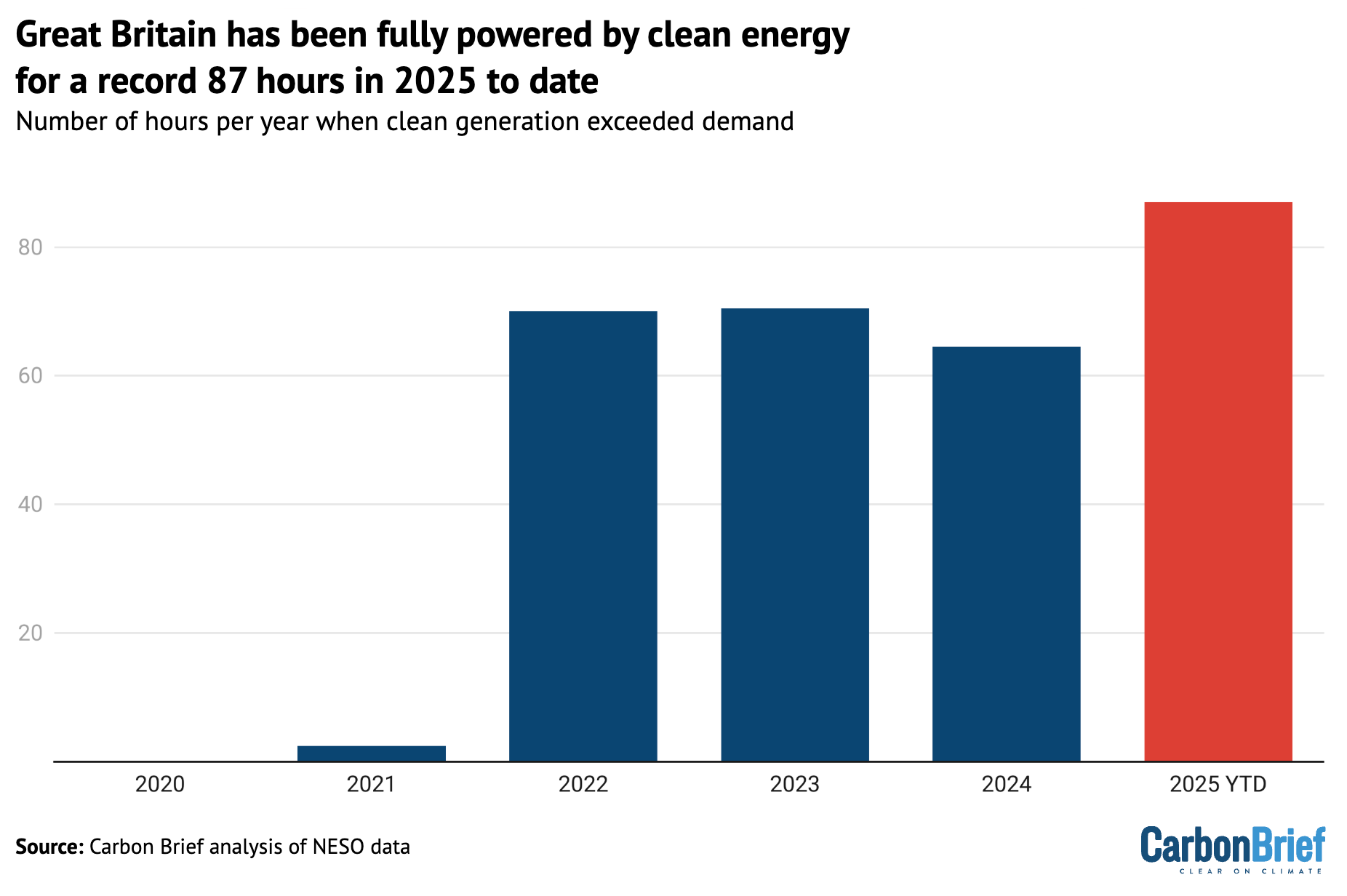
Number of hours per year when clean-electricity generation was sufficient to cover 100% of demand. Source: Carbon Brief analysis of NESO data.
This translates to some 1.3% of hours in 2025 to date, far short of the 2030 target. However, this year’s figure is up 50-fold from 0.03% of hours in 2021 – and double the 0.7% share in 2024.
Cleaner electricity mix
During the periods in 2025 to date where at least 100% of demand was being covered by clean generation, wind power was contributing an average of 72% of demand, followed by 18% from nuclear, 10% from solar, 4% from biomass and 1% from hydro.
This means that, in total, low-carbon sources were generating 105% of national demand during such periods in 2025. Over these periods, gas was also generating enough, on average, to meet 13% of demand. As a result, the country was exporting the equivalent of 19% of demand via its interconnectors with Ireland, France, Belgium, Denmark, Norway and the Netherlands.
The figure below illustrates the most recent period when 100% of demand was being covered by clean generation, which took place early on Friday 12 September 2025.
For a four-hour period that morning – from 2am until 6am – clean-energy sources (dark blue) were generating enough electricity to cover 100% of national demand (red line).
During this period, clean sources generated an average of 23.5 gigawatts (GW), including 19.1GW from wind and 3.3GW from nuclear. This was more than the average demand of 22.7GW. Gas still generated an average of 3.1GW (black), resulting in net exports of 4.3GW (light blue).
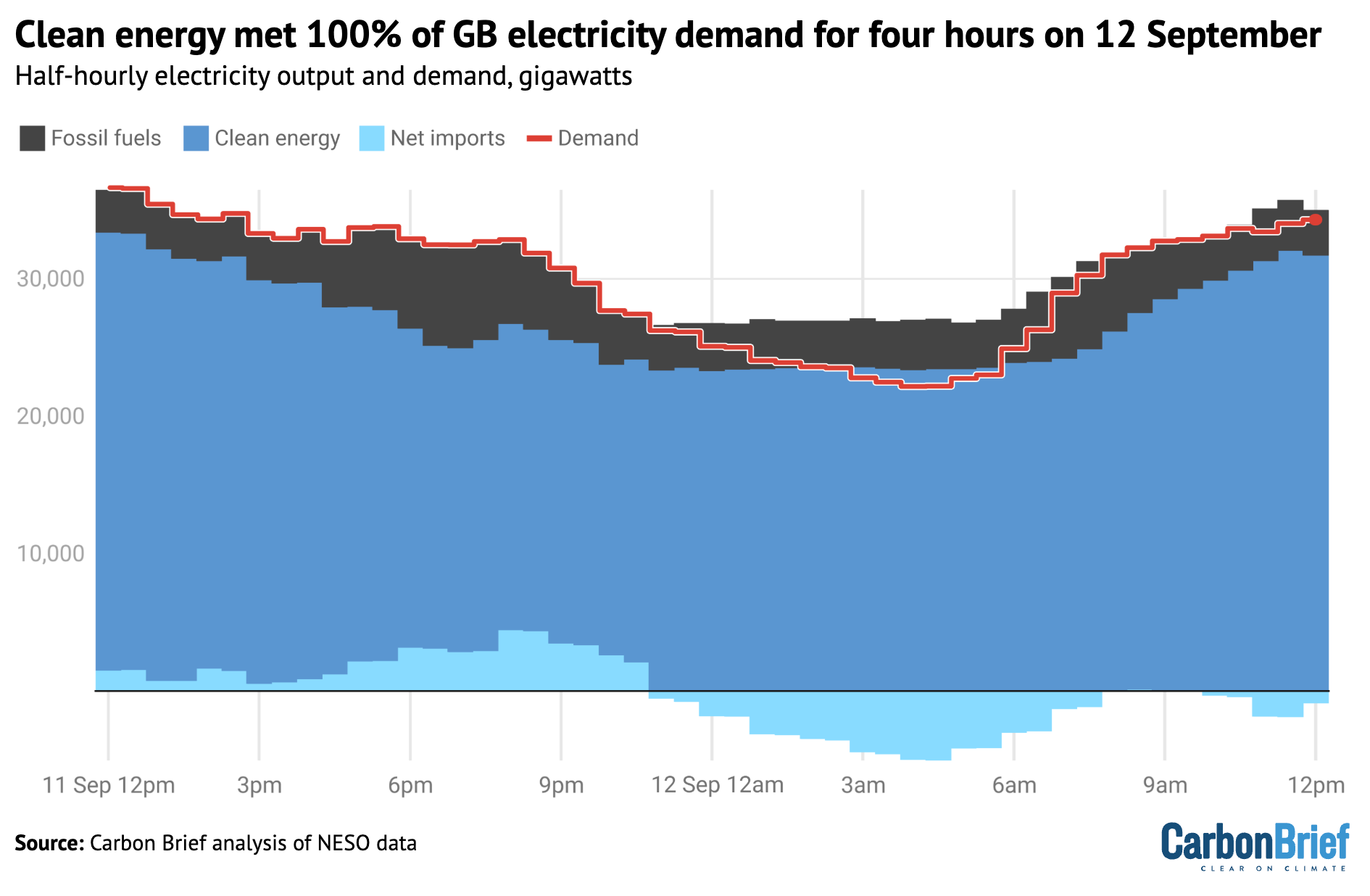
Half-hourly electricity demand (red line) and output by source (coloured areas), GW. Source: Carbon Brief analysis of NESO data.
To date, the record for the longest stretch where 100% of demand was being covered by clean energy stands at 15 hours, from midnight on 25 May 2025 through to 3pm on 26 May.
To meet its clean-power target, the government will need to ensure that this record is extended from just 15 hours in 2025 up to a full year by 2030.
A key test of its ability to do so will come in the seventh auction round for “contracts for difference” (CfDs), which offers fixed-price government-backed deals for new clean-energy developers. The results of this round are due to be announced as early as December 2025.
Until then, NESO will be hoping to meet its target – first set in 2019 – of running the GB grid without any fossil fuels for a short period of time, which it refers to as “zero-carbon operation”.
This target only applies to the transmission grid – effectively, the motorways of the network – meaning it excludes almost all solar power and smaller onshore windfarms.
Craig Dyke, NESO’s director of system operations, previously told Carbon Brief that the first-ever period of at least 30 minutes of “zero-carbon operation” was likely to take place this autumn.
Dyke added that NESO was “confident” it could meet the target, which he said would be “absolutely groundbreaking and pretty much world leading”.





Comments
We changed commenting systems on September 10, 2026 as part of a site-wide functionality and security upgrade. Your past comments have not disappeared, and you can still log in with your old Disqus account credentials if you wish. Contact us with any questions.
So… there are 8760hrs in the year…
87 hrs is 0.99 of 1% … congrats everyone.
taking 5 years to get to one percent … how long will it take to get to 100%?
oh.. and stop calling it renewable energy… it's rebuildable energy. It needs replaced every 20 years.
let's all cheer because we are doing the same thing that got us into the problem and calling it a solution… another win !
congrats to everyone … here's a badge to make you feel good.
Stop with the "clean energy" hype. There is no such thing.
On the one hand we want to congratulate this positive achievement, if it is one, but on the other it seems so improbable that a major industrial economy hell bent on growth and consumerism can be more than a little bit tokenly green.
To give some credit, Britain does seem to have tried to improve its notoriously energy inefficient housing stock, but it still lags behind most of Europe in this respect.
The electrification of its cars in the next 2 decades will make these challenges doubly difficult and presumably its forward nuclear power developments, including Hinkley, is aimed at that challenge…. though at a burgeoning price.
Ehem…….Islands of Great Britain thanks
….with Love from Great Britain
Great Britain didn't "run on" 100% clean power. The UK's electricity grid did. The UK relies on fossil fuels for >70% of their total energy. We're about 4 years away from 2030. Hard to imagine the UK as a whole running on clear power right now.