


Renewable energy will overtake coal to become the world’s top source of electricity “by 2026 at the latest”, according to new forecasts from the International Energy Agency (IEA).
The rise of renewables is being driven by extremely rapid growth in wind and solar output, which topped 4,000 terawatt hours (TWh) in 2024 and will pass 6,000TWh by 2026.
Wind and solar are increasingly under attack from populist politicians on the right, such as US president Donald Trump and Reform in the UK.
Nevertheless, they will together meet more than 90% of the increase in global electricity demand out to 2026, the IEA says, while modest growth for hydro power will add to renewables’ rise.
With nuclear and gas also reaching record highs by 2026, coal-fired generation is set to decline – driven by falls in China and the EU – meaning that power-sector emissions will decline, too.
The chart below illustrates these profound shifts in the global electricity mix – in particular, the meteoric rise of renewables, driven by wind and solar.
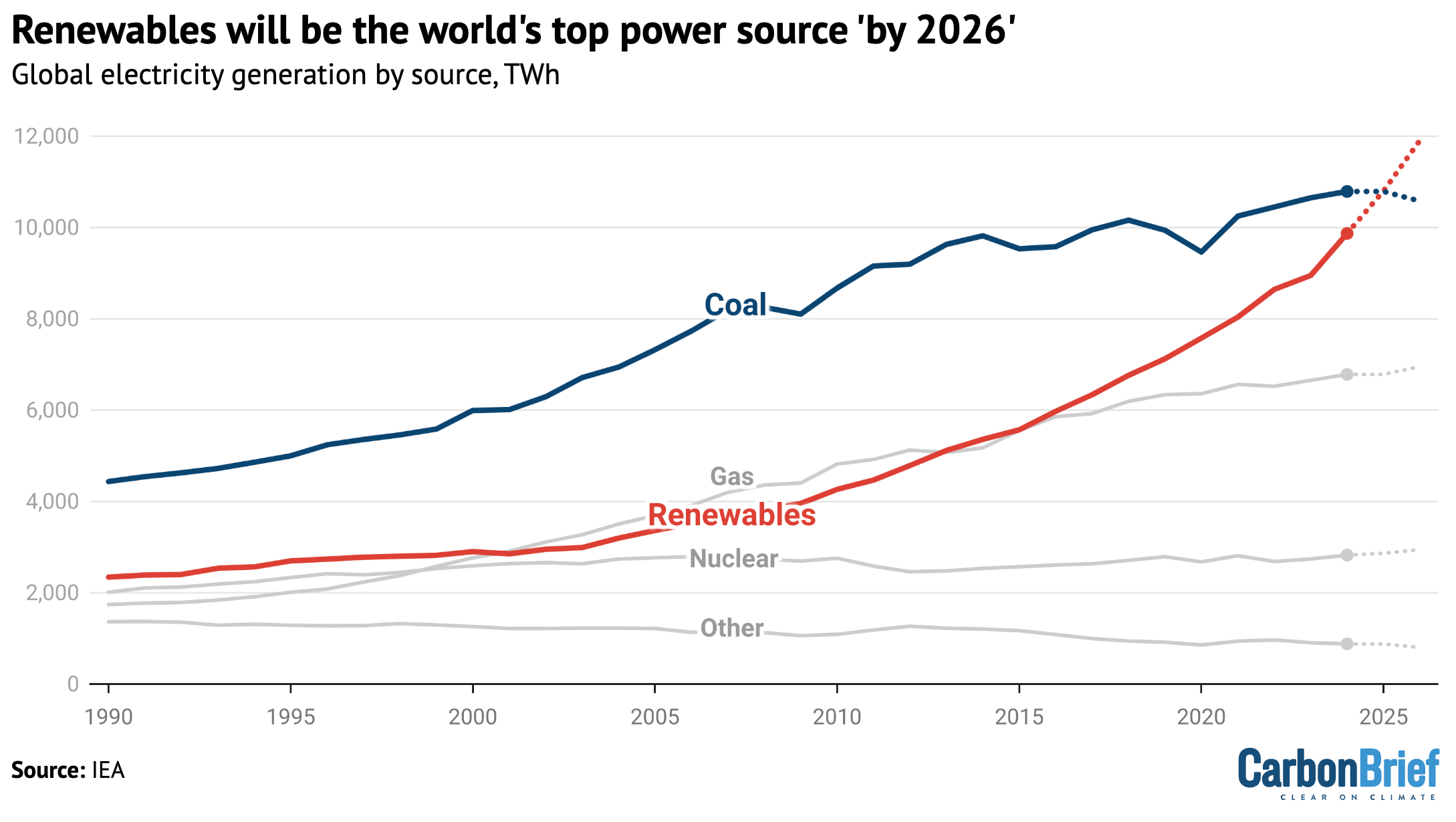
Global electricity generation by source, terawatt hours, 1990-2026. Figures for 2025 and 2026 are projections. Renewables include wind, solar, hydro, bioenergy and geothermal. Source: IEA electricity mid-year update 2025.
The IEA says that renewables could overtake coal as early as this year, depending on weather-related impacts on the output of wind and hydro capacity.
It adds that the switch will happen by 2026 “at the latest”, when renewables are expected to make up 36% of global power supplies, against just 32% from coal – the fuel’s lowest share in a century.
The share of global electricity generation coming from wind and solar combined will rise from 1% in 2005 and 4% in 2015 to 15% in 2024, 17% in 2025 and nearly 20% in 2026.
The global reduction in coal-fired electricity generation will result from declines in China and the EU, which will only be partially offset by increases in the US, India and other Asian nations.
The IEA attributes the coming decline of coal to “continued renewables growth and higher coal-to-gas switching in multiple regions”. It says gas power will rise by 1.3% this year and next.
For nuclear, the IEA says that the new record output will result from plant restarts in Japan, “robust” output in France and the US, as well as new reactors in China, India and South Korea.
The shift to wind and solar is happening despite global electricity demand being forecast to grow much faster over the next two years – at 3.3% and 3.7%, respectively – than the 2.6% average for 2015-2023.
The IEA says new demand is coming from industry, domestic appliances, growing use of air conditioning, ongoing electrification of heat and transport, as well as the expansion of data centres.




Comments
We changed commenting systems on September 10, 2026 as part of a site-wide functionality and security upgrade. Your past comments have not disappeared, and you can still log in with your old Disqus account credentials if you wish. Contact us with any questions.
The heading here will be misleading for those who are not careful students of energy use topics, since probably most people will simply understand "power" as "energy use". But electrical energy is but a very thin sliver of the mostly fossil energy source pie. That pie is fossil fuels, and it makes mining for, smelting for, transport of and emplacement of… "renewables" possible. Renewable energy is just the latest ruse meant to distract and misinform us. Industrial civilization as we know it cannot survive on "renewable energy". Period.
The problem is that our present industrial civilization cannot survive on fossil fuels either. Driven by a relentless growth imperative, the system’s ever increasing material throughput is relentlessly depleting finite resources and destroying the biosphere. And given this relentless growth imperative, as more renewables come on stream, rather than displacing fossil fuels, these investments, as the evidence demonstrates, add to overall aggregrate material throughput.
What is needed is a new post-capitalist economic model, one that doesn’t rely on endless growth and respects both human needs and the ecosphere.
Degrowth theory offers that alternative – an economy grounded in sufficiency, where production focuses on fulfilling real needs and maintains some form of durable equilibrium with the natural world. Such systems would allow for the conservative use of fossil fuels and an increasing reliance of renewables in place of fossil fuels.
Degrowth models require production for use rather than production for profit, thus eliminating the massive production and transport of harmful and unnecessary goods. Fast fashion, planned obsolesence, advertising, military production and all forms of conspicuous consumption, most notably private jets, luxury yachts, SUVs and the like would go by the boards. Societal investments would be redirected from extremely harmful sectors like private automobile transport to socially and ecologically sane sectors like public transit, regenerative agriculture and environmental reclamation.
Reserach has shown that degrowth models could provide a solid foundation for a good life for all within a much smaller ecologically sustainable footprint. While the top earning households who use a disproportionate quantity of energy would see a decline in their consumption, the majority would see an improvement. That would also be supplemented by investments in public wealth such as parks, green spaces, libraries, recreational facilities, and the like.
Rather than relying speculative or unproven technologies like carbon capture and sequestration or solar geoengineering – ‘solutions’ that ramp up energy consumption with no substantial decrease in GHGs – degrowth models actually substantially reduce energy use and material throughput.
These degrowth models are also consistent with forms of democratic control such as worker councils and community governance that put the demos back in democracy.
Yeah. My view is that industrial civilization (as we know it) cannot be sustained, period. It will end — and soon. That does not mean we won't have some industrial production at smaller scales of production and distribution, we will need shovels and hand tools and bicycles and cooking pots. But not cars. Not lawnmowers. Not excess of any kind.
Yes, but nobody is going to vote for 'degrowth models', no matter how often you repeat the phrase. Ain't gonna happen, everyone wants 'more'.
So the System crashes, or we have war(s) over what's left, until an equilibrium is reached. That may well involve a period of undershoot first, as is common after one of overshoot.
Take your choice: capitalist realism – the inability to imagine an alternative to the present capitalist system or the realism based on science that tells us we must turn down the dial on our material consumption or perish. As for the notion that ‘everyone wants more,’ that cyncial spurious ideology serves and furthers the agendas and interests of dominant, elite groups in the society.
"The problem is that our present industrial civilization cannot survive on fossil fuels either."
There is another category of energy which is neither renewables nor fossils.
"What is needed is a new post-capitalist economic model"
Or a large expansion in nuclear energy production.
"Degrowth theory offers that alternative"
All that is missing is societal willingness to accept that offer.
"Rather than relying speculative or unproven technologies like carbon capture and sequestration or solar geoengineering – ‘solutions’ that ramp up energy consumption with no substantial decrease in GHGs – degrowth models actually substantially reduce energy use and material throughput."
You could reduce our energy use to zero and that still would not significantly reduce the greenhouse effect for centuries. CO2 capture from the air has been proved on the small scale. With a large increase in nuclear energy, it could be expanded to the large scale. As for speculative and unproven, that would also be the case for post-capitalism degrowth theory.
"Renewable energy will overtake coal to become the world’s top source of electricity 'by 2026 at the latest'"
The chart here has coal-based electricity at slightly under 11,000 TWh for 2024. But for primary energy–including non-electricity usage–coal supplied 45,850 TWh in 2024. Together, the Big Three of fossil fuels supplied 142,420 TWh of energy, and all three are still on an upwards trajectory, and the amount of annual fossil emissions is still increasing. So the fact that all renewables combined are now passing 10,000 TWh per year is not nothing, but relative to the scale of overall fossil fuel use, it's also not very much.