This week, we’ve excerpted part of a chapter on nature spirituality from Abi Millar’s The Spirituality Gap. In this book, Millar explores many different ways folks are exploring spirituality even as they grow disillusioned from traditional religions. There are chapters on everything from meditation and yoga to shamanism and club raves. But the most exciting chapter (bias warning) is the one on nature spirituality, in which Millar explores connecting with nature, as well as a few efforts to create community around this, including the Gaian Way and GreenSpirit. That part isn’t included in the below excerpt, but I encourage you to read the chapter and the whole book (also available as an audiobook), and join a Gaian community discussion about it with Abi Millar on May 22nd at 1pm ET.
It’s a balmy morning in early June, the first day that truly feels like summer. In honor of the season’s arrival, I book a slot at my local swimming lake and slip into a swimsuit. The water, warm and welcoming, cradles my body as I drift into a gentle lap around the perimeter. Dragonflies hover midair. Ducks bob along nearby. The light shimmers across the surface, and I feel myself loosen—mind, body, breath.
Floating on my back, I’m suddenly time-traveling—back to childhood holidays, afternoons in swimming pools, whole worlds built in my imagination. It’s like time has folded in on itself, delivering me to some unbroken inner self. Maybe that’s what it means to be “in the now.” Here, I’m not zipping past nature or admiring it at a distance. I’m in it. Held by it. Engulfed.
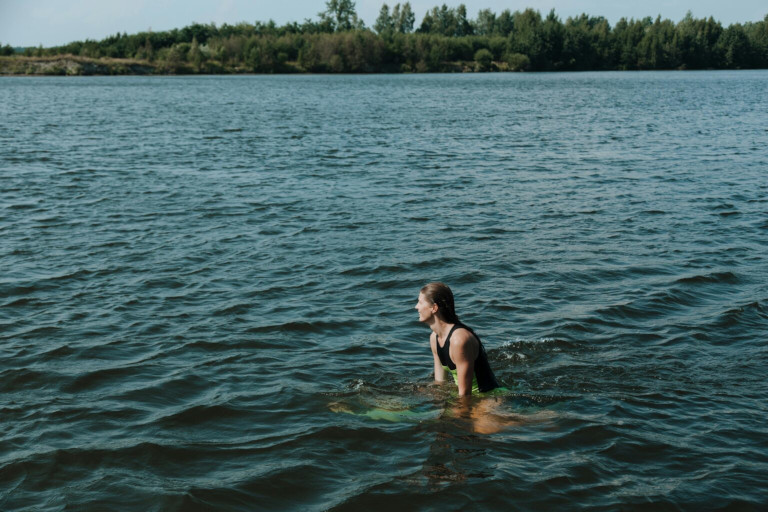
There’s a magic to wild swimming, and clearly I’m not alone in sensing it. In a 2022 poll from the Outdoor Swimming Society, 94% of members said the primary reason they swim outside is joy. Over half also named spiritual reasons—seeking a connection with nature and the deeper self.

Immersed in the joy of swimming in nature. (Image from Pexels via Pixabay)
Lucy Sam, a transpersonal life coach and researcher, once interviewed open-water swimmers at Kenwood Ladies’ Pond in Hampstead Heath to explore why the experience felt so deeply restorative. “They wouldn’t all have labelled it spiritual,” she told me, “but a lot of them said things like, ‘it took me outside of myself.’” There was a sense of awe, of merging, of feeling deeply in the moment. “Swimming maybe helps you sink into that,” she said.
That sense of merging runs deep, beyond individual experience. For much of human history, nature wasn’t separate from us—it was us. Ancient spiritualities around the world often honored natural forces as sacred. But over time, Western thinking created a stark divide. In the 1600s, René Descartes argued that animals were merely mindless machines, that humans were the masters of nature. The world became a mechanism. The forests, the oceans, the creatures—all “resources.”
And yet, counter-narratives have always existed. From the Romantics and Transcendentalists to modern eco-philosophers and scientists, people have pushed back against this disconnection. Gaia theory reimagines Earth not as a passive environment, but as a living, self-regulating being. Deep ecology asserts that nature has value beyond human use. Psychology, too, is shifting. Eco-psychology explores our emotional bond with Earth, while Attention Restoration Theory and biophilia research show nature’s proven capacity to restore our focus and well-being.
All of this affirms something many of us intuitively feel: we are not separate. We inter-are.
The Buddhist teacher Thich Nhat Hanh once described it this way: “There is a cloud floating in this sheet of paper.” Without clouds, there is no rain; without rain, no trees; without trees, no paper. Cloud and paper “inter-are.” So do we. And it’s hard to hold on to the old mechanistic worldview when you’re neck-deep in a lake, sharing space with ducks and algae and reeds and light.
Lucy Sam told me about one of her own moments of connection—after a yoga practice in North Cyprus, looking out over the mountains and sea. “It was like everything stood still,” she said. “There was this merging, like I was connected with the universe. It was brief, but I was like, ‘Wow. We’re part of it. It’s part of us.’”
Wild swimming isn’t the only practice creating such moments. Another is the Japanese practice of shinrin-yoku—forest bathing. More than just walking in the woods, shinrin-yoku invites us to experience the forest through all five senses. “Let nature enter through your ears, eyes, nose, mouth, hands and feet,” says Dr. Qing Li, founder of the Japanese Society of Forest Medicine.

Forest diving: a more advanced subset of forest bathing. (Image from Taryn Elliott via Pexels)
Forest bathing has been shown to lower cortisol and inflammation, regulate blood pressure, improve immunity, and quiet the nervous system. And yet, skeptics might say: of course being in nature makes us feel better. We’re wired for it. Our concrete, overstimulated lives are the anomaly.
But this quantifiable data matters—not only to convince funding bodies or medical systems (in the UK, forest bathing is now part of social prescriptions), but because it affirms something we already know in our bones. Nature heals. Not in a mystical, one-size-fits-all way. But in a way that speaks to our evolutionary blueprint. We are not machines. Neither is the world.
The practice of seeing ourselves in context—ecologically, spiritually, cosmically—is not about rejecting science or reason. It’s about wholeness. It’s about understanding that we live in a system of interbeing. That trees breathe out what we breathe in. That our skin, our gut, our bones are ecosystems in miniature. That awe is not an indulgence—it’s an anchor.
Still, to romanticize nature without acknowledging crisis is a luxury we can no longer afford. The same lake that cradled me during my early June swim looked very different the summer before, during the brutal 2022 heatwave. Water levels were low. The parkland had turned to straw. Fires broke out across the country. It was the UK’s hottest year on record. The government’s response? “Recycle more.”
We can’t pretend anymore. The climate crisis is not distant or abstract—it’s here. And it demands more from us than moments of individual serenity.
And yet—moments of serenity matter. Not as escape, but as sustenance. As the activist and nature guide Alana Hyde Bloom put it, “If we’re not deeply resourced doing this work, we burn out. We mimic the same thing that’s happening to the planet in ourselves.”
Hyde Bloom, who leads forest retreats and Wild Woman camps, has also been on the frontlines of climate activism. But she sees nature connection and ecological justice as two sides of the same coin. Practices like wild swimming and forest bathing nourish us, but without political awareness, they risk becoming escapist. On the other hand, activism without grounding, without connection, becomes brittle and joyless.
“There’s this perspective that we don’t belong here,” she said. “That humans are a scourge on the planet. But actually, this is our home. We have a role in the ecosystem, just like every other plant or animal. My experience is that I always belong here. That belonging isn’t debatable.”
To deny that belonging, to frame humanity as a cancer on the Earth, only reinforces the mindset of separation—the very root of our disconnection. If we can’t see ourselves as part of the web, we’ll keep unraveling it.
Hyde Bloom suggests that even those in power—those enacting destruction—may be cut off from any true relationship with nature. “Could it be a mirror?” she asked. “That the pollution and destruction these people are enacting on the Earth, they are also enacting on themselves?”
That question lingers. Maybe the greatest antidote to the crises we face isn’t only policy change or protest—it’s reweaving our sense of self into the fabric of the natural world.
The door to the woods, as poet Mary Oliver once wrote, is the door to the temple. But what does that mean when the woods are burning? When the temple is crumbling?
Perhaps it means this: that joy and grief are not opposites. That reverence and rage can live in the same breath. That being awake to the beauty of the Earth doesn’t mean denying its peril—but loving it even more fiercely because of it.
And perhaps, if enough of us step through that door, we might begin to heal what’s been broken—not just in our world, but in ourselves.

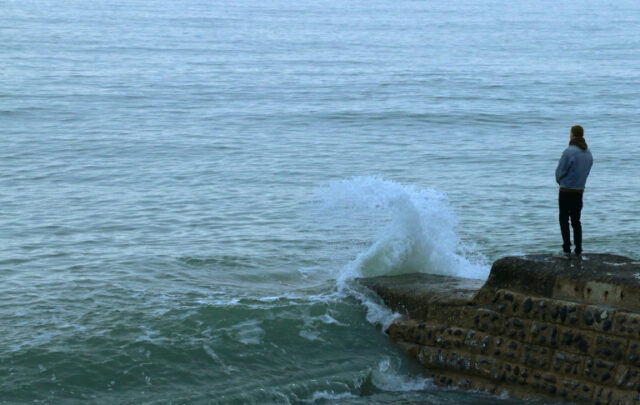
Healing begins with immersing oneself in nature. (Image from Mateusz Dach via Pexels)