

Few in recent years have made a more significant contribution to our ecological salvation than Richard, and in my dogmatic opinion his most recent essay is stating many of the lessons we need to learn fast if we are going to get through to a satisfactory world. But there are themes on which I believe we need to go further than Richard does, and to be more emphatic than he is regarding directions that need to be taken.
There can be no debate with Richard’s outline of our dire predicament, nor of his claim that most people fail to grasp how serious it is. And I have no doubt that his general vision of the way out of the situation is correct. My concern is that we can be much more emphatic about it than Richard is, and we need to be shouting it from the rooftops.
But first a comment or two on Richard’s discussion of the situation. He rightly argues against tech-fix optimism, but I think his case could have been much stronger. The three most impressive studies I know of by Parrique, Hickel and Kallis, and Haberle review hundreds on papers and find that, in general, no absolute “decoupling” of resource and energy use from GDP growth is occurring, and is not remotely likely to be achieved. If you increase GDP, you will be using more resources to do it. Yet we are so far beyond sustainable levels of resource use and ecological impact that resource use must be reduced to a small fraction of current levels. There is no possibility that better technology and more recycling can cut them to sustainable levels while production, consumption, lifestyles and GDP continue to increase. Many, including too many green people, adhere to the myth that solutions can be found on the supply side, that is, in solutions that enable continued rich-world affluent living, while the resource and environmental impacts can be cut sufficiently. The action has to be on the demand side; that is, on transitioning to lifestyles and systems that enable dramatic reduction in resource use. The solution has to be a Simpler Way, involving far resource-simpler lifestyles and systems.
Richard focuses on the population factor in the I=PAT equation. I don’t think this is a wise priority. Of course there are too many people trying to live too affluently, but you and I can’t do much to reduce population, and it seems to be tapering. It will probably only increase by 20%, whereas world GDP increases 3% every year, and the mainstream’s determination is to keep it growing forever. Getting rid of that suicidal system is the main priority.
Richard doesn’t deal head on with this supremely important factor generating our now probably fatal predicament, which is: the economy, stupid. We are trapped in a system that is by nature a growth system. We are producing and consuming far too much, but our economy must have constant growth without end. There can be no conceivable solution to the polycrisis without dramatic degrowth down to levels of production, consumption and GDP that are a small fraction of present levels. This means we must face up to, among many other historically astronomically big changes, scrapping capitalism. It also means eliminating interest on loans, and it means abandoning affluence (the title of my widely ignored 1985 book). Richard seems to have taken the advice he once gave me when he told me that in America to criticize capitalism is like spitting on the flag.
Richard’s account seems to cast us as the culprits. “We” are indeed culpable, but ordinary individual people are not the main causes of the polycrisis. The main causes are our systems. They are far too resource-squandering, and they are geared for growth. For instance, our food system is appallingly energy intensive, transport dependent, nutrient wasteful and soil damaging. Local agricultural systems can totally avoid these evils (see below). Again, obviously by far the most seriously mistaken system we have is the economic system. Richard does not emphasize sufficiently that none of the big problems can be solved unless we face up to dramatic degrowth, probably down to per capita resource consumption rates around 20% of those in rich countries today.
There is only one social form that can enable this. It must be about most people living in small, cooperative, highly self-sufficient and self-governing communities, in control of their local economies, which are driven by needs and not by profit or market forces. (For details, see The Alternative and the Pigface Point video.)
Our study of egg supply shows why. The supermarket supply path has vast global input chains involving factories, trucks, feed mills, chemicals, “waste” dumping, marketing costs, freezers, computers, insurance and expensive technologies. We found that the energy and dollar costs of backyard and village co-op egg supply were around 1% of those for the supermarket egg. In addition, all “wastes” can go to nearby gardens and methane producers, eliminating the need for chicken feed mills and sewer systems. It would be the same for many other items that can be supplied via local economies.
Taking collective control of the fate of our communities would enable us to solve most, if not all, of the social problems we have now. We could eliminate unemployment, poverty, stress, loneliness and depression, by making sure everyone has a valued livelihood, while cutting the work-for-money week to about two days.
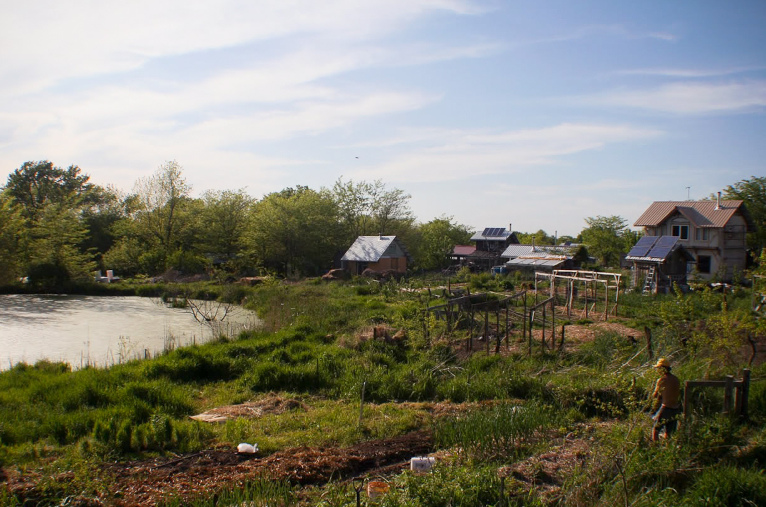
Many ventures now illustrate the wisdom of this path, especially the Catalan Integrative Cooperative and various ecovillages, such as Dancing Rabbit, where various measures such as energy use are around 10% of US averages. My studies of an alternative homestead, how a Sydney suburb could be remade, and the Pigface Point video document show how such savings can be made.
This vision does not jeopardize sensible socially valuable technologies, universities, modern medicine, etc. The evidence is that simpler ways can increase the experienced quality of life.
Richard’s thoughts on what’s needed are sound, but we need to elaborate well beyond the two main themes he very briefly mentions, i.e., localized food production and “social relations”. As I see it the key to our salvation is to be found in the Transition Town arena. That is, we need to build systems in our suburbs and towns which enable us to meet as many of our need as possible though cooperative arrangements, commons, worker bee committees and town assemblies. There can be an important place for small private firms and farms nearby, but we have to take social control over “development” and not allow it to be determined by profit or market forces. This is an anarchist vision, not a centralized socialist way.
Obviously none of this is going to happen unless there is, as Richard realizes, profound change in ideas and values, away from the quest for wealth and property towards concern for the common good, community, and deriving life satisfaction from non-material pursuits. The social form sketched above could not work well without such dispositions, but it would reward and reinforce them. We would all see that our quality of life depended primarily on how well our town was working, rather than on our personal wealth, and it would be satisfying to join worker bees, help make the town’s decisions, and make sure all were provided for well. Many eco-villages are providing inspiring instances of these positive dynamics. The goal has to be moving existing towns in this direction.
It is very likely that there is going to be a huge global collapse before long. If we are lucky, it will be slow-onset, giving time for people to realize that the old growth and affluence path is no longer going to provide for them, and that they must seek to build cooperative, self-sufficient and frugal local systems.
It seems to me that the general perspective I’ve sketched above is very difficult to disagree with, and that we need to argue and state it and the reasoning behind it strongly whenever we can. Richard gives the impression that it is only one option among many that are worth considering. My concern has been to persuade him to advocate it more strongly in the future as the only way out.





Comments
We changed commenting systems on September 10, 2026 as part of a site-wide functionality and security upgrade. Your past comments have not disappeared, and you can still log in with your old Disqus account credentials if you wish. Contact us with any questions.
The brick wall into which Trainer's scheme must crash is the fact that in rich countries, the places where most of the destruction comes from, almost everyone lives in urban places. Since it is not only politically, but also physically impossible to deconstruct cities and move everyone to ecovillages in the country, collapse can't possibly be avoided. We can only hope that collapse comes very soon, before much more damage is done to the environment that the survivors of collapse will live in.
Both authors/observers are correct in their assessments. As Buddha said, "There are many paths but only one way." I am not an academician although I dreamed of it at one time. So I chose what moved me, field ecology, forestry, environmental biology and energy management. I have, for many years, screamed radically sensible responses to the malaise Earth now suffers from, and in small ways have created positive responses. My carbon/ecological footprint is one Earth, with the transportation section not being met because I live/work in the country, but need a small city for materials, tools/equip./and life support products and services. I know, via experience and investigations, that the old-fashioned behavior of conservation of energy/resources, if practiced logically and efficiently by 80 percent of humans, would result in roughly 30-60 percent reduction of life-threatening outcomes.
But here is the rub – as has been shown repeatedly by hundreds of organizations studying thousands of negative behaviors, the top 20 percent (primarily the top ten) of humanity controls/prompts/stimulates/demands/forces 40-70 percent of the destruction via their own private actions. These numbers are, of course, flexible due to the plethora of data out there, but the conclusions are ironclad – the overlords are ogres, and they love living their death wish.
The info is out there, in print and testimony, but a very few humans actually see it, let alone grok it. And the obstacles, via not only cities and their constructed inhibitors, but also rural areas are now trashed repeatedly by the overlords and not available for community-scale rescue/recovery/re-design/reverence. Yes, the hue and cry must become thunderous and incessant – it is an unfortunate fact of human psychology that crises generate heroic, if not chaotic responses – but the examples that educate and stimulate societies cannot be brought forward as long as capital (land, energy, technology, food and communications) are in the hands of a relative few hoarders.
Capitalism is NOT a zero-sum game – it produces only losers and LOSS, seemingly irretrievable LOSS. Mitigation, one-to-one, has NEVER been in the capitalist hoarder equation. All of us know it is bankrupt and nihilistic, a psychotic response to fear-based brain chemistry that engenders outrageous addictions. It can only be destroyed by replacements that are completely contrary to its thesis. Both anarchy and social singularity are needed,
There is always a probability above zero that this can occur, but I do not see favorable odds WITHOUT a torturous and devastating failure of Homo sapiens civilization, which includes the physical and biotic non-human elements of reality taking a huge hit as well. So there is a gamble here, regardless of heroic efforts, that revolution/regeneration will not keep up with extinction.
Repeatedly I hear humans postulate that 'the Earth will survive' our death wish. I find this logic ghastly, nihilistic and profoundly selfish and cavalier. Right here and now we have the eroding but elegant results of 60 million years of evolution. But we humans believe that because we have discerned this, we can re-value its worth via our own destruction.
My only true answer to these questions is that we immediately do a deep dive into our psyches and practice responsibility, respect and reverence toward this planet and all of its non-human behaviors. We did not just 'show up' one day long ago via the dabblings of some invisible, non-existent space alien, ready to obey orders and treat our new home reverently. We even created out of thin air some alien who taught us this, which is why we never took it seriously. We have always known we are liars. Time is long passed to now tell the truth to ourselves about ourselves.