

“Gut punched” fairly summarizes what Trump’s return to the White House means for US and global climate action. Sam Ricketts, a former aide to Governor Jay Inslee (WA-D) and co-founder of Evergreen Action, is credited for the blunt assessment.
It’s hard to argue with Ricketts’ conclusion given what the former, now future, president has had to say about climate change in general and his use of the Green New Deal as a meme for what ails America in particular. There’s no denying that Trump made a punching bag out of climate change and the Democrats in his re-election campaign.
The Moneyball question for the climate community is: “How to punch back–effectively?” Coming up with a serviceable answer is not going to be easy. Among other things, it is going to require critical introspection. Paraphrasing Shakespeare, much of the fault lies not in our stars but in ourselves.
Until the messaging and approach of clean energy and environmental communities change, US climate policy will remain a largely UNACTED UPON voter priority.
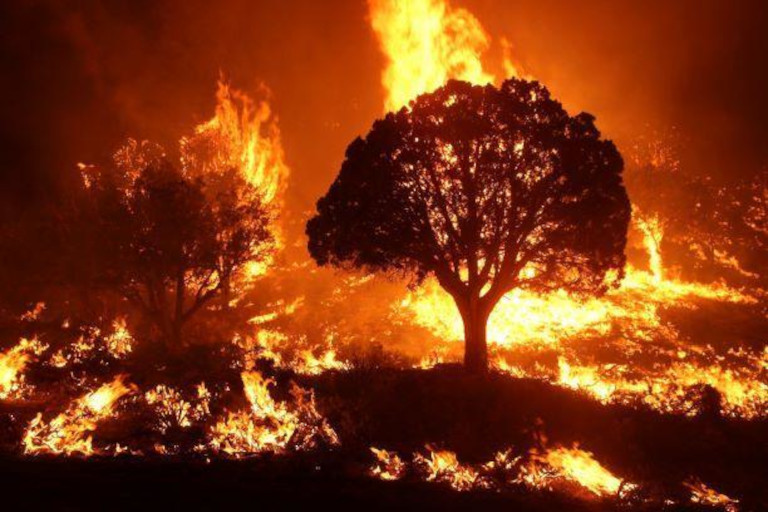
The last weeks of the campaigns took place against a backdrop of billion-dollar weather-related disasters. Hurricanes Helene and Milton caused unprecedented destruction. Their biblical-scale rains caused oceans and rivers to rise and mountains to fall. Forests from California to New Jersey burned, and East Coast states from Maine to Virginia were experiencing some of the worst droughts in recent decades. Things were hardly better between the coasts as farmers continued to battle the extremes of drought and flood. Each year’s heat continues to break records—with no letup in sight.
Making matters worse, insurance companies announced they were getting out of the business of covering policyholders’ losses caused by weather-related disasters—not that the companies covered anything close to the actual amounts. It’s estimated that the damage caused by Helene and Milton totaled between $100 and $200 billion and that 95 percent of the victims of Helene and Milton didn’t have insurance. What does it say when insurance companies back away from coverage because they estimate the risks are too high?
Despite all of the obvious and easily connected dots, 2024 voters failed to cast their lots in support of the environment.
This year’s elections are only the latest evidence of the disconnect between environmental commitment and voter action. It’s not as if the president-elect wasn’t clear about prioritizing the extraction of fossil fuels from under every square inch of the American soil to become the world’s biggest oil and gas dealer (which the US already is). Neither was the former, now future, president subtle about his intention to roll back every Biden climate-related order moments after being sworn in on January 20, 2025.
So, what happened on November 5th? According to a study by the Center for Climate Change Communication at George Mason University (GMU) and the Yale Program for Climate Change Communication, 64 percent of registered women voters prefer candidates who support action on global warming compared to 58 percent of men.
The survey also found that 40 percent of registered female voters considered a candidate’s position on global warming “‘very important’’ in their choice for president. The GMU/Yale report is consistent with the findings of other studies.
Gallup’s research has identified “young women between the ages of 18 and 30 in the United States as the demographic cohort most concerned about climate change. Its surveys show this group more likely than others to express worry and advocate for action on the issue. Moreover, the Guardian quotes Gallup and reports that:
Young women have veered to the left, becoming, by some measures, the most progressive cohort ever measured in US history.
Therefore, you could be forgiven for thinking that young women voted in droves for Vice President Harris—based on her environmental position alone. However, the reality was quite different.
The problem for Harris and the Democrats—as well as for the clean energy and environmental communities—is that young women didn’t vote, according to the surveys, “and many appeared not to vote at all.”
In a year when overall voter turnout was down, Trump raised his game with young women by seven percent over his 2020 totals. Trump also increased his support with young men aged 18 to 29, who generally care less about the environment.
The number one issue of the 2024 election cycle was—what it usually is—the economy, stupid. Gen Z, like voters of every generation, voted their pocketbooks.
None of this information is meant to cast blame on young voters in general or Gen Z females in particular. Rather, it suggests that University of Colorado Professor Roger Pielke Jr. might be right.
There is no such thing as a “climate voter.”-Roger Pielke, Jr.
The implications of the professor’s conclusion are profound when it comes to electoral politics. For decades, the clean energy and environmental communities have been trying to fashion a “climate voter.” However, these efforts have failed to create a political force, even as they’ve educated voters about the causes and consequences of Earth’s heating.
The answer to this conundrum is not to work harder to create a sub-class of moderate to liberal climate voters and elected representatives or to improve survey scores . It’s not that these are bad; it’s that they’re limiting and unreliable.
With control of both Congress and the White House, the Trump regime’s attacks on Biden’s climate legacy will be difficult to stop politically. A Republican Congress, at least initially, will not resist Trump’s orders. The best chances for that will be in the courts.
The clean energy and environmental communities would do well to use the period to look inward at its messaging, its messengers, and methods of communication. Unsurprisingly, the task ahead parallels that which the Democrats will be addressing in the aftermath of their devastating November losses.
The challenge is making climate a core element of voter economic concerns- making it a populist as well as a progressive theme.
Community leaders need to take a step back and honestly consider the changes needed to regain needed policy momentum and create a stable and measured national transition strategy to a low-carbon economy. The answer is not doubling down on what hasn’t been working.
Rising to the challenge will not be easy. But it is possible. More to the point, it’s critical.




Comments
We changed commenting systems on September 10, 2026 as part of a site-wide functionality and security upgrade. Your past comments have not disappeared, and you can still log in with your old Disqus account credentials if you wish. Contact us with any questions.
I don't know why younger people in the US are not voting, and what it would take to change that. It is not just in the US where this pattern occurs.
That aside, the need to make "climate a core element of voter economic concerns – making it a populist as well as a progressive theme." as Joel says above seems to me to be well overdue everywhere. At a global scale, and at a very local scale, as in the examples given below.
Then there is the rising cost of insurance – if you can get it – and food, and… Climate change IS a bread and butter issue, and the sooner it is framed as one, the better.
The costs of climate change
(a) Global destruction caused by increasing extreme weather events in past decade – $2 trillion
(Extreme weather cost $2tn globally over past decade, report finds
US suffered greatest economic losses, report commissioned by International Chamber of Commerce finds, followed by China and India
https://www.theguardian.com/business/2024/nov/11/extreme-weather-cost-2tn-globally-over-past-decade-report-finds?CMP=share_btn_url)
(b) Re-doing the harbour-side roads in Port Levy, Banks Peninsula, Aotearoa New Zealand in the next 10-30 years – NZ $35,000,000.
So we–meaning people who do care about climate, or perhaps liberals–need to "look within" to see where our messaging is off, which this piece explains as…well there is no explanation, just a hint that those who care about climate are at fault in the fact that most voters don't, or prioritize other things. All I can glean about HOW we need to change is that we need to make our climate concerns all about their pocketbooks. Which means, really, being dishonest. Sure, you can point to disasters that are costly–but any way to seriously REDUCE EMISSIONS, which is the only thing that will actually mitigate climate change, requires cutting back,–on the excavation, drilling and refining of fossil fuels, on mining, on shipping cheap plastic junk from China, on trucking cheap plastic food from Iowa and California–so prices will rise. The only way to make this acceptable to the public at large is to do one or both of two things–emphasize plans to make sure those who cut back the most are the rich–or show how life could be a lot better even with lower income. Obviously neither of these are acceptable to the ruling elite, who have total power because they own the Congress, White House, both political parties, the "mainstream" (corporate) media, and the gatekeeper monopolies that can shut off access to alternative media –Google, Facebook, Twitter, Paypal. Apple.
But of course, everything is the fault of the people who care, and didn't win because we didn't get the slightly lesser evil elected.
No. This is a Systems problem, and Donella Meadows was correct: the dominant System will subsume all others. That is what is happening now, and changing voters won't stop it. Nor can any one nation/country.
Thus it will go until it hits some limit, or limits.
At which point all prior bets – money and investment and pension expectations included – are off. At that point, those who have a coherent plan, need to be ready to lead. But trying to change economic growth from within? Impossible – as we're seeing.