

You were born in Crazy Town. You’ve lived your whole life among denizens of delusion, stuck in a culture that believes unlimited growth on a finite planet is perfectly reasonable. You’ve watched as they clear cut the forests, removed whole mountaintops, smothered the earth in asphalt, and most unforgivingly: ran their gas powered leaf blowers from dawn till dusk.
And despite your concern, you have participated in all this, reluctantly perhaps, but in Crazy Town all must participate to survive. You’ve voiced your growing skepticism that things are not quite right, and headed towards obvious disaster. You’ve been called a romantic-idealist, a primitivist-hippy. “Get back to work,” they’ve said. “Crazy Town needs you and you need Crazy Town, so quit your whining.” But you are not alone.
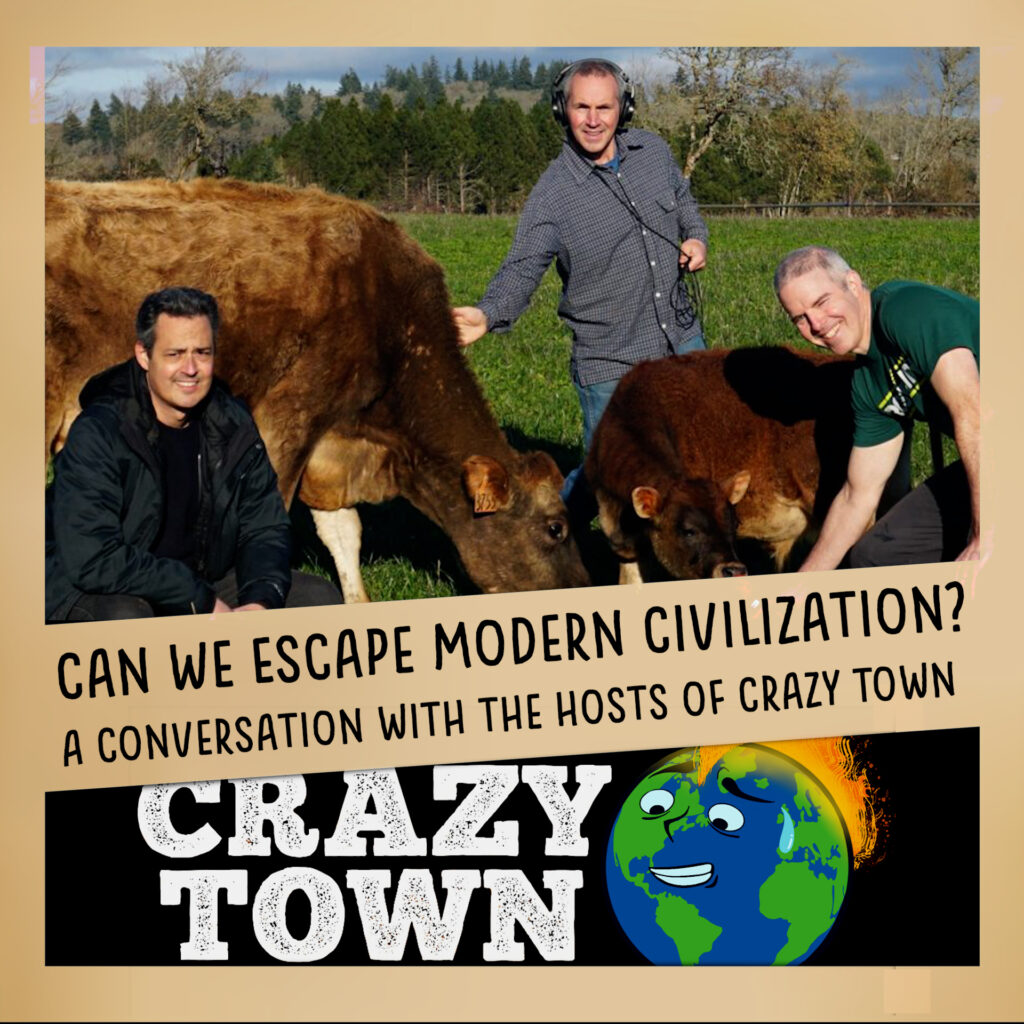
In a farmhouse attic turned podcast studio in Corvallis, Oregon, I joined Crazy Town podcast hosts Jason Bradford, Rob Dietz, and Asher Miller to discuss whether it’s possible to escape our modern civilization and its various components (industrialism, imperialism, capitalism) or whether we’re completely trapped.
I first got in touch with Jason, Rob, and Asher last year during the first season of my Human Nature Odyssey podcast. One way or another, crossing paths was probably inevitable. And in addition to sharing complementary perspectives and assessments of our global crises, they are easy to get along with. Chatting with them feels like sharing jokes in the back of class.
As they give us a full tour of Crazy Town, we discuss what it might look like to escape it and its various components (industrialism, imperialism, capitalism) or if escape is even possible.
We touch on the concept of “red-pilling” and the many factions of fringe that now proliferate in our society. We also discuss the 1993 Bill Murray classic film Groundhog Day. I’m not sure which is more important.
You can listen to our conversation in the latest episode of Human Nature Odyssey titled “Can We Escape Modern Civilization?”





Comments
We changed commenting systems on September 10, 2026 as part of a site-wide functionality and security upgrade. Your past comments have not disappeared, and you can still log in with your old Disqus account credentials if you wish. Contact us with any questions.
This was a really good Crazytown–very thoughtful and honest.