


This is the eleventh of 18 installments in the Metastatic Modernity video series (see launch announcement), putting the meta-crisis in perspective as a cancerous disease afflicting humanity and the greater community of life on Earth. This episode looks at various reasons why renewable energy and recycling are not our way out of the predicament modernity has set out for us. It’s just a doubling-down that can’t really work anyway.
As is the custom for the series, I provide a stand-alone companion piece in written form (not a transcript) so that the key ideas may be absorbed by a different channel. The write-up that follows is arranged according to “chapters” in the video, navigable via links in the YouTube description field.
Introduction
This is the usual short naming of the series, of myself as a recovering astrophysicist, and the topic of this episode (why renewables aren’t the answer) as part of our effort to put modernity into context. I see this topic as a bit of a tangent to the main thread, but one that I think needs to be addressed.
A Past Enthusiast
I have a much more intimate relationship with solar energy than your average bear—or even the average “energy transition” advocate. Besides knowing the semiconductor physics inside out, as a hands-on guy I have experimented with various off-grid configurations of panels, built my own curve-tracer to explore partial shade effects, tried different battery chemistries, learned the ins and outs of four different charge controllers, tried different inverter types, performed extensive monitoring and analysis, etc. Plus, living an off-grid lifestyle connected me more viscerally to weather trends, and my energy haul (and expenditure) becomes more personal. I wrote a Physics Today article in 2008 on getting started, and various Do the Math posts (e.g., here, and here) relating to my experiments. Figure 13.15 in my textbook came from my system.
You could say that I have been an enthusiast, and have acquired a fair bit of knowledge and lived experience in the matter. My default starting position was that solar power was bound to be a huge part of our answer to things like climate change and peak oil. Well, it turns out that narrow solutions work perfectly for narrowly-defined or recognized problems. I will try to broaden the perspective in this piece, which has some overlap with A Climate Love Story and Inexhaustible Flows.
Cost of Climate Change Dominance
A primary focus on climate change means the solution becomes artificially straightforward: eliminate CO2 emissions. Solar, wind, EVs, and done! We are attracted to simple stories and tidy solutions like ants to sugar.
But elimination of climate change and CO2 makes only a small dent in the list of causes for the ecological nosedive presented in Episode 7, so that the sixth mass extinction steams right ahead even in a stabilized climate. Of course, we’re dealing with all the elements on the list all at once, and climate change just makes everything worse.
Don’t get me wrong: I’m not a climate change denier. Some people only have one box for anyone who does not put climate change at the top of the list. If that’s you, please find more boxes. To me, the larger and more pervasive denial is that climate change is the main problem to be cracked—and via technology, of course.
But even on technical grounds, renewable energy fails to get us out of our mess. I won’t even address here the fact that electricity from renewables can’t obviously satisfy our manufacturing and transportation needs, because that’s not even the appropriate goal, for me.
Materials Demand
A very important and real concern is that all renewable energy technologies require a lot of non-renewable materials. This is because they tend to be diffuse, low density sources energy, necessitating large amounts of “stuff” to capture and convert. Below is a figure that represents data from the Department of Energy’s Quadrennial Technology Review (Table 10.4).
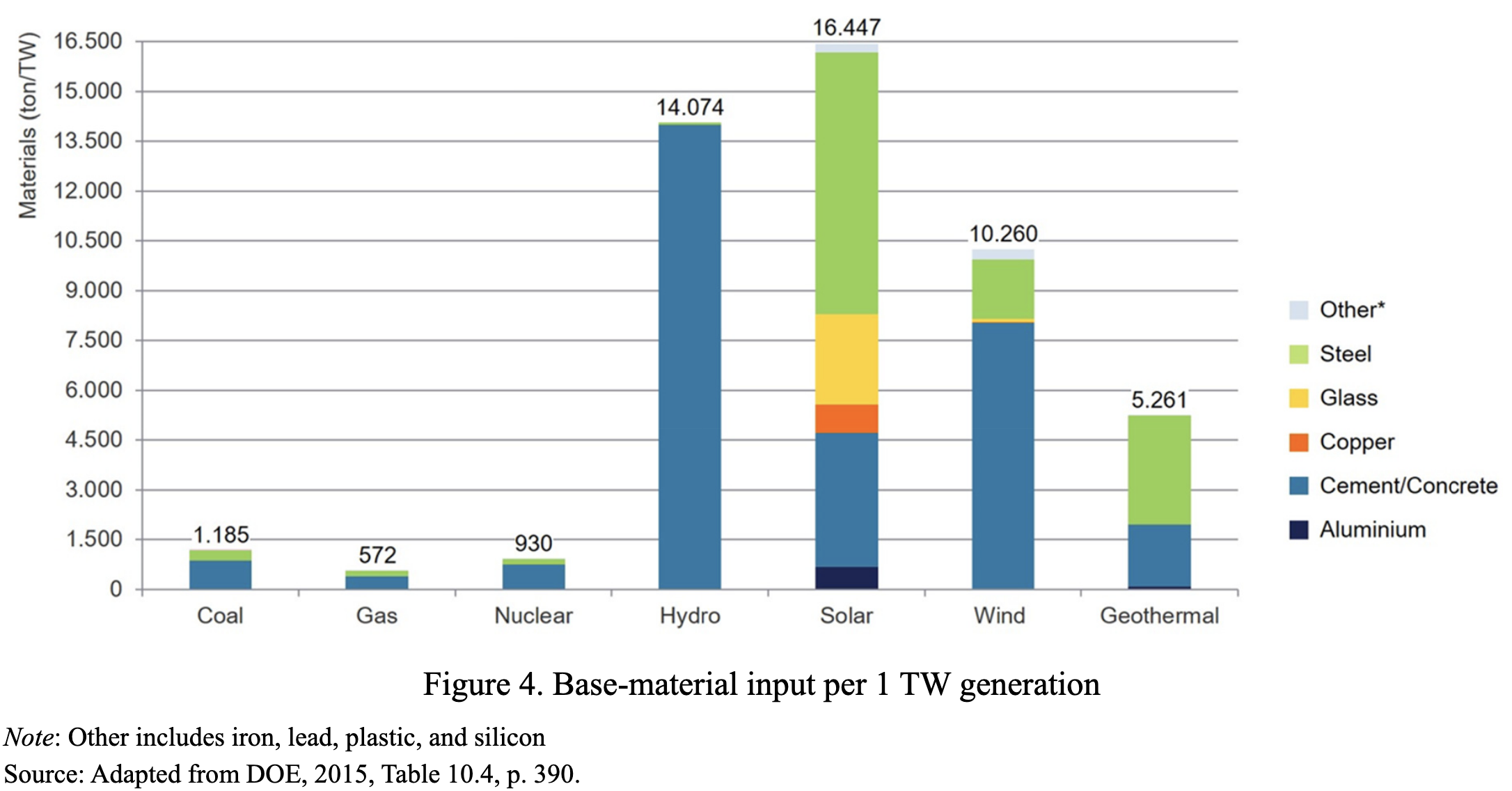
From Schernikau et al. 2022.
In terms of concrete, steel, copper, glass, and aluminum (not counting the fossil fuel mass itself), renewable energy requires an order-of-magnitude more material per unit of electrical energy delivered than does fossil fuel combustion. This translates to never-ending mining, manufacturing, pollution, and all the associated ecological costs. It’s not a build-it-once-and-done game.
Renewable energy is therefore not actually renewable, since it depends crucially on non-renewable materials. If becomes essentially irrelevant that sun and wind keep coming “inexhaustibly” when the weakest link is non-renewable, and therefore dictates the story. An analogy would be saying that fossil fuel combustion requires oxygen, whose supply is effectively unlimited, so fossil fuel combustion is unlimited? Not at all! One has to look at the limiting factor, not single out the one part of the system that is not a limitation (like sunlight or wind). It’s evident, right?
A solar panel made of something that regrows itself (like plant matter) using elements in ecological circulation would satisfy me in terms of renewability. I’ve just managed to describe a leaf, minus the electricity.
The Genius of Life
This is part of what is so remarkable about life. It has figured out how to do all the amazing things it does based on a small set of elements found in common circulation on the surface of the earth. No mining is required. Recycling is essentially perfect, utilizing a vast web of life to carry out the entire process—from microbes to fungi to worms to insects to birds, etc.
In an earlier post called Inexhaustible Flows, I quantify the elements involved in life, which for this abbreviated treatment can be represented via this figure.
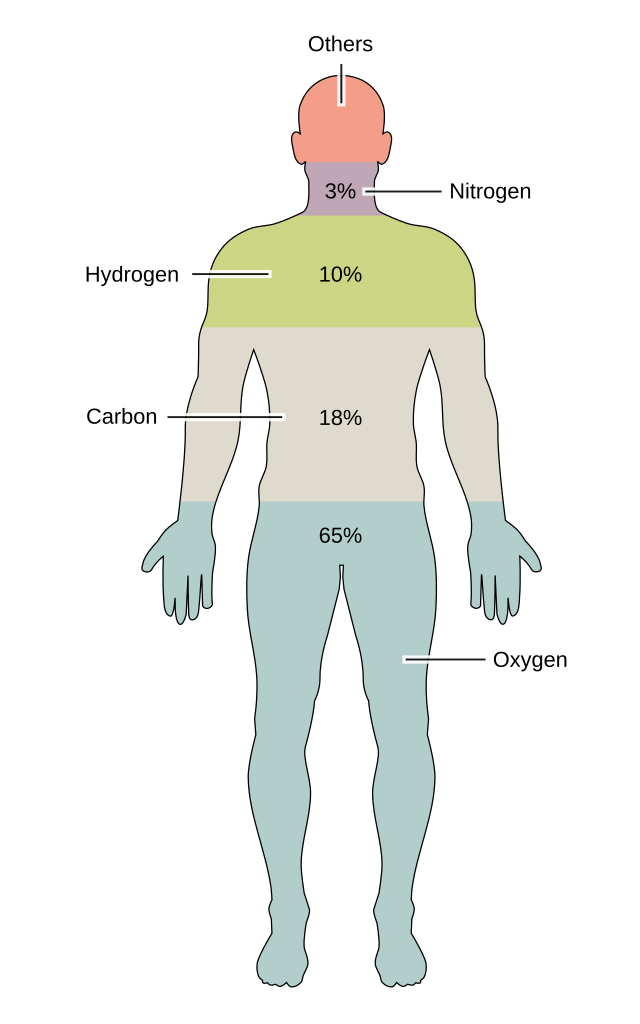
From bottom, oxygen, carbon, hydrogen, and nitrogen make up 96% of human mass. From Wikimedia Commons.
The four labeled elements that comprise 96% of our mass derive from air and water! The carbon comes from plant matter that grabbed it from airborne CO2. Nitrogen is “fixed” out of the air by plants and bacteria before ending up in our bodies. This is a truly incredible trick, huh? Imagine making our clunky cars, computers, submarines, cities, or solar panels out of mostly air and water. Yet life manages it.
The other elements amounting to any significance are calcium, phosphorus, potassium, sulfur, sodium, chlorine, and magnesium: all in broad circulation. As I mentioned, the recycling program is essentially 100% efficient, and goes for millions upon millions of years.
Life does not have much truck with elements that require mining like copper, aluminum, silicon, gold, nickel, cobalt, neodymium, lithium, silver, lead, titanium, and so forth. Our sad inventions use the wrong stuff, don’t last long, leave a waste stream that is not useful (and in fact often harmful) to life, and will not persist on ecological timescales. Where is the true genius, I ask you?
Recycling Limitations
One common reaction to the figure above showing the heavy material demand of renewable energy is: yeah, sure, but you only have to do it once and then it’s recycling from there on out.
First, don’t dismiss the massive initial build-out. You can’t recycle what’s not already in place, and we’re talking about an enormous material outlay to provision modernity with its desired power from renewable resources. In fact, the current “breakneck” pace of solar energy installation is still an order-of-magnitude smaller than it would take even to hold steady at today’s energy appetite based on routine attrition of hardware after a few decades. The effort would require new mines, new deforestation, new waste, new manufacturing and associated pollution, and new habitat loss (and threat of extinctions) from situating these massive infrastructures.
Second, saying the word “recycling” is not a “get out of jail free” card: nice try. In the real world, retrieval is not perfect. Some stuff gets destroyed/scattered, trashed, stored, or otherwise is unavailable for collection. Then not all the collected material will be recoverable. Even an unprecedented, fantasy-level 90% end-to-end recovery results in less than half the original resource after just 7 cycles, and less than 10% after 22 cycles. It’s not indefinite. It prolongs, but does not solve the issue, on strictly technical grounds (leaving aside ongoing ecological erosion for now).
Turbines and panels last a few decades before requiring replacement, which means that recycling peters out on the timescale of a few centuries at best. Compared to the time our species has been on the planet, or even the time since our agricultural departure from ecological living set us on this path, a few centuries is hardly anything. Because it depends on “exotic” (mined) materials, modernity will starve itself in relatively short order even if everything else went swimmingly—which it isn’t.
What Do We DO with Energy?
This is the real question at the heart of the matter. We use energy to cut down forests, clear land for agriculture, mass-murder plants and animals with herbicides and pesticides (I’m not being melodramatic: “-cide” means murder, as in homicide, suicide, and genocide), build cities, highways, dams, cars, gadgets. We use energy to mine materials, spew the tailings, manufacture goods, and release all manner of chemical contamination that the community of life has no provision to process. What we do with energy is produce all those “Likes” from the previous episode, manifestly tangling us into a raft of Dislikes.
The plants and animals know what we do with energy. We dominate the planet and drive ecological health into the ground. They are not cheering ambitions of an energy transition to solar, wind, and electric vehicles. To them, the damage is every bit as bad no matter the engine: the pressure does not let up. The sixth mass extinction barrels on.
The driving attitude is: it’s all ours, dammit! We own the world and can do anything we want with it for our short-term gains. I mean, GDP won’t take care of itself, will it?
You see, it doesn’t matter what form our energy technology takes. What matters is our cultural attitude that sets the agenda. It’s our intent and disregard for the community of life. The next episode will address the related matter of human supremacy.
Intent Matters
Dennis Meadows, of Limits to Growth fame, put it this way (paraphrasing, and emphasis mine):
If a man is coming at you with a hammer, clearly intent on doing you harm, the technology he holds is of secondary importance to you. Instead of a hammer, it could be a gun, knife, bat, mace, or staple gun. The thing that matters most to you is his intent to do you harm.
As we rush at the community of life clutching our technology, we show every appearance of an intent to do it harm. It won’t matter whether we destroy the living world with fossil fuels or solar panels: we are more than capable of getting the job done either way. Before we get too far along, though, I suspect that the deteriorating web of life will create cascading failures that end up making humans victims, too, and pulling the power cord to the destructive machine. Only then would some people accept that ecological ignorance—paired with technological capability—has dire consequences.
Obligatory Titanic Metaphor
One of my favorite Onion headlines is World’s Largest Metaphor Hits Iceberg. The Titanic’s main problem wasn’t that it had a coal-fired engine belching CO2 instead of a sleek bank of lithium batteries charged by solar panels. The problem was the full-steam-ahead, invincible, hubristic attitude of “owning” the ocean. It was the intent, not the technology. Ramming the iceberg wasn’t the coal’s fault. “Renewable” drive would be just as capable of meeting the same fate.
Switching the engine powering modernity to a different technology does not fundamentally alter the situation.
Imagine this conversation on the bridge of the Titanic:
First Mate: Sir, we’re heading straight for a giant iceberg whose encounter even this ship can’t withstand. Oh, and for some reason our engine is slowing and we’re losing steam.
Captain: OMG: if we lose steam, we won’t make it to New York in record time. All hands to restore speed!
Ummm. Did you hear the first part? We’ll break a different kind of record by ignoring the more fundamental peril. Losing speed is the best thing imaginable in this circumstance.
Cease What, Exactly
Of the activities listed above that we use energy to do, tell me which ones we plan to cease under renewable energy. Will we stop cutting down forests, stop clearing land for agriculture, stop murdering plants and animals, stop building cities, highways, dams, cars, and gadgets? Will we stop mining materials, spewing the tailings, manufacturing goods, and releasing all manner of chemical contamination into our living world? Will we stop pursuing the “Likes” that are responsible for all the Dislikes (last episode)?
Sure, eliminating CO2 emissions and reining in climate change would be a great victory, but it doesn’t get us out of trouble. The intense ecological pressures would still be in place.
I mean, think about it: isn’t the whole point of renewable energy to be able to keep doing these things—business-as-usual—but without CO2 emissions? Isn’t the point to keep modernity fully powered? Just be aware that doing so keeps our boot on the throat of the community of life so it can’t breathe. Doing so keeps the sixth mass extinction basically on track, uninterrupted—though perhaps not as quickly or warmly.
Ask yourself the question this way: do the plants and animals cheer heartily to learn that we have a plan to steam along using a snazzy new engine? I don’t see why on Earth they would.


Comments
We changed commenting systems on September 10, 2026 as part of a site-wide functionality and security upgrade. Your past comments have not disappeared, and you can still log in with your old Disqus account credentials if you wish. Contact us with any questions.
Thanks Tom. Obvious to many of us, but there are a bigger echelon who fiercely cling to the 'solve climate and we will solve everything else' mantra. There is an even bigger cohort who run that sentence without 'else'.
It is interesting to watch folk fade away (my trip is parallel to yours, re off-griddery, and thought- evolution) as the story gets less pleasant – from the POV of comfortable continuance. It's like watching soldiers thinning out in an attack; less and less of us on point.
Teaching people how to live, post-event, is becoming more and more the most useful activity. Slowing, diverting or reversing the major System has not – and will not – happen. Raising awareness, though, can.
I have never said that. It's more "unless we solve climate change – we will not solve anything else." And Tom's anti-renewables arguments do NOT stack up against the peer-reviewed energy transition data!
I've got nothing against those who want to live a Powerdown ecovillage life. That is – up until it becomes an ideology that sneers and snarls at the peer-reviewed statement that renewables can run 95% of the modern world. (I'm still not sure the engineers are confident we can do cheap airlines – but we'll see.)
The moment doomer dogma takes over and sneers at young people having hope and getting out there and cheering on renewables is the point at which Degrowthers risk undermining not just the peer-reviewed realities, but the psychological motivation for activist to do their thing.
Eclipse Now, I see your point: Technology can do a lot. But can it do it all, without us changing the intent of our companies (more Profits), the intent of our politics (more growth), and the intent of all individuals (more consumption of whatever people choose to want or are educated to want through marketing and social dynamics? Wouldn't is be better not to bet all our future on one card (technology) and design a new way to run economy and therefore the society, too? Why not do both?
Alas, the problem I fear is that the one card we are currently playing (technology) is used as an excuse to not change anything about the intents of the system. I am curious to hear your view!
Don't be; that commentator is a blinkered evangelist. Nothing in real life is ever as black/white as evangelists paint. And the question we always need to ask of such, is: Why?
I ask 'why'? of the Cato Institute (short term profit, elite control) and indeed, of all comments from all angles. In this case, we have not a US-based persona (evangelism is more prevalent in the US) but Australian. Either they're touting (via job demands, peer-esteem) or they're too scared to face reality. I haven't decided in that case, yet. Maybe both. Pours out a torrent of words, where a couple of sentences would suffice. Bats away every ball bowled. 100%. I don't think that contributed to the needed discussion, at this late stage in the human trajectory.
Dear peak oil kiwi,
You want binary? Black or white? OK – here's binary. Unless you're working for the Energy Transition – you're working against it. Every time you cast doubt on whether or not renewables can run 95% of what we do today (except maybe cheap airlines) – you're working for Big oil. Every time you post in the Doomer way you do – you're fighting against solving climate change.
But hey? Attack me by all means. I'm an easy target. Just don't try going up against the many different peer-reviewed papers from peer-reviewed organisations – let alone the growing exponential renewable industries out there.
There are many other challenges to face. But climate change is finally looking solvable because finally the renewables 'price is right'. I'm not saying we will make it. The US might elect Trump again! I'm saying there's no technical reason we cannot make it.
I'm with you on these extra issues Frank.
I wish I had the magic sociological and marketing formula to release a campaign that would make us all passionate Minimalists wanting to rebuild around leafy dense Eco-cities from a Solar-punk vision. We would transform all Corporations into Democratic Worker Co-ops. There would be less focus on profit for the share-market, and more on providing useful goods and services to the local community. Less focus on productivity for productivity's sake – and more on employees having work life balance and family time. Less marketing on us as 'consumers' – and more on us as citizens engaged with health and lifestyle and mindfulness programs. Less on driving, more on efficient Metro's and walkable town squares. Less of the crap, and more of the meaningful. Less expanding suburbia – and more on the 30% of nature we need to protect right now (while increasing that vision.) Less meat, more veggie burgers. Less grazing, more forest. But I don't have that magic wand right now.
My main point above is that because we are currently profit, growth, and consumer driven – our main hope right now is the T in I=PAT. There's good peer-reviewed reasons for that hope – at least in the face of climate change. So while we also need people working on saving the local endangered critters and ecosystems, we need to be aware of unintended consequences of some of these more 'doomer' articles. Big oil are now sponsoring doomers! We need to be aware of unintended consequences of some of our writing – and watch out that we do not actually feed a delay in the Energy Transition.
Cheers – and thanks for your thoughts.
"I won’t even address here the fact that electricity from renewables can’t obviously satisfy our manufacturing and transportation needs, because that’s not even the appropriate goal, for me."
I'm not even sure what this sentence means? Surely cheering on a massive deployment of renewable energy IS one of our goals as we "Electrify Everything". Industry can be retroffited for direct electric heating from wind and solar, especially with all the cheap heat storage systems coming online. (EG: Rondo heat bricks that can store 1500 C – only losing 1% of the heat per day.)
There will be more mining. For a while. But even including all the waste rock, the entire Energy Transition will still move and crush less material than the 15 BILLION tonnes of fossil fuels we mine each year. https://www.sustainabilitybynumbers.com/p/energy-transition-materials
The whole 25 year project will emit about 4.5 to 9 months of today’s CO2 emissions – and it will stop fossil fuels FOREVER. https://www.energy-transitions.org/new-report-scale-up-of-critical-materials-and-resources-required-for-energy-transition/
CRITICAL MINERALS: The Energy Transition is NOT hamstrung by critical minerals or rare earths. Engineers have already cooked up alternative versions of wind and solar and EV and grid storage we need – all running on super abundant materials that make up a good fraction of the earth’s crust! Solar is silicon which is 27% of the earth’s crust, and aluminium with is 8% (and glass). Wind turbines are aluminium and iron ore 5% –
There’s more than enough lithium for about twice the 1.4 billion vehicles we have today. (As an Ecocity guy – I don’t even really like cars! Just stating the facts. The best EV is a Metro.) There are brands of wind turbine that do not require critical minerals in their magnets.
Heavier sodium batteries for the grid can be made from sea-salt, agri-waste, and aluminium. They can even be used in EV’s – but just have a slightly shorter range. Then there’s 100 TIMES the potential OFF-river pumped hydro sites we could need to back up an intermittent renewable grid.
Aluminium is 1200 times more abundant than copper – and can substitute for it in 90% of applications – even in future EV’s and electric motors.
For a summary of the brands, try here. https://eclipsenow.wordpress.com/materials/
Simon Michaux’s argument that we’ll run out of critical minerals is a dead duck.
They can recycle most renewable systems – even batteries – to about 95% or 97% efficiency. Mining activity after the Energy Transition will collapse! Then – as the world will be developed by 2050, the Demographic Transition will kick in.
IMAGINE THE WORLD OF 2100!
If we get the welfare policy settings right, apparently we could lower the population peak in 2050. Some model that by 2100 the world could be down to 6 billion! (Earth4All – “Club of Rome” sister organisation.) https://earth4all.life/the-five-extraordinary-turnarounds/
Imagine your great grandchildren living in that world. Imagine how different it could be! 6 billion living on clean energy (and potentially new food from Seaweed Protein Powder and Precision Fermentation.)
Now look around! It’s 50 years AFTER the human population peak. They have all that leftover infrastructure from a peak of maybe 9 billion people. If they actually get down to 6 billion – that’s like China’s Ghost cities – but on a scale that is hard to imagine. All those resources! All that wood (from wooden apartments in those eco-cities), all that concrete, all that steel! All those extra wind turbines and solar farms and powerlines that can be recycled.
It could easily be like recycling Chicago or Brisbane but 1000 times over! The world might just get a break from most mining for a few generations after if that scenario unfolds.