

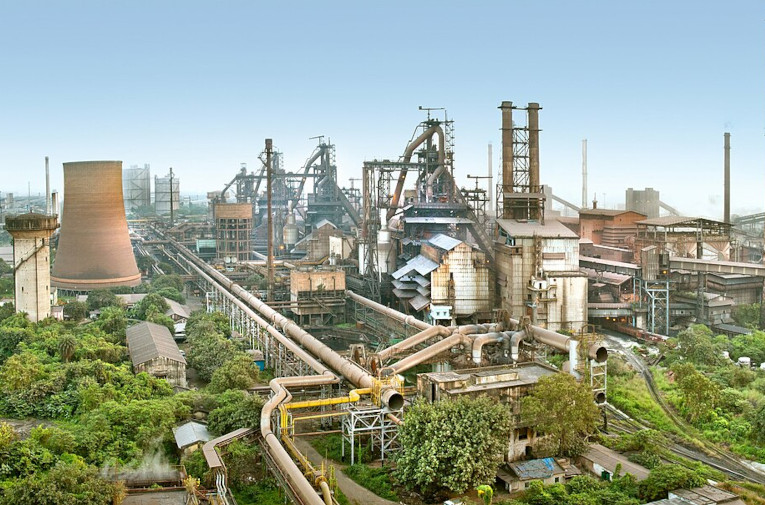
The bulk of steelmaking around the world still relies on coal-based blast furnaces.
As a result, the steel and iron industry is responsible for 7% of greenhouse gas emissions and 11% of carbon dioxide emissions globally, according to the consultancy firm Global Efficiency Intelligence.
This is more than the total emissions from all the world’s cars and vans.
With steel critical to the building out of decarbonised energy infrastructure, production is expected to continue to rise over the coming years, meaning the potential for decarbonisation is “enormous”, according to not-for-profit data organisation Global Energy Monitor (GEM).
GEM’s annual “Pedal to the Metal” report reveals that 93% of new steelmaking capacity announced thus far in 2024 promises to use lower emission electric arc furnaces (EAFs).
It also shows that 49% of the world’s steelmaking capacity under development now uses EAFs, up from just 43% in 2023 and 33% in 2022.
Of this, nearly all of the capacity announced since the beginning of 2024 operates using EAFs, the non-governmental organisation’s Global Steel Plant Tracker (GSPT) shows.
The tracker covers 2,207m tonnes per year (mtpa) of operating steelmaking capacity and an additional 774mtpa of steelmaking capacity under development globally, across 1,163 individual plants in 89 different countries, analysis of which is captured in its annual report.
However, while the report suggests a positive progression towards lower emission technologies in the sector, the increase in the announced projects is not yet leading to a construction of EAF overtaking coal-based production methods.
Coal-based blast furnace-basic oxygen furnaces (BF-BOFs) – where blast furnaces are used to produce iron from ore and oxygen converters then turn this, with some additional elements, into steel – continue to dominate the projects under construction, meaning “pressure must be maintained all the way through to project completion if real progress is to be seen”, the report finds.
Growth of EAFs
Incoming steelmaking capacity is more heavily EAF-based than ever before, according to GEM’s new report.
There is currently 774mtpa of steelmaking capacity under development, of which 223mtpa is in the advanced development stage.
Based on data from April 2024, the GSPT shows that nearly half of the capacity under development (337mtpa) is EAFs.
Just 36% of steelmaking capacity announced in 2020 with a known production route used EAFs, while in 2023 that number had increased to 92% according to GEM. This grows to 93% of capacity when looking at steelmaking capacity under development announced in 2024.
This “indicates a significant shift toward electric arc furnace steelmaking in the years to come”, the report notes.
Meanwhile, of the 212mtpa of steelmaking capacity slated for retirement, 88% if BOF-based.
However, a net increase in BOF-based capacity is expected over the coming years. If all planned developments and retirements take effect, an additional 171mptpa of BOFs is expected to be added to the global fleet, along with 310mtpa of EAF and 80mtpa of unknown technologies.
Despite this growth in BOFs, the surge of EAF means the steel sector is getting increasingly close to meeting the International Energy Agency’s (IEA) suggested 2030 target.
In its net-zero by 2050 roadmap, the IEA suggests that the share of steel produced by EAF should grow from 24% in 2020, to 37% by 2030 and then 52% by 2050.
Considering all planned capacity and retirements, GEM now estimates that the global steel fleet is expected to reach 36% EAF by 2030, noting: “This is still not sufficient to meet the IEA [net-zero] climate target, but with heightened momentum the goal is increasingly attainable.”

The IEA has set a target of 37% EAF globally by 2030. New additions to the steelmaking capacity pipeline could bring EAF capacity to 36%. Source: GEM.
Continuing to construction
While EAF-steelmaking is being announced at “record rate”, GEM finds that less than 14% of this potential capacity has moved into construction.
Of those that have moved into construction, around 46% are still BOF-based. As such, “while we may be within reach of net-zero targets based on proposed electric arc furnace capacity, actually achieving these goals requires follow-through”, the report notes.
Caitlin Swalec, program director for heavy industry at GEM, said in a statement:
“The progress is promising for a green steel transition. Never before has this much lower-emissions steelmaking been in the pipeline. At the same time, the buildout of coal-based capacity is concerning. What the industry needs now is to make these clean development plans a reality, while backing away from coal-based developments.”
As well as the buildout of new coal-based capacity being out of alignment with a net-zero future, it poses a threat of carbon lock-in and stranded assets, GEM notes.
Blast furnaces are becoming riskier investments given the limited options to mitigate emissions from both the furnaces themselves and the upstream emissions from the metallurgical coal mining, it adds.
Estimating an investment of $1-1.5bn per mtpa capacity at an integrated BF-BOF site, GEM found that the future stranded-asset risk could be as high as $554bn in 2023, falling to $400bn in 2024 due to the continued fall in BOF capacity under development.
Astrid Grigsby-Schulte, project manager for steel at GEM tells Carbon Brief:
“As we grow closer to key decarbonisation milestones, coal-based developments get further out of alignment with the direction the industry is moving and present a greater risk of stranded assets to steelmakers. Coal-based, emissions-intensive blast furnaces represent significant investments that often require decades to recoup. This makes them extremely risky for developers, particularly in countries with stated net zero commitments.”Potential stranded-asset risk across key countries for coal-based steelmaking globally. Source: GEM.

The limited options for mitigating the climate impact of BOF-steelmaking was also highlighted within a recent report from the thinktank Sandbag.
While carbon capture, utilisation and storage (CCUS) is often touted as a “catch all” solution, its effectiveness varies widely across applications, Sandbag’s “Steel & CCS/U” report finds.
For steel production, BF-BOFs with carbon capture are unlikely to be cost-competitive with EAFs, the report finds. Although given the slow pace of technological and market development, Sandbag anticipates capturing carbon will play a limited role in the steel industry.
China transitions to EAFs
India has now replaced China as the top steel developer globally, with a pipeline of 258mtpa of capacity, of which 177mtpa is BOFs, according to GEM.
China has a pipeline of 150mtpa meaning, collectively, China and India are responsible for 53% of all developments globally.
Asia operates 68% of all steelmaking capacity (1,508mtpa), the majority of which is in China (1,075mtpa), India (123mtpa) and Japan (109mtpa).
When looking specifically at emissions-intensive BOF production, Asia’s share of total operating capacity increases to 80% (1,181mtpa), of which 918mtpa is in China.
Currently, China has 157mtpa of operating EAFs (22% of the global capacity), followed by the US, Turkey, Iran and then India.
According to a new report from the Centre for Research on Energy and Clean Air (CREA), China did not issue any new permits for coal-based steelmaking in the first half of 2024. This is the first time this has happened since the nation’s “dual carbon goals” were announced in September 2020.
During the first six months of 2024, Chinese provincial governments permitted 7.1mtpa of steelmaking capacity, all of which were EAFs marking a “turning point” for the country’s steel industry, CREA notes.
Xinyi Shen, researcher at CREA and the report’s lead author, tells Carbon Brief: :
“China’s EAF steelmaking has been developing rather slowly in the past few decades, mainly due to the constraint of scrap supply. However, as China’s steel demand reaches its peak and more scrap becomes available, a major opportunity arises to reduce emissions in the next 10 years. The government has accelerated plans to expand the national ETS to include the steel sector by the second half of 2024. By implementing carbon pricing on carbon-intensive products, EAF steelmaking would become more economically competitive and continue the growth.”
Despite India now overtaking China in terms of announced steelmaking capacity, China remains the biggest developer of EAF capacity overall, GEM’s report states. And while India has the most steel in development, 84% has not moved into construction.
As such, there is still an opportunity for India’s plans to change, with the percentage of BOFs to EAFs less set.
Chris Bataille, adjunct research fellow at the Columbia University Center on Global Energy Policy and lead author at the global Net Zero Steel project tells Carbon Brief:
“India’s core demand for steel is set to increase from 125mtpa to ~450mtpa by 2050, especially to meet key building and infrastructure needs. Our modelling suggests EAFs consistently rise from ~35 to 150mtpa by 2050. So the +250mtpa BF-BOFs is just barely feasible, but only over ~25 years and with some exports of BF-BOF steel.
“The difference will be between a world where strong climate policy succeeds and fails. If it fails and coal based BF-BOFs are built, then the +258mtpa looks barely feasible. If it succeeds, India is short on the necessary gas and especially clean electricity to power this amount of steel production. While the country does build a lot of EAFs, it builds up to 250mtpa of clean iron making over time, making the short term shortfall with clean HBI iron imports.”>

Announced and in construction steel capacity, including BOF capacity (red), EAF (green) and other or unspecified technologies (grey). Source: GEM.



Comments
We changed commenting systems on September 10, 2026 as part of a site-wide functionality and security upgrade. Your past comments have not disappeared, and you can still log in with your old Disqus account credentials if you wish. Contact us with any questions.
Interesting article, but I am somewhat confused. My understanding is that electric arc furnaces can only process scrap steel. Only oxygen blast furnaces that use iron ore and coke can make virgin steel. So if we only have electric arc furnaces, then we are limited to recycling existing steel.
Am I missing something here?
We should be cautiously elated by these figures but there is an obvious omission. What is the comparative difference in carbon footprint between the two technologies where coal generation is used to generate the the electricity to feed into electric arc furnaces?
Meanwhile, the majority of articles on fossil-free steel argue the case for hydrogen to displace coal in the blast furnace reduction process. Again, this touted carbon advantage hinges heavily on how that hydrogen is manufactured. At some point steel's need for abundant energy supply probably requires nuclear energy as the primary source, as solar and wind generation requires output that is impossible to deliver.