


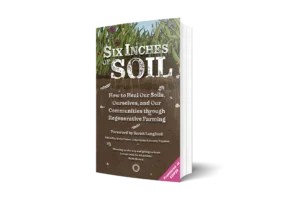
Edited by Molly Foster, Priya Kalia and Jeremy Toynbee, and published by 5M books
I have two caveats for this book review. First, it’s based on a film by the same name and I have not viewed the film. Second, it centers on a farming transition in the United Kingdom, and I’ve never even been there. However, I think the book and the film cover pretty much the same ground (literally and figuratively), and I think the issues raised about farming systems in the UK are very similar to those in the U.S.
The book (and film) follow three young farmers trying to do things in a regenerative way—and still make a living. This is not easy for farmers anywhere. Interspersed between the stories of these three are discussions of issues such as regulation, greenwashing and cooption, subsidies and Brexit, and explanations of what is meant by regenerative farming and agroforestry. At the end of the chapter on each of the three new farmers is an interview conducted by that farmer of a more seasoned mentor. Later, in the appendix, we get a closer look at each of those older farms.
One of the farmers, Anna Jackson, is actually working with an established farm and farmer—her dad. When a young person who is the progeny of farmers wants to maintain the farm, she has quite a leg up since she doesn’t have to start by buying land, equipment, livestock, etc. She also generally has skills and experience and sometimes—as in this case—an experienced mentor right on the farm. It was Andy Jackson who read Gabe Brown’s book, Dirt to Soil, and began experimenting with less disruptive farming practices. When Anna came back to the farm in 2020 because her photography business fell apart during COVID, she found her father’s new practices more appealing, and ended up deciding to stay. But the disturbing part of this story for me, is that they can’t make a living from farming alone—on 750 acres. I think this reflects the power of the big ag-industrial corporations, which keep commodity prices low and input costs high.
Adrienne Gordon’s story is very different. She has no family background in farming and owns no land. She traveled around New Zealand as WWOOFER (that’s Willing Workers on Organic Farms, a way for people to gain experience and farmers to get some semi- free labor). She got some experience with market gardens and CSAs; when she came home she began volunteering at organic farming conferences as she couldn’t afford to go otherwise. But a message left on a board at one of these led to her current arrangement, with a very accommodating landlord. He’d been wanting to get a market gardener on his land—she just manages four acres of his 470 hectares—to diversify crops, make connections to local customers and add education—“a market garden is far more exciting place to hang out than a wheat field!”
There were many challenges—not only did she need to learn all about growing a range of crops, she had to learn to do marketing, packaging, budgeting…fortunately her landlord helped by growing cover crops on much of those four acres the first year so she could start small, and when she was ready to expand, the land was prime for sowing. Now she has some paid help; but has not yet succeeded in generating enough cash to pay herself.
Ben Thomas says he has a passion for cattle, which is clearly true. He manages a conservation herd for his day job, which pays a salary, and then returns home to rented land where he has his own herd. Both are entirely grass-fed and are outside all the time. He utilizes “mob grazing,” which means the whole herd grazes an area quite heavily, and then moves on to another area, giving the previous pasture plenty of time to recover before the cattle are brought in again. He farms in an area that is “all hilly, quite steep,” and thus not suitable for crop farming. Grassfed beef takes longer to finish than those fed grain in their final months, but the meat has a better balance of Omega-3 versus omega-6 fatty acids. This regimen is also healthier for the cattle, who didn’t evolve eating grains.
This simple plan allows Ben to run both operations, but it frustrates him that he can’t make a living running cattle on 75 acres. This is a theme we see throughout the three stories, and perhaps part of it is that they are just starting out—but Anna is joining her father on a farm that’s been in the family for generations.
One concern I have about the stories here is that they mostly use the word “regenerative,” although I do see “organic” and “agroecological.” These three terms don’t mean exactly the same thing, though there is plenty of overlap. Organic has a legal meaning; regenerative is fuzzy, but has been coopted by industrial ag, and is now connected to “climate smart agriculture” which can pay carbon credits to farmers, mostly for not tilling. Tilling is harmful to soil but so is the spraying of herbicides, often done as a substitute for tilling to get rid of weeds. Some people do manage to farm without either tilling or using any pesticides, but it takes a very carefully balanced system.
There is an appendix, which includes a list of resources and organizations, a profile on the farms mentioned other that the three highlighted ones, a glossary and notes.
Overall, the message of this book is that transitioning from the chemical-intensive approach to farming that has come to be called “conventional” to ways of doing things that try to sequester carbon in soil and regenerate the health of the soil, while making a living, can be done and is being done by these people who have this in common: they care. Often it isn’t easy, and the book is full of stories about challenges, some overcome and others ongoing. The authors (and filmmakers) hope the book will be read by non-farmers as well, because those who understand what’s at stake can support these pioneering farmers with their food choices.


Comments
We changed commenting systems on September 10, 2026 as part of a site-wide functionality and security upgrade. Your past comments have not disappeared, and you can still log in with your old Disqus account credentials if you wish. Contact us with any questions.
Big Ag has the subsidy of fossil energy via Haber-Bosch. Plus economies of scale, plus specialisation.
But – and Mary knows this, even if the book doesn't – the existing financial transacting system is itself on the ropes. In other words, the measure we use to define value, is itself in the process of uncoupling itself from true value (via ever-increasing, absolutely unrepayable debt).
Beyond the inevitable financial collapse, values will be so altered – eating comes first – that farming on any scale will be viable, because it will be in relative demand in the new paradigm (in Greece, 10 years ago, a bag of potatoes paid for a dentist-visit).
The entire thing about tilling is so depressing…
Tillage is necessary with annual agriculture! Annuals evolved to colonize disturbed soil, preparing it for a succession of perennial plants.
It's our dependence on annual plants that cause us to till. And now, the RoundUp™ crowd has co-opted "no-till" by just spraying down everything in "fall burn-down," to simulate the fire that annual crops also evolved to deal with.
Until you move to perennial polyculture, you're going to have to do some tilling.