

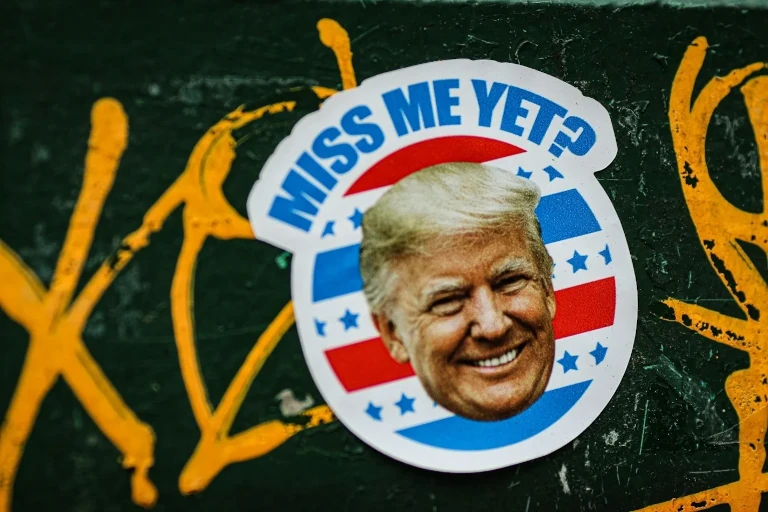
What does a billion dollars buy you these days in politics? As important as the “what” is the who. As in, who’s doing the buying and the selling?
If reports are to be believed, a billion big ones was the price former President Trump put on his rolling back any of the nation’s environmental regulations that roil fossil fuel interests—contingent, of course, on his re-capturing the White House. The offer was made at a gathering of oil executives at his Mar-a-Lago Club.
“You all are wealthy enough, he said, that you should raise $1 billion to return me to the White House.”
According to the Washington Post, Mr. Trump “vowed to immediately reverse dozens of President Biden’s environmental rules and policies and stop new ones from being enacted.” The Post’s sources also said that the former president alluded to the fact that it was a steal of a deal, given what they would get in return.
The ex-president and convicted felon calculated that he would save them the avoided costs of environmental regulation and taxation and no longer need to spend the $400 million a year on lobbyists, which they do now. You have to admit it’s quite a deal.
In 2016, Trump asked America, “What do you have to lose?” Should the former president become the next president, America will find out that it has quite a lot to lose, especially regarding the environment, Earth’s warming, and community resilience.
The truth is Trump doesn’t need a guap-load of Benjamins to convince him to roll back environmental regulations. He’s been crystal clear in his opposition to solar, wind, and other clean energy sources, as well as his disbelief in climate change and the science behind it.
Should he be re-elected, he would cancel all of Biden’s climate-related executive orders and direct his administration to begin rescinding and re-writing regulations to suit the fossil fuel industry.
As problematic for the environment as those Day 1 actions would be, they would only be the opening round of a four-year double-pronged attack on US climate and clean energy policy. It would be an assault intended to weaken national efforts by both the public and the private sectors to combat climate change and transition to a low-carbon economy while holding fossil fuels harmless for the damage they knowingly cause.
Opposition by Trump and his MAGA minions to climate science and clean energy is tribal, and cross-aisle collaboration is a crime against the MAGA nation. The former president has convinced the GOP that despite the march of time and technology, the nation’s future is the past when fossil fuels held sway. Trump uses those who champion climate and clean energy policies as a meme for socialism and denigrates climate science as the product of “woke” imaginations. They’ve proved popular organizing themes for the far-right and not easily dispelled by facts.
The motto of a second Trump administration will be: “To pardon, protect, and prosecute.” Based on what the ex-president has said and the actions of his closest advisors, friends will be pardoned and protected, while enemies will be hauled before the courts for long overdue payback. Among Mr. Trump’s closest friends and allies are fossil fuel-related companies like those he just put the arm on, e.g., Sunoco, Exxon Mobil, and Chevron.
Dharna Noor, reporting for The Guardian, offers a glimpse into the multifarious protections a second Trump administration would attempt to secure for the oil and gas industry. According to Noor: “Far-right fossil fuel allies have launched a stunning and unprecedented campaign pressuring the Supreme Court to shield fossil fuel companies from litigation that could cost them billions of dollars.”
The litigation at issue is by blue cities, like Honolulu, attempting to hold oil companies liable for the damage caused by burning fossil fuels. The civil suits are similar to the cigarette cases of the 1990s that were based on personal injury (tort) law. “A tort is an act or omission that gives rise to injury or harm to another and amounts to a civil wrong for which courts impose liability.” (Emphasis added)
The Congressional Research Service notes that tort (sometimes called common law nuisance) lawsuits are largely matters of state—rather than federal—law and precedents. The oil companies are asking the US Supreme Court (SCOTUS) to overrule a Hawaiian Supreme Court decision allowing the case to go to trial in the state court.
Although the oil companies want the courts to recognize the singular authority of the federal government to regulate air pollution, it’s not as if they’re admitting to the nation’s need for environmental protections from harmful emissions.
Among other things, the suits hinge on what the companies knew (about the dangers of burning fossil fuels) and when they knew it. If found liable, the companies would owe tens of billions of dollars in compensatory damages not just to Honolulu but to the 39 other blue cities currently suing big oil and the hundreds more that will be suing them should the Hawaii suit be successful.
Because civil injury cases largely stem from common rather than statutory law, “judges (not legislatures) developed many of tort law’s fundamental principles through case-by-case adjudication.” SCOTUS is on record opposing the use of common law tort claims as a backdoor approach for addressing climate change.
In American Electric Power (AEP) v. Connecticut, the high court held that “private entities and states could not sue power companies for their contributions to climate change under federal common law.” Writing for a unanimous court, Justice Ruth Bader Ginsburg declared:
“We hold that the Clean Air Act and the EPA actions it authorizes displace any federal common law right to seek abatement of carbon-dioxide emissions from fossil-fuel fired power plants.”
SCOTUS grounded its decision in the AEP case on its 2007 decision in Massachusetts v. EPA establishing EPA’s obligation to regulate harmful carbon emissions. Between the case law and the thinness of federal common law, it’s little wonder that the oil companies want the cases moved out of the state courts and onto the federal dockets.
Although some are shocked, pressuring SCOTUS has become de rigueur in today’s hyper-partisan world. The left hasn’t been exactly shy about criticizing or pressuring the court to stand up for a woman’s right to an abortion, some limits on the kinds of arms Americans have a right to bear, climate change, and establishing some ethical standards for the high court bench. Once thought immune to even a whiff of political influence, the high court has become just another battlefield in the culture wars.[i]
“I have never, ever seen this kind of overt political campaign to influence the court like this,”—Patrick Parenteau[ii]
Trump has made it clear that he intends to be even more authoritarian in a second term than in his first. As president, he declared a national emergency to circumvent Congress’ refusal to fund his border wall. There’s little reason to suppose that having successfully exercised his emergency powers once, he wouldn’t do it again and again.
Although the National Emergencies Act (NEA) establishes procedures for declaring a national emergency, it doesn’t define the term. As Elizabeth Goitein points out, the definition is left to the president to decide when a national emergency exists. She also explains that “the authorities that can be triggered by such a declaration span almost every conceivable area of governance, from agriculture to military deployment to domestic transportation.” (Emphasis added)
Through an emergency declaration, Trump could suspend any part of the Clean Air Act implementation plan or any requirement concerning excess emissions penalties or offsets for up to four months if requested by a state governor.[iii] According to the Brennan Center, the statute has only been used to declare regional energy emergencies, including in states like Ohio, Indiana, Florida, Pennsylvania, and Alabama. Could Trump use it to further his fossil-fueled agenda? Why not?
It’s estimated there are over 150 statutory powers a president could avail himself of under a national emergency declaration. In addition to suspending the Clean Air Act, a president could waive the 30-day minimum comment period on proposed rules and regulations under the Energy Conservation and Policy Act (1975).[iv]
Under 42 USC § 8374, the nation’s chief executive “may allocate coal and require the transportation thereof for the use of any electric power plant or major fuel-burning installation; and may stay the application of any provision or rule pertaining to electric power plants for up to 90 days or the duration of the emergency, whichever is shorter.”
The solidly conservative Supreme Court will open possibilities that Trump didn’t fully benefit from in his first term. The failure of the Constitution or legislation to account for or define what constitutes a national emergency leaves a fertile field on which six conservative justices could expand the authoritative powers of the presidency. The ex-president will push the legal envelope throughout a second term in his efforts to pardon, protect, and reward friends while prosecuting enemies.
“[T]he Constitution did not contemplate that the title Commander in Chief of the Army and Navy will constitute him also Commander in Chief of the country, its industries and its inhabitants.”— Justice Robert H. Jackson
Should the Republicans win the White House and Congress, the possibilities of protecting and promoting continued reliance on fossil fuels would expand exponentially. Legislation could be passed that would preempt state laws in the case of suing oil companies for the damages caused by burning fossil fuels—thereby achieving/reinforcing the desired outcome in the Honolulu and other blue-city nuisance cases. Permitting reforms could be passed that promote fossil fuels and impede the transition to a low-carbon economy.
Far-right organizations like The Heritage Foundation and the America First Policy Institute have a partial to-do list for a second Trump administration and a Republican-controlled Congress. Their agenda includes preventing updates of the electrical grid that would accommodate expanding the use of solar and wind, stopping the states from adopting California’s car-pollution standards, and hollowing out the climate-related programs at the Department of Energy and the Environmental Protection Agency. (Project 2025)
The Trump administration ordered federal agencies to strip any mention of climate change or harmful carbon emissions from their websites and publications. A Trump 2.0 will continue that effort. It will all be aided by the ex-president’s efforts to get rid of career civil servants and replace them with MAGA-approved managers, policymakers, and implementers.
Trump will flood federal agencies with MAGA-approved managers, policymakers, and implementers aligned with the interests of the fossil fuel industry—not only in the Department of Energy but in the Environmental Protection Agency, the Departments of Interior, Treasury, Health and Human Services, Agriculture, and throughout the federal research community.
Fossil fuel interests will see much rosier times through Trump’s lenses. There’s a lot the ex-president has promised to do to bolster the oil and gas industry—and, if you will, stick it to the Wokes. But put yourself in the shoes of an oil company exec who’s just been asked—along with his industry colleagues—to cough up the cheddar.
Why would you spend the kind of money Trump is talking about for something he wants to—and will—do anyway? It’s not much of a deal. But, ever the negotiator, Trump will likely be willing to sweeten it. What could make it sweet enough to buy into?
How about legislation that would limit the liability of the fossil fuel industry the way the Price-Anderson Act does for the nuclear industry? It’s just a thought. However, I wouldn’t put it past Trump’s advisors and leading congressional supporters to give it a shot before the next election is upon them.
Should Trump re-take the presidency, he’ll have vengeance in his soul and six conservatives on the high court bench. None of this bodes well for the future of US climate policy.
Take heart. If there’s a silver lining in any of this, it’s that even Trump and his MAGA minions can’t stop the private sector’s continued adoption of cleaner and more sustainable alternatives. But by mucking up US climate policy, they can slow it down and cede competitive advantage to foreign nations.
Don’t forget to vote in November!
[i] I would note that there’s a difference between efforts to influence by interest groups and the justices being influenced. However, legitimate questions seem to have been raised over “gifts” and pre-set agendas.
[ii] Patrick Parenteau is a professor and senior climate policy fellow at Vermont Law School




Comments
Welcome to the new Resillience commenting system!
We have moved from the former Disqus commenting system to a new system as of September 10, 2026.
We made this change because of privacy concerns regarding Disqus. It's also part of a set of changes to bring more services to the Resilience community under a single login: commenting, (coming September 2026), and online courses (coming 2027). Unfortunately, your old Disqus comments may not reliably link to your account in this new system. Please contact us if you have any questions or concerns.
Yesterday the US ambassador to Russia was called into the Foreign Office because of the latest attack on Crimea using US supplied and aimed ATACMs that killed several civilians and injured ~150 including babies and small children.
Our Ambassador was told that a state of Peace no longer exists between the US and Russia. This is not a casual description of current events but a formal legal diplomatic message that we are on the precipice of War with the one country in the world that can kill every American. There are rumors that the Russians have already shot down a US global hawk drone over the Balck Sea, and a promise that Russia will be suppling weapons and maybe training and funding for anyone who wants to kill American soldiers. Given the 800 bases the US has all over the world the Russians have plenty of targets.
And of course, none of this is being reported in the West.
The Doomsday Clock should be reset to 15 second to midnight.
And here we have Joel the War Mongering Environmentalist wanting to make sure the man most responsible for putting the whole world on the edge of destruction stays in the office where he can start WWIII.
You may want to help set the leadership of Lockheed/Martin straight on the idea of the Republican party of peace. The good people @ Lockheed Martin have donated 4X the $ to Republican organizations and candidates as opposed to Democrats. They are somehow under the notion that their armament profits will be best served by Republicans. The beauty of America is that we have a choice – we can elect rightwing, pro war, pro fossil fuel industry candidates (Democrats), or we can elect a neo Nazi, nativist, genocidal, pro war, super pro fossil fuels party (Republicans). I take it that you prefer Donald "Let Israel Finish the Job" Trump to "Genocide" Joe Biden. Noam Chomsky called Trump the "most dangerous leader in the history of the world." I don't dispute that Biden is a war criminal, but anyone thinking that Trump is a viable alternative has lost their mind.
While this Palestinian war is going on there are a lot of progressive leaning people who despair over the current administration's solid support for that invasion, including the provision of armaments.
Deep anguish over this is allowing many progressive leaning voters to put out of their minds various other serious agendas where there are quite clear strong demarcations between the two parties – climate change, gun violence and abortion policies.
And then… to further dilute attention from pressing issues… is the constant goading that 'Biden is too old'. This politically contrived meme somehow sits way, way above a range of existential issues that will, in time, affect us all.
Climate change is barely on the public agenda at the moment. That's so scary.
Trump rarely pays off any debts. Fossil fuel corporate leaders know this and also know Trump will be good for their industry whether they donate to his campaign or not.