

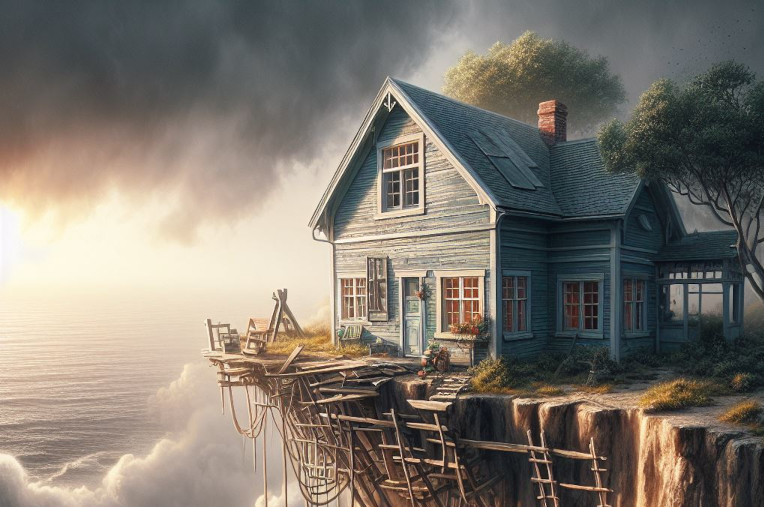
Having developed a perspective that modernity is fated to fail, and that many of our culture’s current pursuits and institutions are misguided efforts to prop up temporary structures, I often encounter the reaction that I am being defeatist. If what I am saying is true, then what’s the point? Yeah: what is this point that others believe justifies all the craziness? Whatever they think “the point” is could well be based on unexamined and incorrect beliefs.
I will attempt in this post to explain what I mean by this, in multiple passes. A starter example may seem a little patronizing, but could still be helpful. If your world only makes sense and has meaning on the premise that Santa Claus exists, then you’ve put yourself in an unfortunate place. Others have found ways to appreciate life without that requirement based on a falsehood.
Let’s also try generalizing the concept before getting to specific examples. We start with something I present that happens to be essentially true (or indeed comes to pass in due time), whether or not we can say so with absolute certainty. Then imagine that the reaction is: “well, if that’s true, then what’s the point of living?” Well, we obviously are living, and if we do so in the context of this truth, then it makes little sense to say there’s no point in living. The problem must then lie in what the person believes “the point” to be, and therefore must be wrong about that. In this sense, a “what’s the point” challenge might be taken to signal a flawed worldview.
Okay. That’s the template. Let’s do a few practice cases (optional if you want to cut to the chase), and work our way toward the main event regarding modernity.
Determinism
As we have no demonstrable evidence to the contrary, it is likely true that the universe operates as a quasi-deterministic symphony that writes itself in real time as the tangle of relationships described by physics play out. I say quasi-deterministic because quantum probabilities add spice to the details of the unfolding, but still in a prescriptive way. Most people have serious problems with this view, because life does not at all feel like it operates deterministically. I get it. Truly, the “undetermined” sensation is not lost on me for a second! But so what? Why would the actual real universe as it exists before us care what notions and hang-ups I construct in my brain about how it works?
Mind-bendingly complex and cool things can emerge from “the stage”—as far as we know all 100% consistent with the laws of physics that we have carefully elucidated, and to which no replicable experiment has found exception. That’s a strong bit of evidence on the side of determinism: we can’t override the physics that makes our neurons do what they do, for instance. Life certainly feels undetermined and open-ended, because the complexity is so extraordinarily insane that the only conceivable way to reveal the outcome is to play it out with the actual full universe as expressed in unfathomably rich inter-relationships between all the particles. No one—including the universe itself—knows for sure exactly what comes next in every detail (though broad brush predictions about things like sunrise tend to be pretty solid). Just because it’s deterministic doesn’t mean there’s a plan or a script: just rules and scads of interactions.
So, if in rejecting the notion of determinism, someone says “what’s the point in getting up everyday if I’m just executing a script?”, then whatever they imagine the point to be is whacked in the context that determinism is actually the way of things. Something doesn’t make sense in their view of the world (which I will alternately label as worldview or cosmology), in a broken sort of way. In other words, if the only thing that makes sense to someone is to live in a world that is not deterministic, but the world is indeed deterministic, then that person’s sense-making of the world is essentially misguided. They have no authority to determine whether determinism is true or not, so what’s their coping strategy if—as mountains of evidence suggest—the universe turns out to be deterministic? Do they have a plan for that besides reactive rejection, or does it break their whole cosmology and leave them rudderless? What a shame, if they short-circuit based on their own chosen flaw: an unforced error. I suppose they can also just never accept determinism and continue to be comfortable within their cosmology, fragile as it may be.
Free Will
It goes pretty similarly with the sensation of free will. Again, I get that our perception of the world convincingly fools us into mistaking agency for free will. But what if that’s wrong? Yes, we have agency in that we are actors in this self-writing script and have impacts on the rest of the performance—impacts that are hatched by our own neurons without violating any laws of physics. But there’s no sign of a “soul” that can override the relationships between all the stuff that makes us up. If physics (e.g., neurochemistry) were that easy to override, then how can drugs gain the upper hand? How can anesthesia make us go completely blank for hours without even a sense of time (where does the soul go)? Why does our sense of soul/awareness/consciousness coincide with our biological birth and subsequent development as biological beings? It’s dazzlingly impressive how resistant people can be to the notion that we are wholly corporeal beings. What a spectacle!
Anyway, it is unacceptable to many to suggest that we don’t have free will—which has every likelihood of being the case with no firm evidence to the contrary. Again, we don’t get to choose whether it’s true or not. If in someone’s mind there’s “no point” to living without free will, and indeed there’s no free will, then we have another case of a self-defeating choice of beliefs: another unforced error.
Consciousness
A third related piece and then I’ll move on to modernity. We are aware of ourselves, which we call consciousness. Many elect to see this as a state of transcendence. Whatever. Call this fascinating piece of emergent complexity what you like, but it seems to be a quality of many forms of life, and this totally makes sense. It is hard to see how you would stop even a moderately complex being with many sensory inputs and a brain from building a mental model in which the organism is a “self” or “entity” that needs to maneuver and perform certain functions in certain ways in order to be a successful member of the community of life. Evolution sees to it that those unable to conjure this capability are less able to operate successfully in a soup of other “entities” who can manage to do so.
If your standard-issue human supremacist has trouble accepting that consciousness is not unique to humans, but just another cool outcome of the evolution of complex organisms, then they have managed to set themselves up poorly—because loads of evidence points to (probably) universal consciousness (not all of identical form, naturally). So if the point to being human is this special power, then it’s a stupid corner to have painted oneself into. Angry reactions then boil down to anger at oneself for engineering another unforced error.
Modernity
I hope these relatively brief starters laid the groundwork for understanding the main topic, and weren’t just annoying tangents.
Let me attempt to frame the modernity version in a series of conjectural statements I might make, followed by reactions I might get from mainstream members of modernity.
Statement: We probably won’t have electricity or much in the way of metals in a thousand years (give or take a thousand years or so).
Response: That seems crazy and nearly impossible to imagine playing out short of nuclear annihilation: it would make all our progress to date pointless.
Statement: Earth almost certainly can’t maintain 8 billion people or anything near it for even a century or two—especially without fossil fuels.
Response: It is our ethical obligation to make it work, and we surely will via innovation and technology (fossil fuels are not what makes us amazing: we just are amazing). Otherwise, what’s the point of our having risen to this state?
Statement: Science as we practice it is a net harm: deployed for short-term human gains at great cost to the ecosphere’s health.
Response: If that were true, then what would be the point? Obviously there’s a point to science, which expands our knowledge and provides ample benefits via technology.
Statement: Centuries from now we will have lost much of the knowledge that science has worked hard to accumulate.
Response: That would be tragic if true: then what’s the point if it’s all going to get flushed?
Statement: I spend much of my time trying to get people to see modernity as fundamentally unable to succeed in its ambitions.
Response: If you think it’s really that bad—doomed to fail—then what’s the point of bothering to write about it?
It would be interesting to collect thoughts about what such respondents do think the point is. How anthropocentric, ecologically ignorant, unrealistic, impractical, short-term, or even delusional are they? What sort of detached utopia do they dream is possible? How much context do they have to ignore or exclude to leave room for this tidy vision of artifice? Trying to remember what it was like to think this way, here are some possible answers:
- Eliminate hunger and inequity; achieve world peace; perfect democracy; no barriers due to race or gender; bend the arc or history toward justice; education and good jobs for all.
- Pursue science until we answer all key mysteries, cure all diseases, perhaps even defeat death from old age via molecular biology insights (telomeres!).
- Star Trek: leap from our earthly cradle and grace the universe with human greatness.
- We’re just starting the good life, which we want billions to experience indefinitely.
- Exercise and perfect our dominion over Earth as granted by God (just swept up a few billion Abrahamic subscribers).
- Preserve and expand human accomplishment in art, writing, music, architecture, science, technology, etc. These things differentiate us from animals and from our animal past, and are the whole point of being human.
- Eventually merge our consciousness into digital form and become more than human: unleash new powers and live (forever) in the cloud.
Quick responses to each in turn:
- Santa Claus again? A pleasant set of fantasies, but very anthropocentric; ecology-blind; unachievably naive. As an aside, success on the first point inevitably grows the population, scaling up the current tension with respect to planetary limits.
- Unachievable hyperbole; we’re not accidentally structured to be capable of understanding everything, and that’s okay; mystery and awe can remain; curing all diseases and achieving effective immortality would be ecologically disastrous!
- Mind-numbingly delusional in terms of realism, and also very Human Reich.
- The “good life” is rapidly wrecking our home, and will thus prove to be short-lived.
- And how’s that supremacism working out (in light of a sixth mass extinction)? Failing the test, are we?
- Neat things, to be sure, but part of the package (Human Reich) that is destroying what it means to be other species. Focusing on one side of the coin isn’t helpful. These things can’t exist long-term if their very pursuit drives ecological collapse. Attempts to differentiate ourselves from animals is itself a deeply flawed and problematic practice.
- Whoa. This degree of disconnected delusional dreaming is almost to the level of mental disease, and ought to be looked at by a professional. Read Iain McGilchrist’s The Master and His Emissary to learn about the imbalance inherent in this kind of view.
Wrong Cosmology
I think a universal observation about these sorts of objections is that my original statements are incompatible with the cosmologies of the respondents. They fail to compute, within the worldviews of those folks. It feels like unfamiliar nonsense, when “sense” is constructed from a misguided notion of what this existence is all about and what the future promises to hold.
The distilled logic is: “if what you say were to be true, then my worldview falls apart, so what you say doesn’t seem like it can be true.” More bluntly: “I reject your premise, as preserving my worldview is more important to me—even if it’s utterly wrong (which it can’t be, somehow).”
In one sense, the “what’s the point” question is a form of progress. It acknowledges a deep disconnect. Problem identified. Maybe the real point is not at all what was imagined! I view it as similar to the fact—which I relish—that racists hate being labeled as racist. That’s a form of progress: they know it’s not okay, and get all defensive. When someone says “then what’s the point?” they have made a big step to appreciating the incompatibility. The harder trick is to get them to re-evaluate their cosmology as the chief source of disconnect.
Once allowing the cosmology to shatter, many of my statements are far easier to entertain, and may even become obvious or seem the most likely truths—to the point of being attractive, even. Cosmologies can therefore seriously distort and limit our thinking—affecting our judgment.
Progress?
A quick detour about the word “progress,” which I used three times previously. The first instance was embedded in a mainstream response, used in its common form to reflect technological development, medical advances, access to economic/material “needs,” social tolerance and justice, and the like. Politically, the term “progressive” applies to those seeking expanded human rights and “fair” distribution of earth’s loot for all (humans).
But the second use reflected a much different form of evolution: questioning the traditional meaning of progress is itself progress. Abandoning “progress” as it is usually defined is, to me, progress. Ronald Wright’s A Short History of Progress helps paint the word in a different light.
Existential Vacuum
A serious barrier to abandoning any cherished cosmology is that without anything to take its place one is left staring into an abyss. It’s scary. What meaning, or purpose could possibly exist? It feels like nihilism. Those who make it to the other side know better. There’s life after Santa Claus; life after shedding God; life without free will; life (literally) with conscious critters to keep us company; life after modernity. By life here, I mean love, joy, meaning, awe, community. Also pain, loss, death, and other counterparts that must exist hand-in-hand to give substance to the pleasant bits. I’m not trying to sugar-coat: just indicating that rewarding experiences are every bit as possible—if not more so—without modernity.
Think of the picky-eater kid who would only ever eat chicken nuggets, pizza, and hot dogs. Frustrated parents catered to the kid’s limited palate, all the way through high school. Now imagine that during college, the kid (still earning that label) goes on an exchange trip to Thailand. It seems super-scary at first: “Nothing to eat here! I’ll starve!” But eventually they try some of the less intimidating items, find that they’re quite delicious, and before long discover that Thai food is amazing. The door is open. The original problem, in a sense, was living in a skewed world that allowed or even promoted the maintenance of an unhealthy, limited tolerance for a broader understanding of the world of possibilities.
Once dropping the problematic cosmology that defines the point of life in terms of human “accomplishment” in the narrow context of modernity, a universe of other values systems becomes available to offer sustenance. To think otherwise is to arrogantly assume that thousands of generations of humans who came before were miserable because they had not found their “special purpose” (not referring to The Jerk movie, here). Modernists are nodding, because this sounds right according to their mythology. But that strikes me as delusional bull$#!+! Joy is part of the package of being human, and always has been! Likewise, all the other plants and animals of the world are not frikin’ miserable because they lack modernity! I could turn the tables and say that the modernity disease produces far more misery (for all life) than any other worldview that has ever existed on the planet.
If successful in sloughing off the mantle of modernity, you’ll see it as a hideous garment. Why did you love it so? It filled your head with crazy ideas that caused loads of damage and had no chance of working in the long run anyway. It was completely out of place: clashing contemptuously with the rest of the community of life. Once shot of the foul wrappings, you’ll see that something wonderful has been staring at you all along: life on Earth. It’s amazing, and quite a privilege to be a part of it. You’ll find no shortage of meaning, in a multitude of dimensions (plants; birds; mammals; amphibians; something for everyone). You’ll feel like now that you’re awake from the fever dream, you can imagine living on the planet without the evil trappings and pulls of modernity. You’ll want others to find the same hope and truth, so that you’re not stuck on the destructive treadmill that is too big for you to stop on your own. You need other people to come with you, and leave the piece of junk behind to rust and crumble, as life reclaims its prominence on the planet.
So, What IS the Point?
If modernity is not to last very long, what’s the point in pretending that it will? What’s the point in holding onto a worldview predicated on modernity’s survival? What’s the point of our current choices, jobs, ways of living? To what end do we pursue the things we presently do?
Just because a lot of the things we do today will turn out to be pointless does not mean there’s no point to anything! What a huge and unwarranted leap that is! In the context of a completely different lifestyle as subordinate partners among a cast of many in the community of life, one might find innumerable sources of meaning. Living, loving, caring, helping, singing, laughing, learning, respecting, offering gratitude, appreciating beauty, jabbering, teasing, playing, sharing—for instance—are all part of being human and of being one form of life among many others on this planet: lots of room to find meaning and “points” that validate life. If the meaning in your life is contingent on modernity, then maybe you’ve come to the wrong shop, and ought to look for new forms of meaning that are built to last.





Comments
Welcome to the new Resillience commenting system!
We have moved from the former Disqus commenting system to a new system as of September 10, 2026.
We made this change because of privacy concerns regarding Disqus. It's also part of a set of changes to bring more services to the Resilience community under a single login: commenting, (coming September 2026), and online courses (coming 2027). Unfortunately, your old Disqus comments may not reliably link to your account in this new system. Please contact us if you have any questions or concerns.
Tom Murphy, to my mind, presents a very negative view. Whilst I agree with some of his statements, such as that intra-stellar travel will probably never happen and that the present world population is unsustainable and must decrease, I am not at all happy with other points, especially the first. Surely it cannot be impossible to eliminate hunger and poverty, achieve equality and world peace and so forth, nor do I see why eliminating hunger must necessarily lead to a population explosion. There is such a thing as birth control. Nor do I see why achievements in art, literature and so on cannot endure in the long term. As for there being no electricity or metals in a thousand years or so well, I do not know. I shall not be around then to see, obviously, nor will he nor anyone else alive now, so it is just an unprovable prediction.
Birth control has been around for my entire life now, and hunger has been around far longer. Based on obvious fact that the number of people now on earth has nevertheless grown to exceed anything you or I could possibly imagine (your heart would only beat half of 8 billion times if you lived to be 100, for example), and that most of them won’t contribute a thing to prosperity save to procreate an even bigger pack of equally useless fools, I personally can’t think of a more certain prediction about the future than that 100 years from now complete civilizational collapse will have occurred and the human population of the planet won’t be a even tenth of what it now is (BTW: in any meaningful sense of the word, there’s no such thing as a “provable” prediction about any future event exceeding a human lifetime). But the only thing about that to lament about that, IMHO, is that our non-human brethren’s populations will probably be down by at least a factor of a hundred by comparison. Though I suspect they may yet have the last laugh …
Having grown up in modernity, it is hard to imagine its utter failure and dashing of its lofty goals. How could we let that happen? But we’re not in control. Biophysical reality does not cave to human ambitions. Maintaining an inherently (grossly) unsustainable system is just not possible in the long term. Electricity requires metals, stability, and maintenance of technology/manufacturing skills. See my recent Outside the Fishbowl post for more on the electricity angle, as an example. It won’t come down to what we want to see happen, but what can.
“Cosmologies can therefore seriously distort and limit our thinking—affecting our judgment.” Yes, and that would include yours.
If I had a cosmology, it wouldn’t demand anything (if pushed, I’d say it would be like the ‘cosmology’ of Native Americans, Australian Aborigines, or something like Taoism. IOW, to go *with* Nature, not to try and control it).
From your hardcore, reductionist ‘scientific’ position, you claim a monopoly on truth. From there, anyone having a slightly different view must automatically be wrong.
Do you think all the indigenous peoples you (rightly) admire for their wisdom share your ultra-deterministic stance? They believe in spirits, have shamanic rituals etc. All kinds of ‘unscientific’ stuff. Yet they’ve proved they are sustainable.
Free will, aka agency, volition, choice – whatever you want to label it, is what allows us to do anything. To call it an illusion is to deny reality (and also, to absolve corporations, murderers etc. of responsibility for their crimes).
Occam’s razor should tell you…
On consciousness, you say “Evolution sees to it that those unable to conjure this capability are less able to operate successfully in a soup of other “entities” who can manage to do so.” – so *some* animals have consciousness. But then, in the next paragraph “evidence points to… universal consciousness” – so now *all* animals have it? Well, which is it? (A rhetorical question, as all life has consciousness.)
When it comes to the deepest underlying structure of reality, that knowledge is not available to any human – yet you lay claim to it. Hubris.
Furthering your good points, i would suggest that free will, like all the other phenomena of experience, is essentially illusory as well. Why make an arbitrary exception?
The illusory nature of free will does not make it non-functional – our illusory free will functions within the normalized traditions of social communication and intellectual knowledge. The functioning of illusory phenomena should not come as any surprise ( as opposed to thinking that illusory phenomena are completely non-existent and therefore non-functional). Example: The moon reflected in still water is not really another moon….. yet the illusion functions and it is only insight that understands the nature of the illusion.
Think of the proverbial “self”….. an illusory phenomena, widely believed in, functional at the level of ordinary everyday experience, yet….. no one can find the “self”. No one. Try to find it for yourselves. Yet its ‘functions’ despite its unfindability and its illusory nature. As long as we don’t look too hard!!! lol
Free will is just another form of consciousness operating with all the other elaborations fabricated by consciousness. The house of cards is illusory, the cards are illusory, the cognitive conceptions of cards and houses are illusory, the self knowing all these is illusory, so the ‘house’ can easily fall apart since it never truly existed. Not as problematic as many believe, but that is another topic.
Likewise, the illusions of progress and modernity are illusory, and if we remain undiscerning, we will continue to choose not to notice that these illusions are causing us great harms and suffering as well as some pleasures. Choosing to exist within the illusion will necessitate the inevitable outcomes of the fabrication. Identifying with the illusion determines the ongoing collective failure to adapt. Illusions are impermanent with no essential essence and will always change despite illusory beliefs to the contrary. Taught to abide in an illusory self and illusory world, it is unsurprising we are trapped and confused by the illusions we are socialized to believe in and identify with. Clinging to falsehoods we tumble into ever more illusory chaos.
Gonna offer a partial argument, that there is some merit in points 1 and 6 above: that it’s worthwhile for a postmodern humanity to strive to end warfare and hunger, and that it might be possible if we figure out how to stop the sociopaths among us from being in control. It would also be desirable, if possible, to maintain the medicine that allows low maternal and child mortality and the necessarily concomitant birth control. That’s the #1.
On #6–some things, like art, music, humor, writing or oral history and science DO differentiate us from other animals and are things to feel good about and perpetuate though I wouldn’t say they’re “the whole point of being human” or of being alive. On yesterday’s Deep Dive, Layla June gave many examples of ways humans have helpfully stewarded their ecosystems; Robin Wall Kimmerer in Braiding Sweetgrass does the same. It is not humanity that has been relentlessly destructive, but one culture–one that is based on domination and very good at domination through violence, so it has taken over basically the whole world. Humanity needs a ten-thousand-year turn, to depose and replace that culture with one–or many–based on, to quote Layla June, “reciprocity, restraint, respect, regeneration, humility and love.” Sure it’s a longshot, but our survival likely depends on our pulling it off anyway.
I’m all for trying modes of living that have a shot at long-term “right relationship” with the more-than-human world, and believe many Indigenous traditions are meritorious in this regard. My #1 sounds like the modernity dream (jobs; world peace) and not local tribal goals. It strikes me as the wrong set of goals (one-size fits all; global) rather than the wide variety of systems that work depending on place. For #6, artistic expression will always be part of being human. I guess I was thinking more about the goal of preserving modernity’s brand of art/music/science/technology, rather than allowing such things to wash away with the winds as other temporary forms come and go in their wake.
Once dropping the problematic cosmology that defines the point of life in terms of human “accomplishment” in the narrow context of modernity, a universe of other values systems becomes available to offer sustenance.
Yes, but for far fewer people than the number presently needing sustenance (both mental and physical). Most modern values are akin to an irrational cargo cult (Santa Claus again), but some parts of the cargo really are needed, like food, water and shelter. Modernity is an emergent, evolved, value and production system which provides those things to many billions of people. Sure, people have lived just fine without modernity, and will do so again in the future, but not anywhere near the number of people that are living now.
And since values and action are intimately entwined, does it do anyone a favor to help change their values when they will not be able to act on that change? Anyone who lives in the modern world would struggle to become independent of that world, regardless of their values. Virtually everything about a non-modern lifestyle is illegal. Trying to live that way is a sure ticket to jail or a mental care facility.
Tom Murphy is clearly anti-modernity, as am I, but since we both live in the USA, neither of us can live outside modernity. We can prepare ourselves for a post-modern life, mentally and physically, but still have to wait for modernity to disappear before we can live that way. We are trapped in the modern world along with all those other billions who think modernity is just fine.
I agree that we are trapped in modernity and would be thrown in jail if violating property rights to roam the land to hunt and forage. But staying in modernity indefinitely is not a choice, either, as it will prove to be biophysically untenable. So, what I am trying to do is crack the concrete casings that trap our brains in modernity. By so doing, we might be better prepared to start shedding bits as we are able, as institutions begin to fade and we become incrementally more self reliant. It’s the long game.
Well Tom i hope you enjoyed beating the stuffing out of the straw men you presented.
Determinism – oppps you mean Quasi determinism, which is a very different thing. Even if you assume that you could do the impossible and know the position and momentum of every particle in the universe you still can’t even in theory predict everything that will happen.
But lets not forget that your “determinism” requires access to incredible amounts of data and unbelievable levels of computing power to make your “determinations”.
For any computationally bounded individual the universe is not deterministic.
Free Will – your definition of free will is ridiculous, why does free will need to be able to violate the laws of physics??? And the idea that we are only corporeal beings is self refuting. Ideas are non corporeal yet they are real. Or are you suggesting that ideas are not real either?
Consciousness if you strip away the misanthropy in your article it seems that you take a pan-psychism point of view that universe itself is conscious. So humans are conscious just not uniquely conscious.
It seems to me that you have a Scientific Materialist Philosophy but you want to file off the “Scientific” part because you understand the philosophical difficulties that science brings with it.
The fundamental question i would put to you is
Are ideas real?
I never set out to “determine” anything. Determinism doesn’t mean knowing or comprehending or computing or predicting: just that it will do whatever the rules tell it to, and nothing can intervene to subvert the inevitable flow. Why must an individual master anything for the universe to still operate deterministically? Take the human out of it.
Any idea or thought you have is a result of matter and energy (real) and cannot exist without the hardware. Absolutely corporeal: a pattern of information encoded in neurons and their interconnections. When you manage to have an idea without complete corporeal dependence, you’ll be the first. In any case, we lack any evidence that thought, ideas, consciousness, or the illusion of free will have any existence outside a biophysical context, although people can believe all sorts of things that aren’t real or true.