


In February, I interviewed biochemist Chris Bystroff, whose peer-reviewed analysis suggests that world population is now peaking. I wanted a contrasting view on the matter, so I reached out to my friend Jane O’Sullivan, an Honorary Senior Research Fellow at the University of Queensland and author of the paper, “Demographic Delusions: World Population Growth Is Exceeding Most Projections and Jeopardising Scenarios for Sustainable Futures.” Dr. O’Sullivan has been active in debates about overpopulation in Australia and the world for many years, as both an analyst and an activist.
Richard: Fertility rates are declining sharply in OECD countries, and China’s population is now dropping rapidly. Is world population growth in the rear-view mirror, a problem we no longer have to worry about?
Jane: “Declining sharply” and “dropping rapidly” are emotive terms that exaggerate the trends and distract from the far more rapid growth elsewhere. Globally we increase by somewhere between 70 million and 90 million annually, and that pace has been unrelenting for more than 40 years. We don’t have hard evidence that the curve has started to bend, let alone that it is on track to peak any time soon. So, the problem hasn’t gone away, and the impacts of the human population get more serious and intractable every year.
It’s important because there are things we could do, that we know work because many countries did them in the past, and that we’re not doing now. Not doing them is leaving hundreds of millions of women who want to avoid pregnancy without the services and means to do it. It is condemning their children to a world of increasing competition and diminishing opportunities, if not outright collapse of civil order.
What we’re not doing is sufficient provision and promotion of voluntary family planning. We’re not doing it because we have been taught, since the mid-1990s, that expressing concern about population growth will harm the people in high-fertility countries, as if all birth control programs involve forced sterilisations (very few did) and as if they’d be worse off with fewer children or siblings (they’re much better off). The hopeful myth was that women would get better services, and fertility would fall faster, if we only championed their rights and shut up about population. But the opposite happened: without the motivation to reduce population growth for the sake of economic development, the funding and policy support for family planning plummeted, and women were left worse off.
As a consequence, fertility declines slowed or stalled in many countries, but the projections haven’t adequately factored this in. In your recent interview with Chris Bystroff, he suggested world population could have peaked already, with birth rates much lower than the UN believes. In fact, the evidence all points in the opposite direction: that the UN has been over-anticipating fertility decline and underestimating population growth.
Every two or three years, the UN publishes an update of their population estimates and projections. Almost every update this century has revised the world population upward. Their mid-2022 release estimated the mid-2022 population to be 7.975 billion. This was 21 million higher than their 2019 projection anticipated it would be, despite more than 15 million unanticipated deaths due to the Covid-19 pandemic. It was 177 million more than the 2010 projection expected, and 253 million people more than was projected in 2000. Despite their consistent underestimation of growth, their model continues to assume all high-fertility countries are experiencing rapid fertility decline, even though their historical data show they haven’t.
Other research groups that attempt global population projections include Wittgenstein Centre in Austria, whose projections are used in climate change mitigation models. They anticipate faster and deeper fertility declines than the UN. History is proving them to be more wrong than the UN. This is worrying when all modeled scenarios that keep climate change below 2oC depend on world population growth quickly tapering off, without including any measures to help it do that.
However, the lower projections get a lot of support in the media because it is what people want to believe. They want to be reassured that doing nothing about population growth is safe and sufficient. So, they cling to myths and misrepresentations that fertility is “plummeting” everywhere and China’s population is “collapsing.”
China’s population fell by about 0.14% last year. It is absurd to regarded this as a “rapid” decline when 2.9% growth in Canada is presented as unproblematic. Growth is much more costly than shrinkage, economically, socially, and environmentally.
Richard: What are the implications for the non-OECD countries that still suffer high rates of population growth? And how could their problems spill over into the rest of the world?
Jane: The main implication is that they are stuck in a poverty trap that can only get worse. Back in the 1960s, when developing country population growth started to gather pace due to better health care, it was obvious to everyone that this would impede development. Everything you do is just running to keep pace, rather than getting ahead. You can improve farm yields, but the farmers’ kids get less land each or become landless. When they flock to the towns and cities, there are not enough jobs for them, and it’s impossible to house them decently. You struggle to improve education if you have to double school capacity every couple of decades. The situation breeds crime and violence, which makes good governance impossible and political instability virtually inevitable.
In contrast, all the countries that made efforts to reduce birth rates in the 1960s to 1990s are powering ahead economically. These days we’re encouraged to believe birth control efforts did nothing but breach human rights, but this is a gross misrepresentation. Almost all national family planning programs were voluntary and based on improving people’s lives by delivering better health and contraception services. They also worked to break down many of the patriarchal traditions that relegated women to childbearing, such as child marriages and son preference, and to ensure girls’ access to education. By slowing population growth, they were able to improve job prospects and access to services such as electricity and sewage. Gradually, it became a virtuous cycle.
It didn’t happen because they were richer or better educated, but because they gave family planning a high priority. For example, Thailand was much poorer and less developed than the Philippines in 1970, but is far better off now, and a major rice exporter, thanks to its family planning program. Bangladesh was the poorest of the poor, but promoted family planning while Pakistan didn’t. Now it has overtaken Pakistan, where worsening conditions are leading to political instability.
The media rarely comment on it, but population pressure has played a large part in the recent conflicts in the Middle East and Africa. The Arab Spring uprisings were triggered by a world food price spike hitting hard in poor countries dependent on imported food. Others are coming close to famine conditions again. In Madagascar last year, hunger was blamed on climate change, but few if any media commentators mentioned that there are now seven Madagascans for each one the country had to feed in 1950.
Whether in war or peace, population pressure generates high demand for emigration. Gallup polls now show a billion people want to emigrate to a richer country, including more than half the adults in sub-Saharan Africa. Western countries are already seeing increased inflows, and people who complain are labelled racist and xenophobic. But if these countries really had open borders, welcoming all comers, their welfare systems would instantly be overwhelmed. They will inevitably tighten border controls, but they will almost as inevitably have higher inflows anyway because the demand is growing so rapidly. This will be an ongoing source of social tension.
Beyond that are the environmental impacts. This is a difficult area to model, because every country that reduced fertility also got richer, so bigger footprints outweighed fewer feet, at least in the short run. But if we were able to reduce the energy demands of middle-class lifestyles, and to generate that energy without greenhouse gases, we’d still be left with the sheer scale of the food system. All the modeling suggests that we can’t draw down carbon dioxide without expanding forests, and we won’t reverse deforestation if global population keeps growing.
It’s not about blaming poor people of color, it’s about creating the conditions needed to end poverty. It’s about acknowledging all the ways humanity is unsustainable, and that we have to address every one of them. Family planning in Africa is no substitute for reducing the footprint of the rich countries, but even if we do the latter perfectly, we’ll still fail if world population is too high. And it would be people in high-fertility countries who’d suffer most.
Richard: In your opinion, why have world leaders failed for so long to take this issue seriously?
Jane: In the post-War decades, leaders took the issue very seriously. Developing countries begged for family planning assistance, and several donor countries gave it high priority. But from the mid-1970s, in response to clear statements from the US Presidency in favor of population stabilization at home and abroad, a concerted campaign started to build to undermine these commitments. It was mainly driven by leaders of the Catholic church, who wanted to defend their ban on contraception: if contraception is the only way out of poverty, then they are morally compromised. So, they worked hard to promote alternative economic theories that population growth is neutral for development—“every extra mouth comes with a pair of hands.” They exerted political leverage on American politicians, particularly Republican presidents, to defund family planning activities. They got Catholic countries to veto attempts to get family planning onto the World Health Organization’s agenda. They recruited evangelical churches to escalate the campaign against abortion. Then they cunningly linked family planning to abortion via the Mexico City Policy, announced by the Reagan administration in 1984 at the UN’s population conference in Mexico City. It put a ban on US funding going to any entity that even gave advice to women about abortion. Despite modern contraception being the most effective way to reduce abortions, many family planning agencies refused to comply with this rule because they would not refuse women life-saving advice, so they were defunded.
The next line of attack was to escalate moral outrage about cases of coercive birth control, so that it seemed as if all family planning programs were coercive by default. In fact, coercion had been rare outside China, and never condoned by family planning agencies. The International Women’s Health and Rights Movement was recruited to oppose birth control programs as an attack on women’s bodily autonomy. The opposite happened—discouragement of birth control actually harmed women’s rights.
This moral crusade against family planning has not been the only barrier to action. Big business wants to ensure cheap labor and fears a declining population, where employers have to compete to attract workers. They have concocted a barrage of myths about population aging causing recession and bankrupting the welfare system. It makes for strange bedfellows when the moralizing Left insists population growth is not a problem because that would be blaming the poor, and big business says population decline is a crisis because it wants to pay lower wages and charge higher rents.
Richard: How can nations use population decline to their advantage?
Jane: They don’t have to do anything to reap the benefits of population decline, other than stop resisting it. It means not having to build so much infrastructure every year just to keep pace with growth. It means more affordable housing and less household debt. It means we can retreat from the most ecologically valuable or fragile places, and see them restored and rewilded.
Most people believe the scare-mongering about aging populations and think we’ll keep getting older and older until there are no young people left. That’s not how it works: at the moment, we’re in a transitional phase where we have very high proportions of so-called “working-age” adults, by historical standards. After the transition, that proportion will stabilize at historically normal levels, around 54% if we have a stable population, and maybe just under 50% if the population is shrinking “rapidly” at a little over 1% per year. This isn’t a problem, because workforce participation will be higher. We have to adjust to having more retirees and fewer children in the community, but that won’t break the budget. The extra we shell out for pensions and health care is offset by less spending on infrastructure, childcare, and education and, in all likelihood, unemployment benefits, rent support, crime, and correctional services. We just need different measures of success than aggregate GDP and stock market earnings.






Comments
We changed commenting systems on September 10, 2026 as part of a site-wide functionality and security upgrade. Your past comments have not disappeared, and you can still log in with your old Disqus account credentials if you wish. Contact us with any questions.
A few interesting charts about human population. We know that human population has risen sharply since the industrial revolution.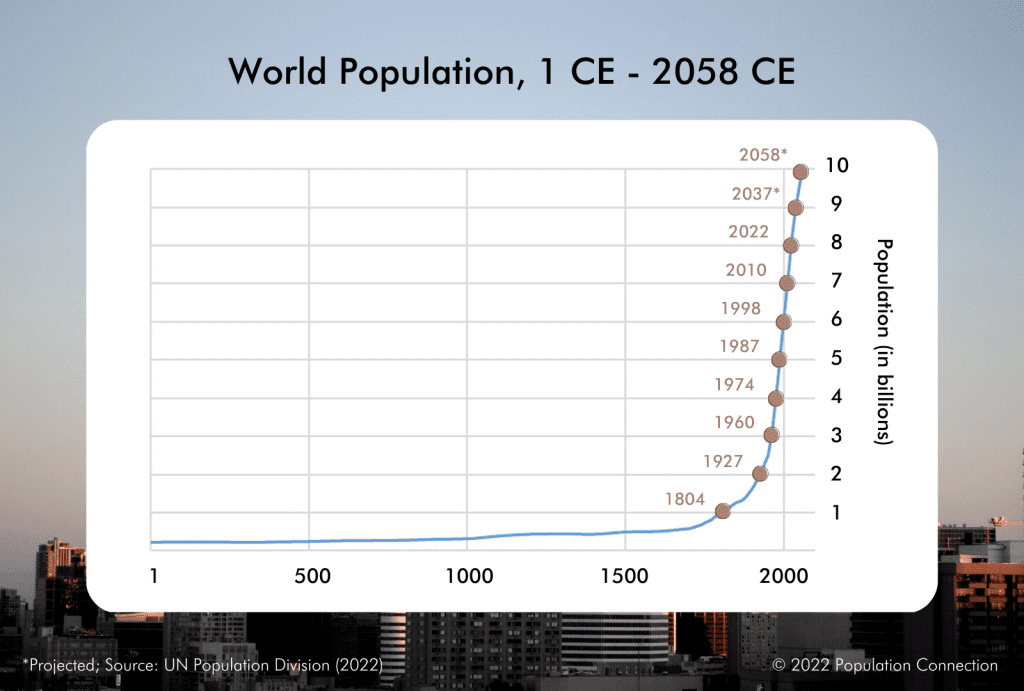
What is less talked about is where the population growth has been the highest.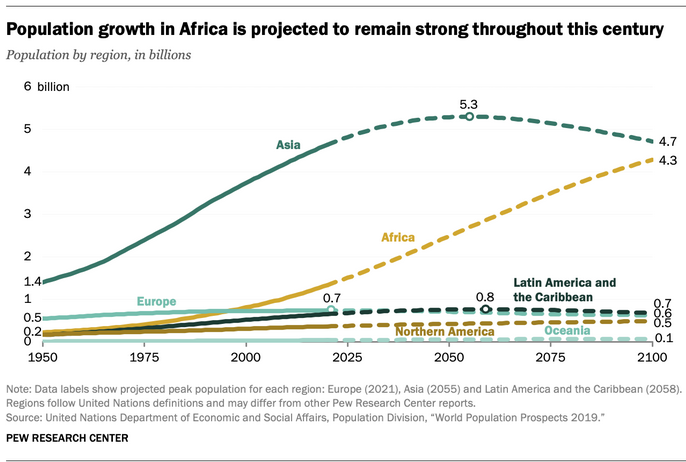
Or where we see high human population density.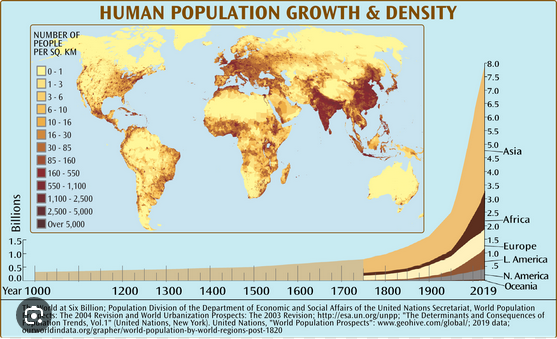
We are already seeing African nations failing to maintain democratic governments in the Subsaharan region. This is where higher birth rates combined with climate change (droughts) are resulting in more conflicts and out flow of people. Many of the migrants at the US southern border are now coming from Africa and Asia and this will likely continue.
NGOs have worked to reduce child mortality in poorer nations. More children who survive then become more parents. In the absence of jobs and food security what do they do? Sending more food aid or weapons is just exacerbating the problem. Giving women family planning options is the only thing that will make a difference.
Unfortunately, even with family planning options, having a lot of children is still considered desirable and necessary in very many countries on the African continent. In addition a lot of women lack empowerment in the predominantly patriarchal societies.
Education of females (past Primary School age) has been shown to bring down birth rates but has a low priority in many cultures.
The migration issue is only going to become more extreme in the coming years.
I would say that family planning options should not just be “women’s” only. Family planning should involve men and women. The problem is “family planning” goes against various economic, religious and political dogma. 🙂
Of course, it should be both men and women’s responsibility to plan for pregnancy and children. If only people were prepared to care for the children they bring into the world. Sadly, this is not often the case. IMO a group’s dogma should have no place in this decision unless those telling others how to live their life are willing and able to step up and care for children born.
Resilience should publish more articles like this.
I think demographers keep missing the cause-and-effect of population growth.
Yes, women’s rights and education are important, but they are just side-effects.
In Erlich’s famous equation, “Impact equals Population times Affluence times Technology,” I would re-define the centre term to “Access to energy.”
If a village gets electricity and an electric water pump, the women don’t need to breed water-carriers. Women’s education hasn’t changed, nor has women’s rights; all that’s changed is where they get their energy.
The problem is that cheap energy is going away. There is evidence that the marginal cost of diesel production from fracked oil is already less than unity† — you spend more energy getting the diesel than that contained in that diesel!
So I fear that, in a world of declining energy, women will once again be forced to breed their slave labour force and retirement plan.
† https://thehonestsorcerer.substack.com/p/meet-the-gator-growing-energy-demand
This discussion is TOO LATE.
The overshot human population IS ALREADY HERE.
By all means birth control, by all means family planning, by all means female education (is that not biased?) but they are TOO LATE TO MAKE A DIFFERENCE.
And yes, I’m shouting. We are going through a bottleneck (Catton’s phrase and title of his last book – sadly not in the ‘Overshoot’ league) whether we like it or not.
Overpopulation/Overshoot concerns have been around for years, however it’s discussion is like the proverbial “Elephant in the Room”! People know it’s in the room and a it’s a problem but rarely want to mention it. However, even attempts at “rational” discussion often digress into accusations of “racism”, “doomer”, eugenics supporter, etc., just to name a few labels.
The author Kurt Dahl in 2009 wrote an article about overpopulation (World Population at 6 Billion at that time) and why it’s not discussed/debated. The article called “The problem with “The Problem” listed various reasons/factors why such as:
1. There is no money in it. For example, “Going Green(alternative energy, recycling, etc.)” is a huge industry, however does going green actually solve overpopulation or is being used as reason/alibi that overpopulation/overshoot is not a problem to worry about?
2. Not my problem or Short-term-ism viewpoint. Most overpopulation articles usually cite somewhere to 2050-2100 as when the World’s Population will be 9 to 11 million people. So the media and most people perceive the problem as something far, far away, to be dealt with by the next generation. In addition, at the same time the articles mention various countries “fertility rates” as going down as a reason not to worry. However, even with declining fertility rates the world’s population will be still around 9-11 million people which will need to be fed and housed. This doesn’t even factor in the effects of “climate change” on food production, etc.
3. The World’s Fundamental Systems oppose it. Democracy, Capitalism and Religion all work against addressing the problem of “overpopulation”. No Democratic Government, politician, political party is going to survive by attempting to limit the number of children. They would be voted out of office at the first attempt. In regard to Capitalism, the economic mantra of “infinite growth” even though we live in a finite world, requires everlasting consumption and demand. There is no allowance made for de-growth, reduced consumption or demand. Even now China abandoned their one child policy because they adopted Capitalism and now are worried they won’t have enough workers in the future to keep their industries producing so they meet thier GDP projections.
In regard to religion, there main goal is to increase their flock either by conversion or birth. So religions see any attempt at population management as against their GOD’s will of going forth and multiplying. For example, the Catholic Church and U.S. Evangelicals are against abortion, citing it as “murder”, but either conscious or not there is an major element of abortion is going against GOD’s commandment to “Go forth and Multiply”. In addition, the usual calls of overpopulation solutions as an attempt at immoral “eugenic” practices to eliminate certain peoples, races, etc.
4. The Overpopulation problems has no voice. There are no groups, media, etc. that are out there that advocate about the problems and/or rational solutions. This reason is that it relates to Factor #1, there is no money that can be made from it.
5.There is no positive approach (spin) to solving the problem. In other words, there is no win-win scenario in regard to resolving overpopulation. For example, a one child policy, composed of government encouragement with tax breaks, family planning 3rd party clinics, male/female contraception drugs, etc. would be met complete derision/revulsion by all Government’s/Religions/cultures around they world?
The above is a short summary of Kurt Dahl’s article. Many more points were made too numerous to be cited here. However, since the article was written in 2009 the world’s population has increased by another 2-3 billion and still is on course for 10-11 billion. So the “Problem” continues until eventually the Elephant will be finally noticed, however,, rational, practical solutions will be too late. So like any other species we will experience the effects of populations overshoot. The saying, it won’t be pretty will apply!
Human population growth over time. Fascinating video. https://youtu.be/PUwmA3Q0_OE
“Growth is slowing because average fertility rates are falling…”
Second-order affect. Fertility rates fall as more exosomatic energy is available. Fertility rates fall as a result of affluence, which is a result of consuming fossil sunlight.
Fossil sunlight is arguably on the down-slope of Hubbert’s Curve. Renewables cannot take up the slack, and are only “fossil sunlight amplifiers.” No nuclear plant has ever been constructed from just nuclear power. No hydropower dam has ever been built using just hydropower. No solar panels or wind turbines have ever been built using only green electricity. The electric power grid is totally dependent on fossil sunlight.
As diesel fuel becomes more and more dear (already happening!), affluence will also decline.
At that point, more and more women will find they need to breed their agricultural labour force and retirement plan.
But by this point, the industrial medical system will suffer from lack of energy, and infant mortality will soar.
Humans face an unprecedented poly-crisis: the combination of population, pollution, and resource degradation are going to hit us very hard… coming soon, to a civilization near you!
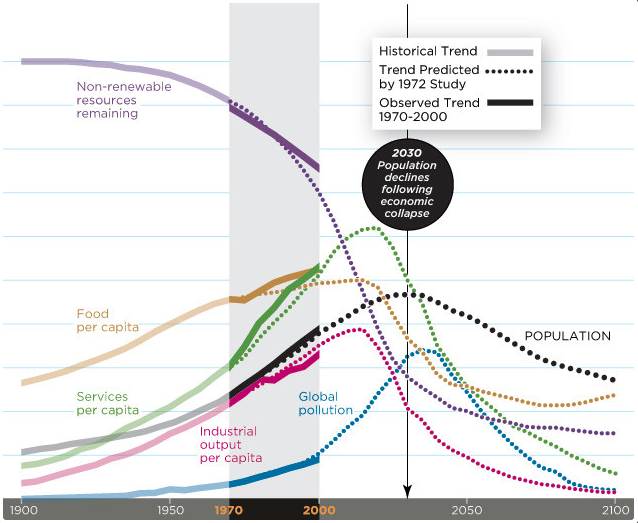
For anyone curious about that attribution-less graph, I found discussion about it here: https://www.nextbigfuture.com/2013/07/the-end-if-near-another-spreadsheet.html
I find the last paragraph — regarding the effect of more “takers” and fewer “leavers” as population ages — to be data-poor, short-sighted, and polyanna-ish.
There is growing resistance to immigration in industrial nations, even while some countries pursue immigrants as a way to pay for the steadily growing expense of supporting elders.
During the Edo Period of Japan† — a rare period of about 200 years when there were no famines and population was relatively stable — most people died in their 50s. If you survived and were unproductive, you were sent up into the mountains in the winter to fend for yourself.
I can see a time coming when seniors will again be thrown under the bus. One of the US Presidential candidates wants to cut Social Security.
If you’re “of a certain age,” I’d urge you to find an age-diverse community and find a way of making yourself indispensable to younger people. The alternative may be a one-way trip into the winter mountains.
† Just Enough, by Azby Brown. Free read at: https://archive.org/details/justenoughlesson0000brow
Provide, Provide
Robert Frost
http://famouspoetsandpoems.com/poets/robert_frost/poems/611
The witch that came (the withered hag)
To wash the steps with pail and rag,
Was once the beauty Abishag,
The picture pride of Hollywood.
Too many fall from great and good
For you to doubt the likelihood.
Die early and avoid the fate.
Or if predestined to die late,
Make up your mind to die in state.
….
https://www.researchgate.net/publication/357430417_Human_population_activity_the_primary_factor_that_has_precipitated_a_climate_emergency_biodiversity_loss_and_environmental_pollution_on_our_watch
Thanks Steven.
We usually ask that there be a comment of some sort when sending a link
Sorry for the oversight. Did not realize the community standard. My concern is human overpopulation of earth as the root cause of the Global Ecological Predicament. Humanity appears to be utterly degrading the world upon which humans and life as we know it exist. See also, https://www.researchgate.net/publication/368685373_On_Ravaging_Gaia's_Web_of_Life
City abortion funding saves city school tax, so much so that cities can then fund country abortions as well, all without answering to country voters.
In this way, my guess is that 10 cities can cover the USA and 25 can cover the world.
https://www.facebook.com/groups/4992336894196490
Thanks!
I don’t think we’ve written it as a community standard.
It just helps readers to understand why the link is being submitted.
It also discourages troll and bogus links.