


Canada’s road to net zero by 2050 will be bumpy, winding and “daunting.”
That’s the mathematical conclusion of David Hughes, one of Canada’s foremost energy analysts, in a comprehensive new report for the Canadian Centre for Policy Alternatives released today.
Hughes, a geoscientist and resident of Cortes Island, looked at what changes are needed in the nation’s energy mix to meet that goal. He found that the scale of change is mind-boggling. Moreover, the transition to net zero by 2050 hasn’t really begun yet.
According to recent projections by the Canada Energy Regulator, or CER, industry will have to:
- scale up wind and solar production by more than 10 times;
- increase controversial carbon capture and storage by 34 to 39 times;
- beef up direct air capture (a nascent technology) by 4,600 to 5,500 times its current world capacity;
- increase hydrogen production to 12 per cent of energy supply from nearly nothing;
- nearly triple nuclear power;
- reduce per capita energy consumption by up to 40 per cent;
- decrease fossil fuel production by up to 70 per cent; and
- triple the ability of Canadian forests to sequester carbon.
Under one of the Canada Energy Regulator’s successful scenarios, the LNG Canada terminal under construction in Kitimat would have to shut down in 2045, 20 years before its designed lifespan, stranding the $48.3-billion cost of the terminal and the Coastal GasLink pipeline built to supply it.
In other words, beyond driving electric cars and erecting windmills, there are many complexities and conundrums in striving to reduce emissions by 2050.
To add to the challenge, by Hughes’ analysis the Canada Energy Regulator projections include a whole bunch of questionable assumptions, and they do not mention real-life obstacles such as crumbling supply chains, populist politics, incompetent elites, technological disruptions, metal shortages for renewables and global inflation.
Future projections also ignore the open resistance by Alberta and Saskatchewan, which are dependent on fossil fuel revenue, to any substantive change in the energy mix.
Hughes said he wrote the report for one reason:
“My objective is to provide policymakers and the public with an understanding of the scale of the problem so they can appreciate the scale that any solution is going to have to take. Only with understanding and buy-in can the necessary changes be implemented.”
He also wanted to put the math all in one place for people for easy reference.
Hughes told The Tyee that a key part of any viable solution will be the seldom heard and little discussed policy of radical energy conservation.
“Maximizing reduction of energy demand through conservation, efficiency and behavioural change will reduce the need for costly energy production infrastructure, as well as infrastructure to capture emissions, and should be at the forefront of government policy incentives.”
Energy consumption today, assumptions for tomorrow
Hughes’ analysis begins with an overview of how our global love affair with fossil fuels powered an emissions crisis over the past two centuries. He then looks at energy production, emissions and energy sector revenue within individual provinces and the country as a whole.
Then he analyzes the net-zero scenarios offered by the Canada Energy Regulator last year, which are based on an economic analysis of current and declared government policies and the most comprehensive knowledge base of Canadian energy data available.
Finally, Hughes reality-checks the CER’s assumptions, some of which are extremely optimistic, to develop an understanding of what a transition to net-zero emissions might require.
The Canada Energy Regulator offered three possible pathways to net zero in its report “Canada’s Energy Future 2023.” In one scenario, Canada and the world actually accomplish the goal; in another, Canada achieves net zero but the world doesn’t; and in a third scenario, Canada sticks with existing policies and reduces emissions only 16 per cent from 2022 levels by 2050, guaranteeing accelerating climate disorder.
The only major difference between the world and Canadian scenarios is fossil fuel consumption. If the global system hits net zero by 2050, fossil fuel production declines more rapidly and LNG will be stranded in Canada; if only Canada achieves that goal, then fossil fuel production will continue at a higher level along with some LNG exports.
Hughes calls the “Canada’s Energy Future 2023” report “an important first step in evaluating what it will take to meet Canada’s net-zero mandate.”
But before delving into his cold reality check on achieving net zero, Hughes takes a hard look at our current energy predicament.
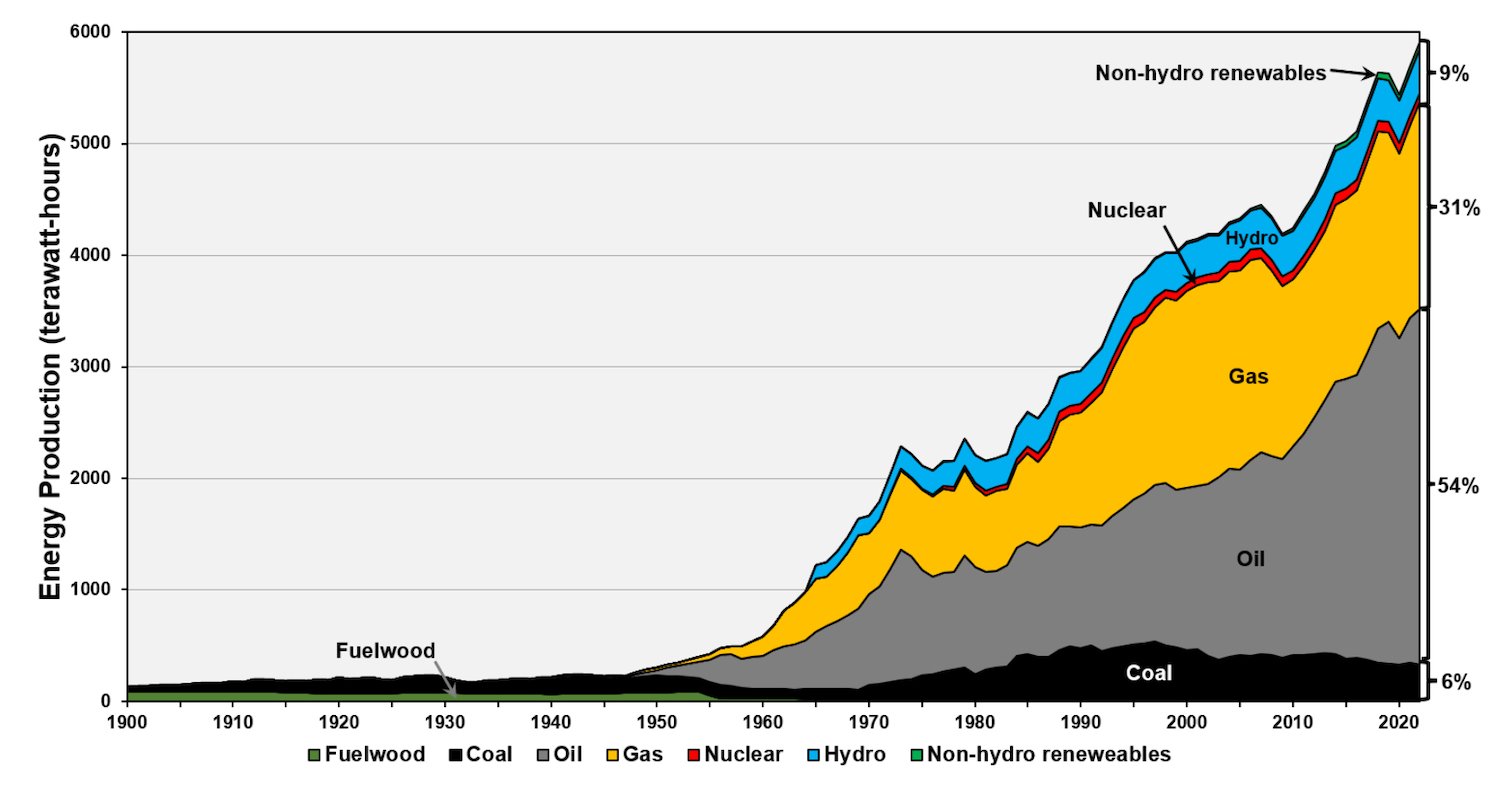
Primary energy production by fuel in Canada from 1900 to 2022. Energy production grew 46-fold over the 1900-2022 period with fossil fuels making up 91 per cent of production in 2022. Source: David Hughes with data from Our World in Data.
Governments and citizens rarely appreciate, let alone grasp, their dependence on fossil fuels.
Fossil fuel consumption drives economic and human population growth. As Hughes notes, half of the oil consumed by humans has been burned in the past 27 years; half of the gas in the past 21 years; and half of the coal in the past 37 years. Since 1800, annual energy consumption has increased 32 times.
Meanwhile population has increased eight times and gross domestic product or GDP has increased 114 times. Clouds of carbon emissions have increased 1,321 times.
As a result, half of the world’s 1.77 trillion tonnes of energy-related carbon dioxide emissions have been released in the past 30 years. Fourteen per cent have been emitted since the landmark Paris Agreement of 2015. Per capita energy consumption has also increased 3.9 times since 1800 due to the rapid growth in consumption of fossil fuels.
To date, renewables haven’t made much of a dent in energy consumption or per capita fossil fuel use, notes Hughes. Renewables have “only served to increase overall energy consumption.” In 2022 fossil fuels still accounted for 82.9 per cent of total world energy consumption.
Canada reflects fossil fuel’s dominance of energy flows and then some. For starters Canada has one of the highest per capita energy consumption rates in the world. Canadians spend energy at 4.9 times the world average and 2.8 times the European average. As profligate spenders, Canadians are profligate emission producers.
Canada is also the world’s fourth-largest oil producer. More than half of the country’s production is exported. Not surprisingly oil and gas extraction accounts for the single largest source of the country’s greenhouse gas emissions: 28 per cent. Since 1990 oil and gas emissions have grown to 189 from 100 megatonnes per year due to rising production and exports. Meanwhile the petro-economies of Alberta and Saskatchewan produce 48 per cent of Canada’s emissions yet have only 15 per cent of the country’s population.
Hughes notes another issue. Given that it takes energy to grow the economy, significant drops in emissions over the past two decades have occurred only during the 2008-09 recession and the beginning of the COVID-19 pandemic.
“Canada faces daunting challenges in meeting its net-zero commitments,” Hughes writes. “These are not insurmountable but must be clearly understood and faced head-on with policies and incentives commensurate with the scale of the problem.”
As things now stand, Canada gets 90.8 per cent of its primary energy production from fossil fuels (54 per cent from oil, 31 per cent from natural gas, six per cent from coal). The remainder comes from hydro, nuclear and renewables. These percentages must change places to get to net zero.
The CER’s two successful scenarios assume that this is possible but with what Hughes considers a lot of questionable big ifs.
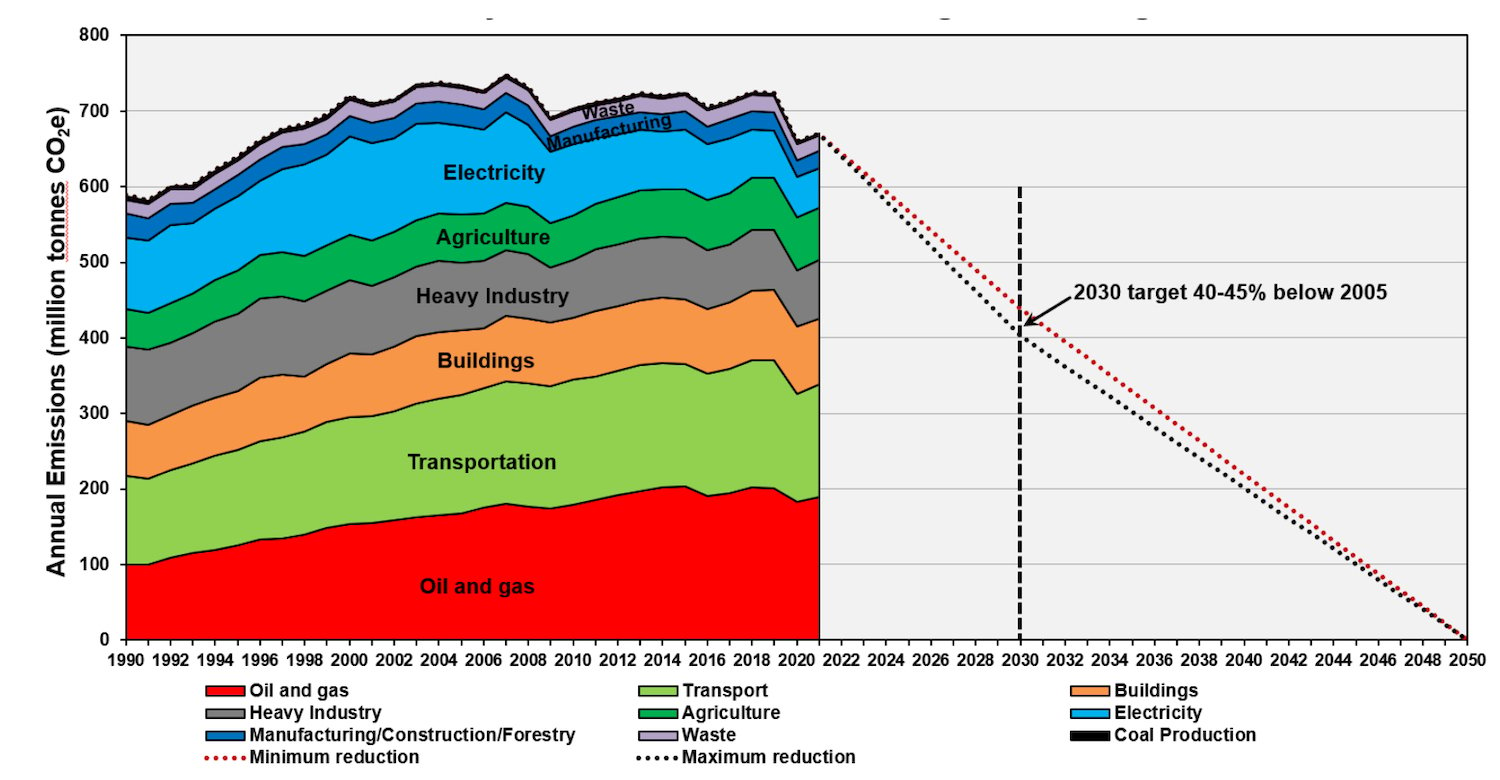
Canada’s emissions by economic sector through 2021 and its emissions reduction commitments through 2050. Emissions from land use, land-use change and forestry are not included in Canada’s official National Inventory Report. Source: David Hughes with data from Canada’s National Inventory Report.
The first big if Hughes analyzes concerns the near tripling of nuclear capacity with small modular reactors. Canada would need more than 80 of these reactors built by 2050 even though only one is currently under construction. Hughes doubts that is a realistic goal unless costs and construction times can be significantly lowered. That’s something that doesn’t seem to happen in the real world anymore, particularly with nuclear power.
The next big if concerns controversial carbon capture and underground storage, or CCS — the building of facilities to capture and bury carbon under the ground for thousands of years. Even the International Energy Agency admits
“the history of CCS has largely been one of unmet expectations. Progress has been slow and deployment relatively flat for years. The current level of annual CO2 capture of 45 megatons represents only 0.1 per cent of total annual energy sector emissions.”
According to the CER’s net-zero scenarios, industry would have to add 1.5 to 1.8 times Canada’s total current CCS capacity every year from now until 2050. Hughes doesn’t think that’s desirable or realistic.
Why not reduce dependence on fossil fuel even more instead? he asks.
Direct air capture raises similar problems. The Bulletin of the Atomic Scientists recently called the infant technology dangerous and stupid.
“Unlike other climate technologies, the only way to make air capture a business is with oil production and perpetual giant subsidies. Misallocating resources to air capture makes the planet hotter. The only winners are the recipients of the subsidies and the builders of the boondoggles,” say the authors.
The next big if concerns the overall issue of cost. The Canada Energy Regulator largely assumes in its successful scenarios that the cost of renewables, hydrogen, batteries, CCS and nuclear power will magically go down. Yet even the International Energy Agency notes that is not the current reality:
“Costs have started to increase rather than decrease in the last two years for some clean technologies such as solar photovoltaic and batteries, reflecting inflationary pressure and, in particular, surging costs for critical minerals.”
Next comes the issue of overhyped hydrogen. The Canada Energy Regulator assumes it will play a big role in getting to net zero. Hughes questions that assumption:
“The use of hydrogen as an energy storage medium is in its infancy and its current production for the chemical industry is very energy- and emissions-intensive,” notes Hughes. Furthermore, “producing hydrogen from renewable electricity costs 54-82 per cent of the energy in the electricity used.”
Although some hydrogen will be needed for hard-to-electrify uses, reducing the amount in the CER’s scenarios by half would be more realistic.
What it will really take
Hughes concludes that getting to net zero will be a steep, hard climb and will take much more aggressive policies than those currently on display in government.
Rather than assume that carbon capture and underground storage or direct air capture can be affordably scaled tens of times from current levels before 2050, Hughes recommends reducing fossil fuel demand by half compared with the CER scenarios.
He adds that reducing fossil fuel demand will require scaling up the proportion of energy demand supplied by electricity, which will mean more renewable generation. (Remember: hydro and renewables made up only 11.8 per cent of end-use energy demand in 2022.)
Canadian forests cannot triple their ability to sequester carbon (as the Canada Energy Regulator’s scenarios envision) without major changes in industrial practices. As Hughes reports, they have become major carbon emitters, not sinks.
The carbon released from last year’s wildfires exceeded the country’s total GHG emissions. “Clearcuts replaced with combustible monocrops” have compromised the ability of forests to capture carbon from the air, reports Hughes.
Lastly, Canadians will have to use much less energy to prevent an acceleration of the climate crisis. And that means an end to economic growth.
“Mother Nature has other priorities,” Hughes told the Tyee. “We are going to have to accept contraction, unfortunately. It has been a slice. But the math does not work for continuous growth.”
Echoes from US experts
Hughes’ findings are mirrored by a U.S. study published by the academic journal Sustainability. The authors conclude that, yes, it is theoretically possible to achieve net zero by 2050 with the following conditions.
Energy demand must be constrained to 25 per cent or less above the present level.
The development of renewable energy sources must be done at six to eight times the present rate.
Governments would have to apply aggressive energy efficiency and conservation measures; nuclear power would expand by 30 per cent or more.
Per capita energy use would need to fall by 40 per cent or more.
And carbon capture, utilization and storage technologies would have to be built everywhere.
“We readily acknowledge achieving these goals in practice will depend on some technological breakthroughs and a high level of international co-operation that are both uncertain and may not be possible,” say the U.S. researchers.
They also admit that the availability of land and metals may make the achievement daunting.
The researchers also note, as does Hughes, that
“added renewable energy is not yet replacing fossil fuels because of growth in energy demand due to increases in population and per capita consumption. It only met 42 per cent of increased energy demand in 2019.”
The researchers say the biggest uncertainties in their scenario “are whether renewable energy can be increased sixfold and whether demand increase over the 2020 level can be constrained to 25 per cent.” ![[Tyee]](https://thetyee.ca/design-article.thetyee.ca/ui/img/yellowblob.png)




Comments
We changed commenting systems on September 10, 2026 as part of a site-wide functionality and security upgrade. Your past comments have not disappeared, and you can still log in with your old Disqus account credentials if you wish. Contact us with any questions.
And we should remember to add the high probability of nuclear technology failures, much higher than projected costs, and the ever present nuclear bugaboo of toxic wastes and their management. We still don't know how to resolve nuclear wastes. Humanity is addicted to pollution and toxic wastes as 'progress' – when will we learn?
I realize the modular reactor faithful have already decided such issues are overblown and/or irrelevant. But for those of us who do not accept the nuclear advertising for modular reactors as legitimate/accurate, we again must return to the black hole at the center of humanity's conundrum – using much less energy and cleaner energy while ensuring economics does not punish mere citizens for the criminality of economic extremists that lock us into failure and authoritarian domination.
The desperation to produce more energy to serve the endless growth propaganda is our unresolved pathology and a political crime against humanity and our blue green planet.
The takeaway – not the coffee, the idea – is that an ‘economy’ as we’ve come to know it, is not viable at such a low energy use-rate. And that we will not go there willingly – but will be forced there anyway.
So the more we can raise awareness of the implications, the better.
I envisage the collapse being like falling down/walking down a staircase. Societies dependent on fossil fuel will be hit hard. Low tech and large self-suficent autocratic countries, like Russia, might last longer. At some point rising sea levels, land temperatures, etc and millions of starving refugees will force a demand/supply drop to sustain a much smaller, less mobile population. The lucky survivors live a life totally based on their ingenuity using a limited supply of low tech electricity and manual/animal labour.
“I think the scale assumed, not whether or not more nuclear and DAC will be added, is what is being questioned. Sure some will be added – one SMR is under construction – but it is wildly optimistic to assume 80 will be built in the 26 years remaining until 2050.”
I’m pretty sure nobody is assuming the various parts of this transition *will* happen. These are rough CER projections of what would need to happen. So the most they are assuming is that some workable combination of these builds is possible. And even the critics aren’t saying this would be impossible. Only that it would be difficult and daunting. But what alternative would not be difficult and daunting? And the notion that 80 small nuclear reactors could be built in 26 years looks practically unachievable if we imagine trying to do it using the civil engineering model of old-tech nuclear, but that isn’t how SMRs would be built. If you look at the build time for, say, airliners (which are far more complex than any of the SMRs being developed) or supertankers (which are far more massive) the build times for those are generally less than two years each, and multiple builds can be in-progress at the same time. So a single shipyard was able to produce all four TI-class supertankers in under two years–while also building other ships–and Boeing has often had years in which it delivered more than 300 airliners. With that kind of build approach, 80 units in 20 years (4 units per year avg.) across all designs from all makers combined does not seem so unachievable.
“Similarly with DAC – some additional capacity will be built – but 4600-5500 times current world capacity in 26 years is an extremely unlikely assumption.”
Last I heard (late last year) global DAC capacity was around 10K tonnes per year. These are demo and lab-scale projects, with no full-sized plants in operation anywhere. Relative to that, we’ll need something like 3.5 million times current world capacity. I think the full scale plant most likely to go operational first will be the Stratos plant in TX, slated for 0.5 megaton scale. With that one plant, the needed scale will change from 3.5 million x to 70 thousand x. Oxy has also secured land for a 30 megaton hub in south Texas–which would drop the needed scale down to 1200 x, and that’s for just one kind of DAC from just one company. How much did global solar capacity increase in 26 years from, say 1996? Wasn’t that more than 3000 x? Challenging–yes But unachievable? I think it’s way too early for such a conclusion. We’ll have a better sense after we’ve built a few plants. And again, what are the better alternatives? The article here mentioned reduced dependence on fossil fuels, but that does nothing to draw down CO2 that is already in the air–which we are definitely going to need on a massive scale.
Just a thin, greasy line in the strata, someday!
Perhaps with a bit of luck, the sentient bonobos, canids, or cetaceans that evolve will do so before our artifacts totally turn to dust, so they can take that as a warning sign.
Ain’t gonna happen, obviously. Collapse will, even more obviously. Though I expect someone will decide they can nuke their way outta the grave we’ve dug for ourselves first. The only question is “what, if anything, that any human has ever said or done, will survive?” But that’s a question whose answer no one reading these words will know.
“The first big if Hughes analyzes concerns the near tripling of nuclear capacity with small modular reactors. Canada would need more than 80 of these reactors built by 2050 even though only one is currently under construction.”
If only one is under construction, that pretty much by definition means that it is not being constructed by modular manufacturing.
“Hughes doubts that is a realistic goal unless costs and construction times can be significantly lowered. That’s something that doesn’t seem to happen in the real world anymore, particularly with nuclear power.”
It happens often with modular manufacturing–which nuclear power has never had before. So projecting future modular build cost and speed based on the track record of the bespoke civil-engineering model of the past has an obvious flaw from the outset.
“Direct air capture raises similar problems. The Bulletin of the Atomic Scientists recently called the infant technology dangerous and stupid.”
That’s the thing about infant technologies. Like actual infants, they all start out weak, and not very bright, and full of risk. Every technology that eventually achieved strength went through that early phase. And that Bulletin article authors were projecting long-term future capture cost per tonne of CO2 based on the build cost of the very first full-scale facility–for just one form of DAC. That seems like a particularly stupid basis for calling an infant technology stupid. Imagine if anyone had projected all future photovoltaic facility costs based on the price of the very first one. Also stupid was the authors’ supposition that we wouldn’t need DAC for 50 years, if ever–as if we could wait around for 50 years to see if we’ll need it (and actual scientists have already concluded we will) and then develop it instantly when it is needed. The reality is we are already late in getting started on its development, and we already have need of it, and we will need to do years of development work on it before it is ready to take up a major load.
As for danger, we don’t have any totally-safe means for rapidly pulling hundreds of billions of tonnes of CO2 out of the air, but if we don’t figure out some way to do that, we will either need to do solar radiation management–which has dangers and costs of its own–or we will be facing the accumulating and cascading harms that accelerated heating will almost certainly bring. Because accelerated heating is what we will get if all we do is halt all fossil fuel emissions. That part is already baked-in.
I don’t know what Canada’s future will be, but when it comes to nuclear technology development, and DAC technology, and synfuel development, Canada has already played an outsized role for its population size (less than California last I saw). So if we are going by track records, I think it is premature to count Canada out for being able to continue in that leadership role.