

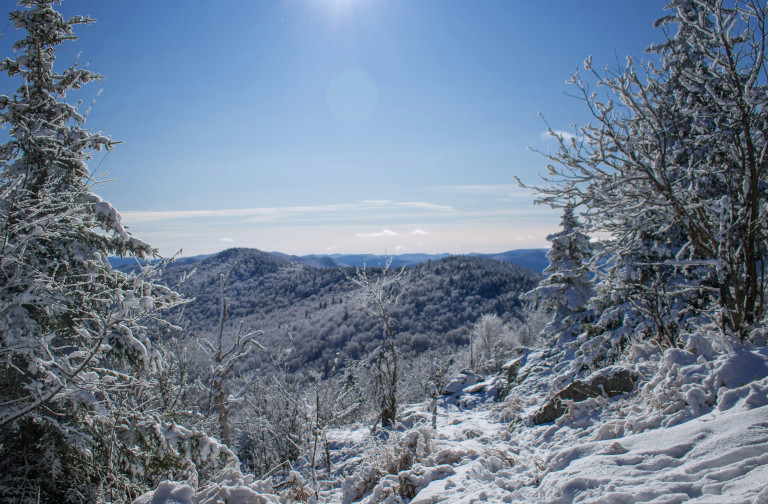
The Official Groundhog in Pennsylvania did not see his shadow. If there are groundhogs stirring in Vermont, they also did not see their shadows. There have been few shadows for months and none this week. In my weather calendar, I’ve recorded three days of sun and another four of partial sun since November. Not especially good weather for making shadows.
This is also not especially good weather for making solar energy. These people, who I trust more than most to deliver unbiased information, say that you can expect your solar panel output on fully cloudy days to be just 10-25% of normal. Perhaps, if you have dozens of panels, most of which are just there for redundancy (ie those cloudy days), you may be able to keep the electricity flowing in average Vermont weather. If your solar cell surface area is closer to an average rooftop or free-standing mount, I wonder if you’d even be able to keep the lights lit on cloudy days.
As an example, there is a speed check sign coming into my town’s downtown area where the speed limit drops to 25mph. It is powered by a solar panel that is in full sunshine all day at a good southern exposure angle. The panel has to power a radar gun to record speed and an LED display, so it’s not a great deal of energy use, maybe about the same as a strong incandescent flashlight. I would estimate that the solar panel is about two square feet of surface area. Now, it can get covered in snow on occasion, and there have been a few such snowy days this winter. However, the bigger problem is that there has not been sun. I have not seen that sign lit up since sometime last autumn. This suggests that a fully exposed 2ft square panel can’t keep the lights on in Vermont these days, never mind powering more energy-intensive appliances and tools.
I don’t want to be a solar pessimist. However, I have to be a realist, especially when investing that much in an energy system. You would need to install a large bank of solar panels just to run the lights and perhaps the fridge, an electric range and a hot water heater. But then here in Vermont with all its cloudy days, you would need 4-10 times the surface area necessary for the same output as on a sunny day. So if your energy needs translate into the sunny day capacity of an area of 225 square feet (which is a low average for the energy needs of an average American home), then you need 900-2250 square feet to collect enough photons on cloudy days. At the upper end, that’s about a quarter of my quarter acre property covered in solar panels. And unless I have a similarly large battery bank, I’ll only be able to power things during daylight hours.
I’m not sure that I would make that investment even if I could afford it or had the space for it — neither of which is true. The upper end of that area is more space than my entire rooftop, nearly half of which does not face the sun, ever. I could cut down all the trees in my jungle and put a bank of mounted solar panels out there — and I have thought about doing just that — but then I don’t get to have trees, which would be a much more productive use of that space for a much longer time period than a solar array with a usable life of less than three decades. (Great for me, but only for me… after which that is a large bank of rather toxic trash.) And as for the expense… I used this page of decidedly intimidating numbers to calculate the lowest expense — that is, for 900 square feet, without considering the battery bank — and found that it would cost between $3600 and $9000 just for the panels, no installation labor or mounting equipment or whatever it needs to deliver that energy to your house (which, if it’s going to be a free-standing panel bank out in my jungle, is at least power cabling under or over the street and a substantial upgrade to my house wiring). I don’t have that money. I don’t even know that many people who do, and I am part of a rather affluent demographic.
Of course, most people don’t buy their solar panels. I suspect that the panels in my neighborhood — of which there are very few — are all owned by SunCommon or other solar power companies and are rented by the homeowners. In theory, this rental fee is offset by reduction in electrical energy costs, potentially even credits from Green Mountain Power if the panels are feeding unused energy into the grid. (At times when the grid needs it, that is). However, there are no arrays anywhere in my town that are large enough to be producing sufficient household energy in cloudy weather. So these houses still must be connected to the energy grid and its monthly expense. And I suspect the rent on the panels is more than what is shaved off the grid electricity bill. Especially if the electrical system is providing home heating.
If the house electrical needs include heat, you must have electricity flowing at all times, most especially when there isn’t much, or any, sunlight. I would guess that a well-insulated Vermont tiny house might be heated by a solar-powered heat exchanger if there is a large battery bank somewhere near the tiny house to keep the heat on at night. I doubt it’s even possible to heat my house that way. For one thing, I would need to re-plumb the basement in order for an exchanger to be used in place of my oil-burning furnace. I’m also not clear on whether it’s possible to use my current central air duct system or whether I’d need to install water-based heat delivery — ie radiators and all that incumbent plumbing. If I skipped that and just used a space heating arrangement, I’d need at least one heat pump for each level of my home and probably more than one for the second level, where there are bedrooms and bathrooms. That’s a lot of electricity, and it’s most needed when there is no sunlight.
That’s also a lot of expense. Each space-heating heat pump is going to cost at least $1000 and will need considerable labor and materials to install. There will probably be holes cut in exterior walls. Architectural Digest says that it’s more expensive to install space heating than central heating, though I get the feeling that they are assuming a compatible heat-delivery system is in place. If you need to add ducts or pipes, they seem to think you might as well build a new home. Which few of us can afford.
The other day, I saw a newsletter from 350Vermont that talked about a neighborhood solar grid. For about ten seconds my brain was hijacked by Bright-Shiny-“I want that!” — and then reality reasserted itself. In my neighborhood, the only available space for a community solar panel array is my jungle. I would be happy to cut down the trees in order to power my whole neighborhood, only I don’t know that my quarter acre could power the whole neighborhood. Maybe the lights and minimal refrigeration… if we had more sunshine… From the calculations above, it seems like it would take much of the quarter acre just to power this house if heating is included and the skies remain cloudy.
However, there are also economic problems. For one thing, many of my neighbors live in rental homes. And nobody up here has a great deal of expendable income. In the twenty or so houses nearest my quarter acre, I think less than half are owned and maybe three or four of those homeowners are not on fixed incomes. Renters can do nothing about the electrical systems in their homes even where they have the money to spend (and at current rents, they probably don’t have the money to spend). On the other hand, unless they’re both wealthy and unusually altruistic, older people are rather unlikely to invest their retirement funds in expensive home upgrades — and the majority of property owners, for both home ownership and rental properties, are older. (Remember: Boomers own 53% of all material wealth in this country.)
To get the people in my neighborhood to invest in a communal solar array, I would need to first find the owners of each of these rentals and then convince all those people to spend money that does not benefit them. In fact, it reduces their income. Then I would need to convince the older home-owners to spend money they probably don’t have on an electrical system that they probably won’t use for more than a decade. In summary, in my immediate neighborhood, there might be one or two households who would stand to gain from a neighborhood solar array and could afford to invest in it — however, these are probably the one or two houses that already have rooftop solar.
And none of this addresses the biggest uses of household energy — heat. I would be shocked if a rental property owner would gut their heating systems in order to install electric heat. But I don’t even think it’s possible. To heat twenty old Victorian homes in central Vermont would likely take more solar panels than would fit in all the area taken up by twenty old Victorian homes. It takes a lot of energy to generate the waste heat necessary to warm a house even just a few degrees above ambient temperature. Heck, it takes a lot of energy to generate heat at all — and the more heat needed, the less it is possible for electricity to generate it.
I’m sure you’re aware that most high-temperature industrial processes are just not possible with electrical heat generation. Electrical systems melt down at temperatures far below what is necessary to produce glass, for example. But even within the range of possibility, electrical heat generation is energetically and economically expensive — it takes a lot of pricey electricity to run a heat pump. An average 15 square foot solar panel produces 1.5 kilowatt-hours of energy each day. An average heat pump uses 15 kilowatt-hours every day. That’s ten solar panels just to run the electric heat pump on an average house — and that’s in an average winter climate (whatever that means…). How do you heat Vermont houses with heat pumps? I think for most houses, it may only be possible with grid power — and a considerable investment in electrical upgrades.
In Vermont, this means that electrical heat is largely produced by burning the same fossil fuels that currently heat homes. Perhaps there is less diesel oil in the grid electricity (maybe), but there is very little “renewable” grid electricity. Because the grid is neither publicly nor individually owned, there are few paths to grid-scale fossil-fuel independence. The grid is not a state-owned thing where upgrades can be financed with public money (if there is that much public money). It is not a personally-owned thing that can be financed with property-owner money (again, where there is that money). For most of this country and nearly all of Vermont, grid electricity is a corporation-owned thing that must generate more revenue than expense for its shareholders.
So for as long as it is possible to run power generators with fossil fuels, that is what will happen. There will be no investment in other energy sources. There is no incentive to spend money to create new systems and infrastructure. (Especially when the energy source is inferior to the current system.) But it might not even be economically possible, even if the energy corporation does what corporations do — pass all costs onto their customers. To build out this grid conversion to renewables, users would need to pay many, many times what they currently pay in electrical bills, and most people just don’t have that elasticity in income. Money doesn’t appear just because expenses are increasing. There would, instead, be a large-scale reduction in electrical energy use as more and more people were unable to pay those costs. Which demand-destruction would result in a collapse of the grid.
So unless we start converting our energy systems to user-owned corporate entities that do not need to produce profit — just energy — it is very unlikely that grid-scale energy will be converted to anything other than what it runs on now. But even if we do that impossible thing, the conversion will still cost money. Who will pay for this transition and with what? Who or what is going to pay for the labor, resources, and energy needed to do all this? Do we nationalize every part of the process — from mining and manufacturing and installation to disposal of the current infrastructure? Do we nationalize all resources? And still, how is it paid for even then? Who or what is going to pay taxes that can be spent on nationalized expenses? And once we jump that considerable hurdle, who or what is going to pay for maintaining this whole edifice? I just don’t see how this is going to happen… This energy grid conversion would cost more than we have to spend. And the conversion is just the beginning of the expenditure.
And this brings me to the most intractable problem with running the house on solar energy. Or renewables generally. This wholesale conversion is not a one-time expense. Renewables are not really renewable. Yes, the energy source is more or less continually available (though rather intermittent in Vermont weather). But none of the tools that we currently use to harvest that energy are renewable, and none of them last for more than a few decades. This whole infrastructure would need to be replaced at least every generation. All the solar panels. All the electrical infrastructure. All the turbines and generators. And because almost none of it can be recycled, nearly all of it is waste, a good deal of which is highly toxic. Where does all that waste go? Where do the new resources come from? How do we generate the heat necessary to make these tools? Glass panels, steel, concrete footings — all of these processes require temperatures that can’t be generated with electricity. And most problematically, how do we move all this bulky stuff around without fossil-fueled engines?
If we pooled all our labor and resources together to turn everything over to renewable energy right now — if that were possible! — we would only have about three decades of energy use, after which… we’d have what we could produce locally, at human scale… and a large pile of toxic trash everywhere.
And even if that miraculous conversion could be accomplished, there’s still no guarantee that, in that very short term of system viability, Vermont would have heat in cloudy winter weather. Among other issues… (For example, did you know that solar panel output is also substantially reduced at air temperatures above 77°F? I didn’t until today… puts air conditioning in a whole new light…)
This does not seem like a reasonable project, even to gain a bridge to a more sustainable way of living. It sounds like it costs more than the Earth has. And what exactly does it buy us?
It seems to me that the only thing it gains is the ability to use electrical appliances for a few more decades. Probably only for a few wealthy people. And only if we keep using fossil fuels for mining, transport, and manufacturing everything.
So what if we don’t do that? What if we transition instead to the long-term, localized, human-scale economy that is inevitable no matter what we do? What does that look like?
There may still be solar panels. However, I suspect most will be for heating, not generating electricity. Most of our actual energy needs relate to heat, and electricity is approximately the worst method of producing heat. Moreover, unlike a solar electricity panel, a solar heating panel is made up of simple components that can largely be made at human scale, using local resources. Glass is still a problem, but maybe we’ll come up with ways to create translucent panes of wax or fabric or bioplastics that can withstand weather. And for the interim, we have glass — and glass itself is rather durable and recyclable and non-toxic. In any case, at small scales, it might be possible to repair solar heat panels more or less indefinitely. This still requires a considerable expense in heating infrastructure replacement, but given that Roman plumbing still works, I suspect that we wouldn’t need to replace that infrastructure more than once, certainly not every generation.
And maybe we reconsider home heating. Maybe we don’t heat a whole building, but only the parts that need to be heated, the places we sit and sleep and have pipes that must be kept above freeing. Maybe we don’t heat spaces forty to fifty degrees above ambient temperature. Maybe we wear more clothing and use blankets in winter. Maybe we don’t have enormous rooms and high ceilings and lavish panes of glass letting in the light — while just as effectively letting out the heat. And maybe we start to rebuild our homes to take advantage of ground warmth — and cooling!
There will also be heat needed for cooking and cleaning — because there has always been heat needed for those tasks, as long as we’ve been human. There will be burning, but I suspect we’ll go back to burning wood and peat and animal wastes in small, contained fires. We probably won’t be as profligate with our cooking as we are today, but then we probably won’t have as much desire to be profligate. When cooking is about filling bellies and nurturing bodies, there really isn’t much energy necessary. One loaf of bread and a pot of stewed veg can amply feed a body for a week. This is a matter of a few hours of fire, maybe a dozen in a month, the equivalent of maybe three or four foot-long sections of quartered maple limb. And of course, when there is fire for cooking, there is also space heating. The wood-fired stove can bake the bread and — when paired with thermal mass like iron and masonry — heat the entire room for hours.
I suspect this is where we are going no matter what sort of transition we think we are creating. We just don’t have the resources to invest in short-term systems. We don’t have the resources for much of anything really. Whatever comes next will be a cobbling together of what exists now, and acres of solar panels along with all their incumbent electronic infrastructure do not now exist. Nor does any electronic thing that will last more than a few years. And as those electronic things wear out it will be increasingly impossible to replace them. Within a couple decades, an electrical grid will not be necessary because we won’t have the functioning stuff left to consume electrical energy at grid-scale.
So, what will happen in cloudy weather in Vermont? For one thing, we’ll all be sleeping more, and we won’t be doing much when we are awake. We won’t be going shopping or otherwise traveling around. We won’t be engaging in the immense waste of resources and time that is wage work. We will probably be hunkered down with small tasks, few of which require more-than-human energy. As this century wears on, we’ll be repurposing whatever we have into whatever we need. There will be less need of large heated buildings, more need of space for trees and other truly renewable fuels, those that can reproduce themselves. My quarter acre jungle planted in fruit and nut and maple trees will be an invaluable store of real, warm wealth!
And when the sun doesn’t shine, we’ll gather around the wood stove. It will not always be pleasant, but then it’s not pleasant today either for most people. And a world covered in toxic trash, the energy fever dreams of today’s wealthy people, would be thousands of times worse. Probably unsurvivable… So I’ll take the quickest path out of today’s energy-sucking culture. And that path does not include photovoltaic heat.
I suspect the Official Groundhog will be predicting earlier and earlier springs. The real groundhogs will be sleeping until spring actually arrives, when the green world awakens, which is a function of sunlight as much as weather. The irony is that even though it will be warmer and the Groundhog won’t be seeing his shadow for all the clouds, plants will not be putting out growth any earlier because they won’t have enough light to feed themselves. It may be spring warmth, but it won’t be spring until we get some sun.
Similarly, winter may be warmer, but it won’t be warm enough to go without heat — and heat will be very difficult to generate from sunlight in cloudy, short winter days. Among the many flaws in depending on technology to save us, this is one of the most fatal. If we put all our efforts into creating a system of electric heat, what we’re going to produce is very little warmth for most people, a whole lot of wasted resources and toxic trash — and no capacity to produce any energy at all within a few decades.
Perhaps we need to take a lesson from real groundhogs… sleep through the dark winter… until there is enough sunlight for shadows. And use the Earth’s natural capacities to keep you warm.




Comments
Welcome to the new Resillience commenting system!
We have moved from the former Disqus commenting system to a new system as of September 10, 2026.
We made this change because of privacy concerns regarding Disqus. It's also part of a set of changes to bring more services to the Resilience community under a single login: commenting, (coming September 2026), and online courses (coming 2027). Unfortunately, your old Disqus comments may not reliably link to your account in this new system. Please contact us if you have any questions or concerns.
Yes rocket mass heaters do seem to profoundly boost the efficiency of firewood!
That would be essential for me, should I ever heat with wood again, as I have vowed never to use a chainsaw again. They are probably the most dangerous tool ever invented, and I’ve used them for thousands of hours. So this cat’s nine lives have been used up already.
I would have to use the woodcutting tools of old — hand saws, axe…
Hi Chris,
as an Ecomodernist for over the last decade who has finally admitted that renewables are now so cheap the old mantra of “Overbuild across a wide geographic area” is finally affordable. Now while I think we have some areas where we fundamentally agree on – as you put it – live in a rampantly consumer industrial culture – I do think that a fair reading of the peer-reviewed literature is that we actually can run most of our modern industrial processes on electricity. See my “Four Rules of Renewables” post for how it seems they are recommending we make renewables reliable. Read the Scientific American article linked there on the law of large numbers across a wide geographic area. Remember that modern HVDC means IF there was some economic case for it – we could hypothetically run a base at the North Pole from solar at the equator with only 16% transmission loss! Yes – HVDC has got that good – 1.6% loss per 1000 km.
But of course – if a nation is particularly cold and also in a Cold War with their southern neighbours (Russia, China) they may not want to rely on a power grid that expands outside their territory.
Also, “Electrify Everything” means we’re no longer fighting the laws of thermodynamics. We’ll do the same work with 60% less energy – meaning as we Electrify Everything one unit of renewables replaces OVER 2 units of thermal fossil fuel energy. https://www.sustainabilitybynumbers.com/p/electrification-energy-efficiency
Australian industrial giants worth a THIRD of our stock-market figured out it’s cheaper to Electrify Everything and run it on renewables. They’re going to build 3 TIMES our 2020 electricity grid capacity in renewables to electrify industrial heating and run electric mining trucks etc. Page 45 here. https://energytransitionsinitiative.org/wp-content/uploads/2023/08/Pathways-to-Industrial-Decarbonisation-report-Updated-August-2023-Australian-Industry-ETI.pdf
Of course, the main concern is the effect all this has on the environment. But without a doubt climate change is the MOAB (Mother Of All Bombs) and exacerbates all the others. We’ve got to roll out the energy transition ASAP while also striving for conservation, cleaning up the industrial ecosystem, etc.
The ironic thing about pushing solar-powered electric heat in Vermont — aside from not having much solar power and only passing electric grid functionality — is that there is no need here. Most homes have wood heat capacity and there is plenty of maple, much of it blown down for free each Yuletide…
This house has a spectacular hearth, two stories of thermal mass masonry just waiting to soak up the BTUs. But some idiot took out the actual heat generating bits, leaving just the brick shell. Putting in a replacement wood stove is my prime heating goal. (I like Hearthstone, been using them for decades.)
Which all sounds great on paper… but doesn’t currently exist. Nor does it change the core problems which are 1) where do the resources & labor come from; 2) who pays for it all; and 3) how do we build/transport/maintain any of it without using more fossil fuels? Oh, and who controls the super-stuff and the whole super-sized decision-making process?
1. Where do you think?
2. Customers
3. With today’s energy and mining systems as they gradually curve down while the clean electric mining and industrial systems curve up. Just like every previous energy transition. EG: The Pit Ponies gradually went underground to mine coal, then were replaced by steam shovels and pumps and equipment, then diesel, and now most of underground mining systems are ALREADY electric.
Things are changing – fast. EV’s are growing – and could be half of all cars by 2030. Off-grid EV charging stations are coming – and they are just a big battery pack with a solar roof. It’s happening so fast the IEA says there will be an oil GLUT of 3.8 mb/d by 2028! This gives other sectors like trucking and mining more fuel and time to roll out their electrification programs. https://www.iea.org/news/growth-in-global-oil-demand-is-set-to-slow-significantly-by-2028
COOKING is going electric: The Australian State of Victoria has banned gas connections to new homes – period. Being in colder Victoria – this is seen as a benchmark for the rest of Australia.
HEATING is going to heat pumps, and over a third of INDUSTRIAL HEAT can be met this way! (Up to 200 degrees C for light industry like paper, food, and chemical industries.) https://en.wikipedia.org/wiki/Heat_pump#Industrial_heating
ELECTRIC TRUCKING has now intensified with the release of the Tesla Semi which can – as long as charged on the legally required lunch breaks – go further than their human is allowed to drive on a shift! But wait – because Janus Electric in Australia is doing battery conversions of expensive old diesel trucks. The cheaper electric motor and electricity as fuel will pay back the conversion within a year. Most trucks need a major engine rebuild every 8 years – so why not do a Janus conversion and save money? Also – these are the 100 tonne Aussie Road Trains – more than twice a Tesla – and they just do a 60 second battery swap to ‘recharge’. https://www.januselectric.com.au/
MINING: All the big miners are already playing with electric prototypes – names like Catepillar, Liebherr, Fortescue, Komatsu and Hitachi. But as some of these monster trucks last 40 years – the REAL action will be in converting existing trucks. EG: These guys have funds to convert 8,500 trucks over the next 3 years. https://www.mining-technology.com/features/mining-vehicle-electrification
Watch a 240 tonne electric truck do TWICE the speed of a diesel truck while going UP hill. How? It’s charging on overhead lines from clean hydropower. No coal and minimal diesel at this mine. Also, does going twice the speed mean they would eventually only need half the trucks. 1 min here: https://youtu.be/6TxMeHRq1mk?t=213
ELECTRIC ARC SMELTING: “Industrial electric arc furnace temperatures can reach 1,800 °C (3,300 °F), while laboratory units can exceed 3,000 °C (5,400 °F).” https://en.wikipedia.org/wiki/Electric_arc_furnace
GREEN STEEL: Along with abundant clean renewable energy, hydrogen can be used to replace coking coal as a reductant. https://en.wikipedia.org/wiki/Steelmaking#Strategies_for_reducing_carbon_emissions
STORING INDUSTRIAL HEAT is an order of magnitude cheaper than trying to store electricity. Rondo Heat bricks use interestingly shaped concrete blocks to store over 1500 C – and only lose 1% per day. Perfect heat storage that enables industry to run on super-cheap but intermittent wind and solar. https://rondo.com/how-it-works https://en.wikipedia.org/wiki/Thermal_battery
Some great youtube material on green industry below – there’s nothing like seeing it with your own eyes.
https://eclipsenow.wordpress.com/thermal-batteries/
https://eclipsenow.wordpress.com/smelting/
https://eclipsenow.wordpress.com/mining/
Assertions without a shred of evidence are easy to make. Here – let me try.
We will have over 95% “live” wind and solar coverage. See – they’ve studied this. Modelled it against vast geographic regions. See? That’s called an assertion.
Let’s try with some evidence. Not mine – others. Who have studied this stuff. Unlike you an me – they’ve made a career of it. Here’s a user-friendly report on it from Scientific American way back in 2015. That’s just Texas wind – imagine adding in some solar from Mexico and Wind from Canada! That’s the kind of super-grid that’s coming.
From that article, why don’t you tell us all:-
How much wind Overbuild requires what PERCENTAGE of backup? Cheers.
Hey – today’s 22% efficiency with a THIRD of the silicon from 20 years ago (and much more efficiency) is so much better than I could have dreamed for – why not be happy with that? But over 30% has already been demonstrated in Perovskite labs that threaten to commercialise in the next few years. My (layman’s) understanding of the problem with Perovskites is that they’re fragile – they break down under that sunlight within a few years. Yet – they’ve strengthened it somehow. Nano-composite materials. Amazing hey?
firewood (trees), and direct capture is the way to go for hot water (why waste energy in transitions?).Why have your village chop down your forest every year when a heat-pump should last 15 years? I’m scratching my head here at the “logic”?
You need to study physics, before making silly assertions.
https://www.withouthotair.com/
It’s a free download, his credentials are more than impeccable. And his comments make sense (just a hint). For instance, using electricity does NOT circumvent the Laws of Thermodynamics – electricity is merely an energy vector (there needed to be a source). Oh – and wind is solar-energy-derived.
Do some learning, please, rather than plastering great screeds of cut-and-paste.
By referencing that you’re immediately Cherry-Picking 3 things:
1. An irrelevant date
2. An irrelevant place
3. An irrelevant argument.
1. DATE: Things are changing SO fast in renewable technology that a paper 5 years old is utterly irrelevant. EG: In 2016 the cost of solar PV was 30c per kWh, but 5 years later it was 7 cents.
https://energypost.eu/5-charts-show-the-rapid-fall-in-costs-of-renewable-energy/
What is it with Doomers quoting irrelevant old papers? I still get Weissebach quoted at me! Weissbach! His EROEI figures were laughable when they came out in 2013 because he quoted solar tech from 2005! Here we are 19 years later, and the solar panels he was discussing needed 3 TIMES more high embodied energy and expensive silicon as today’s PERC solar cells. With 1/3 the silicon and yet MORE efficiency, today’s solar cells have a higher EROEI than oil! (David Murphy – 2023)
https://www.sciencedirect.com/science/article/pii/S0301421513003856
Doomers need to quote modern peer-reviewed papers to have ANY hope of credibility. Unfortunately – the best they can reach for is Michaux. (And Mark Mills – a climate and peak oil denier! Ha ha ha!)
2. PLACE: You may as well pull a Michaux and quote GERMAN WINTERS at me. (Dumdumdum dah!) That’s just irrelevant. 3/4 of the human race live in the Sunshine Belt (between the 35th parallels with abundant sunshine and almost no winter.) At 1.6% loss per 1000 km, HVDC could take solar power from the Equator to the North Pole with just a 16% electricity loss. With HVDC, nowhere is outside the reach of the “Sunshine Belt”. Which means…
3. THIS IS AN IRRELEVANT ARGUMENT: As the peer-reviewed papers I keep quoting say – the wider the grid – the more the law of large numbers kicks in and smooths out the energy supply with vastly less storage.
Now – how is Britain’s electricity sector for starters? Oh – look at this!
“In 2019, the electricity sector’s grid supply for the United Kingdom came from 43% fossil fuelled power (almost all from natural gas), 48.5% zero-carbon power (including 16.8% nuclear power and 26.5% from wind, solar and hydroelectricity), and 8% imports.[10]”
https://en.wikipedia.org/wiki/Energy_in_the_United_Kingdom
They’re nearly half way there! Also, note the 8% imports. That’s about to grow – and there’s no reason it cannot grow a whole bunch more. “The project is designed to bring 3.6 GW of wind and solar energy to the UK (Figure 1) via a 3,800-kilometer (about 2,630-mile) undersea cable system, featuring four cables. Xlinks has said the electricity could supply about 8% of Britain’s power needs.”
https://www.britainremade.co.uk/undersea_cable_projects_to_transmit_renewable_energy_move_forward
An additional 8% takes the UK up to getting 16% from overseas. Maybe on a superficial level, the answer to Mackay’s question of if the UK can supply itself its own renewable power is “No” – quickly qualified by “And if they’d thought about it – it was never MEANT to! It’s a silly strawman in the first place!”
But I respect Mackay too much to imply there isn’t value in his approach. In fact – data Scientist Hannah Ritchie was inspired by David Mackay to get into energy analysis. She wanted to name her blog after his book but the phrase “Without hot air” has copyright.
https://www.sustainabilitybynumbers.com/about
She writes:
“I’ve always wanted to do an update, but thankfully someone else did the hard work for me. Last month, Brian O’Callaghan and colleagues from the University of Oxford published a policy paper looking at the potential for solar and wind to meet Great Britain’s energy needs. Here’s their summary.
Far from being an “appaling delusion” they think that its “wind and solar resources are more than sufficient to meet all its energy needs, both practically and economically”.
In this post I’m going to work through their numbers, and how they compare to MacKay’s.
I’ll try to explain clearly where their numbers come from so that you can pick them apart for yourself. I think it’s important that we get some solid numbers because it really does affect policy decisions and public perceptions. I’d be interested to hear your strongest criticisms of the paper.”
https://www.sustainabilitybynumbers.com/p/can-solar-and-wind-power-britain
Please – do check out the numbers.
Now my only question is what relevant, up to date, peer-reviewed source are you going to quote next? Leonardo Da Vinci?
Physics is not cherry-pickable.
Pot – kettle.
In your case, there seems to be a need to believe, and a need to splurge, well beyond reasonable. I suggest you take a physics course, or stick to social stuff and keep taking the medication.
So – desperate As Hominems rather than substantive replies? Looking a bit empty there Powki
Anything to avoid studying physics.
“If we’re talking energy, we need to be talking entropy”
Really? The second law of thermodynamics is news now? I thought playing with energy way back in the industrial revolution was when we discovered this law.
“it’s the irrefutable trend at the top of the ‘problem’ list.” A “trend” now is it? I thought it was a law of physics.
“Humans managed to turn the ‘fertile crescent’ into a saline desert…”
I see – you’re conflating your worldview that humans are ALWAYS bad managers of the environment with an irrefutable scientific law like entropy. You’re blurring the categories there. Try not to smuggle your worldview baggage in under the language of physics – and then claiming physics is on your side! Yes – we can be awful destroyers. We can also heal. Here’s 8000 food forests growing across the “Great Green Wall of Africa.”
https://youtu.be/1LCTVO_Y5Rs?si=AuAkb6sr5XL2T4ch
Here is the UN holding back the Sahara – with rain-trapping swales.
https://youtu.be/WCli0gyNwL0?si=UK4oWKUBM_SIdxsU
Tell me – are these guys practising good environmental management, or somehow breaching the law of entropy? You prove that – you’ve won yourself a Nobel prize! 😉
“The problem is to manage the energy-descent, rather than have it manage us.”
The Energy Descent is fine – we’ll use 40% of the energy we do today and end up richer for it!
https://www.sustainabilitybynumbers.com/p/electrification-energy-efficiency
But here’s the thing. If too many environmentalists forget basic conservation principles because they’re so busy planning for the great peak oil apocalypse that will never happen – then we may just end up with more environmental tragedies and biodiversity loss because of this apocalyptic navel-gazing.
“One problem will be the number of deniers; of evangelistic/believer types and those who are just too scared to appraise; they will need some form of control….”
It’s not my fault you’re in denial of the peer-reviewed science. You may as well be a climate denier – because the climate doomer also says there’s no point trying!
You will not have to wait very long to realise how wrong you are. The oil GLUT of 3.8 mb/d will be here by 2028! https://www.iea.org/news/growth-in-global-oil-demand-is-set-to-slow-significantly-by-2028
But hey – what do the IEA know? You’ve got “physics!” on your side. 😉
wow, really interesting article, thank you.
It is my belief that the economies of cities — urban economies — will not be able to sustain their current population levels in a very low energy economy, and so will lose most of their population to rural areas in which it is feasible (if only just barely) to meet one’s need for food, shelter, water, etc. without the income from a job. Jobs will disappear in a very low energy economy, rather obviously. City dwellers will not be able to pay rent / mortgage, nor buy food. Nor is there land enough in cities for city dwellers to engage in self-provisioning of food, etc.
So this is the really big back story — in a world in which the majority of humans now dwell in cities.
All of this demographic shifting will require time, but we’re not even yet at the stage where we’re having a culture-wide conversation on how to transition in this way.
Whether consciously or just through having not read the right papers yet, renewables sceptics often seem to ignore what I am coming to think of the 4 Renewables Rules. I have a Social Sciences background but this is not about me, but the peer-reviewed research anyone can read. And because people KEEP repeating the same errors, I’ve created a silly mnemonic to help them remember. Renewable grids should be Sunny, Super, Salty, and Soaked!
“SUNNY” – THE SUNSHINE BELT
This is an enormous area of the earth that stretches from the 35th parallel South up to the equator to the 35th parallel North. 6 billion of us live here – 3/4 of the human race! Renewables in this region never or barely experience winter. This includes Australia, Africa, India, most of South America, and the southern third of China and the USA. But sceptics cherry-pick a (hypothetically) isolated German renewables grid and start asking about winter? They want to generalise the conditions of 2 billion to the 6 billion. Is that logical? Scientific? Is it even honest?
“SUPER” – SUPER-GRIDS
So what about Germany or the northern USA and Canada? Super-grids are the answer. Models show that if we Overbuild wind and solar capacity across a large geographic reach, storage requirements CRASH!
SUPER – CAPACITY: Because renewables are 1/4 the cost of nuclear (Lazard) we can afford to Overbuild those wind and solar farms and still have change left over. EG: Engineer David Osmond graphed Australia’s terrible La Nina weather of 2022. He calculated Australia only needs to build 170% capacity in wind and solar for a mostly firmed renewable grid cheaper than coal! Just a 70% Overbuild. http://reneweconomy.com.au/a-near-100-per-cent-renewables-grid-is-well-within-reach-and-with-little-storage/
A year later he reworked the numbers – and got Australia’s grid down to needing just 5 hours of storage! https://reneweconomy.com.au/a-near-100pct-renewable-grid-for-australia-is-feasible-and-affordable-with-just-a-few-hours-of-storage/
SUPER – GEOGRAPHIC REACH: Modern HVDC powerlines only lose 1.6% of their power per 1000 km. The equator could hypothetically supply a base at the North Pole 10,000 km away and only lose 16% of the power! Now that we understand the “Sunshine Belt” AND HVDC we can see that only rare cases need live outside the reach of abundant reliable wind and solar as if there were no winter! This should all be understood by now. By the time something hits Scientific American it’s not just in peer-reviewed papers – it’s in popular culture. They described Overbuild way back in 2015! https://blogs.scientificamerican.com/plugged-in/renewable-energy-intermittency-explained-challenges-solutions-and-opportunities/
Professor Andrew Blakers won the Queen Elizabeth Prize for inventing the PERC solar cell. It’s now in 90% of all solar panels worldwide. Blakers developed plans for Australia, and warns that if each State tried to build their own grid they would REQUIRE 5 TIMES MORE STORAGE than if we linked the whole continent in the one super-grid. But a connected Australia only needs 2 days for each city! https://reneweconomy.com.au/solars-stunning-journey-from-lab-curiosity-to-global-juggernaut-wiping-out-fossil-fuels/
Professor Blakers summary youtube: 25 minutes: (timed to avoid slow intro). https://youtu.be/BIcwaXRN1Hs?t=105
IF Australia – which is IN the Sunshine Belt and is 21 TIMES larger than Germany – needs to be connected up – then how much more does Germany? But the good news is the Europeans already know all this. Germany and the whole EU itself is in the ENTSO-E super-grid spread across 35 countries and 532 million people. https://www.entsoe.eu/ The area is a THIRD LARGER than Australia! They are going to trade abundant northern wind with abundant southern solar. Remember – with HVDC powerlines – anywhere on earth can now effectively be in the Sunshine Belt. There are many plans for super-grids. https://en.wikipedia.org/wiki/Super_grid
“SALTY” – SODIUM BATTERIES
There are 38.5 QUADRILLION TONS of sodium in the sea. There are a variety of super-abundant cathodes as well -one of which is agri-waste. (Tens of billions of tons of that a year!) Sodium batteries are 30% cheaper, operate in a greater temperature range, and don’t burst into flames like NMC batteries! Also – we only need them for the first hour or so then OFF-river pumped hydro will kick in for a few days or more storage. (See Rule 4 “Soaked” below.) People that cherry-pick Germany are trying to maximise the storage requirements – and then they’ll pick something ridiculously fancy like NMC batteries and claim “There’s not enough minerals in the world!” But it’s like arguing that we could never have build the Sydney Harbour Bridge because there is not enough GOLD in the world! For crying out loud – google “Can you build x without y?” for any critical mineral of concern for ANY ENERGY TRANSITION TECHNOLOGY of concern and you’ll soon see that the entire energy transition can be built out of super-abundant and basic minerals. Sodium is just one of the new grid-batteries being worked on. Ever heard of iron batteries that rust and de-rust?
RULE 4: “SOAKED” – PUMPED HYDRO FOR DEEP STORAGE
Back to Professor Blakers – who says OFF-RIVER closed-loop pumped hydro should take over after an first hour or so. A good pumped hydro site has about 500 m to 800 m height. “Triple the height, halve the cost.” His team have a satellite database of all the best OFF-river pumped hydro sites on earth – and there is 100 TIMES more than we need! OFF-RIVER is better because it does not damage fragile river systems. It can also be built faster and cheaper – coming in at half the cost because it avoids expensive on-river spillways. https://re100.eng.anu.edu.au/pumped_hydro_atlas/
If you build a renewables grid in the Sunshine Belt, extend it out as a Super-grid, and make the storage Salty and Soaked – the whole thing comes in cheaper than coal.
Thanks for this long piece doing so much to alleviate my Vermont envy. I get sick of the social/political climate in West Virginia, but my two-person household does just fine with six solar panels, off grid. We don’t heat with electricity–I don’t think that makes sense even here, let along Vermont–but one to two cords of wood take care of our heating needs. If I lived in Vermont I’d look into a rocket mass heater, as I am always seeing claims on permies.com that these keep a house comfortable with a tenth of the wood and produce a hundredth of the emissions.
Or, if any of the new Triso-powered reactors turn out to be as cheap as it looks like they could be, we could do a lot of that for electricity and producing fuels for making glass and such. And Vermont could have nuclear power once again.
Is anyone else finding the ‘everything is going to be perfect, no exceptions’ splurger/poster to be a pain?
It is all very well threading the intellectual gauntlet via peer-review or devils’ advocacy – but this ‘everything is a forward projection of selected graphs (forget the rest folks, nothing to see here)’ approach is neither – it’s just a big space-waste/time-waste.
If we’re talking energy, we need to be talking entropy – it’s the irrefutable trend at the top of the ‘problem’ list. Humans managed to turn the ‘fertile crescent’ into a saline desert WITHOUT the help of low-entropy fossil carbon. It follows that it’s no wonder we are heading for a cooked planet, having burnt half that one-off bonanza.
The problem is to manage the energy-descent, rather than have it manage us. That will involve using real-time local solar energy, at real-time rates (only burning firewood at the growth-rate, for instance). That will only support south of 2 billion, perhaps south of 1 billion, at real sustainable rates.
We can ease that along by using existing stuff (the product of the low-entropy burn) to do useful jobs: turning derelict vehicles into old-school windmills, for instance. It won’t be permanent – entropy never sleeps – but it would tide things along a while.
One problem will be the number of deniers; of evangelistic/believer types and those who are just too scared to appraise; they will need some form of control….
Great article, but a minor lack of physics-grasp here and there.
The concept to grasp, is that we will end up on real-time solar energy. The best we can hope for, is the efficiency of photosynthesis – about 25%. Solar PV is approaching that, but won’t surpass.
But capture is food (gardens, orchards, paddocks), it is firewood (trees), and direct capture is the way to go for hot water (why waste energy in transitions?). I run a 100mm (4-inch) deep tray of water, glass over, insulated, with a lid which when raised, reflects sunlight in and when closed, insulates the gathered heat. Six months of the year (and I’m in a higher than 45degree latitude, well down in the Southern Ocean) we get free showering, and could easily store several day’s worth (in a standard insulated tank). Even if (when) supply-lines fail completely, that level of tech is maintainable using scavanged materials, for al long, long time.
The other point is that ‘cheap’ and ‘afford’ should not be associated with energy. The reason is simple; energy is needed to do work (even human labour requires solar-derived food) and work is needed to produce. Anything. So if there is no energy going into the system, there are NO dollars underwritten. Debt completely defaults. Equally, is there is a reducing supply of energy (as will obviously happen as fossils decrease) then the underwrite decreases, exponentially too. Inflation or default are the options; maybe a jubilee (as per Steve Keen).