

Conversation recorded on November 21st, 2023)
Show Summary
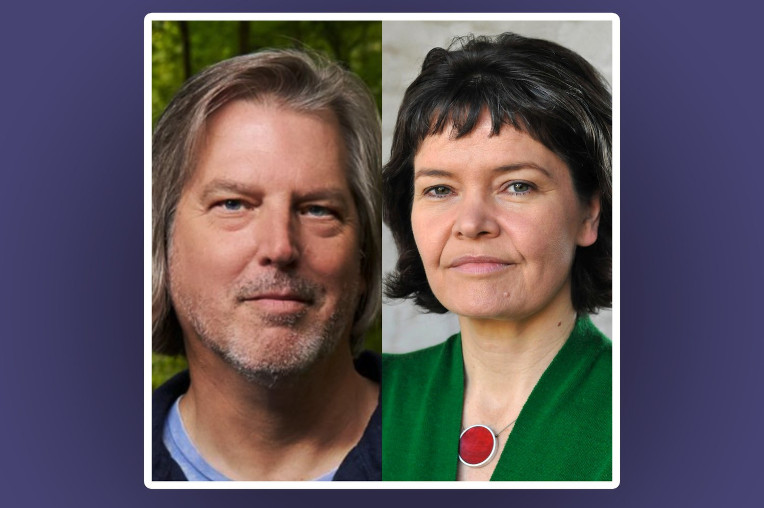
On this special 100th episode, Nate is interviewed by his friend and colleague in the metacrisis space, Kate Raworth. The conversation is a reflection on the past two years of podcasting – and how Nate’s worldview has evolved because of it. What fundamental concepts could help us better understand the trends happening around us and the potential futures they point to? With so many moving pieces, how can we begin to create a coherent story of the world around us and – even more difficult – start preparing responses to coming challenges? What should individuals aware of these converging crises be thinking about in order to prepare themselves, their families, and their communities for a materially smaller future?
About Nate Hagens
Nate Hagens is the Director of The Institute for the Study of Energy & Our Future (ISEOF) an organization focused on educating and preparing society for the coming cultural transition. Allied with leading ecologists, energy experts, politicians and systems thinkers, ISEOF assembles road-maps and off-ramps for how human societies can adapt to lower throughput lifestyles. Nate holds a Masters Degree in Finance with Honors from the University of Chicago and a Ph.D. in Natural Resources from the University of Vermont. He teaches an Honors course, Reality 101, at the University of Minnesota.
About Kate Raworth
Kate Raworth describes herself as a renegade economist focused on making economics fit for 21st century realities. She is the creator of the Doughnut of social and planetary boundaries, and co-founder of Doughnut Economics Action Lab, based on her best-selling book Doughnut Economics: 7 Ways to Think Like a 21st Century Economist. Kate is a Senior Associate at Oxford University’s Environmental Change Institute, where she teaches on the Masters in Environmental Change and Management. She is also Professor of Practice at Amsterdam University of Applied Sciences. She is a member of the Club of Rome and currently serves on the World Health Organisation Council on the Economics of Health for All.
Watch on YouTube
Show Notes & Links to Learn More
00:00 – Nate Hagens Work + Info, Frankly Series
05:15 – Energy Blindness
05:54 – 400-500 billion fossil laborers in the global economy
05:55 – We are depleting these fossil stores rapidly
06:32 – Economic growth is linked to energy growth (Section 1.2)
07:05 – Carbon Pulse
08:45 – Superorganism
09:42 – Economic growth 100% linked to material consumption
11:06 – Mordor Economy – J.R.R. Tolkien
12:27 – 1999 all time low of energy extraction as part of the economy (5%) but has grown by 10% since
13:10 – Ecological destruction of the economy
14:28 – Nate on AI
15:11 – Jevons Paradox
16:52 – Metacrisis/Polycrisis
20:23 – 13k Nuclear Warheads
20:47 – Just in time supply chain
21:02 – Food travels on average 1500 miles to the dinner plate in the US
27:27 – Donut Economics
30:18 – Citizen Kane
33:38 – Minsky Moment
38:39 – Humans weren’t evolved to handle modern day stress, but human connection helps
41:32 – Harms/dangers of social media – benefits/utilitarian uses
43:50 – Mark Twain, “Buy land, they’re not making it anymore”
45:26 – Rural vs Urban sustainability debate
47:11 – Robert Saposky + TGS Episode
48:18 – Maximum Power Principle
48:48 – Rube Goldberg Machine
49:28 – Infinite growth is impossible
49:45 – New oil drilling leases granted in Alaska and the North Sea
50:31 – Since the Paris accords, we’ve grown coal capacity by 200 GW
53:02 – Fossil Fuel Non-proliferation treaty
53:52 – Degrowth vs Post-growth
54:21 – China has the most renewable energy, and the most coal (and increasing)
57:09 – Nate’s Homeland Security Presentation
58:02 – Renewables are actually rebuildables
1:00:36 – Joslin Faith Kehdy + TGS Episode
1:06:05 – Financial Overshoot
1:11:48 – Bill McKibben
1:12:40 – Civil disobedience
1:16:50 – Parallel Currency
1:18:10 – Bernard Lietaer
1:18:14 – Stephanie Kelton, Modern Monetary Theory
1:22:55 – Privilege of the dollar as the reserve currency
1:23:25 – US credit rating downgrades
1:26:36 – Jean Marc Jancovici + TGS Episode, Simon Michaux + TGS Episodes, Sandra Faber
1:31:30 – Inter and Intra country inequality
1:35:59 – Advance Policy
1:52:25 – Helen Thompson + TGS Episode





Comments
We changed commenting systems on September 10, 2026 as part of a site-wide functionality and security upgrade. Your past comments have not disappeared, and you can still log in with your old Disqus account credentials if you wish. Contact us with any questions.
Well, that was a long one, but worth listening to–and nice to see a little more of the personal side of Nate. I’ve wondered if he’s single as he never mentions kids or a wife but here he mentions a girlfriend three times and shows us a toy goat her kid gave him (I loved the goat, and I’ll bet everyone else did too).
Couple places I’d push back–one to both of them. “There isn’t room for everyone to have their own bit of land and grow their own food,” But someone has to grow it, it takes the same amount of land–if most people stay in cities, how do we truck enough food into the cities without fossil fuels? And how does the one farmer with 10,000 acres grow corn or soybeans for 20,000 people without fossil fuels, pesticides and fertilizers? These things are substitutes for human labor (and wiser practices).
The other one’s just Nate: He opposes degrowth because it would cause crises, apparently because of supply chain and economic disruption. But if we don’t have degrowth then we have sudden breakdown, with more devastating impact on more people (a little later, maybe)–and more importantly, waiting for nonvoluntary collapse means more acute damage to ecosystems which just can’t take much more.
Nice interview, Kate. I noticed your attempt to show partial solidarity with Nate by creating a similar background in your video: a globe on the left and two lights on the right. Whereas Nate shows N and S America on his globe you emphasize S America. Whereas Nate’s right globe is the highest, your left globe is the highest. Interesting.
Anyway, it was a fun watch on difficult topics. Thanks.
And Nate, George Lakey (https://www.georgelakeyfilm.com) is a non-violent revolutionary who may be an interesting person to invite to your podcast….. in answer to a request for suggestions.