


The speed of economic growth hinges to a large extent on the supply of fossil fuel, especially of oil and gas, which depends in turn on pipeline capacity. Thus, if we are to turn the tide against economic growth, pipelines are a good strategic place to start. In what follows I focus on the fight against one pipeline in particular.
Spiderwebs of pipelines hold six continents in thrall to climate-wrecking, air-polluting oil and gas. Partly owing to this vast, expanding network, global fossil fuel use continues to rise. In turn, every ton of fossil fuel ‘emits’ around $7,000 of additional GDP. That economic growth wreaks ecological havoc, well beyond the grievous harms directly related to production and consumption of fossil fuel.1 So stopping new pipelines in their tracks and decommissioning old pipelines quickly can help to unhook society from fossil fuel and GDP growth.
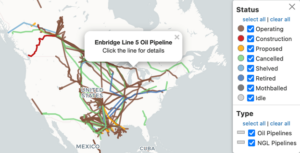
Pipelines carry oil and natural gas liquids across the mid-latitudes of North America. (Global Energy Monitor)
Climate activism has prevented several pipelines from being built on Turtle Island (the continent also known by the non-indigenous name of North America). These are shown as green lines in the map above. They include the Keystone XL (KXL) pipeline, which President Biden canceled on his first day of office. Among existing pipelines, Enbridge Line 5 stands out as a prime candidate for decommissioning. This is because it is especially harmful, and thus especially vulnerable, as described below.
A Diversity of Tactics in the Struggle against Enbridge Line 5
Line 5 runs across northern Wisconsin and the upper and lower peninsulas of Michigan. It carries oil made from tar, which is extracted in a way that uses abnormally large amounts of energy and water and devastates forests in Alberta. It terminates at refineries in Sarnia, Ontario that have turned the area—including the nearby Aamjiwnaang First Nation—into one of the most polluted places in North America.
As it snakes across the upper Midwest, Line 5 invades and degrades Anishinaabe treaty lands and leaks more than 15,000 gallons per year on average. Because of the decaying condition of the 70-year-old pipeline and because of the erosion around it, it is arguably just a matter of time before a catastrophic spill poisons the Great Lakes, which hold more than one-fifth of the world’s surface freshwater. And the reality is that, decaying or not, pipeline accidents will occur in proportion to their proliferation.
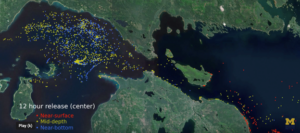
Oil from a simulated Line 5 spill spreads across two Great Lakes between the upper and lower peninsulas of Michigan (David Schwab at the Graham Sustainability Institute)
The extraordinary threats posed by Line 5 have spurred extraordinary levels of resistance. In 2017 the Bad River Band of Lake Superior Chippewa declined to renew the easement that had formerly permitted operation of the pipeline on their Wisconsin reservation. Then, in 2020, the State of Michigan revoked the easement for its operation in the Straits of Mackinac and gave Enbridge 180 days to shut down the pipeline there.
However, no police were called upon to enforce this directive. So on October 19, 2021, and again on July 25, 2023 (the 13th anniversary of a million-gallon spill of tar sands oil caused by another Enbridge pipeline) some people took matters into their own hands—literally—by manually closing pump valves along Line 5. Meanwhile, a grassroots coalition of organizations and individuals has employed a variety of other means to spread the word about the need to shut down the pipeline for good.
Facing down State and Federal Negligence and Complicity
A few months ago, a federal judge ordered Enbridge to shut down Line 5 in the Bad River Reservation by June 16, 2026. He also imposed a token fine on the company for having trespassed there in the years since the easement expired. The court order leaves Enbridge with a large but shrinking window of opportunity—999 days and counting down—to re-route the pipeline outside the reservation.
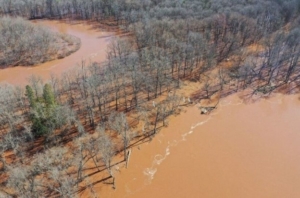
Spring floods progressively erode Mashkii-ziibi (Bad River) banks, threatening nearby Enbridge Line 5. (Wisconsin Public Radio)
Enbridge can start laying the new pipe to keep Line 5 running only if the project gets permits from various levels of government, including those of Wisconsin and the USA. Activists hope to dissuade these governments from granting these permits. How likely are they to succeed?
In its draft environmental impact statement (EIS), the Wisconsin Department of Natural Resources (DNR) bent over backwards to facilitate the re-route. In that document, the agency ignored the climate impacts of new fossil fuel infrastructure and neglected many other aspects of proper environmental review. Meanwhile, despite canceling the KXL pipeline, the Biden administration has helped make the USA the world’s ’planet wrecker in chief,’ with plans to expand fossil fuel extraction more than any other country on Earth.
Finally, the government of Canada, where Enbridge is incorporated, has twice invoked an obscure treaty with the USA in an effort to prevent the Bad River Band and State of Michigan from shutting down Line 5. In these communications, the Canadian government ignores the clause in the treaty allowing for protection of the environment against pipelines, not to mention both countries’ treaties with Indigenous peoples. This is appalling. But it’s not surprising, coming from a government whose leader recently called Canada “a major oil- and gas- producing company—uh, country.”
Fortunately, not all government authorities are quite as complicit. As noted above, those of the Bad River Band and State of Michigan have taken some action against Line 5. Eight other tribal governments, and even the U.S. Environmental Protection Agency, have joined with thousands of individuals in calling out the Wisconsin DNR for its shoddy draft EIS. Also, largely thanks to the efforts of the Bay Mills Indian Community, the United Nations Permanent Forum on Indigenous Issues has counseled the USA and Canada to decommission Line 5.
Supporters Uniting across Turtle Island
Support from those involved in struggles against two other Enbridge tar sands pipelines—Lines 3 and 9—has bolstered the fight against Line 5. Individuals and groups engaged in the heroic campaign against Line 3 (now re-named Line 93), which ends where Line 5 begins, have lent tremendous help. For example, the citizen-science group Waadookawaad Amikwag keeps discovering and exposing more cases of damage to aquifers caused by construction of Line 3. That information strengthens the case against the Line 5 re-route project described above.
Those of us striving to stanch the flow of tar sands oil through Enbridge Line 9, which begins where Line 5 ends, are doing what we can as well. For example, last May activists fighting Lines 5 and 9 converged in Ottawa for a demonstration and meeting with a sympathetic Member of Parliament. The figure and caption below depict another example. Increasingly, people from across the Great Lakes watershed and beyond are joining forces to stop the madness.

Line 9 activists join the fight against Line 5 at this year’s annual Mackinac Bridge Walk. (Michigan Coalition against Tar Sands)
Proponents often cite economic growth as a reason to build pipelines and to keep using them for as long as possible once built. But to a steady stater, economic growth provides a reason not to build new pipelines, and to stop using old ones sooner rather than later. Let’s join the ongoing efforts to banish one pipeline after another, thereby cutting down on ecologically disastrous fossil fuel use and GDP growth. Click here to learn more about, and get involved in, the campaign to decommission Enbridge Line 5.
1 Stay tuned for GDP: The Untold Story (Steady State Press, scheduled for 2024) for an analysis of links between GDP growth and nearly two dozen major negative environmental and social impacts.




Comments
We changed commenting systems on September 10, 2026 as part of a site-wide functionality and security upgrade. Your past comments have not disappeared, and you can still log in with your old Disqus account credentials if you wish. Contact us with any questions.
Simply shutting down fossil fuel infrastructure is the only effective way to combat climate change and associated harms. In theory, we should have a plan involving a careful phaseout of fossil fuels–in reality such plans will never be implemented because of the power of the industry. The way we make the changes that enable us to live well with much less fossil fuel, and eventually none, is to block the flow, reduce the availability, increase the price, so that we have to find other, better ways to do things, or not do them. Yes, rationing would be better, so that the rich aren’t free to keep using as much as they want while everyone cuts back and struggles. Yes, it’s hard for poor and middle class people to find alternatives when they’re embedded in a system predicated on fossil fuel use–a government policy that transitioned the large systems would make everything easier. But it’s not going to happen, ever. Governments are completely, abjectly subservient to well-heeled interests, incapable of change no matter how bad things get, and those special interests are mostly corporations–which are incapable of caring about anything, being essentially machines. So we have to take matters into our own hands and find ways to make a stop to the destruction of the ecosystems on which we depend, of which we’re a part. And fossil fuels are the obvious place to start. Yesterday I watch Hagens’ latest, in which a woman who started Plastic Planet says that plastics are a good gateway to dealing with all this, because they’re ubiquitous and we keep discovering how harmful they are. But plastic is made mostly from petrochemicals–the gas industry has stated that it’s looking to increased plastic production to make up for falling fuel use. So this is not a competing approach–it’s coming at fossil fuel ramp-down from another angle.
You explained very well…thank you…
“Governments are completely, abjectly subservient to well-heeled interests, incapable of change no matter how bad things get, and those special interests are mostly corporations–which are incapable of caring about anything, being essentially machines.”
Yes, governments are subservient to the fossil fuel industry, but not just because of the lobbying power of the fossil industry. They are also committed to economic growth as a top priority — largely to protect capitalism, which, as presently designed, depends upon growth to for debt servicing, money creation, etc. Governments (“the state”) are/is a chief component of what Fabian Scheidler has called “The Megamachine” — https://theraven.substack.com/p/the-rise-and-fall-of-the-megamachine Structurally, the state (governments) is designed in service to the Megamachine. That’s why the state will not choose to phase out fossil fuels, which are the lifeblood of the Megamachine in this time in history.
It is very worth reading Turchin’s book on Cliodynamics, or even the research literature on that. Turchin is one of the major contributors to the field. The data indicate that the United States has always been an oligarchy – which is to say plutocracy, given that power in the US has always correlated rather well with wealth. (hence the usage of the word “Elites” rather than “politicians” or “the Affluent”) For instance, with only rare exceptions, every president before 1850 was a millionaire (in their dollars).
This is to say that the Elites are “the ruling Elite.” It also says that this group includes many/most politicians, the highly Affluent, wealthy corporations, etc., and they are not homogeneous, but rather, under ceratin conditions will fight amongst themselves, with corresponding bad outcomes, such as the craziness we see in the US government during the last decade or three. (Remember that these observations are derived from data analysis methods such as principle/orthogonal component decomposition, statistical correlations, etc. – not the ad-hoc opinions of historians, observers, writers, etc.)
Thanks PattiMichelle. As valuable and important as data analysis methods such as principle/orthogonal component decomposition, statistical correlations, etc., may be, thorough historical studies are also very useful for such understanding, and also complementary, I’m sure. It’s really not at all difficult to use evidence from history as evidence for the USA being an oligarchy of the plutocratic kind. See, for example: https://www.counterpunch.org/2017/12/13/the-u-s-is-not-a-democracy-it-never-was/