

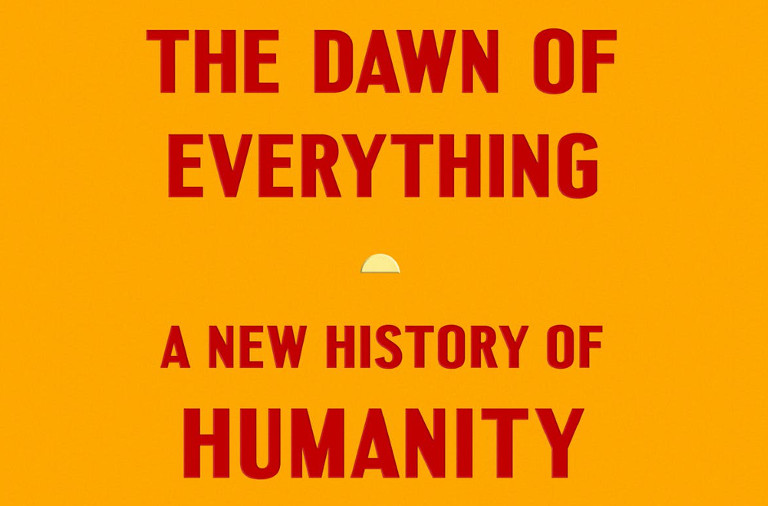
 Graeber and Wengrow’s book The Dawn of Everything keeps coming up in my life—especially as I dip an amateur toe into trying to understand human prehistory—so I thought I had better take a look. The title sounded promising, and I had heard that the book offers many pieces of interpreted evidence from humanity’s distant past. I like data.
I elected to “preview” the book as an audiobook borrowed from the library, jotting 32 pages of notes as I went along. 24 audio-hours later, I am ready to report. A key point from the authors is: it didn’t have to be this way. To which I say: but it is. Making a convincing case that it could have gone much differently is a tall order given a single—seemingly conclusive—global experimental run. But we’ll get to all that.
I will say up front that I am unqualified to supply a scholarly critique of the book. I can’t argue about any of the archeological evidence, but do find that I have a few bones to pick when it comes to logic and interpretation.
Before I got very far into the book, I wrote down some things I wanted to learn from it.
- Is my basic understanding correct: that agriculture leads straight to modernity, in time?
- Will the book provide insight into the emergence of human supremacy—a false sense of separateness or transcendence above nature that drives much of modernity?
- Does the book talk about animist belief systems and how languages embodied different ways of thinking?
- Does the book present our history in the context of one-time inheritance spending of, e.g., fossil fuels and ecological health?
- Is the “Everything” in the title broader than an anthropocentric focus on the last 10,000 years as civilizations arose?
I can say that the answer to all these questions is, disappointingly, no. But I’ll be a bit slippery on the first point, in due time.
A Rough Start
I got off on the wrong foot with the book (before later growing to like it, briefly) because Chapter 1 revealed something I considered to be fundamentally wrong with the approach. The authors put forth two Enlightenment-era views of the nature of humanity that remain influential today. Hobbes characterized life before modernity as “solitary, poor, nasty, brutish, and short,” implying a sort of barbarism intrinsic to humans (see my earlier counterpoint), remedied by civilizational constructs. Meanwhile, Rousseau imagined an innocent age of idyllic harmony with nature that was destroyed by the very same trappings of civilization—starting with agriculture 10,000 years ago. In reaction to these schools of thought, the authors enumerate their three motivations for writing the book:
…we don’t much like the choice between these two alternatives. Our objections can be classified into three broad categories. As accounts of the general course of human history, they:
- simply aren’t true;
- have dire political implications;
- make the past needlessly dull.
On the first: by all means let’s get the facts right. On the third: I looked forward to learning about the richly storied past. On the second: they lost me. It seems like working backwards—much like IPCC models that start with politically acceptable trends in economic and energy growth and examine the resulting climate consequences (rather than the harder job of evaluating what is biophysically likely or possible). Sometimes implications are dire, and we don’t get to choose. But okay, I’ve been warned that a primary motivation is rejection of implications.
Core Content and Themes
The primary message I took away is not terribly surprising to me in hindsight, and actually reinforces an important message: early humans were impressive, diverse, thoughtful, logical, creative, generous, and fiercely free as groups. The picture that emerges is far more multi-dimensional than facile characterizations of early humans—by either Hobbes or Rousseau. In many ways, modernity has served to dumb us down as individuals. Particularly engaging were stories of French encounters with Indigenous Americans, who often ran circles around Europeans in reasoned, eloquent discourse. I am also a sucker for (apparently numerous and overwhelmingly lopsided) accounts of people who tried both European and Indigenous lifestyles and ran back to (or stayed in) Indigenous communities having acquired full, adult knowledge of the pros and cons of each. Perhaps Indigenous life held onto a sense of meaning, place, and unconditional community that has long disappeared in modernity.
Down with Determinism!
A recurrent theme of the book is pushback against determinism or any sense of inevitability, supported by myriad examples of places and times that defied conventional expectations. People tried all manner of organizational arrangements in almost every order and combination—some even flip-flopping between radically different regimes on a seasonal basis. The argument seems to be that if even one society (and in fact, there were many) goes against the deterministic, evolutionary narrative, then determinism is destroyed.
For example, a common narrative they repeatedly reject is the evolutionary sequence that horticultural hunter-gatherers began practicing more full-time agriculture, formed settlements, then cities, then a state, complete with kings and armies and all that. Since plenty of cultures did not follow this prescription or even traversed backwards or back-and-forth, then the purported sequence is dismissed as bunk—or at least not universally supported by all the actual data.
I get it, and I appreciate the wealth of archeological findings the authors presented. But to what degree can variations invalidate the overall pattern?
That is, in broad brush we know that humans started as foragers and hunters: not as citizens of states and not practicing full-time agriculture. Today, virtually all humans live under state rule and are fed by means other than hunting and foraging. The nations of the world are sovereign entities sporting bureaucracies, political machines, market systems, hierarchy, extreme division of labor—and all the various tributaries depicted in the river system metaphor. The small fraction of humans alive today operating outside of this global order tend to be those who managed to evade making the transition. No modern-era nations have broken rank and reverted to earlier ways. That’s the main flow: some water might have hidden in pockets or swirled in turbulent eddies, but most of it is decidedly gushing in a coherent direction.
No Revolution to See Here…
Yes, the process was not linear, or simple, and it took a while to play out. We might compare the beginning of agriculture to lighting a fire in a fireplace. Sometimes an initial flame will not manage to spread to the logs, and the whole thing winks out. But with persistence, or if the match is applied to enough places having favorable conditions, some regions will catch fire and then propagate to other regions where efforts may have previously started then faltered, or stubbornly resisted all along. Once in full swing, it becomes hard to walk it back.
The authors at one point describe laboratory results indicating that when all the right actions are taken, wild grasses can be domesticated into something like wheat in as little as 20–200 years. Since the agricultural transition took 3,000 years, the authors express contempt for the term Agricultural Revolution, on the basis that something taking 3,000 years to unfold can hardly be called a revolution.
The transition from living mainly on wild resources to a life based on food production took something in the order of 3,000 years. […] Clearly, it no longer makes any sense to use phrases like ‘the Agricultural Revolution’ when dealing with processes of such inordinate length and complexity.
Excuse me? To me, it seems that a radical change in methods is revolutionary even if it takes 3,000 years. I don’t know of a rule that it has to transpire in a single person’s lifetime, for instance. More important to me is what 3,000 years represents on the scale of Homo sapiens: 1–2% of its time? That’s pretty darned fast—especially compared to the pace of biological evolution. The very same diversity of approaches lauded by the authors also means that people were free to not follow the quickest laboratory route to domestication. The important thing is that it eventually happened—somewhat inexorably, I would say—and had enormous consequences. We’ll return to the central friction around determinism later, after laying out a few more key pieces.
It’s a Trap!
The book rejects the characterization of agriculture as a trap, since plenty of people abandoned the practice of agriculture in its early days. And it’s no wonder, at some level: farming is hard work! But this is an example of metaphors being tricky. If one pictures a mouse trap on a hair-trigger that snaps shut in inescapable finality, then indeed agriculture is not such a trap. The river metaphor plays better, here, as it is easier to get in and out of the stream when the flow is gentle nearer the headwaters. Now that we’re in the middle of a raging river, the trap is more fully realized. Escape is never impossible: it just becomes increasingly more difficult and unlikely.
The actual operation of the trap might simply look more like many other forms of technological adoption: early adopters, holdouts/abstainers, and some who try it and then give it up. But virtually everyone—in the U.S., for instance—ends up with a smart phone, a computer, a television, and a car. The advantages for the many overwhelm the sometimes principled downsides of the few. The new capability becomes essentially ubiquitous, the few exceptions lost in obscurity.
If, rather than a snapping mouse trap, we view agriculture as a “deep attractor” whose dynamical foundation ensnares most people in due time, then we’re closer to the mark. Painting it as an instant, irreversible trap that has 100% efficacy is indeed inaccurate, and not how most proponents of the “trap” concept would present it.
Agricultural Ubiquity
I paid close attention to any mention of food acquisition practices in early cities. I never caught an example of a city that did not have some agricultural/livestock practice: no purely hunter-gatherer cities. Many early settlements supplemented with foraging and hunting—perhaps even outweighing domestic food production in some cases. But time after time, I heard mention of the rich soils of this or that settlement region. I came away satisfied that agriculture sensibly led to cities—rather than, say, the puzzling reverse.
The Fall
Several times, the authors reject an interpretation if it in any way echos the story of “The Fall” from the Garden of Eden. For instance, a common telling has it that adoption of agriculture was a major event that set most of humanity on its current (now obviously destructive) path. Besides sounding like determinism, it conjures the old “Fall” trope, which is discarded simply because it’s a stale tale. Yet, sometimes the oldest and most persistent stories are based on a kernel of truth. If modernity proves itself to be a failure mode, and agriculture was a monumental transition that kicked off the process, then the well-worn shoe fits.
But: North America!
A centerpiece of their case against the inevitability of European-style modernity is Indigenous North America, which I admit to viewing with awe, respect, deep regret, and longing. A number of tribes had tried agriculture, building large settlements and regional hegemony, only to melt away. This is held up as a reflection of deliberate choice, which certainly may be the case. Does it mean that North America had forever consciously rid itself of agriculturally-based city life? Who can say? The main example of Cahokia near present-day Saint Louis disbanded only a few hundred years before Europeans upended the continent. Given the much longer and extensively detailed history of Eurasian fits and starts thousands of years prior, it seems premature to declare North America as forever settled in its wholesale rejection of agricultural city-states based on this short pause.
Also compelling to me is the recognition that Eurasia got a head start in developing agriculture. Okay, sure, the post-glacial stability of the Holocene arrived simultaneously in both places, but North America’s wild spaces had been subjected to human pressures for far less time, perhaps staving off the widespread impetus to move to a more labor-intensive way of life. In other words, I could believe that Americans enjoyed a greater degree of natural freedom in terms of a vibrant ecology that still left plenty of room for prolonged enactment of the easy life. These things take enough time to cause the authors to shun the word “revolution.” North America had simply seen fewer matches trying to get the agricultural blaze going. Europe saw to that, in a conclusive conflagration.
The Big Miss: Dynamics
The authors repeatedly admonish the sloppiness of (seemingly all) previous research for coming to conclusions that are inconsistent with various specific cases. Granted, it’s clearly nuanced. But they themselves make plenty of sweeping statements that are similarly inconclusive and appear to me to be a matter of taste. My impression is that they offer a delightfully rich tapestry of the complex and diverse cultures of the past, and criticize the logic of many, while not demonstrating the most solid, unbiased logic themselves.
As alluded to above, the book offers myriad “exceptions to the rule” from early instances of societies in an attempt to break the idea of determinism or inevitability. Property rights did not always accompany agriculture. Cities did not always have sovereign rule. Surplus did not always mean standing armies. Bureaucracy did not always imply state rule. Chiefs or kings did not always have unquestionable authority. Agricultural settlements were not always hierarchical. Yes—point taken—undoubtedly, early examples displayed almost every combination of properties, and sometimes reverted to notionally more “primitive” arrangements. They conclude from this evidence that none of the usual associations are deterministic or evolutionary, which they like because then it means we can now select any combination from the extensive menu and do civilization better.
What they miss, in my view, is interaction and game theory. Early on, and in relative isolation, every experiment is likely to be tried somewhere by a highly creative and versatile species. Although virtually all instances leave archeological traces, some fail on their own lack of merits, others get by for a time, and a few prosper and expand. Now let them interact. The more advantageous arrangements simply outperform, displace, eliminate, or assimilate others. Fast forward to today, and we’re (essentially) all in sovereign states under military protection, all agriculturally based, all respecting property rights, all hierarchical, all living with bureaucracies, and all engaged in competitive market systems using money. Is it all just some random accident that could have gone any other way? We all just happened to pick the same courses off the menu?
We might compare the book’s dizzying array of archeological examples to a menagerie of exotic animals. Each is fascinating to study, and offers lessons on what’s possible in isolation. Now open all the cages, let the animals interact (play?) together and see what happens. Graeber and Wengrow never do this—instead pointing to each animal, safe in its archeological cage, and emphasizing how different it is from today’s arrangement. In my view, the ubiquity of today’s systems marks the outcome after all the animals are “played” out, leaving one dominant beast. Erp. (Note: then it dies of its own success, having consumed the “world.” Of course, I’m referring to modernity. Finding remains in the bowels of the beast is certainly interesting, but does not overturn the story that actually unfolded.)
Just upstream of a waterfall, one might find pockets of still water, turbulence, and even eddies where water momentarily runs counter to the overall flow. Meanwhile, the relentless grip of gravity—the chief dynamical element—pulls the bulk flow along and over the edge, at which point acknowledgement of the varied motions upstream seem less relevant. It’s hard to understand a waterfall using snapshots of water motions upstream while ignoring how gravity interacts with the landscape. The dynamics rule!
The completeness of the transition to modernity, which indeed took a long time and had plenty of turbulence, smells essentially inevitable to me. At one point, the authors acknowledge this apparent inevitability based on the ubiquity of today’s system, but counter that the ubiquitous order all seems to be falling apart now [data, please?]. They point to global institutions not based on sovereign power, like the WTO and IMF (can we combine these to make WTF?), or note that non-sovereign entities like cryptocurrencies can undermine sovereign powers. Except: A) no state has yet fallen to such threats to my knowledge; B) if they did, another state would likely assume control of the failed region; and C) how exactly would global entities like the IMF convince nations to dissolve their governments and cede their sovereign power? Until I see the flow reverse, I’ll remain skeptical.
To be fair, I also believe that the ubiquitous order will fall apart, and is arguably already starting. But this is more a matter of other near-deterministic dynamical forces involving biophysical constraints and the fundamental incompatibility between modernity and planetary limits—not because of cultural evolution such as ultra-globalization or due to conscious decisions to pull the plug on the underlying dynamics driving the bulk flow, much as I would cheer the latter course.
So: Why are We Stuck?
The authors repeatedly asked the question: “why are we stuck” in the current systems, if indeed we have a diverse menu of choices available to us? The authors never deliver an answer, and my sense is that this was a truly perplexing question for them. Given their rejection of deterministic forces that put us all in essentially the same system today, very little is left to explain why we are all in this situation. If one does not banish determinism from the scene, the answer is far easier to elucidate. It is at least some progress that they recognize our “stuckness.” I’m not claiming that I have the right answer, but can say that the question does not bother me in the way it appears to flummox the authors.
In the end, my impression is that the authors had strong allergic reactions to certain credible—and in some cases I would say obvious—explanations for how we got here, and an impressive-enough command of archeological details to throw a bunch of sand in the gears (while trying to argue that there are no gears). To me, this doesn’t wash well, and feels like middle-school science fair projects I have judged that almost invariably miss the point of science and work desperately to prove the initial hypothesis rather than take in all the evidence and see what story it has to tell when considered in full. But, as I pointed out in the introduction, they indicated exactly this ideological motivation in Chapter 1.
Reconciliation?
Despite the long rant, I did like a number of things about the book. It more than quadrupled my detailed knowledge of the emergence of civilization. It provided insights into the variety of Indigenous social structures. I liked their suggestion to think of civilization as extended moral communities based on mutual aid and political wisdom (i.e., civilization need not be like modernity).
I can also find common cause with the authors in one of their core messages, but perhaps from a different vantage. That is, the human animal is indeed a plastic being: a high-end piece of hardware capable of running any number of operating systems (my characterization, not theirs). The disagreement is whether we had to go through this phase called modernity. I think the forces are too powerful for it to have been avoided. But once modernity loses power by its own hand, new ways of living indeed are likely to fill the void and benefit from hard-won lessons. We’ve seen evidence that people can live differently, and profess profoundly sustainable philosophies that seem alien to the modernist, human-supremacist mind. Therefore, I share their underlying hope in organizational diversity, but place less stock in navigational agency in the face of overwhelming dynamics. I would have appreciated delving below the superficial arrangements to better understand the forces involved, the conditions under which various schemes emerge and persist or (mostly) perish, and the philosophies (and languages) that accompanied sustainable practices. Even without the ability to plot a course, it’s good to have a deeper understanding of what has worked or failed before, and why. But who am I kidding? We’ll just wing it and some groups will stumble onto something that works.
Coming back to the first question I posed in the introduction, while my river metaphor is admittedly vastly oversimplified, I am not persuaded that it’s garbage. I still think we would not have modernity without agriculture (and that the time-ordering and thus causal relationship is clear, however nuanced). Likewise for all the tributaries: most are contextualized to the overall amalgam, and are not particularly likely to persist in isolation. What the book shows, in essence, is that no single map can depict an exact sequence of tributaries. But I knew the map was not “correct” in this sense. In aggregate, though, we unambiguously find ourselves now on the raging river, and all those tributaries have influenced every modern society in a process of turbulent mixing following a variety of historical orderings.
Given all this, I’m not going to recommend your reading the book, unless you are thirsty for extensive archeological tidbits. Perhaps it’s like the old ad campaign for the “scrubbing bubbles” bathroom cleaner: I worked hard, so you don’t have to.
Note: I am grateful for feedback and comments I received on a draft of this post by Alf Hornborg, Robert Jensen, Tom Love, and Bonnie Nardi (many of whom are anthropologists). Tom Love pointed me to a much more professional review by Ian Morris that makes some eerily similar points.





Comments
We changed commenting systems on September 10, 2026 as part of a site-wide functionality and security upgrade. Your past comments have not disappeared, and you can still log in with your old Disqus account credentials if you wish. Contact us with any questions.
Well, historians and archaeologists disagree often on very much. Harari did a very good book also, digesting a lot about the distant past, but he’s a devout technooptimist about the future – suggesting the problems associated with relying too much on the readings of this branch of science – its practitioners can be ideologically very distant from the extremely solid knowledge of physicists known about the present and near future.
Harari’s work is actually something they Dawn of Everything fairly sharply critiques. The first couple chapters are worth a read if not just for that perspective.
Thanks for this very detailed review, Tom. I bought the book in eager anticipation and gave up after two chapters – there were just too many unsubstantiated and glib comments which I felt were wrong, annoying, or both. (Example – Shakespeare wasn’t that special because everyone in Elizabethan England spoke like that. NOT!) It was a real let down after Graeber’s book on debt, which is much better researched and referenced.
I think that if, in your current mission to explain what is going on with/in the world, you added the works of James C Scott (anthropologist and political scientist), Raj Patel and Jason Moore’s ‘A History of the World in Seven Cheap Things’, Alf Hornborg’s ‘Global Magic’, Karl Polanyi’s ‘The Great Transformation’, Bruno Latour’s ‘Facing Gaia’ and Tyson Yunkaporta’s ‘Sand Talk’ you would find much better explanations of how the global capitalist/colonialist/industrial system we all live under and take for granted evolved and spread, and what the implications of this are. As for how it might change – see my article on Earth Uprisings at
https://radicalecologicaldemocracy.org/earth-uprisings-une-histoire/ – for what some people in France are doing to put life-for-all before current system death.
Human history does not unfold according to the rules of game theory. Most people on the planet did not “pick” the social organization that they live under today. To say that “the more advantageous arrangements simply outperform, displace, eliminate, or assimilate others” is simply to restate outdated ideas of social Darwinism that were used to bolster ideologies of racial hierarchy and white supremacy. The Aztecs chose not to kill Cortez when they could have, but he chose to destroy them. Why? You cannot use game theory to answer that question, nor why the Spaniards were successful in conquering Mexico. Certainly, the social system they brought in was not “more advantageous” to the Aztecs!
Game theory can apply at a macro-level; not just as individual Aztecs weighing choices. Had the Aztecs killed Cortez, I doubt the gold-hungry Europeans would have just given up, or decided not to bring guns to the fight. These are advantages I can’t wave away. I may be using the term game theory in a broader sense, capturing the full complexity of interactions.
Later addition: The decisions by Cortez and the Aztecs were not random coin flips, but heavily influenced by their respective cultural norms and expectations. So, the way it played out may be a less-than-random expression of what happens when those two cultures meet: the strong and unflinching will tend to overrun the more circumspect—even if less respectable.
On your point: “I still think we would not have modernity without agriculture”
I would say it was coal (and subsequent fossil fuels) that allowed the rise of nationalism which gave the necessary conditions for modernity. Modern society, in Ernest Gellner’s conception, is actually an industrial-scientific society. Industrialism being the big factor in increasing production outstripping population growth.
My guess is England probably would have chopped down all its trees, stalling industrialism if it wasn’t for coal.
So perhaps modernity would have required agriculture (to allow specialization) but it was coal that actually enabled the detachment from seasonal cycles.
I would say coal accelerated the process dramatically, but nationalism was alive and well long before, complete with a long history of wars between countries. England had indeed exhausted its timber for ships (tall masts especially hard to find), and began getting resources from Brazil and other places. Colonialism and exploitation of global resources was well underway when fossil fuels edged into the scene. Not to diminish their explosive role…
Tom: The soil was exhausted and they began hauling guano from remote islands.
The What Is Politics? YouTube channel has an excellent series of video reviews on The Dawn of Everything. I highly recommend it.
https://www.youtube.com/@WHATISPOLITICS69
This is a book that takes away the “ignorance of nature’s laws is an excuse” defense.
It says that humanity was initiated with full sentience.
I do appreciate your comments on what we can learn from the variety of ways of organizing society. However, your “interaction and game theory” in response to why we got stuck seems to fall in to the same trap of ahistorical teleology that the book critiques. Wengrow has said in interview that the short answer to that is European colonialism. (I do agree that could have been more clearly stated at the end of the book.) My longer historical answer to the question is as follows: the Romans and Chinese we very good at taking the decentralized “barbarians” at their borders, picking leaders to negotiate with their by spreading their centralizing formula. Jump forward to the 1500s and the death of 80-90% of the population of the Americas due to disease and, to a lesser extent, genocide made European conquest of the Americas possible. Those growing resources made it easier to Europe to conquer or subdue most of the rest of the world in the subsequent four centuries. What we see now are almost entirely post-colonial states. So I suppose in a sense that while yes “more advantageous arrangements simply outperform, displace, eliminate, or assimilate others” did happen, those “advantageous arrangements” were ones that allowed one people to better dominate another. That interpretation is basically defining “advantageous” as the ability to dominate and not something like provide freedom and safety for its people, make technological advances, gain a better understanding of how nature, the earth, or space works, etc. If we really want a sustainable resilient world, we need to better understand the latter definitions of “advantageous” and not the former.
I’ve not read Dawn of Everything, but have read several reviews. It looks like a valuable contribution to the literature, although I agree with Tom that polemic seldom yields satisfying conclusions.
‘Western way of life’ is agriculture overlaid with a further revolution enabled by fossil fuels. The latter took only 200 years or so to completely dominate, rather than 3000 (or more). The key issue is how over that much longer time agriculture came to dominate and eventually displace other models.
As with so many other things, it seems like scale is key. Hunting & gathering requires a lot of land. There is a definite carrying capacity, beyond which surplus human population must migrate or fight. But in almost all conditions, the number of people is small. Fighting would thus also be small scale and localised. This presumably will have happened continuously throughout hominid history.
Agriculture enables greater concentration of population. At some point in a hybrid ag / hg system, there will be sufficient surplus that a community means of storing and allocating will be devised. Surplus frees up human resources for other activities, including fighting, increasing its scale and power.
I don’t think there’s a need to characterise any of this negatively. It’s what Tom means by ‘game theory’, where choices that have different pay-offs will over time tend to maximise the gains. Clearly anything which takes 3000 years is not a clean and simple A or B choice though!
Once agriculture becomes firmly established in an area, the usual population growth leading to migrate & fight forces tend to make it expand. Also, at some point so much social structure has built up around food surplus that it becomes impossible to choose an alternative arrangement, which could not support such a large non-producing group. And equally important, those who consume the surplus have a vested interest in continuing the current arrangements, most likely at the expense of those who product the surplus.
That’s a fair analogy of where we are with fossil fuels too. Just swap food surplus for energy surplus (food is energy of course) and the parallels are strong. It’s equally impossible for us ‘moderns’ to choose to revert to an agrarian or hunt/gather system, because there are too many of us whose very lives depend on the current surplus.
Regarding group learning, we’re talking about a timescale of over 10000 years. I suspect that as you say some kind of folk memory enshrined in quasi-religious terms will have supplied some background wisdom (like in Australia). Which always remind of Churchill’s quip that the USA always does the right thing, but only after exhausting the alternatives. But think of yourself as a neolithic group, surrounded by easily hunted mammoths, etc. They seem plentiful, so why worry about hunting them and taking only the best parts before moving on? When have humans ever worried about resource depletion until the limit is imminent?
Incidentally, one reason North American people might not have opted so readily for agriculture is lack of easily domesticated species. The Old World had aurochs, sheep, goats and pigs, which will have been at least as important as wheat.
Agreed: this is what DoE misses: the interactions (which indeed often took the form of violent conflict). I never spelled out the ways in which “interactions and game theory” manifested, but the analogy of one remaining beast in the menagerie (burping after eating the rest) nods to the violence and non-consentual nature of the encounters.
I guess it depends on how you define “perform.” If it’s in the brass-tacks sense of “outlasted, outcompeted, prevailed” then the victor outperformed, by whatever (sociopathic?) means.