

Each ewe marked with a blue crayon streak down her back holds a membership among the select. One day last week we moved the marked group of seven ewes into a separate pen before turning the rest of the flock out onto the summer grass. Later that afternoon we took the chosen seven to a graded sheep auction in Athens, Tennessee. At auction, they might be sold to another sheep farmer or someone looking to start their own flock. Then again, they might be bought as part of a larger lot and head to a processor. You never know who will be buying on any given day.
Ewes are culled for practical reasons. Some are at the end of their productive life, others have given birth to lambs that grew out unsatisfactorily, and some have proven to be unthrifty or especially susceptible to parasites. Every ewe culled has been known to us and valued, and the vast majority have been born on this land.
Farming livestock involves a daily exertion of power over life and death. A flock of chickens only needs so many roosters, with the excess going into the pot. The cock that rules the roost remains for a couple of years, at which time he makes way for a younger, more virile replacement and becomes the flavoring for a savory gumbo. A sow that doesn’t produce satisfactorily becomes whole hog sausage. Her weanlings grow and grow and are then loaded in a trailer and sent to the butcher. Extra bull calves are banded and fattened as steers—again, whatever the livestock, one male only is needed for breeding.
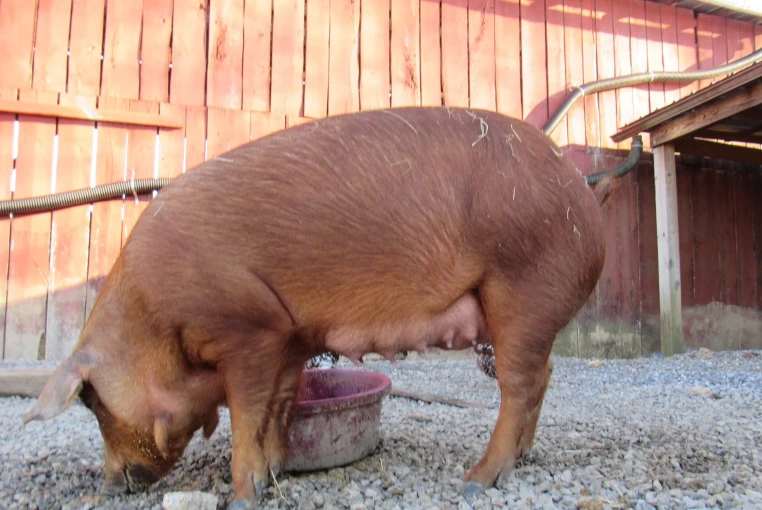
Our Red Wattle sow, named Ginger for her coloring, had been chosen for culling. Her date with Morgan’s Meat Processing was booked and noted on the calendar. I bought Ginger in remote Hancock County, a rural county nestled right against the Kentucky border, at a homestead set back in a deep no-light “holler” in the spring of last year. She is a very personable, very docile sow, a lovely specimen of her heritage breed.
Ginger had her first litter in January—a disappointing four piglets, of which only two survived. We would have been content with six but prefer 8-12. We decided to give her another chance and breed her once again to a Berkshire boar. When the farrowing date at the first of August passed with no piglets, it was with real sadness that we scheduled her slaughter. That she would make that final trip with her two market-weight offspring was of no comfort.
On a small farm we have some latitude for keeping animals. Because ours is a modest economic model of a peculiarly non-industrial bent, choices are often made as much for personal reasons as for financial. Still, keeping a two-time loser on the payroll truly doesn’t make sense. We are not that kind of place, neither a petting zoo nor an animal rescue. Ours is a working, producing farm, and here everything is expected to earn its keep.
Yet … last week we were at our friends’ farm picking up three weanling piglets to grow out for ourselves and customers. They were from the same litter that we had helped castrate just a couple of weeks earlier, and we were buying them now because Ginger’s failure to farrow had left us with a gap in our pork production schedule (not to mention that a 500-pound non-producing hog eats the same massive amount of feed that a 500-pound producing hog requires).
While it is still not certain if the failure to farrow was the fault of our sow, when our friend mentioned while loading the barrows that she would be happy to help us artificially inseminate Ginger, I did an uncharacteristic clutch at the offer. I wanted Ginger to work out, did not want to take her to market, at least before she had lived out her productive life.
For those who don’t farm, my attitude may strike you as callous and unfeeling. Practical decisions often do. Which is why so many tough decisions in life are “farmed out” to others. But, not here on our farm, while livestock is in our care, we treat them well; we give them plenty of room, feed, and attention. Yet there is an end, as indeed there is for each of us.
When I fed Ginger last evening—watching her tuck into her trough, then galumph around the pasture—I felt at peace with this very uneconomic decision to give her another chance and allow her to keep her place.
…………………………………………………………..
My book, Kayaking with Lambs, is now available from Amazon and Barnes & Noble (as well as Front Porch Republic Books).



Comments
We changed commenting systems on September 10, 2026 as part of a site-wide functionality and security upgrade. Your past comments have not disappeared, and you can still log in with your old Disqus account credentials if you wish. Contact us with any questions.
It’s too bad — and a tad ironic — that the daily exertion of power over “life and death” isn’t written about more as it relates to the Western style diet. Although it’s common knowledge that diets that center around meat, dairy and processed foods show an average lifespan of 7.5 years fewer than those cultures who don’t. Essentially, we each have a power of “life and death” of ourselves and our loved ones — that is, if we care about living longer and healthier.
Do you really think people should make decisions based on a “a statistic 7.5 years of lifespan improvement, on average”? Who thinks that way? Who acts that way?
Why wouldn’t you?
This is vile. I cannot fathom how anyone can do this.
It’s been done for many thousand years in this world. Before that it was hunting
We are no longer an integral part of the ecosystems we inhabit.
Many things have been done for a very long time. Doesn’t make them right. Slavery? FGM?
I can think of nothing more evil than causing an animal to be born, nurturing an animal, only to kill it or have it killed when it is no longer ‘useful’ or because you think it tastes good.
Because life is an experience, not a statistic. And for what it’s worth, death comes for all of us, no matter how statistically healthy we live
That makes no sense. Living a healthier life means a better life and potentially a longer life.
My healthy life means I am in excellent physical shàpe which means I can experience life in all the ways I want to. The dietary and exercise choices we make informed by statistical research can and do have beneficial outcomes.
There is a difference between eating based on statistics, and eating so that you feel good and stay healthy. I have no problem with the latter, obviously. I find it extremely odd to argue food choices on the basis ‘7,5 years average lifespan’, as if food is only nutrition and not enjoyment, culture – and importantly, what is available to someone. And also, it’s odd to talk as if the length of life is the thing that matters most. You could probably stretch these 7,5 years even longer with extreme asceticism. Would it be remotely worth it?
So that just sounds to me as if someone wants to hide their sense of superiority behind ‘science has proven it’. They might as well just be openly superior with no science involved.
Perhaps. But this is a very everyday part of existence. If it leaves you horrified and flabbergasted then that just points your even deeper alienation from the process of getting food on the table than this author here is
I have lived all my life in rural Australia in the heart of farming country. For many years as a child my family owned a mixed farming operation.
I grow quite a bit of food. I know quite a bit about getting food to the table. I own 120 acres. None of it is used for animal agriculture. Instead it is home to incredible biodiversity – unlike our neighbours running sheep and cattle, destroying their land in the process, alienating wildlife and endlessly exploiting sentient beings for profit.
Then I misjudged you on that one. I still don’t like it, calling other human beings vile, but apparently you do while knowing something of their lifes
I didn’t call anyone vile. It is their actions that are vile.