

George has a long and heroic record of fighting for the environment. His latest campaign is to reduce the huge burden that farming inflicts on global ecosystems, by shifting much food production to high-tech “factory farming”. But he fails to see The Simpler Way solution.
“Factory farming” involves growing nutritious substances in vats and processing them into edible forms, thus enabling large areas of farmland to be returned to nature.
George’s case against contemporary farming, especially the production of meat, is sound. He insists that the already worrying global food supply problem, the deteriorating soil and climate situation, and population growth, leave us with no choice but to face up to radical change. But he assumes that the only alternative is the factory. He fails to see that there is a better one.
The Simpler Way perspective.
Here’s a quick outline of our situation, detailed elsewhere.
The basic cause of the many alarming global problems we face is the pursuit of affluent “living standards” and economic growth … the determination to produce and consume more and more, without limit, even in the richest countries. There is no possibility that the per capita levels of resource consumption in rich countries can be kept up for long. Only a few of the world’s people have these “living standards” and the rest can never rise to anything like them. (See Degrowth: How much is needed? )
This is the basic cause of the big global problems, including resource depletion, ecological destruction, the deprivation and poverty of poor countries, resource wars and deterioration of social cohesion.
These problems are inevitable consequences of a society that is driven by acquisitiveness, competition, the profit motive, market forces and above all by economic growth. Technical advance etc. cannot solve these problems, because growth cannot be decoupled from increasing GDP, let alone enable the enormous degrowth needed to get rich world per capita consumption down to levels all could share. Governments and people in general have no idea that this is the situation, and they are not capable of doing anything about it. We are heading into a time of mega-breakdown and great troubles, possibly terminal for this “civilisation”.
The problems cannot be solved unless this society is largely scrapped and we transition to some form of simpler way that allows everyone to live well on maybe 10% of present rich world per capita resource use. This could easily be done … if we wanted to do it. Following are some of the necessary elements in the required social form.
– Simpler lifestyles, much less production and consumption, focusing on non-material sources of life satisfaction with no interest in luxury, affluence, possessions and wealth or getting richer.
– Many mostly small, highly self-sufficient local economies, largely independent of the global economy, putting local resources to meeting local needs.
– Cooperative and participatory ways, enabling communities to take control of their own development, to include and provide for all. There must be commons, town assemblies, local committees and referenda making the important decisions about local development and administration, and working bees must do the building and maintaining.
– A new economy, one that is not driven by profit or market forces, produces far less than the present one and does not grow, and focuses on needs and rights and is geared to maximising the quality of life of all. There might be many small private firms, and markets, but there must be (participatory, democratic, open and local) social control over what is developed, what is produced, and how it is distributed, exercised via town meetings. There must be no unemployment or poverty; all would have a livelihood enabling a valued and respected contribution.
– Some very different values, especially cooperative not competitive, caring, more collectivist and less individualistic, and concerned with frugality and self-sufficiency not acquisitiveness and consuming.
This is not a utopian wish list. These are elements and conditions that are essential for a globally sustainable town or suburb. A high level of community self-sufficiency dramatically reduces transport of goods and workers and wastes, largely eliminates the need for sewers and fertilizers (because nutrients are recycled) and for international trade, enables recycling of materials, provides substitutes for energy-intensive leisure and travel and cuts the need for industry, finance, “welfare” and social services such as commercially-provided aged care, high-tech systems and expensive professionals. Our study on the dollar and energy costs of the agribusiness-supermarket path for egg supply found that these were around 100 times those of the backyard and cooperative path.
The Dancing Rabbit ecovillage in Missouri following these kinds of principles has cut resource use to 5-10% of the US averages. Ecovillages report higher than average quality of life.
Even more importantly, in small communities aware that their quality of life depends not on their personal wealth but on the town working well, all would realise that they must be caring, cooperative, conscientious and determined to make sure everyone is cared for. That eliminates most of the present tonnage of “welfare” problems and expenditure…the unemployment, struggle, alcoholism, drug abuse, homelessness, suicide, prisons, and the depression that is now our biggest health problem.
One of the many benefits of this way is that because a) we would be consuming far less, thereby not needing to build much industrial and transport infrastructure, and b) because many goods would be free from the commons, we would probably only have to work for money a couple of days a week.
In his important book Small Farm Future Chris shows how small farms could meet UK food demand with a small proportion of the workforce. As noted above they would play a vital role in the simpler way.
As consumer capitalist society deteriorates and descends into its final depression people will realise that they must develop these kinds of local self-sufficient and self-governing communities. Governments will not and cannot do it. Large and increasing numbers are moving in this direction, in the ecovillages, transition towns and degrowth movements within rich countries, and more impressively in the Campesino, Ubuntu, Zapatista, Swaraj, Catalan and Kurdish communities mostly within poor countries.
Implications for factory farming?
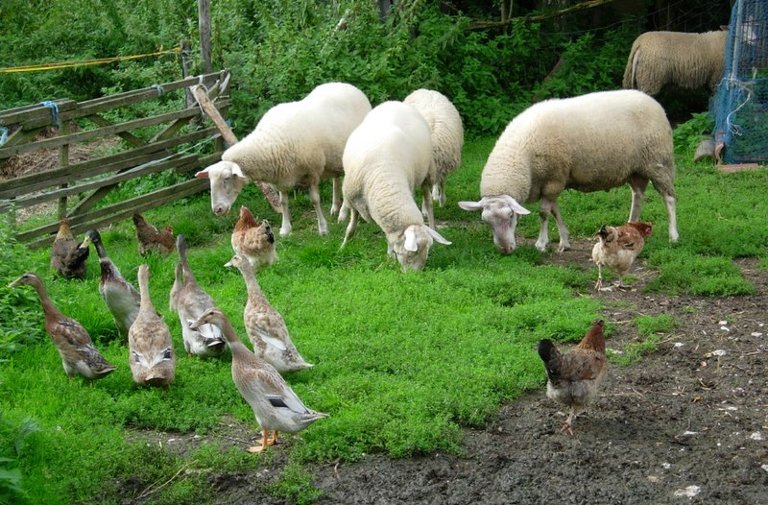
The point George, is that there would be no need for it. Food will come from home gardens, community gardens, edible landscapes of free fruit and herbs on the commons (incl fish tanks and poultry pens) throughout the town maintained by the committees and working bees, and from the nearby small farms … and all nutrients in food scraps, animal manures, fish tank water, and human “wastes” will be recycled to nearby soils. Thus the one-way energy squandering soil-mining, polluting agribusiness system will be replaced by a circular flow of a more or less constant amount of nutrients from soils to kitchens and back again. This would also produce energy (from the methane digesters) and eliminate the need for packaging, marketing, sewers, artificial fertilizers, trucks, computers, soil-damaging practices, techies and expensive experts in suits.
Note how these huge resource savings and social benefits are due to the small scale, proximity of functions, complex networks of causes and effects, overlapping functions and connectedness/integration of functions that are possible at the village scale. Kitchen scraps can be recycled to nearby poultry pens and compost heaps by bucket, eliminating the need for sewers and fertilizer. In cities they cannot be recycled to the soils on the other side of the world from which some of them came. Proximity and overlapping functions enable the scraps on their way to the gardens to also produce methane for kitchens. The nutrient-rich water from the fish tanks can go to nearby aquaculture and then to the nearby gardens. Poultry can provide eggs, meat, manure, pest control, vege garden clean ups, firebreak maintenance, chicks, and entertainment. No “marketing” is needed in the village. Neighbours can informally discuss poultry rosters, bypassing the need for armies of techies organising logistics, insurance, inputs etc. …and reinforcing social mutuality and cohesion.
But would this way still be land-hungry? Not very, because the new settlements will be what the Permaculturists call “edible landscapes”. They will be full of food producing plants and animals. For instance, the parks and roadsides will grow many fruit, nut and olive trees, with herb patches underneath, beside ponds full of fish and ducks. Small largely craft based family firms will produce preserves, honey etc. My Remaking Settlements study estimated that such designs could provide most food needs from within an outer Sydney suburb. Obviously significant reduction in red meat consumption is highly desirable and would increase the viability of this vision.
It is no good targeting isolated faults within this society and attempting to fix them one by one. Many of its core structures, procedures, assumptions and values are mistaken and the focus must be on replacing the system with one that does not generate the present range of problems leading us to destruction. A satisfactory alternative must be some form of simpler way. We will get nowhere unless and until this is widely understood and willingly accepted.





Comments
We changed commenting systems on September 10, 2026 as part of a site-wide functionality and security upgrade. Your past comments have not disappeared, and you can still log in with your old Disqus account credentials if you wish. Contact us with any questions.
Thanks for the corrections from commenters here about the position I really take in ‘Saying NO…’ which is pretty similar to Ted’s. There’s a section called ‘Rural promise’ (pp.50-55) in which I state that the future for humanity is going to be mostly rural, and in Chapters 1 and 4 I discuss the wastefulness of existing energy-intensive settlement patterns and food supply chains along similar lines to Ted. I don’t believe there’s anywhere in my writing where I “proceed as if the task will be to supply the present kind of settlements via the more or less present delivery systems”. Odd interpretation from Ted there!
I tend to agree with much or most of what Ted has to say, but this is not the first time I’ve noticed that on some important matters he’s written about that he hasn’t properly done his homework / research. Sometimes he does it right, and sometimes he’s just plain sloppy about it.
It seems that you have misunderstood Chris Smaje’s perspective: “Both take for granted the basic social
form that we have today, in which food is grown, packaged and
transported long distances to energy-intensive cities where most people
live and work, and turned into sewage and garbage which have to be taken
out and dumped, at astronomical transport, energy and ecological costs.” I would argue that Smaje promotes seomthing quite different, not very far from what is promoted by you.
For the rest I agree with the post!
Keyword: Metabolic Rift
I like Ted Trainer well enough. But I must strongly agree with Gunnar Rundgren’s comment here. Trainer, it seems to me, can’t be very well acquainted with Smaje’s books and other writings, and probably should not have made these comments about Smaje’s work without being more acquainted with it.
I was going to make the same comment;Trainer cites Smaje’s work but seems not to have fully read it. However, there is one point where Smaje, and I, disagree with Trainer’s prescription. Smaje sees a zillion small farms, mostly family owned and run, growing much of their own but also selling some food. Trainer sees cooperative farming going on kind of everywhere with no owner. I am highly skeptical that this would work, unless it was part of a culture in which the responsibility to pull one’s weight and the tools of effective collective decision-making were well ingrained. Otherwise, you have the problem of nobody feeding the chickens, or too many people doing so; someone deciding they want a chicken dinner for their birthday and slaughtering the best layer; the pigsty becoming a total pigsty, because nobody feels like cleaning it; or maybe you have meetings to work all these things out. Lots of meetings, frequent and long meetings, which most people find tiresome. It makes sense to have most farms owned and run by one family, which invests it time and energy and money and is thus entitled to the fruits; and which can make a cohesive plan.
But I agree that cities and towns could have more fruit and nut trees and bushes, schools could have gardens and maybe livestock, and we could ease off the obsessive profit pursuit to everyone’s benefit; we could also eliminate bullshit jobs, all good.
It’s true that a set of social and material skills are necessary for communal agrarianism to work, but that’s no reason not to give it a try, in my opinion. Yes, most people in the so-called “developed world” lack the necessary social skills. Heck, I was almost run over in a crosswalk yesterday, so I know lots of folks are out to lunch these days. But, honestly, the necessary skills and knowledge and insights can be learned, and it ought not take all that long to learn in a supportive environment with people who are adult enough to offer guidance and support.
I believe the “conflict” between household ownership/tenure and communal or cooperative management is partly a construction. Farming communities in most parts of the world has built up various ways of cooperation with everything from irrigation schemes to grazing. The independent farm(er) with private land is mostly a cultural construct. But as you rightly say: ”
I am highly skeptical that this would work, unless it was part of a
culture in which the responsibility to pull one’s weight and the tools
of effective collective decision-making were well ingrained.”
Private ownership can stand in the way for this culture. Secure tenure is more important to capture the best of both….
I have been in contact with both Ted and George with my suggestions for over a decade. Their solutions for present overshoot (ecological damage) and future overshoot (not enough energy to feed people from loss of fossil fuels) create views of the human predicament at its margins and thus their solutions are focused at the margins.
The big injuries (billions dying of starvation and conflict) are controlled by the miss management of the system’s momentum. Momentum is the core issue we are facing. The solutions have to create forces that change or manage the system’s momentum.
How did I change my perspective from the margins to the core.How might you change your perspective from the margins to the core?
Let me give examples of questions I ( and you) might ask.
How many subsistence farmers (wood tools and energy and animal labor – no competitors) can the earth support? David Pimentel’s estimate 600 million.
How many Amish (use metal in their tools ) and animal oil to light their homes can the earth support if they are allowed to spread without any competitors for their space? maybe 300 million.
How many people can live about the way we live — (96,000 kwh per person annually) (no cars or planes or fossil fuels, or wind or pv — just hydro from existing dams) Maybe 50 million?
These are just questions each of us (George and Ted included) should answer.
The answers focus our attention on the momentum of our 8 billion person civilization and the forces (behavior) that manage that momentum.
Ted and George are correct in most of their suggestions on what civilization is doing incorrectly on an operational level and changes in those operations that will be less bad.
However, they are blind to the core issue which is if we don’t find and implement behavior to manage the momentum we are going to have a die-off of 90 to 99% of the human community as early as 2100.
Preventing the die-off amounts to letting the 8 billion to die of old age and replacing them with a very small number of annual births that results in a population living at some living standard.
The transition is a bit more complicated than just reducing population but radically reducing the population is a precursor to a viable civilization. How people grow their vegetables, create they protean and handle their wastes is import but these actions will have little effect on the die-off we are facing and the total loss of all of most of the good parts of our civilization.
Jack
A summary of the references and models for this statement can be found here
https://www.evernote.com/l/AAmZY0Hicy9KbLmuRpZRVAjtdR3UQC_bhEE
Jack Alpert PhD Director:
Stanford Knowledge Integration Laboratory http://www.skil.org
(C) 913 708 2554 [email protected]
13617 W. 48th Street Shawnee, KS 66216
Chris and I have exchanged emails and I think we have sorted things out ok. Here is my email to him.
Chris, thanks for the. helpful reply. I accept your criticism that my statement doesn’t reflect your general position on a desirable future and I will revise it accordingly. But that was not the issue I was concerned with in the article. There are two things, the meeting of food demand via today’s system and living ways and settlement patterns, and doing it tomorrow when all that has been transformed as you and I would wish. Much of your commentary READS as referring to the present situation, esp your comments on George. I feel pretty sure that many readers and participants in the debate would see it as a discussion about whether small farms could meet food demand in today’s world, and the worse one coming up due to the accelerating problems George stresses. Of course your future vision is for “…deurbanized, agrarian localist, low tech, low energy, agroecological, soil-preserving, nutrient cycling distributed populations” but again I am suggesting that you need to make clearer in your wrangles with the factory farming lot that you are not assuming that the task is to meet current demand via current systems. (Even if that was what you believed, it’s a different issue to meeting future demand from future systems.) It’s some time since I read the original book and maybe you make the distinction well enough there, but again I fear that readers of the current debate will be taking you to be assuming supply to present demand.
I might add a note on one of the comments taking me to be for collective ag without small private farms, and arguing that cooperative/collective farming might be problematic. I upset socialists by arguing strongly that most production in a sensible future could and should come from private firms and farms … operating under strict social regulation and guidelines. It’s satisfying to be able to run your own little outfit as you wish … but it’s not ok to strive to become a tycoon and take the livelihoods of others, and to live on investments. Market forces should not be allowed to determine distribution or development; those should be community decisions.
Would collective management become a pigsty? I do assume that a good community would have many commons, coops, committees and community property. There would be powerful incentive to run these well, to turn up to working bees, to be a conscientious caring citizen. …because in the society soon to come, after the inevitable collapse of this one, your fate will depend entirely on whether or not your town is working well.
Ted Trainer
I think you have misunderstood what he meant: 5-10% of US average means a 90-95% reduction.
You are right. I’ve edited my comment.
We’ve been on about an alternative for 119 years, join the club,
https://www.worldsocialism.org/spgb/pamphlet/from-capitalism-to-socialism-how-we-live-and-how-we-could-live/