

There are those who believe our current way of life is not facing any near term threat and will go on indefinitely. In this view, any existential problems—should they ever arise—will be dealt with by new technologies.
Others assume the threat of civilizational collapse is real and can be and even will be addressed. They may believe that the threats include climate change, the challenge of evolving microbes that are rendering antibiotics useless, and the increasing toxicity of the biosphere due to human releases of novel toxic chemicals. This group frantically offers solutions which are emitted on an almost daily schedule from the world’s universities and industrial research laboratories.
The solutions that are offered usually address an isolated issue such as carbon-free energy. A recent proposal suggests burning iron powder. As one reads about this “solution,” it seems more and more like a nonstarter. There’s plenty of iron, of course. But we need to ramp up dramatically the manufacture of iron powder. This gets burned to make iron oxide. Then we can make iron “renewable” by using hydrogen to strip away the oxygen from the resulting iron oxide so we get iron again.
Of course, the hydrogen is assumed to be “green hydrogen” made using renewable energy. Even if the amount of green hydrogen necessary for widespread adoption of iron oxide recycling were to become available—which is a real stretch—storing and transporting hydrogen is a nightmare because as the smallest molecule in the universe, it leaks easily and persistently from practically anything you put it into AND any hope of storing it economically means it needs to be turned into a liquid at minus 423 degrees F. Keep in mind that absolute zero at which all molecular motion theoretically ceases is minus 459.67 degrees F. Of course, this will be very energy-intensive.
I am reminded of the joke about the priest, the engineer and the economist stranded together on a desert island. They need food, and the logical source is fish. The priest suggests that they all pray for fish. The engineer recommends building a fishing net with materials available on the island. The economist ponders for a moment and then says, “Assume a fish.”
That is what most of the “solutions” to civilizational collapse amount to. For example, fusion energy assumes a stable geopolitical environment capable of funding, building and running complex energy infrastructure. So does renewable energy. So-called vertical farming in cities assumes the capital to build environment-controlled buildings which use enormous water, fertilizer and electricity resources while sitting on high-value real estate.
For the various solutions to take hold we must assume ongoing access to huge sums of willing capital, geopolitical stability, plentiful resources to get us through any transition, and a climate that does not plunge us into a sudden catastrophic change that undermines food supplies and challenges the limits of existing infrastructure. And, we must assume that the multiple threats we face regarding depletion of fossil fuels, water and fertile soil and the continuous poisoning of the air, land and water will be addressed in tandem successfully. The smooth functioning of the existing system depends on it.
None of the solutions, however, get to the heart of the matter. I regard the heart of the matter as ever rising consumption (and therefore use of energy and resources). Dramatically reducing consumption is simply not in such plans for the future except among a few groups advocating for what has euphemistically come to be known as “degrowth.” Degrowth means the same thing as the economist’s “negative growth.” It means less stuff and energy and a lot less over time.
As the dean of the steady-state economists, the late Herman Daly told us again and again, human civilization will achieve a steady-state economy one way or another. Either we will plan for it and execute a plan that takes us as a global society on average down to a fraction of what we consume today. Or, nature will take its course and we will collapse down to a steady-state level of consumption, probably one considerably below what would occur if we took the planned route.
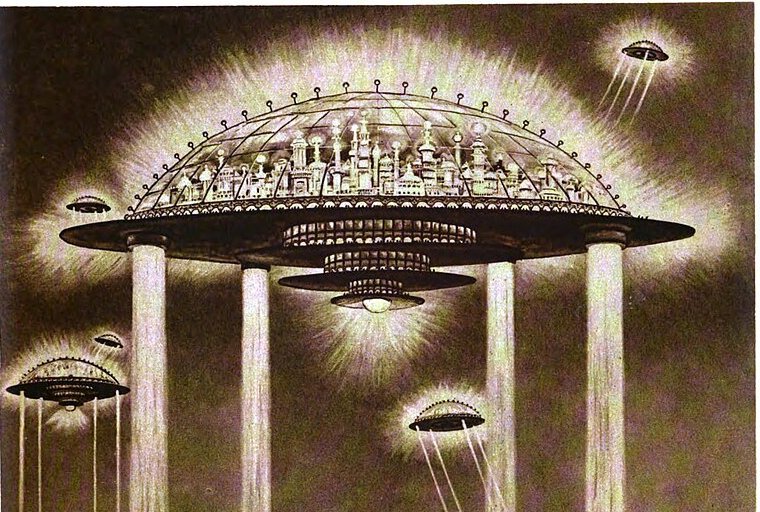
Image: Illustration of Hugo Gernsback’s speculative article on what cities will be like in the future (1922). Illustrator: Frank R. Paul. Via Wikimedia Commons https://commons.wikimedia.org/wiki/File:Science_and_Invention_Feb_1922_pg905_-_Cities_of_the_Future.jpg
“The city of the future, 10,000 years hence, will not be located on the surface of the Earth. It will be floating up miles high, and such things as snow, rain, and storms will be unknown to the city dwellers of the future. It will have perpetual sunlight, and weather will never bother our future citizens. Just as our leviathans of the sea are built to remain on top of the water at all times, so the floating city of the future will remain afloat constantly, supported by shafts of electro-magnetic rays, which, nullifying gravity, keep the city raised up by reaction. The city dweller of the future will not be bothered much by diseases such as tuberculosis, because all of these are now transmitted by the high density of the air near the surface of the Earth. Three or four miles up bacteria are not so common as they are near the surface.”





Comments
We changed commenting systems on September 10, 2026 as part of a site-wide functionality and security upgrade. Your past comments have not disappeared, and you can still log in with your old Disqus account credentials if you wish. Contact us with any questions.
Herman Daly was wrong. Even planning a route down to a potentially steady state economy won’t avoid the lower consumption rate because, ultimately, the level and style of consumption must be sustainable to get to a relatively steady state. A sustainable consumption situation would entail the whole world consuming resources only at or below their renewal rates and not damaging the environment beyond its ability to assimilate that damage, in that consumption. I guess there could be a planned way down but I very much doubt Herman Daly would have wanted the kind of “society” that operates sustainably. Very few people alive today would want that. Yet, ultimately, that’s where we’re heading.
It is good that he says:
“None of the solutions, however, get to the heart of the matter. I regard the heart of the matter as ever rising consumption (and therefore use of energy and resources). Dramatically reducing consumption is simply not in such plans for the future except among a few groups advocating”
It’s bad that he goes on and says “except among a few groups advocating for what has euphemistically come to be known as “degrowth.” Degrowth means the same thing as the economist’s “negative growth.” ”
The author, Kurt Cobb, is either:
– Not expressing himself well (I doubt it, he seems to be an accomplished writer), or
– He’s ignorant (again I doubt it), or
– Is against Degrowth because it involves middle class people losing (monetary) wealth.
No, Degrowth does not ‘the same thing as the economist’s “negative growth.”’ Degrowth is “a planned and democratic reduction in energy and material throughput in over-consuming nations while improving wellbeing and global justice.”
Negative growth is recession, it is not Degrowth.
Excellent essay by Kurt Cobb, and I agree with it all, except I leap to the keyboard to make the possibly pedantic point that the smallest molecule is helium. Hydrogen is the smallest atom, which may be what he was thinking.
Central to our current planned global failure is the lack of a plan to actually address the causes of problems.
Foundational to this planned failure, is a conservatism* which refuses to observe and recognize the seeds of failure locked within its ideological hierarchy. This refusal ensures that establishment thinking perpetuates the replication of authoritarian falsehoods as solutions. Planned failure is a bad ‘plan’ or not really a plan at all……either way, proponents undermine their ideology.
While conservatives should get on board with a plan that actually resolves the planned failures of its social-political philosophy, their resolute distortions and mythological narratives explode further into the mayhem that denialism and brutality guarantee. The lack of social responsibility, the deceptive nature of their communications, and their celebration of autocratic, elite power based upon wealth, must all be rectified for ‘solutions’ to even start to emerge. Wishful thinking promoted as ‘independent achievements’ and ‘hard work’ further demonstrate the detachment from reality – that major systemic reforms are necessary.
Civilization requires we act civilized……… conservatives have failed endlessly and must recognize and resolve the incivility, inhumanity and destructive nature of their traditions.
* conservatives include Conservatives, Liberals, Republicans and Democrats, and other political parties/politicians who insist that continuing an anti-democratic, economic authoritarianism built on installed power/profit hierarchies will resolve the problems they reliably create.