

Peter Turchin’s latest book, End Times: Elites, Counter-Elites, and the Path of Political Disintegration, is receiving glowing reviews. Its message is highly relevant to our collective understanding of the emerging global polycrisis and what needs to be done to minimize it. Turchin began his career as an evolutionary biologist, analyzing large datasets to clarify patterns in population dynamics in insects and other organisms. Throughout the last 25 years, he has applied these analytical methods to questions having to do with changes in human societies over time, a study to which he and his colleagues have given the name cliodynamics (after Clio, the Muse of history). Turchin, who now refers to himself as a complexity scientist, is an emeritus professor at the University of Connecticut, a project leader at the Complexity Science Hub in Vienna, and a research associate at the University of Oxford. I was delighted when Peter consented to engage with me in an emailed interview about his most recent book.
RH: Thank you, Peter, for writing this important and timely book. As you know, I’ve been following your work for several years, and I discussed it in my own recent book, Power: Limits and Prospects for Human Survival. The data-driven, mathematical methods you and your colleagues have developed for understanding patterns in history seem highly illuminating. In the US, rising economic inequality (since the 1970s) has immiserated the working class, while the number of elites (e.g., billionaires) and elite aspirants (e.g., people with law degrees) has skyrocketed. As you show in detail, these developments align with a historical pattern seen repeatedly in complex societies, and it never seems to end well. In End Times, you lay out clearly what your analysis means for the United States in the 2020s. It’s not a pretty picture. And indeed, we’re seeing the evidence of increasing polarization and political ill will everywhere.
PT: Thank you for the kind words about my book, Richard!
RH: Your book reminded me of the terrible irony of the enduring worship of Ronald Reagan by populist Republicans—whose voter base now largely consists of working-class people whose prospects have been repeatedly undermined (starting in the Reagan era) by Republican-led tax cuts on high-income Americans. In effect, the US economy is now a “wealth pump” that gives to the rich and takes from the poor. As you point out, Democratic leaders (with exceptions such as Elizabeth Warren) have also largely turned a blind eye to the economic interests of the working class as they align themselves increasingly with urban voters with high incomes and education levels. Due to this evolution in the two parties, there seems to be little support among government leaders for the kinds of policies that might tend to defuse the country’s political crisis—higher taxes on the rich and a higher minimum wage. According to David Leonhardt, writing in the New York Times, a few populist Republican politicians (including Marco Rubio and J. D. Vance) are now calling for higher taxes on the super-wealthy. Do you see this as a significant shift? And if it is significant, how might it help sort out (or further scramble) our country’s politics?
PT: Indeed, by 2016 the Democratic Party had largely completed its evolution from a party of the working classes to the party of the “10 percent”—successful, educated, urbanized Americans. As Thomas Frank wrote in Listen, Liberal (2016), with the Republicans traditionally reflecting the interest of the wealthiest 1 percent, 90 percent of Americans were left without effective representation. Popular discontent, driven by decades of stagnating—and even declining—wages, especially for workers without college education, was first harnessed by Donald Trump, which propelled him to the presidency. As you note, there are now several populist politicians, whose professed goal is to remake the Republican Party into a party of the working class. Whether they succeed in this, and how sincere they are in reversing the decades of anti-working-class policies, remain to be seen. But, in any case, this movement represents a significant shift in this country’s political landscape.
As I discuss in detail in End Times, the most important thing we need to do, in order to find a solution to the crisis in which we find ourselves, is shut down the perverse wealth pump, which has been, since the late 1970s, taking from the poor and giving to the rich. Most obviously, accomplishing this will allow wages and incomes of the majority of Americans to again increase together with economic growth, as they did during the period following the New Deal (and until the 1970s). Even more importantly, this will eventually reverse the overproduction of the uber-wealthy and elite aspirants with advanced degrees, which, as I explain in the book, are the most dangerous drivers of political instability, especially when combined with immiseration. Until the wealth pump is shut down, America will continue to experience social and political turbulence, which at any point could spiral to levels that would transform our current “cold” civil war into a hot one.
RH: End Times is all about social structures—the economy, the political system, the military, the media, and the educational system. But social dysfunction is hardly the only kind of crisis facing America, or humanity in general, this century. Most people are justifiably concerned about climate change, and many ecologists also warn about the consequences of resource depletion and continued population growth. The energy subsidy that humanity has derived from fossil fuels has enabled a massive escalation of everything we do, but the evidence (whether framed in terms of ecological footprint or planetary boundaries) suggests that we’re exceeding the planet’s long-term carrying capacity. The implications of that are frightening enough. Do you see social collapse as more imminent and therefore a more important subject of discussion—particularly in the US?
PT: The ecological crises and political crises are not separate. Thus, a spike in food prices has been a common trigger of revolutions and other outbreaks of political violence. Most recently this was seen in the Arab Spring of 2010–12, and even more recently in the French riots of 2023. Conversely, solving global crises requires cooperation of humans at large scales—at the global level, in fact. Yet, political disintegration within countries undermines our ability to cooperate at needed scales. This is most obvious when we consider American politics. Here, how to deal with global change, or even whether it is a real crisis, has become one of the divisive issues used by different political factions against each other.
RH: China has seen rapid growth in wealth inequality too, especially since 1990. Does China’s elite overproduction also signal trouble? Are “end times” likely to occur later in China than in the US, and is that country likely to follow a different trajectory?
PT: China has emerged from its previous “age of discord” much more recently than the USA (and Western Europe). Analysis by my research group of CrisisDB, a database of more than a hundred past societies sliding into crisis (and then emerging from it), suggests that China still has time to deal with the negative trends you mention. In my opinion, thus, China is likely to enter its own End Times decades later than the US. However, I should note that a proper cliodynamic analysis of contemporary China has not yet been done, and that’s what would be needed for a more solid, empirically buttressed answer to your question.
RH: The Russia-Ukraine war has already had economic and geopolitical ripple effects globally. The fact that you grew up in the USSR perhaps gives you a perspective on the conflict that’s different from most US commentators. Combining that perspective with your historical analysis, is there anything on this subject you would like to impart to readers that you didn’t say in the book?
PT: As it happens, I am currently working on an article that will be posted in several installments on my blog (https://peterturchin.com/cliodynamica/), which will provide an answer to this question.
RH: As an American, I’m deeply saddened and concerned (though not entirely surprised) to read that you don’t see any way to fully defuse the strong likelihood of further US internal political violence in the 2020s (on page 202, you write that “it is too late to avert our current crisis,” though we could “avoid the next period of social breakdown in the second half of the twenty-first century.”). You offer some advice for political elites in that regard. But is there anything ordinary citizens can do to reduce the trend toward polarization and violence over the short term?
PT: Speaking for myself, the most effective way I can help is simply continue my work as a scientist attempting to better understand societal dynamics. Although we made great steps in understanding the structural factors driving “end times” in our societies, our theories, models, and data can be greatly improved. Such understanding, in my opinion, is key for developing effective reforms and policies that can take us on a better course out of this crisis. Beyond making science better we need a broad public discussion of its implications, and of what needs to be done. Ordinary citizens can help by educating themselves on these issues, by participating in the discussion of possible remedies, and ultimately by putting pressure on our ruling elites to act in ways that benefit the people broadly, rather than (as they’ve been acting over the past few decades) in their own narrow and shortsighted personal interest.
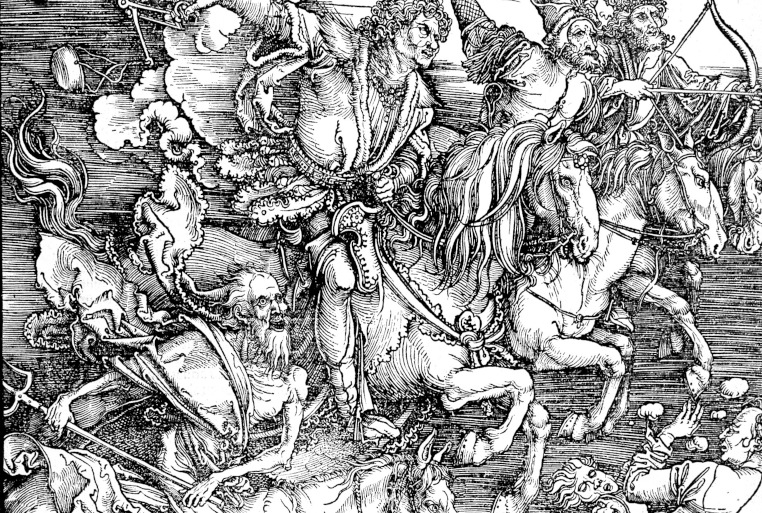
Teaser photo credit: Four Horsemen of the Apocalypse, woodcut print from the Apocalypse of Albrecht Dürer (1497–1498), Staatliche Kunsthalle Karlsruhe. By http://www.wga.hu/html/d/durer/2/12/2apocaly/index.html, Public Domain, https://commons.wikimedia.org/w/index.php?curid=95226


Comments
We changed commenting systems on September 10, 2026 as part of a site-wide functionality and security upgrade. Your past comments have not disappeared, and you can still log in with your old Disqus account credentials if you wish. Contact us with any questions.
@Jon Wright –
Your thinking lacks nuance. I could have said that human ecology and frog, turtle and reindeer ecology are alike in many respects, but not in all respects. And I could have explained why this is important to understand if we are to understand ecology in a human context. And I think I did at least touch upon that. But it is clear you’re not interested in any of this. You prefer to imagine that I just don’t know what I am talking about. But your ignorance of what I am talking about isn’t anything which can be ameliorated. You’re too sure of yourself!
I also accept the inevitability of collapses of various kinds, but my attitude toward it is very different from yours, Jon Wright. I think there are lots of things we do need to do — in an organized way — to soften the collapse and pave the way for a world following collapse. You seem to ridicule people like me as a bunch of fools and morons, and it really isn’t very kind, nor intelligent or wise.
Yes, indeed! Even if there were absolutely no political conflict and lefties and righties got together to hold hands and sing Kumbaya, nothing they could organize would prevent collapse. Civil strife might well make collapse marginally more horrific than it would be with optimum cooperation and planning, but nothing in our social or political culture can make up for a lack of food, water or shelter. The “end times” are not going to be a political event à la Turchin, they are going to be a die-off.
“Even if there were absolutely no political conflict and lefties and righties got together to hold hands and sing Kumbaya, nothing they could organize would prevent collapse.”
I’m becoming increasingly reluctant to presume, as too long I had, that “collapse” is a word we (us here) all have a reasonably good handle on. Anyone who has looked into “collapse” with any degree of thoroughness will know that “collapse” has a variety of kinds, degrees and paces (with paces being rates of collapse). Of course we cannot avoid collapse, then! It’s already well underway, and is amplifying — but it is amplifying more in some places than others, so “collapse” has not only differing kinds, degrees and paces, but also differing geographies wherein this unfolds and is now unfolding. Therefore, “collapse” is very nearly a meaningless floating signifier, until the user of the word gives it some specificity and clarity of use. Is it — or has it been — “collapse” in a given geographical location if a “first world” nation has reverted to per capita GDP from sixty or a hundred years ago? Does “collapse” necessitate that groceries are no longer showing up in grocery stores? What criteria are we using to determine whether or not economic, ecological, social (etc.) “collapse” has occurred or is occuring? Where are we drawing which kinds of lines here?
“Civil strife might well make collapse marginally more horrific than it would be with optimum cooperation and planning, but nothing in our social or political culture can make up for a lack of food, water or shelter. The “end times” are not going to be a political event à la Turchin, they are going to be a die-off.”
True enough. But, of course, if enough people are hungry or without their basic needs being met, there will be “social strife” in proportion to that proportion. That’s a given — a truism.
Not so long ago I engaged in discussions and debates about whether or not mass human die-off was inevitable as we move forward, deeper into the overshoot crisis, and my thinking was shaped mainly by premises about the rate at which anthropogenic climate disruption (ACD) would likely unfold. So I was thinking in terms of acres of land, productivity of industrial versus more organic / regenerative agricultural methods… and all that yada yada. Well, my whole frame shifted recently as it became increasingly clear the rate of ACD will be the principal crisis driver with regard to food and water. Serious and dangerous food shortages are now inevitable in the very near term, and will pose a dramatic risk to the entire world. And the driver of this risk is heat waves and domes, droughts, floods, and a thousand other assorted disruptions to agriculture and livelihood from global warming (global weirding).
Food and water access will soon enough be the overwhelmingly greater framing topic and issue, as will the attempts at mass migration with come along with these.
We can bring some proactive responsiveness to all of this, but the folks who are “running the world” don’t give a flying fork about any of this, and ordinary people are too ignorant and foolish not to know they’re being led down a path to utter ruin and horror. I mean, how will it even help their bottom line to care about people and animals and plants and stuff? It doesn’t. And in this precise way our political lives are now fully obsolete in the one of two senses of this word. The first sense is “no longer in use” The second is “no longer useful”. Our political paradigm is no longer useful. Time for a paradigm shift — and fast! But what are the odds?
“Eating is not the cause of human overshoot. Not even the presence of fossil fuels are the root cause of human overshoot.”
I’m sorry, but this is just wrong. Every species tries to reach its biotic potential, which (almost) always includes exponential growth if possible. Overshoot is a problem of a temporary excess of food supply in combination with reproductive potential, not a cultural failing. Every species, including humans, is susceptible to overshoot when encountering a temporary surplus of food resources (or something that temporarily enables more food to be produced).
There are many papers about population dynamics that discuss overshoot and collapse, but the example that is closest to our current situation is what happened to the St Matthew Island reindeer herd. Substitute fossil fuels for lichens and the parallel is almost perfect.
https://www.geo.arizona.edu/Antevs/nats104/00lect21reindeer.html
I’m glad I took the time to write out what I did about how human overshoot differs from overshoot in relation to any and all other species, because what I said isn’t a guess or a mere opinion, but a fact. That you don’t understand human overshoot as I understand it, Joe, demonstrates why it’s good that I provided the explanation I did.
Human ecology is not the same thing as reindeer or turtle or frog ecology. It just plain isn’t. Period. Full stop. And the reasons and explanation I provided really do sum up why this is so.
I should also add that humans make decisions and choices to an extent far beyond anything done by non-human animals–, so far as anyone has reason to believe. And we make decisions quite differently, and collectively…. So comparing us to reindeer, as if there were no such differences, is just rather clueless.
If the global population gave up all consumption of ‘stuff’ ie anything other than fulfilling needs we would still be in overshoot and beyond carrying capacity.
Fossil fuel is what has enabled the food production that has fuelled the exponential rise in human numbers. And pointedly, allowed human expansion into areas of the globe that would otherwise not provide habitat for large numbers (or any at all) of people. Without fossil fuels 8 billion people is a number that the Earth cannot support. And whilst our collective psyche may have brought about this problem, it is still the fundamentals of ecological science which will prove the limiting factor.
Absolutely agree with you and Joe C – life is an energy equation, and we added a one-off bonanza of energy in the last 200 years. And multiplied. Temporarily.
“If the global population gave up all consumption of ‘stuff’ ie anything other than fulfilling needs we would still be in overshoot and beyond carrying capacity.”
You may well be correct on this point, Danielle, but if you are it is probably mostly due to the fact that we’re now looking at the holocene in the rear view mirror, and food production is inevitably going to become increasingly difficult, with failed crops becoming much, much more common over time. This, of course, is due to “global weirding” — the complete disruption of holocene climate conditions in which there were far fewer heat waves, heat domes, floods, droughts, fires, etc. Growing food, having water… shelter, everything, is getting more difficult to succeed at now, because we wrecked the holocene.
As an eco-cultural philosopher, a kind of human ecologist, I’m interested in deeply examining causation in systems terms, including those features of systems which are borne of cultural evolution, psychology and the like.
There’s a relatively new field of study which has demonstrated that humans are not alone in having culture. Many animals have what is popularly called “animal culture,” though still, while humans are no longer considered alone in having culture, as we were only sixty years ago, human culture is entirely unlike (in kind and degree) all other Earth species. Culture is described, now, mainly in relation to “social learning”. This is almost a definition of the dynamics of culture — be it among non-humans or human animals. Where there is social learning there is culture.
Because my field of eco-cultural philosophy is a philosophical field, I ask and ponder a lot of basically philosophical questions … like Could things have turned out differently with regard to the holocene, the anthropocene, human overshoot…?
I think it is pretty clear that (like many others) Joe Clarkson would say that it could not have turned out any differently than it did.
(continued in another post. Not sure how long these can go!)
Yes, humans do make decisions and choices far differently than other animals, but they have nothing to do with the physical reality of overshoot. Overshoot is not a cultural choice, it’s a physical condition.
Cultural choices can certainly affect human behavior, but they didn’t prevent us humans from getting far too over-populated in comparison with carrying capacity. There are now just too damn many people for a food that can be sustained indefinitely, probably twenty times too many.
And once we are in overshoot, there is no cultural solution, unless you think that a deliberate program of mass suicide or mass homicide to reduce population to carrying capacity is plausible. Perhaps getting into a condition of overshoot was a cultural choice (though I doubt it), but once we are in that condition we can’t just “choose” to get out of it.
“Human ecology is not the same thing as reindeer or turtle or frog ecology.” And here we have the root of our inability to fully grasp what’s in store for us. The belief in human primacy. You cannot make sense of where we’re headed if this is what you believe. It’s a false premise.
Me:
Please list some of the variants of determinism spoken of by philosophers.
ChatGPT:
Various philosophers and thinkers have explored different variants of determinism, each presenting nuanced perspectives on the nature of causality and human agency. Here are some of the key variants of determinism:
Hard Determinism: This view asserts that all events, including human actions, are causally determined by prior events and natural laws. According to hard determinism, free will is an illusion, as every action is the necessary outcome of preceding causes.
Soft Determinism (Compatibilism): Soft determinism reconciles determinism with free will by arguing that even though human actions are causally determined, free will can still be meaningful. It suggests that free will is compatible with determinism if individuals act in accordance with their desires and internal motivations, even if those motivations are influenced by external factors.
Logical Determinism: This variant posits that the laws of logic and the structure of the universe inevitably lead to a single possible future. In other words, it claims that the future is logically determined by the present and past.
Theological Determinism: This perspective holds that a higher power, such as a deity or divine being, has predetermined all events in the universe, including human actions. This notion is often associated with certain religious beliefs that assert an all-knowing and all-powerful God.
Biological Determinism: This form of determinism suggests that human behavior is predominantly shaped by biological factors, such as genetics and neurobiology. It implies that our actions and choices are heavily influenced by our biological makeup.
Psychological Determinism: This view maintains that human behavior is determined by psychological factors, such as unconscious desires, conditioning, and cognitive processes. It posits that our actions are products of psychological influences.
Environmental Determinism: Environmental determinism argues that human behavior and societal development are primarily influenced by the physical environment, such as geography, climate, and available resources.
Technological Determinism: This perspective asserts that technological advancements and innovations play a decisive role in shaping human history and culture. It suggests that technology has its own trajectory and impact on society.
Economic Determinism: Economic determinism proposes that economic conditions and the mode of production in a society determine its structure, institutions, and even its cultural norms and values.
Structural Determinism: This variant emphasizes the influence of social structures and institutions in shaping human behavior and societal outcomes. It suggests that people’s actions are largely determined by the larger structures in which they exist.
These are just some of the many variants of determinism discussed by philosophers and thinkers throughout history. Each of these perspectives brings a unique angle to the ongoing debates about causality, human agency, and the complex interplay between individual actions and the wider world.
Yikes. I guess this is where I just shut up. There’s nothing more for me say here.
(continued from above)
You will recognize the philosophical question I’m asking as a form of “The Determinism Question”.
Clearly, there is causation involved in all of this, so some kind of determination of human behavior and activity is a given. But this doesn’t resolve the “Could things have turned out differently” question.
There is a variant of Determinism in which it is assumed that had we access to a complete description of preliminary conditions — e.g., the Big Bang or origin of the Cosmos — we should be able to know the outcome of all historical processes in minute and exacting detail. In this framing on determinism, there is a clear and simple answer to the question, “Could it have turned out differently than it did?” That answer, from within the paradigm of capital D Determinism (in which the World is a predictable Machine which was fully Determined at Origin), is simply No.
For many — very very many — humans these days, once fossil fuels had been discovered a whole set of unavoidable, purely determined, events became inevitable — among these would be catastrophic human overshoot of the sort I’ve been talking with y’all here. (No, I’m not a Southerner. Y’all just seemed somehow most apt a term at the moment.)
As anyone who reads my writings knows, I’m interested in how humans could accord ourselves differently in relation to the natural world. I’m interested in how we could change course and transform our culture / civilization at this very late hour at the end of the Holocene. Such questioning is only really possible if one is not a hard line Determinist.
To many, it is pointless to ask “Could it have gone differently in the past”? And these have a point, up to a point, as we can’t alter what has already occurred. The world of events has the quality of irreversibly. But I believe “Could it have turned out differently” is a valuable and important question, because we need to wonder and question about that in order to understand and work with the question of how we might engage in the world now in order to change course.
Because we’re no longer in the holocene, and the climate is now unstable and rapidly further destabilizing, I do believe a great many humans will inevitably perish, and that we cannot sustain our current human population in this climate regime. Were we still in the holocene, perhaps we could stumble through with much less rapid human population decline than is now pretty much baked into our cake. But the shift in climate stability we set in motion is irreversible. So there’s not much point in pretending otherwise.
We still have to live with the philosophical questions concerning the fact (to my mind it is a fact) of human agency — the fact that what we think, say, do … how we feel and perceive … how we talk and behave … have complexly related consequences for the future. We’re collectively culpable … and responsible (response able). What we do matters. We are not merely culture dwellers, culture consumers. We are also culture-makers. Just as we learned long ago to make stone tools and use fire, we can learn to be conscious and deliberate shapers of culture. But we, too, can allow ourselves to be shaped by all of the non-human voices and agents. Perhaps, as some are now saying, agency is everywhere … in clouds, mountains, plants, animals? Perhaps allowing ourselves to be shaped can empower us to shape? To reclaim our agency? I’m not sure. Are you?
Look i am honestly not interested in long winded essays on philosophical questions regarding how we got to this point. Or the definition of terms we use to describe things.
We are well into overshoot. We are facing a catastrophic collapse of human population. There is no fixing it. What is important to me is the practical know-how that may give my family a half decent chance of surviving.
Something i wish this site would focus on.
“Look i am honestly not interested in long winded essays on philosophical questions regarding how we got to this point.” Indeed Danielle. The math is not complicated and it is the same math that governs carrying capacity in any other species. And what happens when you exceed it.
I seems to me that even if the wealth were re-distributed more evenly among all the 8+ billion people on the planet, this would need to be accompanied by a far greater frugality, and a far less materialistic way of seeing reality.
The “wealth pump” works in the directions of both up and over. When you outsource the good jobs to China and other low-wage countries, the corporate owners and big consumers (the top 10%) gain, as do the elites in the other countries that you’re offshoring too. RH seems to miss this point in this article, which is a policy fueling some of the right-wing populist movement.
RH asked the question, but it wasn’t answered. The Limits to Growth slash existential predicament is not in Turchin’s model, it seems. I will read the book – as we should, even if we don’t agree – but it seems he is a victim of siloing. The elite issue is indeed something that happens towards the end (Tainter, Wright), but is not the underlying problem.
The author and quite possibly Heinberg himself are still in the bargaining stages of their grief over the fact that these are, indeed, our “End Times.” All these articles are full of “we need to” and “we must” and as soon as you see these presaging an idea you know the author doesn’t understand our predicament. The fact that it is just that, a predicament. They believe we are in a position to bargain with the inevitable. We are not. We’d be better off at this stage of the game accepting that the party is over and discuss how individuals and families might position themselves to have a better shot at negotiating the fallout of something inevitable. We cannot evolve to this stage of the conversation without first acknowledging that this particular model, this civilization, is going away. That this is the math.
I don’t agree with the interviewee. While world is not going into crisis as a result of Income Inequality, my biggest complaint is he still feels that with more political effort the “problem” can be solved/corrected, etc. What we are experiencing is a “predicament”, (something without a solution, but just is” and not a “problem”. Well past time to move on from this stage of thinking.
Such preambles – “As I discuss in detail in End Times, the most important thing we need to do, in order to find a solution to the crisis in which we find ourselves…” i think reveal a fundamental confusion in the mind of the writer pertaining to the context they are addressing. If there were solutions to our crises today, we wouldn’t be in our End Times. The reason they are end times is because we’ve run out of solutions. I think this statement is equally confused – “the most effective way I can help is simply continue my work as a scientist attempting to better understand…” We hear this a lot in the natural sciences as well. It’s based on the false premise that understanding itself is an antidote. If understanding was what lead to answers in our culture, we’d have very few problems. There have never been so many scientists in the history of man as there are today, nor more readily available knowledge. A state of affairs made possible by the very energy equation brought to us by oil that is destroying us and much else. The truth is, we are not in a position to bargain with where we’ve arrived. Once our model became based on fossil fuels, dependent on them and the growth they allowed, the math dictated we were only going to arrive at one outcome, and that much sooner than otherwise – collapse.