

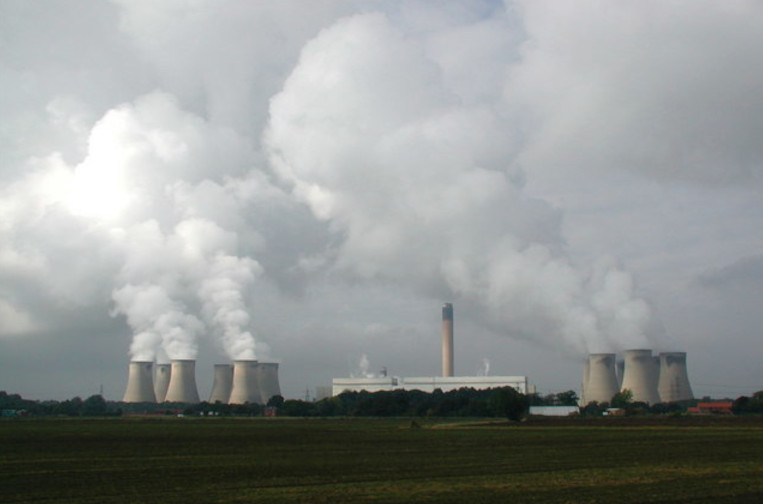
Drax, the company that runs Britain’s biggest power station, stands accused by residents of “brazen politicking” in a closely fought by-election contest in Selby and Ainsty, North Yorkshire.
DeSmog can reveal that Drax is co-hosting a hustings with five of the local candidates on Wednesday evening, and has encouraged its allies both to attend the event and offer statements in support of the firm.
Ahead of the by-election, set for 20 July, Drax has also been heavily sponsoring articles in local newspapers, where it repeatedly states that the company hopes to build a “constructive relationship” with the area’s next MP.
Pro-Drax coverage in the Selby Times over the past fortnight has included a four-page paid-for advertorial feature, an article on the company sponsoring York Pride, and a direct appeal by Drax for the support of prospective representatives.
The scale of pressure applied by Drax during the by-election contest to date “shows a level of desperation on Drax’s part not seen before,” Katy Brown, of campaign group Biofuelwatch, told DeSmog.
The latest polling for the vote gives Labour the lead in the former Tory safe seat, which was previously held by Nigel Adams, who was a vocal champion of Drax during his 13 years in office.
Drax, which says it supports over 6,000 jobs in the North of England, is the UK’s single largest emitter of carbon dioxide. The firm has actively lobbied politicians at a local and national level, applying intense pressure across government departments to influence energy policy in its favour. Last year it made a £12,000 donation to the Labour Party, and has sponsored major events at both Conservative and Labour party conferences.
The Selby and Ainsty by-election coincides with a deeply uncertain time for the future of Drax, which is looking to Westminster for continued financial and political backing.
Drax earned £617 million in direct government subsidies in 2022 to burn wood pellets at its former coal-fired power station, which generates around 12 percent of the UK’s renewable electricity. This comes in addition to £893 million in subsidies in 2021.
With its subsidies coming to an end in 2027, Drax is now waiting to hear whether the government will back the firm’s controversial plans to store its significant carbon emissions under the North Sea (a process known as BECCS). Energy think tank Ember has estimated the total cost of the plant at £31.7 billion.
The electricity Drax produces is classified as carbon neutral under the premise – disputed by many experts – that new-growth trees will reliably recapture and store the carbon emitted from burning wood pellets.
“Drax knows its greenwash and jobs claims are starting to wear thin, and clearly wants to use the Selby by-election as an opportunity to promote itself to all prospective candidates,” Brown said. “It wants another local champion who will talk up its inflated jobs claims at Westminster to try and influence central government decisions over Drax’s subsidies.”
Drax Hustings
Residents who spoke to DeSmog said the upcoming hustings has been poorly advertised to the 96,000 residents living in the constituency, with many unaware it is taking place.
Drax did however alert its supporters to the by-election and the upcoming hustings in multiple emails sent to its ‘Friends of Drax’ newsletter list.
The first, dated 28 June, noted “a few opportunities for you to make your voice heard during this critical time”, including by lobbying the candidates and attending local hustings.
“By engaging with the candidates and asking thought-provoking questions, you can help ensure that representatives from all political parties understand the significance of supporting thousands of green jobs, decarbonising the Humber region, and positioning Selby & Ainsty as a pioneering force in green technology,” it read.
In the newsletters, Drax says advocating for BECCS technology “should be a focus of our parliamentary representative”, highlighting its ambition to achieve ‘carbon negative’ energy by 2030.
Multiple academic studies, however, have found that the vast increase in bioenergy required to upscale BECCS in line with current international targets would put at risk future generations due to uncertainties over land and energy use, as well as the effectiveness of the technology to safely capture and store emissions.
Five candidates are due to meet at tomorrow’s debate, including the by-election front-runners, the Conservative Party’s Claire Holmes and Labour’s Keir Mather. Neither candidate, nor their party press offices, responded to DeSmog’s multiple requests to clarify either their position on BECCS, or whether Drax had communicated with them directly.
The Yorkshire Post, the primary regional newspaper, is chairing the two-hour event at the Drax Sports & Social Club, a community venue that lies opposite the power station. In an email between organisers, seen by DeSmog, a journalist from the newspaper said Drax would be “hosting”, but appeared to rule out any undue editorial influence.
“This will not be a hustings on Drax or energy, but Drax will be hosting the event,” they said, adding that Drax staff would attend along with members of the public and the media. Drax did not respond to DeSmog’s requests to clarify what “hosting” the event will entail.
In another email to its supporters, Drax describes the hustings as “a great opportunity to ensure the candidates understand the important role that Drax plays in the local area, as well as for national issues such as supporting energy security and net zero.
“With the power station serving as an ideal backdrop for the discussion, as someone who cares about the future of Drax we wanted to make you aware of the event.”
A third newsletter was dispatched on Tuesday, the day before the hustings. “We look forward to seeing you there,” Drax told supporters.
Cherry Waters, a Selby Green Party member from South Milford, described Drax’s role in hosting the event – and its pushing of a pro-BECCS message in the local press – as a clear “conflict of interest”.
“This has crossed a line – it’s never happened before” she said, referring to the location of the hustings and Drax’s status as a co-host. “The next MP should not be in the pocket of Drax.”
Winning local support is crucial to influencing policy on a national level, Waters added.
“If the local MP isn’t seen to be championing Drax, that’s going to make everyone else question it,” she said.
During his tenure as the Selby and Ainsty MP, from 2010 to 2023, Conservative Nigel Adams faced criticism for his extensive ties to the biomass industry. Until 2017, Adams chaired the All-Party Parliamentary Group for biomass, an informal group of MPs and peers that has been funded by Drax. The company also spent at least £17,000 to fund Adams to make four trips to the US Industrial Pellet Association (USIPA) in Miami between 2015 and 2019.
Drax did not respond to DeSmog’s requests for comment.
‘Put Us On the Map’
In the run-up to the by-election, Drax has sought to influence the local community by promoting itself as a green champion through coverage in the local press.
In the 29 June weekly edition of the Selby Times, UK Drax plant director Bruce Heppenstall wrote that: “I’d like to thank Nigel [Adams] for all his positive engagement and support over the past 13 years.
“We look forward to building a constructive relationship with Nigel’s replacement and I hope that they will welcome the role Selby and Ainsty, and Drax, play in powering Britain and realising the country’s decarbonisation efforts.
“Whoever is elected, we hope they will do all they can to help us put the constituency on the map as the global hub for carbon removal technologies.”
The Selby Times has also been filled with articles and advertorials pitching Drax as a community champion. Accompanied by a picture of smiling volunteers cleaning up a river, a paid-for front page advertorial on 29 June reads: “Drax foundation gives £90k to good causes”.

The most recent 6 July edition of the Selby Times contained one article on a new carbon capture project based at the power station, which had no byline and included lengthy quotes from three Drax executives. A resident described this as a “quiet and somewhat unusual week” for the newspaper’s coverage of Drax. Selby Times did not respond to DeSmog’s request for comment.
There is no mention in any of the articles of any concerns raised around the sustainability or sourcing of the wood pellets used by Drax, nor any critique of its claims over how many jobs its BECCS plans will create. A BBC Panorama documentary last year found the company was cutting down primary growth trees in Canada – claims that Drax has denied.
“Community groups in Selby are used to Drax’s greenwashing and turn a blind eye to the money being handed out to sponsor community events and local parks,” Selby resident Tom Beharrell told DeSmog. “The narrative continues being fed via local schools, colleges and educational visits, hijacking genuine climate change concerns and the push to net zero.
“It is brazen politicking… when they donate money to the local MP and political parties, and ask their friends group to lobby parliamentary candidates and attend hustings hosted by themselves. The science can be complicated and inaccessible to the public, but scientists and environmentalists are seeking the truth and ringing the alarm bells.”
The Drax Community Fund donates tens of thousands every year to causes in the vicinity of the power station, including primary schools, sports teams, and community halls.
Katy Brown, of Biofuelwatch said that Drax’s public subsidies should be diverted “to wind, solar and home insulation – genuine climate solutions which would provide many more jobs than the monolithic, out of date, polluting Drax power station.”
Teaser photo credit: By Paul Glazzard, CC BY-SA 2.0, https://commons.wikimedia.org/w/index.php?curid=7932928





Comments
We changed commenting systems on September 10, 2026 as part of a site-wide functionality and security upgrade. Your past comments have not disappeared, and you can still log in with your old Disqus account credentials if you wish. Contact us with any questions.
I didn’t say zero-emissions. We don’t have any options which can be built with zero emissions at this time. I referred to 100% capture of carbon and zero *combustion* emissions, which we know is possible because it’s already been done in a pilot plant. A full-scale plant is currently going through the permitting process for a site near Odessa.
“The electricity Drax produces is classified as carbon neutral under the premise – disputed by many experts – that new-growth trees will reliably recapture and store the carbon emitted from burning wood pellets.”
This “carbon neutral” status is also helped by the fact that the carbon emissions from felling, and hauling 12 million tons of tree mass per year (root mass is not included in the felling tons), processing it into pellets and kilning it, and transporting the resulting 7 million tonnes of pellets an average of thousands of miles do not show up on the Drax carbon ledger.
Here is one of the Drax biofuel trains carrying a load of pellets (start at 55 seconds):
https://www.youtube.com/watch?v=c-dZyxeLMs0
Each of those cars is a live bottom hopper that can dump its load without stopping the train. They are the largest heavy-freight cars in the U.K. There are 24 cars on that one train, and on an average day, Drax will consume around 340 carloads (so each car represents less than five minutes of fuel).
Burning trees releases much more carbon per Mwh than burning coal and way more than burning gas. While it is true that eventually, decades or maybe even centuries down the road, the carbon released by burning trees now can be recovered by future tree growth (after it has had years to add to global warming), we are not experiencing any shortage of space for new tree growth. So the same could be accomplished by not burning trees now, burning gas or even coal to generate that same amount of energy instead, and growing additional trees to capture the smaller amount of carbon released. And yet, we would not consider burning fossil fuels carbon-neutral even though it could be offset by future growth the same way that future growth is credited against emissions from burning trees now.
“Drax says advocating for BECCS technology “should be a focus of our parliamentary representative”, highlighting its ambition to achieve ‘carbon negative’ energy by 2030.”
Since they are starting from “carbon neutral” (via bogus accounting tricks), if they sequester even a thousand tonnes a year of CO2 (out of the roughly 19 million tonnes a year they emit) they will be able to claim they have attained carbon-negative energy status. The UK target for all forms of carbon removal combined by 2030 amounts to only 5 million tonnes per year. Even if 100% of this goal was met at the Drax station (it won’t be), they would still be emitting 14 million tonnes per year–not counting all the carbon emissions from producing and transporting the fuel to the plant.
We know how to make natural gas power plants that achieve 100% carbon capture now, in the present, where it matters the most. And these could even be shifted to carbon negative eventually by replacing some of the natural gas with bio-methane. But the Drax approach counts as “green” and “renewable” energy, while the zero-combustion-emissions natural gas plant does not. This is as dumb as the NHTSA/EPA fuel economy standards which killed off small economical trucks and pushed the development of huge trucks.
This fills me with rage. I live in West Virginia, so why do I care what Drax does? Because they’re getting a lot of that wood from not so far south of me, and they are NOT WELCOME to deforest North America to maintain their energy lifestyle. And because elsewhere natural gas is going to the UK and Europe from the Marcellus shale, under my feet, and the UK and EU are also NOT WELCOME to the gas obtained by fracking the hell out of Appalachia. Lots of people are suffering health effects and land loss, often people who had no say (because they don’t own the “mineral rights”) and get no benefit from having their homeplace torn up by gas drillers. Meanwhile, the UK and EU ban the nasty practice in their own lands, probably because of public pressure. This is the right thing to do, don’t get me wrong. But replacing it with gas taken from benighted places where public pressure has no effect is no solution, is not ethical. The UK, EU, AND the US need to transition off fossil fuels, which necessitates reducing the wasteful levels of energy use typical is these places.