

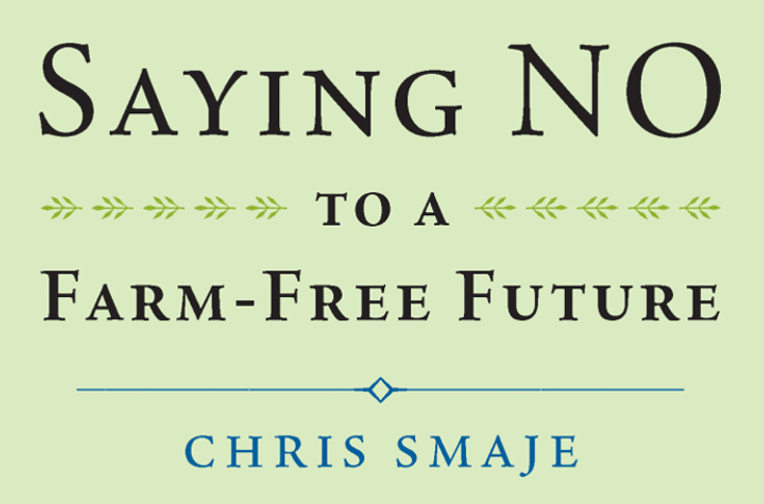
UK publication day is nigh for my new book Saying NO to a Farm-Free Future: The Case for an Ecological Food System and Against Manufactured Foods. I’ll be blogging about it here over the next couple of months and as ever welcome constructive debate. I’m unlikely to be debating it on Twitter, because I find it a terrible platform for meaningful discussion, so if you’re landing here from Twitter this post is where to place your comments about the book. Unless it’s about a specific issue that I’ll deal with in a later post, I’ll do my best to reply (though I’m not promising you’ll find my best to be good enough).
Before I say anything more about the book itself, just to mention that the official launch is at the Groundswell Festival this Wednesday 28 June, and I’ll also be on a panel there about the diet of the future. My new website offers better tracking than before on the events page for things like this that I’m involved in. Look out there for more details of my conversation in London with Vandana Shiva on 18 July. There’s also now better tracking on the Research page of the website of various articles and reports I’ve written (I’m still building this up at the moment). Some might be interested in the note I’ve just published on the energy costs of microbial food manufacture from hydrogen-oxidizing bacteria.
Turning to the book’s content, in this post I’ll restrict myself to a few remarks about what’s on the front cover.
Now it’s fair to say that not everyone I’ve spoken to loves the title of the book that’s emblazoned over the cover. It wasn’t me that came up with it – with things like titles, I tend to defer to publishers on the grounds that they know better than me what draws readers to books. But I did assent to the title, and so I need to own it. In this post, I’ll explain why indeed I do.
In making that argument, I’m going to enlist the help of Alex Milne, who tweeted his objections to my title thus,
>”saying no”: creates oppositional us-versus-them dynamic – turn off to who you actually need to convince
> framing as binary choice — either a future with farms or without — you fall right into a false dilemma fallacy
>appeal to nature fallacy, “argumentum ad naturam”
Let’s take each of these three points in turn.
Maybe it’s true that ‘Saying NO’ creates an oppositional dynamic (I can see already that in discussing my book I’m going to have to try to avoid the temptation of repeatedly saying “well he started it!”). In all honesty, I’m not massively bothered if it’s a turn off to those who I “need to convince”, largely because I don’t really feel the need to convince anybody. I’ve never been a politically strategic writer – I pretty much just try to explain as clearly as I can the way I see things. The way I see things is that we’re headed towards a small farm future, like it or not. If people collectively embrace that, and quickly, they might be able to make it the best small farm future it’s possible to have. If they don’t, it will be a worse small farm future. I don’t know how to convince anyone that we’re headed to a small farm future, and I don’t especially feel the need to try. I just want to share my thoughts about it, because … well, because. You can take a horse to water…
Still, let me offer three reasons why I’m happy with ‘Saying NO…’ in the title.
First, my book is a polemical critique of George Monbiot’s book, Regenesis. In it, I make the case for agrarian localism in the face of his derision for the same. Monbiot used to be an influential ally to agrarian localism and is now an influential enemy to it. My first reason for ‘saying no’ is simple heartfelt emotion when you lose something you care about. George Monbiot is now an ecomodernist? Nooooo!
Second, while there’s always a case for seeking concord where one can, there’s also a case for defining boundaries and clarifying key points of divergence. As I see it, there are ambiguities in Monbiot’s arguments in Regenesis that must be brought to the fore. Ultimately, I believe that – wittingly or unwittingly – he’s making a play for urbanism, biotech solutionism, state-corporate control of the food system, enclosure and class conflict with rural and agrarian people, while presenting all this as progressive, humane, democratic and pro-social. I think this demands negation. For those of us who notice and feel this contradiction in his writing, I think it’s necessary just to say no. No to Monbiot’s analysis. No to the way it veils social contradictions that must be brought to light.
Third, I believe that ‘saying no to a farm-free future’ is a good way of setting up the alternative of a small farm future, not in the form of the ‘bucolic romanticism’ that Monbiot likes to allege, but out of practical necessity. Monbiot’s farm-free vision is another iteration of ecomodernism’s efforts to find high-tech, high-energy, high-capital solutions to contemporary global problems that rescue the status quo. But I believe they’re unlikely to succeed, and risk wasting time and resources we can ill afford. Saying no to the pursuit of implausible techno-fixes implies saying yes to the least worst alternative of a small farm future. Getting to that ‘yes’ from that ‘no’ establishes the case for a small farm future – not as some vapid ideological desire, some ‘bucolic romanticism’, but as a pragmatic, clear-headed, real-world, best-option response to present problems.
I’ll now move on to the second objection, the one about falling into a false dilemma fallacy – a future with or without farms. Well, here are nine reasons why I think it’s fair to identify Monbiot and the reboot food ecomodernists as advocates for a farm-free future:
- Monbiot writes that while people rail against “intensive farming”, “the problem is not the adjective. It’s the noun” (Regenesis, p.90)
- Monbiot writes that emerging technologies of microbial food synthesis represent “the beginning of the end of most agriculture” (Regenesis, p.187)
- As I’ll discuss in a future post, the whole narrative drive of Regenesis culminates in Chapter 7, concerning factory-based microbial food synthesis. The chapter title is ‘Farmfree’
- At the end of Chapter 7, Monbiot professes a “Counter-Agricultural Revolution” which “appears to possess an inexorable economic logic” (Regenesis, p.210)
- In Chapter 8 of Regenesis, Monbiot effectively dismisses pro-farming arguments as captives of pastoral literary ideologies – “One of the greatest threats to life on Earth is poetry” (p.212)
- Monbiot writes that “Real solutions to our global food crises…inevitably involve factories”, while seemingly dismissing agroecological thinking as “an idyllic reverie that would lead us to the twin disaster of agricultural sprawl and world hunger”
- Throughout his recent oeuvre, Monbiot identifies agriculture itself as inherently a driver of needless land-take and wildlife decline
- At the 2020 Oxford Real Farming Conference, a fixture in the calendar of Britain’s agroecological and alternative farming community, Monbiot said that the conference “gives me the sense of a typewriter convention circa 1970 talking about their expansion plans”
- Monbiot has fronted the Reboot Food campaign sponsored by an organization, RePlanet, with visions to rewild three-quarters of the world’s farmland, produce all of humanity’s protein needs on an area the size of Greater London and locate 90% of the population in cities
I’m sorry, but unless Monbiot and the reboot food ecomodernists repudiate these positions I’m going to continue to label them as advocates for a farm-free future. Sure, they conceive a small ongoing role for some kinds of farming, but I don’t think this error bar is sufficient to negate identifying them with ‘farm-free’ within the acceptable ambiguities of everyday language. If there’s a false dilemma between the farmed and the farm-free, I think it lies principally with the food ecomodernists (“he started it!”), as detailed in my book.
Now to the third objection, ‘appeal to nature fallacy’ – presumably Alex Milne sees this fallacy in the part of my subtitle that runs: “The case for an ecological food system and against manufactured foods”.
I think this objection is easily dealt with. The ‘nature fallacy’, if I understand it right, is the misplaced view that something is good or right if it’s ‘natural’. But that’s not a view I share and it’s not a view that can be inferred from my ‘case for an ecological food system and against manufactured foods’. Only by absorbing that case, I’d argue, can a critic form a judgment about whether it’s convincing. And so I’d humbly suggest that would-be critics take the trouble to read my book, lest they fall foul of another fallacy – the judging a book by its cover one. But don’t take it from me – if you think you’re going to be ill-disposed towards its contents, I can only quote Joel Salatin’s comment from inside the front cover “You owe it to yourself to learn the best arguments from the opposing view” (thanks, Joel…)
Finally, talking of book covers, perhaps I should remark upon the overall appearance of this one. It’s quite wordy, and unadorned with artwork. This felt right to me. The book is a polemic, somewhat in the spirit of the eighteenth-century pamphlet wars, with their long-winded subtitles and florid engagements with interlocutors, as I mention on page 14. Writing it felt like a job of work that somebody had to do so that there was an alternative analysis to Monbiot’s dangerous visions out there in the consultable record. I feel like the cover nicely captures this mood – unflashy and descriptive, an attempt at an honest and necessary bit of hackery to right a wrong. I daresay the book won’t meet with universal approval, but I hope at least some readers will agree.


Comments
We changed commenting systems on September 10, 2026 as part of a site-wide functionality and security upgrade. Your past comments have not disappeared, and you can still log in with your old Disqus account credentials if you wish. Contact us with any questions.
Some of this–the “I don’t care whether I convince people or not”–I
found rather weak. But the overall drift, that the title and lack of
artwork are a fair description of what is after all a “polemic” pretty
specifically arguing against Monbiot’s latest vision and his Regenesis
book, I think is accurate–having already read the book, as I was asked
to do a review for this site, which I presume will be posted soon. As
for the “it doesn’t have to be binary” argument, Smaje never said we ALL
have to be farmers. He argues, convincingly in my opinion, in Small
Farm Future, that a lot more of us will have to be farmers than now are.
But preindustrial societies always had a percentage of people living in
towns or cities who focused on other pursuits, even when the majority
were farmers, or peasants. We can assume the same for the future.
Last night I listened to the CrazyTown podcast about Mark Jacobson and David
Keith; the latter pushes DAC, direct air capture carbon sequestration
machines, along with geoengineering. The worst problem with DAC is the
huge amount of energy these machines require; in the comments, PattiMichelle
Sheaffer, did the math and showed that the amount of energy they would actually require is laughably beyond anything that makes a shred of sense. The energy required to run one of these would cause emissions many times what it could possibly collect, never mind the questions around sequestering it. The JRiver Martin asked whether it’s credible that these people who teach at Harvard or Stanford could possibly not understand this, could so thoroughly fail to Do The Math.. Good question. But maybe it’s “energy blindness” like Hagens talks about–is it possible that well educated people like Monbiot, Jacobson and Keith could have a blind spot where they assume that limitless energy is magically available? Or do we have to assume they’re con artists?
While I agree with Chris’s projection that a huge increase in the number of small farms is inevitable, neither he nor anyone else that I know of has created a realistic plan for increasing the number of small farmers and decreasing the number of city dwellers during a time when capitalism and the global market economy are still functioning. The headwinds against de-urbanization and creating small subsistence farms are hurricane force, especially in rich countries. The economic turmoil of the 1970s created a nascent back to the land movement in the US and Europe for a tiny number of people, but since then, nothing.
I think there will have to be a massive failure somewhere in our global industrial civilization, a failure that results in mass unemployment and actual famine in high income countries before there will be any attempt to move people out of cities and on to small farms. Of course, by then it will be too late for most people to make the transition; there just won’t be any resources to help them make the move. The energy and material costs of reversing decades of headlong urbanization are very high. Wait too long and those costs are unpayable.
By the end of this century, if not sooner, over 90% of the world population will be small farmers, but that population will be a small fraction of the 8 billion alive now. Most of them will live in the Global South. Most of those who perished prematurely will have died in a city.
Those who have the means should be leaving the city for the country now. Don’t wait for government assistance, it won’t be coming.
I appreciate anyone to who does not pretend to be in accordance with people they are not. I see too much of this “we ARE working together” in other spaces I frequent. It only causes the conversation to turn in circles and never progress. I side with Smaje and I find Monbiot insufferable and delusional.
I made my living for 25 years as a farmer (I lost my farm to foreclosure in 1995). Farming requires large amounts of energy, today most is supplied by natural gas and diesel. The consensus is we must stop using those. Then there is the push to go “organic”, no pesticides or GMO’s. Some people are doing this but they start with 10 or 20 acres and still have use of the fossil fuel economy around them. Right now there are millions of people who can shop at Whole Foods or boutique markets but when most of the population are poor farmers there will no money in organic farming.
Right now most farmers love their job but how about when tens of millions are forced to onto the land. Where does this land and the housing for those millions come from? Maybe Chris has some thoughts on this, I will have to buy the book to find out.