

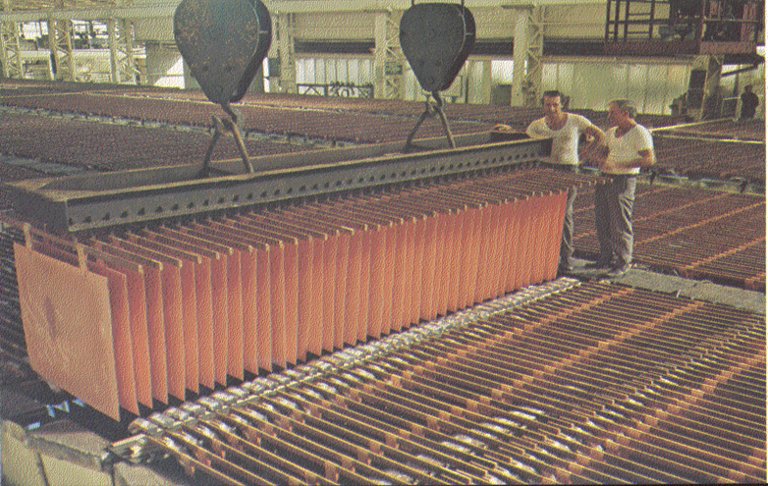
I’m certainly not the only person who noticed before now that sustaining our increasing consumption of copper would be difficult as I suggested in my July 2022 piece entitled “Acceleration forever? The increasing momentum of mineral extraction.” But the mainstream media now seems to be catching up with the story. The boom in demand for copper for electronic devices, electric vehicles, and energy infrastructure is likely to lead to shortages in the next decade.
The Reuters story cited above also tells us that mines take 10 to 20 years to develop AFTER the deposits they are based on are identified. There is, therefore, little prospect that copper production will be dramatically increased in the next decade. (I’m assuming that there are going to be no crash government-subsidized programs and waiving of environmental and permitting regulations. But, even if such programs and waivers emerge, I’m not sure they will have much effect in the next decade or so.)
Copper isn’t the only critical metal of which we may not have enough. The European Commission noted in a 2020 white paper the growing list of critical minerals, the supply of which may not be adequate. Some are in demand because they are important to an increasingly electrified transportation system and the renewable energy industry. Many so-called Rare Earth Elements fall into this category. Right now those metals come primarily from China.
I summarized the mentality that has neglected what to me was an obvious emerging problem in a piece I wrote in 2009. Let me quote from that piece:
[A reader] insists that indium simply can’t be that scarce because–get this–there is indium in billions of electronic devices including cellphones and computer screens, in fact, in nearly everything that has a flat-screen display associated with it.
This is curious logic. It says that because we are using a resource ubiquitously and at an exponentially increasing rate, it must be plentiful. Now, I would conclude that such a situation would, in fact, be likely to result in the very scarcity I fear. Of course, it is always possible that everything will turn out all right with regard to the supply of critical metals and energy. But given the risks and uncertainty, is it wise to bet the future of civilization on the most optimistic assumptions?
I realized later that what this computer professional actually meant was that the corporate and government planners charged with thinking about resource supply issues couldn’t possibly have made a colossal blunder which would lead to a catastrophic shortage of key metals in the electronics industry. He presumed, I think, that such an outcome was simply out of the question given the competence and intelligence of the people in his industry.
I think this is really the hardest kind of denial to cut through. If one admits this kind of incompetence is possible, then it implies that we could be hitting limits all over the place which have not been foreseen by corporate and government planners. That would mean a complete readjustment of one’s world view and a concentrated dose of fear and uncertainty to boot.
Of course, the long-running denial about limits is what has gotten us to this point. We won’t get a do-over. We will just have to stumble forward from here. And, that is what I expect, a lot of stumbling. There will be finger-pointing and excuses and even recriminations against anyone who can be labeled an “environmentalist” (and therefore somehow vaguely responsible for standing in the way of mine development). But there will be almost no talk of egregiously bad planning and wildly optimistic cornucopian assumptions.
We live in a world in which the main equation in economics for calculating production has only two factors, capital and labor—leaving out the obvious: physical resources. In the Cobb-Douglas production function, physical resources are assumed to be readily available in the quantities we require at the time we need them and at prices we can afford. (By the way, I am no relation to one of the authors of this function, Charles Cobb.)
So, here we are in 2023 and someone has discovered, “Oops, we don’t have enough copper to do all the things we think we’ll have to do to support population growth and an energy transition to renewables.” Maybe everything will work out. But that’s what my reader back in 2009 thought. The truth is that things are NOT working out and we don’t have plan.
Photo: Rack of copper cathode starter sheets hanging from a crane in a copper refinery. Photograph probably dates from the 1960s or 1970s and shows old technology. Via Wikimedia Commons https://commons.wikimedia.org/wiki/File:Rack_of_copper_cathode_starter_sheets.png




Comments
We changed commenting systems on September 10, 2026 as part of a site-wide functionality and security upgrade. Your past comments have not disappeared, and you can still log in with your old Disqus account credentials if you wish. Contact us with any questions.
I was just thinking about that the other day – thanks for the update?
I’ve noticed that many managers and computer professionals live in fantasy worlds – where they can conjure seeming magic on their computer screens and over networks with software, programming, etc. They’ve never had to do hands-on work to stop corrosion from destroying a bridge, fail to halt a runaway fire, or foil bank-robbers, for instance. It’s kind of a funny world their minds live in. Sort of a PBS/NPR “it’s a beautiful,” techno-cool world. They tend to believe in false-heroes like musk.
Yes, talk about major human group insanity – pretending physics doesn’t rule the known universe. That is, in part, believing that deposits of any ore are in arbitrarily large supply. Harari said, “Humans … learned to flexibly cooperate in large numbers…” – but it is a very flawed cooperation – to be expected, I guess, since he’s evidently a strong technooptimist…
Increasing shortage is already happening to most Americans because most Americans are poor and can’t afford to just “pay more” like the Affluent do. (“Affluence” here is as in Hurth, V. [2012] – basically anyone with net worth over about $75,000USD)
https://pubs.geoscienceworld.org/gsl/books/edited-volume/2343/chapter-abstract/132276611/Selling-planet-Earth-re-purposing-geoscience?redirectedFrom=fulltext
This was the post that brought your exceptional scholarship and interpretation of data to my attention.
Thank you so much for your work and for your references. I hope Resilience and their readers recognize and appreciate the work you contribute. My curiosity led me to find you are a real rocket scientist with many interdisciplinary interests. I can understand why you are compelled to share what you’ve learned.
Thanks.
“There will be finger-pointing and excuses and even recriminations against anyone who can be labeled an “environmentalist” (and therefore somehow vaguely responsible for standing in the way of mine development).”
Or alternatively, for opposing the development of options which would not depend on such constrained resources–like forms of nuclear which could be built with small quantities of common materials and run on abundant fuels.
It is a bit more complex. In general there would be enough copper (part could be substituted by aluminum) but it is the question of constraints (Theory of Constraints, https://www.consideo.com/files/consideo/pdfs/papers/eng/ConsideoPaper-ToC_Transformation_Engl.pdf), of prices for primary (first high grade then low grade) and secondary copper (once the repowering of renewables sets in) in particular for regions transitioning later, and then there could actually a steady state of a constant populations and the repowering of its energy sources around 2050 which could question investments in the years before this situation.