

This article was originally published at Deep Transformation Network.
“Human history becomes more and more a race between education and catastrophe.” – H. G. Wells, The Outline of History (1920)
I had a dream this morning in which I had decided to call Charles Eisenstein on the phone. (I very rarely just call folks on the phone these days. The new phone etiquette is to send a text message and arrange a day and time for a phone conversation. Still, I’m old enough to remember rotary dial phones without any such capabilities.
So there I am with Charles Eisenstein on an old fashioned rotary dial “land line” (as now these are called). Charles, who I had never spoken with on the phone in this dream world, answers the phone and I tell him who I am, then I ask “Will you co-author a book on education with me?” There was a pause of roughly half a second, and Charles answered, “Yeah, sure.”
I don’t plan to make that phone call in real life, though I can imagine myself as the editor of a collection of essays on education. Maybe I’ll do that–, eventually. I know a lot of great writers on social, ecological, and related topics and issues. Some I’m quite friendly with.
But the dream made it clear that I need to write about education — an essay. And so I need to sort out the themes I’ll weave together in this essay. I’ll almost certainly begin with the above epigraph. It states perfectly what I believe about education today, more than a hundred years later. And I’m just as likely to use the very same title for my essay as the one above.
I was just about to begin work on another essay, however. It was to be on the topic of “the energy transition narrative” — a topic I keep coming back to over and over again. My belief about this narrative is that the popular, familiar, mainstream story of “energy transition” is flatly false. There are heaps of evidence for its falseness. And the people I consider to be my colleagues in the field of inter- and trans-disciplinary energy studies (which field includes economics and ecology, history and cultural criticism, etc.) almost always agree with one another that this narrative, while extremely popular among people in the media and in politics, is deeply, terribly, dangerously flawed.
And this brings me smack-dab up against the topic of education, because what I am feeling called to say in my essay on education is that the time has come for us to update the notion of education for the coming decades of the twenty-first century. Something about the image which appears for most of us when we read or hear the word “education” feels tired, old, dusty and obsolete — especially the strong association of “education” with “schooling” (whether K-12 or college and university).
When I contemplate “education” I tend to include newspapers, radio news and commentary, podcasts, magazines and journals … and even internet fora like Deep Transformation Network. But more and more, when I contemplate “education” I’m on a slippery slope slanting into anger, fear, resentment. And I really don’t like being angry! It doesn’t feel good to be angry. I don’t want to hang out in the energy of anger, resentment. Rather, I want to help the world to correct its false narratives — such as the very popular false narrative on “energy transition” — which makes me especially angry, as it is murderously wrong and false. Literally murderous! Vast numbers of people’s lives (also plants, animals … species not just individuals) are put in grave danger by the deeply entrenched false narrative of “energy transition” which has been plastered everywhere, scattered and broadcast everywhere.
It’s not like the energy transition narrative is uniquely false and problematic. It’s just that this is the one I probably know and understand the best.
I only very rarely listen to the Crazy Town podcast, but I happened to listen to their last show. And what do you know, all of a sudden these three guys are talking about me, the coiner of three terms which are like headings for why it is that the popular story on “energy transition” is a dangerously false narrative.
Rob Dietz
Yeah. So the three problems that J.R. Martin came up with, or at least that he’s named, are the Michaux Monkey Wrench, the Heinberg Pulse, and the Smil Crawl all named after-
Asher Miller
These are all bars that are in downtown Corvallis.
– from transcript here – Crazy Town: Episode 72. Sucking CO2 and Electrifying Everything: The Climate Movement’s Desperate Dependence on Tenuous Technologies – resilience
Asher was joking about the bars. These guys are always being silly. Sometimes they even tell fart jokes.
Anyway, as you can see, I do tend to think of education in a very broad, open contextualization. I don’t think it is wise to isolate the concept of education into schools and schooling. Journalism, at its best, is educational, for example. A basic feature of our social lives, in all of its aspects, is educational. Learning is fundamental to what it means to be human, as I see it. And when whole societies are purveying false narratives into near ubiquity, something dangerous and very disturbing is happening. Education is being turned away from and against understanding, knowledge and truth. It’s becoming propaganda. But not just propaganda. It’s becoming misinformation and disinformation. It can become a society-wide pulling of the wool over our eyes.
There is a concept alive in our world, called “corporate capture”. Generally, corporate capture is defined as it is defined here. “‘Corporate capture’ is a phenomenon where private industry uses its political influence to take control of the decision-making apparatus of the state, such as regulatory agencies, law enforcement entities, and legislatures.” (Source: Corporate Capture | Center for Constitutional Rights (ccrjustice.org)) But “corporate capture” can also refer to how corporations and the very rich can, and do, deliberately (and non-deliberately) influence the public discourse on any topic, thus shaping the most essential aspect of our political and social lives. Too often, by far, the narratives which are popular are popular because those narratives are convenient to the rich and powerful — or because they are friendly to an ideology which is deeply entrenched in a culture.
The familiar notion of “energy transition” is deeply mistaken, but it is also deeply mainstream and popular. The basic shape of the story has it that because burning fossil fuels leads to an ever-increasing quantity of greenhouse gases in the atmosphere, causing dangerous climate change (global warming, anthropogenic climate disruption), we will need to “transition” from a fossil fuel based economy to a “renewable energy” based economy. This part of the narrative is true. The part of the narrative which is outrageously, dangerously false is the one which paints a picture of what I sometimes simply call “full replacement”. The full replacement clause in the narrative proposes that our energy transition will allow for a mostly very smooth transition from fossil fuels … which will allow the capitalist-industrial growth economy of the “global north” (rich countries) to remain basically unchanged.
The full replacement clause frankly pisses me off, because it’s nothing other than a steaming pile of fresh horseshit. The evidence for it being a steaming pile of excrement has been revealed here and there by experts on the relevant sciences, but almost never enters into public discussion — except among members of the choir, such as myself and my friends at Post Carbon Institute, and in the pages of PCI’s Resilience Members of the choir are not reaching the ears of the general public, and so a horseshit version of “energy transition” has the wool pulled over the eyes of politicians, the media and the general public.
In other words, those who are educated on this topic have a tiny audience, and those who are selling us horseshit sandwiches have–for now–managed to keep the pubic living in a fog of misinformation and disinformation. And it’s my view that this fog is essentially criminal — even if spreading this fog everywhere is presently perfectly legal. It’s criminal because the fraudulent, deceptive (and sometimes merely delusionally naïve) mainstream energy transition narrative is preventing us from, for example, understanding why Chris Smaje’s book, A Small Farm Future is just as urgently important and valuable today as E. F. Schumacher’s Small is Beautiful, and Aldo Leopold’s A Sand County Almanac were those decades ago when they were published, and as important and valuable as Carson’s Silent Spring, etc. And I’m not saying this because I think Smaje gets everything right in that book. (I’ve not even read it, yet, but I know a lot about the book from reviews and from reading Smaje’s blog. [Who can read a hundred books at once, anyway?]) The book is of crucial importance to us because it seriously asks crucially important questions about how we might organize our economies and communities in a vastly smaller economy with vastly less net energy in the system. These are the questions we should all be seriously exploring, but that discussion isn’t happening because it’s just not convenient to the people who own and run this world. (Yes, I’m pissed again.)
I wasn’t planning on writing so much here. I was planning merely to ask for help in re-thinking and re-imagining the word education, and how this word sets in relation to society and politics. This isn’t the essay I intend to write, but I think I’ll publish it in The R-Word, anyway, just because. Because we all need to be having a conversation about how to have the conversation we ought to be having. And it’s a big, sprawling, challenging, difficult — and inconvenient — conversation.
Maybe Resilience will republish this there … and my questions will be spread around a bit, following my fifteen minutes of fame on Crazy Town. Maybe generous people will help me to think these things through? Maybe we can have our conversation, at last, about the conversation we would be having if the world weren’t slathered in horseshit.
I’m saying I need and want your help, all of you. I’m saying we should not take any of this lightly. We have preparation work to do, a bridge to build to a future better than the one we’re heading toward. We cannot take the necessary steps if the popular narrative is horseshit.
What we need now is … somehow … to unleash education.
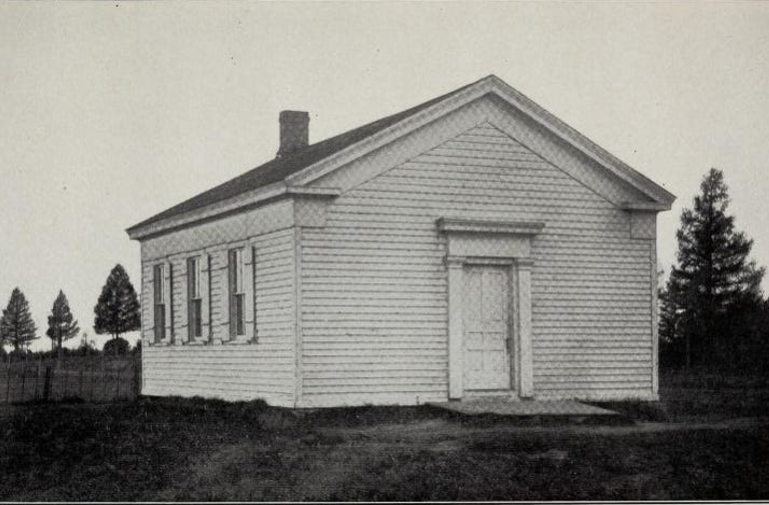
Teaser photo credit: Old schoolhouse – public domain photograph



Comments
We changed commenting systems on September 10, 2026 as part of a site-wide functionality and security upgrade. Your past comments have not disappeared, and you can still log in with your old Disqus account credentials if you wish. Contact us with any questions.
I am a retired college professor, and grandmother to four daughters. I am appalled at what passes for education these days, with its apparent focus on training compliant consumers. The American educational system has likely never been perfect, but when the business model took over around the time Ronald Reagan was elected in the early to mid 1980s, it took a sharp dive towards the bottom. These days, the important disciplines necessary for a a truly well lived life are rarely taught, and way too much of what happens is based on a binary system of either/or choices conducted online. Especially neglected are interpersonal communications, the arts, critical thinking, history civics, and biology–especially ecology , not necessarily in that order, brought about by a heavy reliance on STEM education.
These days, the Corporate Controlled Technocracy, which has pretty much taken over the world, controls just about everything, including education. Elementary schools have gotten way too big, despite the understanding that small neighborhood schools are far better for younger children, while higher education, which is not for everyone, has been pushed only because its graduates make more money to become better consumers. In fact, the very recent shift to technical education has a major drawback in that it is a way of sorting people into social classes by promising higher wages for those with mathematical /technical leanings than those who have never attended college would have. This leaves far too many people who are clueless, with no means of making a living in a dying world, and despite some further education–even college degrees–many more individuals with little understanding of how the world works.
Another drawback is that STEM ed is being pushed in high schools, so that a kid can leave high school with a two year degree or a certificate, and little knowledge of any of the core disciplines which make life worth living. And far too many classes at all levels are taught online by poorly paid temp workers who have no benefits. Until we restructure the way we operate, across the board, things will continue to deteriorate. The educational mess we have is much more complex (think ecology, with its focus on complexity of systems,) than this short diatribe would suggest. It is not a binary world we live in, and the causes and solutions are intertwined. Essays like this one keep the issues out there, though they may seem buried by the decaying world we live in. Thanks for bringing it up.
Education, for the centuries leading up to the last fossil-fueled two, was grandparents looking after children while the able-bodied were out there, mostly food-producing. It was a Commons, and free.
The system which we run under (and which was inevitable, given the implied need to facilitate growth) has had to commandeer the Commons, both physical and cultural, to support exponential growth. Health is now a business; education is now a business. But they fall foul of EROEI; the surplus energy available to a society. Student loans cannot be repaid, the jobs aren’t there or don’t pay enough, universities physically decay, demanding ever-more energy themselves. The whole, is unsustainable.
What to do? Make education free. Teach for nothing. Nobody can stop you, and what you teach is unlimited. James is doing it here, I’ve been doing it in the blogosphere for nearly 20 years. Ultimately, knowledge needs to be stored (and I think books will outlast the internet by centuries). Ultimately, it needs taught (a process which doesn’t care what – and if – the teacher is paid.
I like the key idea here very much — except for the word “free”. Free of cost in dollars or other units of currency? Yes! The key idea in these paragraphs from you, pokiwi is summed up in the phrase “education commons”. We can still have education with financial costs, but we do need — also — to expand and develop an ‘education commons’ where education of every kind is freely given for all who wish to learn. Actually, for a while yet I’ve been thinking this is what ought to occur with permaculture and bioregional education in particular! Every community should, ideally, have ample opportunities to learn permaculture and bioregionalism within a gift economy — a learning commons. Same with learning the other kinds of skills and knowledge so crucial to our time, but which are not being offered as an educational opportunity in most places.
The problem with the word “free” is that there will inevitably be costs in offering no-fee educational opportunities. This is where giving comes in! Gifts are not — most aptly — “free”. They cost time, energy, and often land access. That means we need to organize around commoning in both education and land access, etc. The commons in the 21st century will need to be freely given, yes — for the most part. But whole communities ought, in my opinion, to organize the effort of such by providing ample support for the generous people who are willing to give in this way if only they can also meet their most basic needs for shelter, food, etc.
Whole communities can support those willing to give with their own gifts — e.g., a place to set up and/or build a “tiny house,” some hot soup or stew given into the community effort, vegetables, fruit and eggs — whatever we can spare in the growing of a true commons for commoning within. What’s lacking is not the willingness to care and to give to the givers, but an organized effort to do so and ensure that it functions as it ought to.
Thanks, pokiwi. I think you found the very core of the solution to this catastrophe.
“Here, let me educate you.” When someone says that to me, the situation is always that I hold a position they disagree with, and the subtext of that ‘offer’ is: “I am right because I am wise, I have all the relevant information, and I can perceive Truth directly, while you are wrong because you are an ignorant and deluded fool. So I’ll be the teacher and you be the student and I will tell you what is True and what is the right way to think, and you can just shut up because you have nothing of any worth to contribute.”
And sometimes I’ll get “You need to go educate yourself”. Subtext for that is “I don’t know how to counter your position, but I’m certain that I’m right and you are wrong, so unless you want to remain ignorant, its up to you go do the work of proving that to yourself. And also, I’m running away now.”
I’ve heard both of the above, and similar remarks, from a number of young-earth Creationists, chemtrail believers, 911 Truthers, and anti-nuke zealots. They see their role as imparting Truth and education. And they think anyone who argues for a different view is spreading propaganda and doing indoctrination. Whenever I see someone make a remark like that, I know the probability is very high that I’m dealing with someone who is arrogant, condescending, emotional rather than rational, and who doesn’t know beans about how to mount a persuasive argument. Whenever I engage them, I know there is roughly zero chance they will change their mind, but I’m still happy to do it in a public setting, so that reasonable people (the people I’m most interested in reaching) can judge for themselves the relative merits of our positions.
Jag Levak –
My impression of your comment here is that it is less a comment about the role of education in responding to our polycrisis, but more a personal rebuke directed at me, for not having been in agreement with you about nuclear energy. So let me say this, there are pro- and their are anti- nuke folks, and either can be just as zealous. And you strike me as a pro-nuke zealot. I just looked over your recent posts in the comments in Resilience, and all of them are nuke-boosting posts. And that’s fine. But I can’t help wondering which of the pro-nuke think tanks you’re working for.
Anyway, I don’t get the impression from what you’ve written here that you much care about discussing how we might promote education which doesn’t promote the ‘interests’ of the rich and powerful over the interests of those who simply want a healthy living planet and a decent society and culture to live in.
I’m saying, I don’t see your comment here as a “good faith” contribution to a necessary conversation, but just another opportunity to publicly look down your nose at those who are skeptical about nuclear energy as some kind of savior.
“My impression of your comment here is that it is less a comment about the role of education in responding to our polycrisis, but more a personal rebuke directed at me, for not having been in agreement with you about nuclear energy.”
It was about the whole mindset of bringing other people into right-thinking by ‘educating’ them. My disagreement with that approach stands on its own, independent from any disagreements we may have in other areas. I would have had the same response if this article had been written by any other author.
“So let me say this, there are pro- and their are anti- nuke folks, and either can be just as zealous.”
I have encountered many people who have rational concerns, skepticism, and criticisms of various aspect of nuclear power, but none of them have taken the attitude that they were going to ‘educate’ me. It is always the zealots–which is why I singled them out specifically.
“And you strike me as a pro-nuke zealot.”
A zealot has a closed mind. I can definitely change my mind when I encounter better information or reasoning, and I know I can because I’ve done it many times before. And I am more likely to learn by engaging with people who disagree with me than from people who hold the same view. And the more I do that, the more I migrate towards stronger positions. That makes it increasingly rare to find even stronger positions, but it’s always possible.
“I just looked over your recent posts in the comments in Resilience, and all of them are nuke-boosting posts.”
If you go back to the early years of this account (which I leave open so anyone can rummage through it), you won’t find any posts in favor of nuclear power because I was an anti-nuke back then. Not a zealot about it, but also not well-informed. I was too gullible in trusting people like Caldicott, Gundersen, Busby, and such. I now use this account primarily for energy and environment-related topics, and nuclear is a big part of that, but it’s not exclusively that.
“And that’s fine. But I can’t help wondering which of the pro-nuke think tanks you’re working for.”
That’s a stereotypical bubble-reality defense mechanism. I’ve seen it with Creationists, warming deniers, Truthers, etc. If you can convince yourself that people outside your bubble are shills, or agents, or in some way deceptive, then you can simply disregard anything they have to say without consideration. It’s a good way to convince yourself your position is strong by making it invulnerable, but all you’ve really done is eliminate your best chance at error-correction. Also, you may be able to trick yourself that way, but it won’t be convincing to anyone outside your bubble. Also, this is the same mechanism many others will use to block your attempts to “educate” them. Also, I am less pro-nuke than James Hansen, so do you think he’s a shill? Also, nearly all the money going towards promoting nuclear power comes from the old-tech industry, which I have criticized and would like to see replaced, so why would they fund that message? Also, actual shills generally burn through many short-lived identities and they don’t leave their posting history open for everyone to see.
“Anyway, I don’t get the impression from what you’ve written here that you much care about discussing how we might promote education which doesn’t promote the ‘interests’ of the rich and powerful over the interests of those who simply want a healthy living planet and a decent society and culture to live in.”
Yeah, I’m definitely not promoting the whole “education” mindset — all sending, no receiving. It is the mark of someone who doesn’t believe in, or has given up on a democratic discourse among peers–or they don’t think their position is strong enough to compete or survive in such a setting.
“I’m saying, I don’t see your comment here as a “good faith” contribution to a necessary conversation, but just another opportunity to publicly look down your nose at those who are skeptical about nuclear energy as some kind of savior.”
What you mean by “necessary conversation” is ideas and views that you can marshal in support of a course you’ve already decided upon. So anything outside those boundaries you set, you don’t see as “good faith”. But I genuinely think the ‘education’ approach is likely to do more harm than good, and I think it will be you who is seen as superior and condescending by the very people you are trying to reach if you go into it with that attitude. Now, that’s just one person’s opinion, and I’m definitely not claiming to be an authority on the subject, but you are clearly a person who goes by emotional response to a large degree, so try doing that. Imagine that someone who holds a position you strongly disagree with offers to ‘educate’ you. How would you feel about that? Would those feelings increase your receptiveness to what they have to say?
Jag Levak –
The tone of my response to you was, for the most part, resulting from how you managed to pigeonhole what I was saying about education into a very distorted version of what I was meaning by that word. And I want to give you some benefit of the doubt here, so you might extend me the same courtesy. I have read your words in your several comments here to mean that you have a very tightly constrained conception of what “education” amounts to. It seems to me you see the word “education” as referring to some sort of authoritarian type of one-way communication, in which there is a very sharp teacher / student dichotomy … in which a learner is playing the role of a neutral recipient of knowledge, perspective, information, or what have you.
This is NOT how I understand the word at all. To me, “education” refers to a process of inquiry, discovery, dialogue and essentially collaborative learning. If it isn’t proceeding in that way, something has gone terribly wrong, and the result doesn’t deserve to be called an “educational” process.
Now, you can say you don’t view “education” in this “pigeonholed” way, and perhaps we can come to learn what each of us means by the word. And then we can really communicate with understanding. But it certainly seems to me that you went on the offensive (attack) on the basis of your false premise that I see myself as an absolute authority and dictator — and an “educator” who doesn’t listen or dialogue, or compare notes. As if I were promoting what is to me a ludicrous notion of “education” as a one-way communication rather than a mutual inquiry into reality, truth and knowledge. And this is just not my style in the least! Quite the opposite, in fact, and yes I have been an educator, a teacher. But I treated my “students” as peers and taught my classes literally in circles rather than in rows with me at the front of the class. My teaching was as light-handed as could be. (I say ‘was’ because I haven’t been teaching recently.) I sought to help my students to empower themselves as learners, and saw my teaching role as basically that of such empowerment.
All that said, I do believe that various kinds of broadly understood “education” is actually propaganda, not truly education at all. Much of this “education” is misinformation and disinformation, as I said in the above article. And, to me, this is just an observable fact which people with open minds can readily discover, as I have.
But please bear in mind that I regard journalism as a form of education — at least, ideally it would be. Education is about empowering learning, facilitating learning. It’s not indoctrination. Nor is it authoritarian.
Anyway, I’m pretty sure that if you hand not attacked me as a straw man of your imagination we’d have had a much more pleasant and fruitful dialogue. And I’m willing to let the past be in the past and to open to the opportunity of learning and exploring with you.
*edit / p.s.*
I didn’t pepper my article with explanations, arguments, footnotes and citations because I was writing for “the choir,” or those who — like myself — have researched the “energy transition narrative” in relation to the available science and research … and concluded, as I have, that the arguments for the conventional / mainstream / popular narrative has an incredibly shaky foundation, at best. It is with these folks with whom I share a perspective that I wanted to engage in a particular dialogue about what we might do about the fact that we’re losing the propaganda “war”.
I didn’t set out to persuade the unpersuaded that the mainstream / popular “energy transition narrative” was false, as my intended audience know full well that it is false already. Had I intended to persuade the true believers in this narrative, I’d have written a much longer article with ample evidence, citations, footnotes, etc.
Until there are viable modes of subsistence (jobs?) with a critical mass of participants there can be no educational praxis (on the job training) . The prevailing business model stunts education in order to keep an intellectual monopoly. Powers that be are always prepared to snuff out competing subsistence attempts. The public is susceptible to the energy transition teaching because they are anxious and curious about the precarity and instability they experience. It’s a matter of being conditioned to fear anything different. Never assume freedom to choose because the punishments and penalties are real, built into every institution and sanctioned activity.
Great essay. I think an oft neglected form of education is self education i.e. trying to do things for yourself. I think that would be an eye opener for all the cornucopians and techno-narcissists out there, if they realised how things work in reality.
Take gardening for example. I am trying to walk the walk and grow some of my own food with as few artificial inputs like pesticides and herbicides as possible, but it is very difficult because a large proportion of my crop gets eaten by birds, slugs, rabbits, long-tails and the like, or swamped by weeds, but I am having some success with lots of physical barriers like netting, and lots of back breaking hand weeding. This is the reality of “sustainable food production”.
Or take PV energy. I have a PV panel which I can use to charge up my electric lawnmower which I use to trim the grass paths around my allotment. It takes about two hours to charge the lawnmower battery. Using the same PV panel to charge the battery in my electric car would take about two weeks i.e. not practical for a daily or even a weekly commute. This is the reality of “energy transition”.
“The tone of my response to you was, for the most part, resulting from how you managed to pigeonhole what I was saying about education into a very distorted version of what I was meaning by that word.”
You were talking about an outreach project to the general public, and you asked for help in re-thinking and re-imagining the word ‘education’, and how this word sets in relation to society and politics. My comment was meant to show why I think trying to change what the word means to society is a hopeless goal. It has too much baggage.
“I have read your words in your several comments here to mean that you have a very tightly constrained conception of what “education” amounts to.”
Namely, the usual meaning that almost everyone uses.
“It seems to me you see the word “education” as referring to some sort of authoritarian type of one-way communication, in which there is a very sharp teacher / student dichotomy … in which a learner is playing the role of a neutral recipient of knowledge, perspective, information, or what have you.”
That is essentially what the word means to almost everyone–which you noted yourself when you said: “Something about the image which appears for most of us when we read or hear the word “education” feels tired, old, dusty and obsolete — especially the strong association of “education” with “schooling”.” Which is right. And if you present it as an education project, you might as well be telling people you have come to ‘school’ them.
“This is NOT how I understand the word at all. To me, “education” refers to a process of inquiry, discovery, dialogue and essentially collaborative learning.”
Doesn’t matter what it means to you. The people you are trying to reach are going to go by what it means to them. That’s just how language works. If you make up your own meanings for common words, you are only damaging your ability to communicate with others.
“it certainly seems to me that you went on the offensive (attack) on the basis of your false premise that I see myself as an absolute authority and dictator — and an “educator” who doesn’t listen or dialogue, or compare notes. As if I were promoting what is to me a ludicrous notion of “education” as a one-way communication rather than a mutual inquiry into reality, truth and knowledge.”
You weren’t talking about a mutual inquiry into reality, truth, and knowledge. You saw yourself as part of a small, isolated, choir who is ‘educated on this topic’ with a tiny audience (namely, each other), wanting to take on the task of helping the masses understand that they are misinformed. There’s nothing ‘mutual’ about that. And if you felt attacked by my illustrating why I think using the word ‘education’ is a bad idea, do you even have any idea of the firestorm you are fixing to call down upon yourself when you try to tell them that what they think they know, what they believe is possible, what they hope for, and what they are striving for is all a steaming pile of horseshit?
“and yes I have been an educator, a teacher. But I treated my “students” as peers and taught my classes literally in circles rather than in rows with me at the front of the class.”
And who decided they would sit in circles? You may have thought you were treating them as peers, but it’s a safe bet they didn’t see you that way. Every one of them clearly understood that you set the agenda, you framed the issues, you set the boundaries of the discussions, and it would be you evaluating their performance in learning what you taught them. And if your outreach project has any whiff of that dynamic, it won’t just fail, it will be a setback.
“Anyway, I’m pretty sure that if you hand not attacked me as a straw man of your imagination we’d have had a much more pleasant and fruitful dialogue.”
My comment didn’t address you and made no reference to you at all. You took offense and fired back with a personal slur–no question in your mind about whether I was a shill, you only ‘had to wonder’ who I was working for. –And also had to type that out and post it in a public forum, apparently.
“And I’m willing to let the past be in the past and to open to the opportunity of learning and exploring with you.”
Well that’s mighty gracious of you. But after years of being on the receiving end of hate speech, harm wishes, and even death threats from self-styled, peace-loving, humanitarian progressives, I do have some concerns that my hide might now be a bit too thick for someone of your sensitive nature.
“My comment didn’t address you and made no reference to you at all.”
Yes, it was a clever way if insulting someone while retaining “plausible deniability” for a case in which the person who is insulted can’t prove or demonstrate that they were.
All of your communication works basically this way, and it isn’t really communication; nor is it in good faith or honest dialogue. You have no interest in such. And that’s fine. But I’m not going to participate any further in your clever little game. What you obliquely accused me of you have embodied yourself, perfectly. How ironic.
No need to respond, Jag. I’m quite done attempting to dialogue with you.
I have encountered this account elsewhere and agree it is all a word game. I’m sorry you were drawn into a wasted effort. The Jagwork in the future may all be done by AI, so this tenacious person can go build fuel rods for Bill Gates.
But we have learned something about the technique of diverting the conversation with endless qualification and reopening of settled issues.
Tenacious, eh? Okay, I’ll take that. I suspect you know something about that yourself.
And I see Bill Gates as being as toxic to new nuclear development as he was to the early grass roots development of personal computers. I’ve had nothing but criticism for every kind of nuclear his company has worked on–except for the one good design TerraPower basically cribbed from the tiny company Elysium–much like how Gates raided Microsoft’s first operating system and the whole Windows interface from other developers. If Bill Gates gets his way, he will steamroll all the seedling companies on behalf of the entrenched industry, so that he can become part of the entrenched industry. Same thing he did with IBM.
“Yes, it was a clever way if insulting someone while retaining “plausible deniability” for a case in which the person who is insulted can’t prove or demonstrate that they were.”
It was a direct way to illustrate how an education project would tend to be perceived, and thereby had a high likelihood of going wrong. And I get that this is an idea that you have some hopes for, but if you cannot distinguish critique of an idea (and in particular, a label) from personal insult, that indicates you have invested emotion into this and made it part of your very identity–even before you have figured out any way that it could actually work.
We all get hold of bad information, or arrive at mistaken beliefs, or have bad ideas sometimes. But a big benefit of being a social animal is that we have access to outside perspectives–*if* we choose to use them. When we become hurt, and enraged, and lash out with personal attacks when someone points out defects in our positions, or pitfalls in our paths, we only increase the likelihood of binding ourselves to error and blundering into doing harm–to objectives we care about, to ourselves, and sometimes even to others. And the risks of this attitude are multiplied for anyone who aspires to be a teacher.
“No need to respond, Jag. I’m quite done attempting to dialogue with you.”
It’s no bother at all. This touches on themes I want archived in my Disqus feed. Jacob Bronowski felt the importance of keeping alive the recognition of our vulnerability to error was so profound that he dedicated an entire section of his book, and an episode of the companion series, “The Ascent of Man” to this issue. (Knowledge or Certainty) And while I don’t have his literary flare, I would rate this issue no less in importance than he did.
Jag –
I’ll say one final thing before closing this “conversation” with you. Throughout your responses to me are not a few, but very many, complete misrepresentations of my intended communication, and then a sort of boxing match with a straw man argument of your own invention. I suspect this is intentional and deliberate, so that’s why I was very reluctant to engage with you any further–as it is an utter waste of time to try and metacommunicate reasonably with someone who really just enjoys creating havoc in communication (as has been my experience with narcissists, which I do my best to avoid). But maybe you simply don’t know that you’re behaving in this way, as your style of making sense with words differs from mine so much that we’re talking past one another?
So one last thing before I disappear from this “conversation”. My above article was inviting dialogue, not so much debate. I was hoping to explore what we could learn together (whoever wants to participate) by exploring the word and concept of “education” as if it were more fluid and open a concept than it usually gets treated as.
Why was I wanting to do this? I was wanting to do this because I believe we (a big we, the people of many nations) are in a political crisis resulting from powerful interests manipulating us through media, educational institutions, political parties and institutions, etc. The general public often buys into deceptive, inaccurate “information” — be it misinformation nor disinformation. And this prevents us from responding to our world on the basis of what is real and true. So it’s very dangerous!
Maybe you disagree on this premise of mine? But I know it to be true. And so there is the question, how can we inform the public of the truth not only on matters like “energy transition” but also on the broader field of mass propaganda and disinformation?
I wanted to invite a dialogue as a kind of collaborative learning exercise on this matter. In dialogue, one doesn’t berate one’s fellow conversation partner, but seeks to understand what they actually mean by their words. This requires some humility, open-mindedness and curiosity. Collaborative learning as dialogue is a respectful, generous, curious and playful process.
You crushed that intention from the first moment you arrived. You made it clear you have utterly nothing new to possibly learn about education, and you ridiculed the idea that anything new could be learned about it.
This is why you will never hear from me again. As that’s a form of abuse. it’s precisely the kind of abuse I’ve been subjected to by a couple of former friends who turned out to be narcissists. Narcissists are toxic, mean, and incapable of empathy, kindness and compassion.
“Throughout your responses to me are not a few, but very many, complete misrepresentations of my intended communication,”
What we intend to communicate is often not the same as what others on the receiving end perceive.
“I suspect this is intentional and deliberate,”
So you went straight to a retaliatory personal slur on the basis of a suspicion. That seems a bit premature–assuming there can ever be a legitimate role for retaliatory personal slurs. For myself, I generally try not to ascribe to malice that which can have other explanations. But what you do is up to you.
“so that’s why I was very reluctant to engage with you any further–as it is an utter waste of time to try and metacommunicate reasonably with someone who really just enjoys creating havoc in communication (as has been my experience with narcissists, which I do my best to avoid).”
I see. So first my views were bought and paid for by some nefarious organization, and now I enjoy creating havoc, which is what you’d expect from a narcissist. But that’s not an actual symptom of narcissistic personality disorder. It is more characterized by a sense of one’s superiority over others (like seeing oneself as having more insight and education than the deluded masses, for example) having a sense of entitlement (like, to dictate the terms of a conversation, or to venture unsolicited personality-disorder diagnoses in public while having no qualifications to do so), and, oh yes, having an inability to handle any criticism. If you are going to resort to name-calling, ya gotta got to watch out for those ricochets.
“My above article was inviting dialogue, not so much debate.”
So, basically dialogue in which everybody agrees with you.
“I believe we (a big we, the people of many nations) are in a political crisis resulting from powerful interests manipulating us through media, educational institutions, political parties and institutions, etc.”
I think most people on the Left and the Right would agree with that. They would only have differing views about who is doing the manipulation and for what ends.
“And so there is the question, how can we inform the public of the truth not only on matters like “energy transition” but also on the broader field of mass propaganda and disinformation?”
What you are talking about is ordinary advocacy–where you express your views, support them with arguments, and support your arguments with evidence. And people don’t have a problem with advocacy. It’s honest, it tells people where you are coming from, and it puts you on the same footing as advocates for other positions. And the marketplace of ideas works best when all sides of an issue are represented by ardent and capable advocates. It’s when you do advocacy and try to call it ‘education’ that people see that as propaganda. And as an insult to their intelligence.
“In dialogue, one doesn’t berate one’s fellow conversation partner,
Like, for example, suggesting they are a dishonest and amoral mercenary. With a personality disorder. Who enjoys causing havoc.
“This requires some humility, open-mindedness and curiosity.”
And I’m guessing in your mind, you feel you’ve manifested those qualities here. Oookay.
“Collaborative learning as dialogue is a respectful, generous, curious and playful process. You crushed that intention from the first moment you arrived. You made it clear you have utterly nothing new to possibly learn about education, and you ridiculed the idea that anything new could be learned about it.”
I don’t think changing the public’s understanding of–and feelings about–the word ‘education’ will be feasible, especially in any short timeframe. I also don’t think it’s necessary. You can still advocate all you want, but there’s nothing to be gained and lots to lose by calling it ‘education’.
“This is why you will never hear from me again.”
I won’t hold you to that, because I *always* allow people to change their minds. But you would do well to pay heed to that impulse to run away which you are feeling right now. Because if you attempt this public outreach project yourself, that same urge will very quickly rise to something many, many times worse.
“As that’s a form of abuse. it’s precisely the kind of abuse I’ve been subjected to by a couple of former friends who turned out to be narcissists. Narcissists are toxic, mean, and incapable of empathy, kindness and compassion.”
If that’s how you see me, that’s fine. You’re entitled to your opinion. But if you seek empathy, kindness and compassion, and want nothing to do with people who can be mean and toxic, then I think the emotional tranquility you crave will be least at risk if you remain cloistered within the cushiony-soft safe-space of this small choir of like-minded and supportive individuals. Because I am a kitten compared to the enormous pack of wolves that will come after you out there.
I hope you fellows can work out a way to communicate respectfully.
It’s everybody’s responsibility, and each person can do something to make it work better.
Also sent to Jag:
I hope you fellows can work out a way to communicate respectfully.
It’s everybody’s responsibility, and each person can do something to make it work better.