

(Conversation recorded on April 05th, 2022)
In this episode, Simon Michaux returns to discuss his new paper “A Resource Balanced Economy”, which outlines an alternative economic and social system. This conversation builds off of his two previous episodes on The Great Simplification, unpacking the ideas and tools that will be helpful in planning for an unknown future with more energy and material constraints. How can we be more intentional about the design of our technology to make products that are longer lasting and easier to reuse? How can we organize society to create resilient communities based around actual human needs, rather than endless efficiency geared towards growth? Can an ‘Arcadian Blueprint’ emerge, and at what scale, and by whom?
About Simon Michaux
Dr. Simon Michaux is an Associate Professor of Geometallurgy at the Geological Survey of Finland. He has a PhD in mining engineering. Dr. Michaux’s long-term work is on societal transformation toward a circular economy.
Watch on YouTube: https://youtu.be/bb801wdRULM
Show Notes & Links to Learn More:
00:10 – Simon Michaux info + works, Part 1, Part 2, paper on the Resource Balanced Economy
02:01 – Be More Pirate
04:38 – Cocoon Weaver
04:51 – Hypnagogic State
08:00 – Complex adaptive systems
09:26 – Venus Project
10:40 – Circular Economy
13:56 – Bill Rees + TGS Episode
14:50 – Peak oil
14:52 – Art Berman + TGS Episodes part 1, part 2, and part 3
15:45 – ICE transport network
17:12 – Things made out of plastic can be made out of hemp
21:50 – 6 continent supply chain
22:57 – BASF Processing Plant
24:12 – Comparative Advantage
25:01 – Import Substitution
25:22 – Autarchy
26:39 – Advance Policy
28:30 – Biodiversity and resilience
35:29 – Complex alloys in the modern smartphone
36:19 – Gallium
27:35 – Metallurgy
37:55 – Actual rates of recycling of technology
41:16 – ChatGPT4
41:25 – Calls for ‘smart monitoring’ or resource consumption
42:26 – 4th Industrial Revolution
43:32 – Elysium
50:20 – Existing nuclear fuel cycle
50:32 – Thorium
50:50 – Small Modular Reactor
51:42 – Thorium Molten Salt Reactor
52:28 – Monazite sand
57:51 – Calorie trackers, carbon product trackers, energy product trackers
59:14 – Jacque Fresco
1:00:08 – Helsinki, city planning
1:02:04 – Trojan Horse
1:02:24 – Petrochemical Fertilizers
1:03:16 – Humans’ tribal nature
1:04:25 – Lebanon has 50% [youth] unemployment and 1000% inflation [on food]
1:05:01 – Hempcrete
1:10:30 – Pool pump
1:10:50 – Desert reclamation technology
1:11:43 – Case study of anthropologist in the amazon depositing orange rinds and reforestation
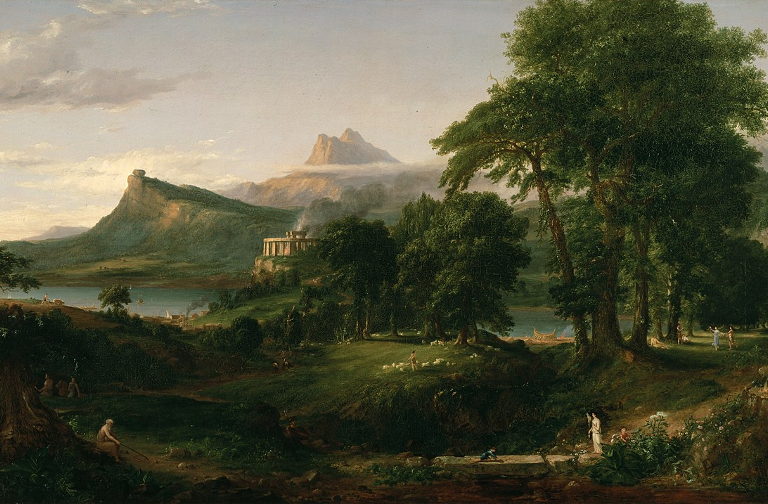
Teaser photo credit: Thomas Cole‘s The Arcadian or Pastoral State, 1834. By Thomas Cole – Explore Thomas Cole, Public Domain, https://commons.wikimedia.org/w/index.php?curid=182982




Comments
We changed commenting systems on September 10, 2026 as part of a site-wide functionality and security upgrade. Your past comments have not disappeared, and you can still log in with your old Disqus account credentials if you wish. Contact us with any questions.