

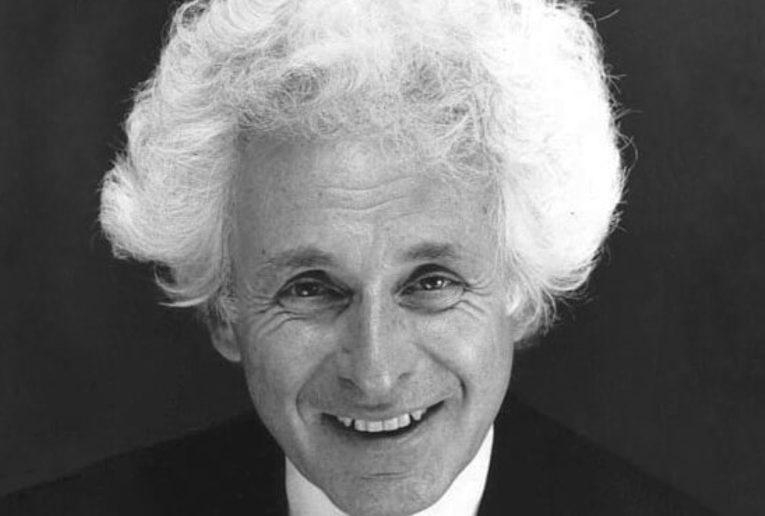
A trail-blazing author and activist, once called “the patriarch of the anti-globalization movement,” Jerold Irwin “Jerry” Mander passed away earlier this week at the age of 86.
Jerry’s incisive mind and optimistic spirit guided many of us over a career spanning four and a half decades. Rising to national attention with his 1977 book, Four Arguments for the Elimination of Television, he later served as senior fellow at the Public Media Center, program director for the Foundation for Deep Ecology, and Director of the International Forum on Globalization. As a Member of the Schumacher Center’s Board of Directors, Jerry sharpened our analysis of the impact of global corporations on small communities and local economies. An all-encompassing thinker with an abiding commitment to human potential, Jerry will be missed.
Introducing Jerry at his 1999 E.F. Schumacher Lecture, Nancy Jack Todd had this to say of the man and his work to that date:
In all three books he has documented the steady erosion of essentials in the pursuit of abstractions that take us farther and farther from cultures of economic and ecological sanity and social equity.
A story about C. G. Jung may be applicable here. When he was still quite a young man, traveling in Africa, he met a shaman… To Jung’s immense delight they fell into a discussion about dreams. They were able to establish that they had shared many experiences having to do with dreams. Jung said, I find that there are dreams we all have about the busyness and the details of our lives, and the man said, Yes, he understood; he had those dreams too. But, Jung said, there are also the great dreams, the dreams of destiny and meaning and of the human role in the larger scheme of things. The man said, Ah yes, we did indeed used to have such dreams. But now, alas, the district commissioner has them for us.
We too have had our great dreams, but now the corporate-run media, the corporate world, have them for us. Part of what Jerry Mander is crusading for is to encourage us to have great dreams again.
Jerry’s lecture, “Economic Globalization: The Era of Corporate Rule,” is a window into a particular moment in the history of decentralist economic thought — one with many clear parallels to our present day. In it, his analysis of world political and economic dynamics clearly explains the agitation and activism around “anti-globalization” at the turn of the millennium:
We read about environmental problems such as changes in the global climate… about ozone depletion, ocean pollution, or wars over oil… But rarely are these grave matters linked to the imperatives of global economic expansion now accelerated by free trade, the overuse of resources, and the consumer lifestyle that’s being promoted worldwide…
[A]ll of these issues—overcrowded cities, unusual new weather patterns, the growth of global poverty, the spread of new diseases, the lowering of wages as profits and stock prices are soaring, the elimination of social services, the destruction of the environment—are part of the same global process. They are of one piece, a fabric of connections resulting from the world’s new economic arrangement, all in the cause of an economic ideology that cannot serve social or ecological sustainability.
His thorough critique is permeated by a conviction for local self-reliance and community-building as viable responses to corporate capture.
Never let anyone get away with saying that globalization is somehow a natural process like gravity..only five years ago the term “globalization” was unknown, and now there is suddenly a spontaneous outburst of pain and anger against it. Resistance is growing, and the media are beginning to notice.
Jerry’s concluding remarks — a rousing call to action for renewed localization — are a fitting reminder to those carrying on the same pursuit today:
“Of course, advocates of globalization and technological society argue that there is no viable alternative, that it’s utopian to speak about turning back to decentralized self-reliant models. But what is truly ‘utopian’—corporate utopianism—is to believe that a system which marginalizes so many… and assumes it can grow endlessly on a finite planet—bringing the planet to the brink of environmental catastrophe—can possibly be sustained for long.
Far better to do exactly the opposite of what has brought us to the brink.”
Jerry Mander’s 1999 lecture can read in full here.





Comments
We changed commenting systems on September 10, 2026 as part of a site-wide functionality and security upgrade. Your past comments have not disappeared, and you can still log in with your old Disqus account credentials if you wish. Contact us with any questions.
i still consider the week spanning November and December of 1999 the best of my life–in which my dream of people from all over the world uniting to defend ourselves and our planet from the corporate monster, came true. And we WON. I call this the biggest win in a lifetime of activism, when we knocked the WTO and the juggernaut of corporate rule back on its ass. Why did we win the Battle of Seattle? A key reason is that the other side was asleep at the switch, not prepared for 50,000 protesters, including 5000 doing direct action (a mistake they have not repeated). Another reason was that so many organizations and individuals from all over the world (but predominantly the US and Canada) worked together in harmony before and during this event–perhaps because of the failure to prepare (with infiltrators). But a key reason–a reason there were five THOUSAND people doing direct action, thus able to actually block all 13 entrances to the convention center–was the weekend-long workshop put on by the International Forum on Globalization. For two and a half days there were speakers from all over, more women and POC than I’d ever heard speaking before. This was where I first heard about GMOs, and heard Victoria Tauli-Corpuz, who became the official spokesperson for indigenous people at the UN later, talk about people from the western medical establishment wanting blood samples from her people. This packed weekend was largely organized by Jerry Mander. As was another a few years later in DC–someone told me it was his idea to pack the talks so fully that you had to miss something to get some food, maybe even to go pee. The one in Seattle was very informative, but many of the speeches had more of the tone of a rally, and ended with, “Be at Steinbrueck Park at 7 a.m. Tuesday.”
Yes, what a week it was! I wasn’t there in person, but I wanted to be. It was a huge inspiration to many of us.