

Sometime during this century, it is highly likely that worldwide depletion of natural resources will force an entire reorganization of social and economic structures, perhaps violently.” — Walter Youngquist, ‘Our Plundered Planet’
We are going to have to dramatically downsize the dream of a future in which we replace 150-year-old fossil fuel infrastructure with “clean energy” by 2050.
That’s the message in a number of recent important reports and books. They underscore a number of problems with the renewables illusion, including the complexity of the task, the toxicity of rare earth mining and the scarcity of critical minerals.
These grounded realists, including the French journalist Guillaume Pitron and the Australian geologist Simon Michaux, all have three basic messages:
There are dramatic limits to growth.
And the world needs a better plan to avoid collapse other than replacing one unsustainable fossil fuel system with another intensive mining system powered by even more extreme energies. In other words, electrifying the Titanic won’t melt the icebergs in its path.
‘Doubling down on the wrong thing’
For largely ideological reasons many greens and “transitionists” have presented the transition to renewables as a smooth road with no potholes.
In so doing they have ignored much basic geology, energy physics and even geopolitics. As a consequence many imagine the construction of millions of batteries, wind mills, solar panels, transmission lines and associated technologies, but they downplay the required intensification of mining for copper, nickel, cobalt and rare minerals you’ve probably never heard of such as dysprosium and neodymium.
One of the great lies of modern technological society is that of endless mineral abundance. Urban consumers, who have little knowledge of energy realities underpinning their existence, have swallowed the idea that digital gadgets and automation will somehow detach society from the physical world and allow us to do more with less, leading to a dematerialization of society.
But that’s a wholesale fiction long debunked by the likes of the energy ecologist Vaclav Smil and the late geologist Walter Youngquist. The average North American citizen not only consumes 1.3 million kilograms of minerals, metals and fuels in their lifetime but has no idea where they come from or at what cost.
The current global mining footprint is already “unsustainable” if that plastic word has any meaning left. In his book Extraction to Extinction the British geologist David Howe politely notes that current mining operations have now become their own geological force, scraping, sorting and collecting more dirt, rock and sediment than the world’s rivers, wind, rain and glaciers every year. But you can’t build solar panels, wind mills or electric cars without mining more copper, lithium, iron and aluminum along with the rare earth technology metals that only appear in small concentrations. That means vastly more destructive scraping and digging of ocean floors, rainforests and tundras on a scale inconceivable to most environmentalists.
Already the industrial global machine that serves our shop till you drop culture has dug up more materials and metals than the globe’s total living biomass. In other words our machines, cellphones, buildings, cars, asphalt roads, concrete, plastic, gravel and bricks started to outweigh the world’s plants, fungi, animals and bacteria by 2020. If we continue on this extractive course the pile of human mined materials on this groaning planet will triple global biomass by 2040.
Will it really matter if we reach net-zero emissions by extinguishing the last remnants of biodiversity in the process, asks the U.S. physicist Tom Murphy in a recent essay. He considers the current prescription for stopping climate change with a mining boom to support an industrial production of renewable technologies a dangerous course.
“It’s doubling down on the wrong thing: propping up and accelerating the machine that’s eating the planet alive. Barrelling forward on renewable energy is the last thing Earth’s critters would vote for, and would be considered one of the more disruptive decisions we could make.”
Murphy is far from alone in that assessment. After the U.S. renewables skeptic Alice Friedemann tabulated the mining costs of rare earth mineral mining needed for renewables, including enormous tailing ponds, poisoned groundwater, radioactive waste and volatile geopolitics, she flatly concluded,
“Our quest for a more ecological growth model has resulted in intensified mining of the Earth’s crust to extract the core ingredient — rare metals — with an environmental impact that could prove far more severe than that of oil extraction.”
Making a pile
Years ago, the U.S. historian and technology critic Lewis Mumford argued civilization’s dependence on intense mining had dramatically changed its values. As the extraction business became more important to empires, it contaminated economic thinking with an ethos dedicated to making a killing as opposed to a living. In mining the ends always justify the means. And in a technological society everything is now mined, from soils to people’s behaviour on the internet.
In 1934 Mumford described what this destructive ethos entailed:
“The miner works, not for love or for nourishment, but to ‘make his pile.’ The classic curse of Midas became perhaps the dominant characteristic of the modern machine: whatever it touched was turned to gold and iron, and the machine was permitted to exist only where gold and iron could serve as foundation.”
So when you strip away all the plastic words and inflated claims, what you find in the enthusiasm for a new era of renewables is the prospect of making another pile. In Canada, mining companies already are licking their chops with more than 50 rare earth mining projects now on the books. The Mining Association of Canada declares without a hint of irony that “there is a natural synergy between mining” and so-called “clean technology.” Yet neither mining nor technology are green or clean.
In Australia geologists now gush without embarrassment that, “We will need more mines to save the planet.” But more mines will have the opposite effect. More destroyed landscapes, debased watersheds and displaced rural communities. All to sustain our technological dependence on minerals.
The average smart phone contains at least 40 elements from the periodic table including cobalt and six rare earth minerals that make the screen glow. The average electric car uses six times more critical minerals than a combustion car. An onshore wind plant needs nine times more mineral resources than an equivalent gas-fired power plant. An e-bike is more mineral intensive than an ordinary bike. And so on. Renewables just haven’t accelerated the demand for rare earth minerals but a variety of base metals such as copper, silver and cobalt.
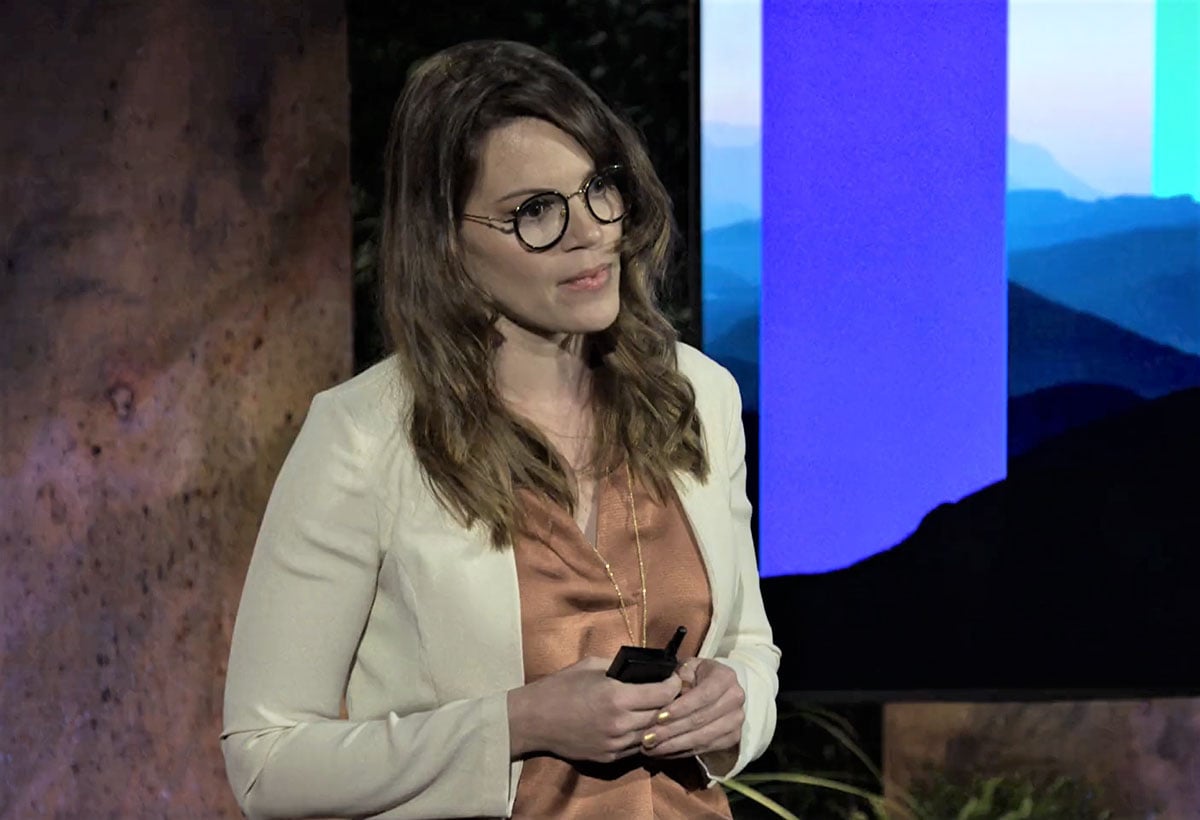
Mining conflict expert Olivia Lazard: ‘We could actually lose the future of humanity trying to save it on behalf of the climate. And this is the ultimate irony, right?’ Screen shot from a TED Talk.
Every electric vehicle contains about 75 kilograms of copper or three times more than a conventional vehicle. A single wind turbine generally contains 500 kilograms of nickel. That nickel requires 100 tonnes of steelmaking coal to be refined. And every crystalline silicon solar panel contains 20 grams of silver paste. It takes 80 metric tons of silver to generate approximately a gigawatt of solar power. (In power terms that’s equivalent to 9,000 Nissan Leafs.)
Demand is projected to spiral upwards. A recent U.K. report on critical minerals estimated:
“Global demand for electric vehicle battery minerals (lithium, graphite, cobalt, nickel) is projected to increase by between six and 13 times by 2040 under stated policies, which exceeds the rate at which new primary and secondary sources are currently being developed.”
Calculating inconvenient truths
Simon Michaux is an Australian-born geologist who now works for Finland’s Geological Society. Over the last couple of years Michaux has produced a number of comprehensive papers that challenge the assumption there is enough energy and minerals to replace combustion engines with electric ones and fossil fuels with other forms of “green” power.
Michaux recently made an important calculation on what would be needed to replace a system run by fossil fuels with a “renewable” one based on 2019 consumption figures. The scale of the thing is mindboggling. Just to replace 46,423 power stations run by oil, coal, gas and nuclear energy would require the construction of 586,000 power stations run by wind, solar and hydrogen. That’s 10 times greater than the existing system due to the low power density of renewables.
Building such infrastructure will require an incredible volume of metals and rare earth minerals and a vastly larger scale of mining. No wonder billionaires talk about mining asteroids, Mars and the ocean floor.
Since 400 BCE, various civilizations dug up 700 million tonnes of metals (everything from bronze to uranium) prior to 2020. But a so-called green transition will require mining another 700 million metric tonnes by 2040 alone, calculates Michaux. Copper tells the grim story here. (Trying running a phone or a windmill without this metal.) Current copper reserves stand at 880 million tonnes. That’s equal to approximately 30 years of production. But industry will need 4.5 billion tonnes of copper to manufacture just one generation of renewable technologies, estimates Michaux. That’s six times the volume of copper mined throughout history.
After that generation comes many more, and sooner than you might imagine. On average a windmill and solar panel has to be replaced every 25 years and that’s why energy critic Nate Hagens has called them “rebuildables” instead of renewables.
Global reserves for battery metals such as water-intensive lithium in Latin America and slave-labour extracted cobalt in the Congo present even more problems. They represent less than five per cent of what society needs for an energy transition. And so, as Michaux highlights in his research, society will need to develop different materials for batteries than lithium.
“The message here,” he states dryly in one presentation, “is that we need to come up with a different plan.”
Declining ore quality complicates this picture. The world’s industrial machine has already exploited the easiest metal reserves to extract. As a result the volume of rock processed for gold increased between 20 and 50 per cent between 2000 and 2009 while production declined by 11 per cent or did not change. Costs, meanwhile, climbed significantly. Diminishing returns haunts the entire metal mining industry.
Paying more for less comes with extreme energy costs. As ore quality declines, industry must use more energy to mine it. Recent studies show that the average ore grade of copper mines has decreased by about 25 per cent in just 10 years. That means more fossil fuels must be burned to haul and crush more rock. As a result total energy consumption in copper mining has increased at a higher rate than production.
Growing energy intensity translates into higher emissions for lower returns. Multiply the problem of depleting ore quality for other essential metals for renewable energy and you have a major global crisis in the making. Michaux estimates that the carbon footprint of the world’s mining industry could soon surpass that of industrial agriculture.
The goal of weaning off the world off fossil fuels with renewables runs into another geological problem. Mining is not an app that you can download overnight. Of 1,000 potential deposits, only one or two become economic mines. On average it takes 10 to 20 years to develop a workable deposit. Furthermore, increasingly volatile market conditions shut down two of every 10 operating mines.
Extracting technology metals is also a high energy and high emissions affair. Even the International Energy Agency recently admitted in its minerals report,
“Production of energy transition minerals can lead to significant GHG emissions. These minerals typically require much more energy to produce per unit of product than other commodities, which results in higher emissions intensity.”
In response to Michaux’s work and the IEA report, a group of academics with no background in geology recently wrote a paper in the journal Joule claiming that people had nothing to worry about. “Historically, mineral markets have adjusted to accommodate growing demand over time.”
The paper unfortunately pretends that depletion, corruption, wars, water shortages and geopolitics don’t exist in global mining markets. Moreover, it leaves out the minerals needed for batteries and only addresses a tenth of the demand needed for an energy transition.
Rare earth realities
Now let’s add more complexity to this picture and examine the unique case of rare earth elements, or REEs, which occupy 17 spots on the periodic table. These so-called technology metals can be found throughout the Earth’s crust in small quantities — which means industry has to use more energy to mine more ore to get less of the desired product for refining.
This explains why the rare earth elements needed for “clean energy technologies” as well as most military systems generate 2,000 tons of toxic waste for every ton produced, including one ton of radioactive waste.
The Japanese refer to REEs as “the seeds of technology” because they possess unique catalytic, metallurgical, nuclear, electrical, magnetic and luminescent properties. Neodymium and praseodymium, for example, are used to make permanent magnets essential for electric motors and wind turbines. Conventional vehicles don’t need these minerals but EVs do — about one kilogram per vehicle.
Rare earth metals are dirty to mine and dirty to process. A recent Canadian environment review highlighted that REEs are anything but green, noting, ”radioactive contamination and REE toxicity are unique potential risks compared with other types of mines.” It added, “These potential risks are cryptic and of high risk for public health because there are few proven mitigation strategies appropriate for Canada to reduce or minimize their adverse impacts.”
For the record there are no Canadian federal water quality standards or guidelines for REEs.
One of the reasons most digital consumers and many greens know little about the destructive mining practices required to supply their phones and electric cars with REEs boils down to Chinese politics.
Decades ago this authoritarian state made the strategic decision to concentrate on REE production as part of its imperial ambitions. To dominate global markets (and it has done so), the government largely ignored the horrific environmental costs, writes Guillaume Pitron in The Rare Metals War: The Dark Side of Clean Energy. As a consequence China has provided the REEs necessary for the technological gadgets that North Americans relentlessly employ in their daily life. Distant supply chains and China’s lack of transparency hid the environmental costs in rural China and consumers wrongly assumed their electrical cars and phones were the products of immaculate conception.
Pitron exposes the results in his book.
“Concealing the dubious origins of metals in China has given green and digital technologies the shining reputation they enjoy. This could very well be the most stunning greenwashing operation in history.” Another blindness has also taken hold: “in contrast to the carbon economy, whose pollution is undeniable, the new green economy hides behind virtuous claims of responsibility for the sake of future generations.”
So here’s what green revolution actually looks like. If you’ve owned a cellphone or a computer over the past 25 years, your gadgets were probably assembled with rare earth minerals from Bayan Obo, the largest rare earth element mineral deposit in the world. Once a sacred mountain in Mongolia, the Chinese government reduced its geography to ruin as part of its strategy to dominate rare earth markets.
Over a 10 year period the cancer ridden population of the region has fallen from 2,000 to 300. “First the animals got sick, then the infants, and then everybody else,” went the local refrain. One village near the mine’s radioactive and acid tailings pond was known as “death village” because 60 of its residents died of brain or lung cancer between 1993 and 2005. Radioactive tailing waste, fluorides and arsenic have contaminated both food chains and drinking water.
Even reticent Chinese scientists now warn that “intensive geological prospecting for REE ore deposits… causes extreme damage to the environment.” They also now “worry that there would be widespread tailing facilities concomitant with serious pollutions” due to rising demand from “green high-tech industries.”
The pathway to a low carbon economy looks just as ugly and destructive in the Democratic Republic of the Congo where men, women and children mine cobalt. About 72 per cent of the global supply of cobalt comes from either giant Chinese-owned mines or so-called artisanal miners who scramble for ore in a colonial hell.
In his book Cobalt Red, the British researcher Siddharth Kara details the razed forests, the polluted watersheds, the impoverished communities and the legacy of theft. Ask any Congo miner and they will tell you that the face of the renewable revolution is not virtuous or clean. Concludes Kara:
“The ongoing exploitation of the poorest people in Congo by the rich and powerful invalidates the purported moral foundation of contemporary civilization and drags humanity back to a time when the people of Africa were valued only their replacement cost.”
Let’s add another brutal reality about the geopolitics of technology mineral resources on the planet. They tend to be concentrated in Latin America, Africa, Central Asia, North America and northern Europe. The deposits are often located in jurisdictions that are corrupt, water challenged or highly vulnerable to climate events. In fact the mining industry boasts one of the highest rates of corruption on the planet.
Both China and Russia have both realized that the technologies that drive modern life require rare earth minerals, and they are scrambling to monopolize these resources in Africa and other regions. These tyrants realize that a global owner and refiner of these precious minerals will have more power than a global shopper such as Europe. Russia didn’t just invade the Ukraine because of Putin’s delusions of grandeur; the Ukraine is one of the most resource-rich places in Europe.
Olivia Lazard, an expert on the political ecology of conflict, recently emphasized these dark developments in a TED presentation and in an subsequent interview:
“If we delve into a scramble for rare earth minerals (and that process has already begun) then various governments and corporations could well plunder what’s left of the planet as well the seabed and distant asteroids on the much vaulted path to decarbonization,” noted Lazard. “We could actually lose the future of humanity trying to save it on behalf of the climate. And this is the ultimate irony, right?”
The ultimate irony is also an ultimate hell. Given that the “pathway to a low carbon economy” requires a toxic and unsustainable mining boom, experts have been quietly raising red flags for years. The Kleinman Centre for Energy Policy, for instance, warned in 2021 that
“the clean energy transition will require economic mobilization on a scale not seen since the industrial revolution, and will strain the global production of silicon, cobalt, lithium, manganese and a host of other critical elements.”
The centre added that failure to avoid the toxic realities of China and the Congo “would jeopardize the sustainability of renewable energy technologies utilizing REEs and could partially offset their emissions benefits.”
‘We need a frank discussion’
So here’s the basic problem as eloquently summed up by Michaux.
Over 150 years civilization has built a highly complicated industrial system based on cheap fossil fuels. The cheapness of those fuels created a robust banking system and an industrial agricultural system. It fuelled urbanization and globalization. Moreover cheap energy sustained the illusion that resources are inexhaustible.
Now that fossil fuel emissions have cooked the climate and decimated biological diversity, our fearless leaders want to replace that entire system with one that is more mineral-intensive and complex.
They want to do so at a moment when economic flows have slowed down due to the rising cost of extreme fossil fuels such as fracked shale gas and mined bitumen. The whole process of replacing a declining system with a more complex mining-based enterprise is now supposed to take place with a fragile banking system, dysfunctional democracies, broken supply chains, critical mineral shortages and hostile geopolitics.
Meanwhile climate events are destroying infrastructure and producing great waves of homeless migrants from failing states.
All of these incontestable realities highlight the fact that our dreams of a renewable powered boom are illusory. We need a different conversation than fossil fuelled business as usual or a Green New Deal.
Michaux has offered some starters.
“We need frank discussion about what minerals we think we need versus what we’ve got,” he said in an excellent interview with Nate Hagens on his podcast, The Great Simplification. “And then we’re going to realize that what we got won’t work with the existing plan.”
Fundamentally, we need to talk about a future of less instead of a future of more.
Society will have to build simple products that last and that can be easily recycled.
“And we will scale back our needs and our society will simplify,” adds Michaux.
That is the conversation we should be having now. The one we continue to avoid. ![[Tyee]](https://thetyee.ca/design-article.thetyee.ca/ui/img/yellowblob.png)
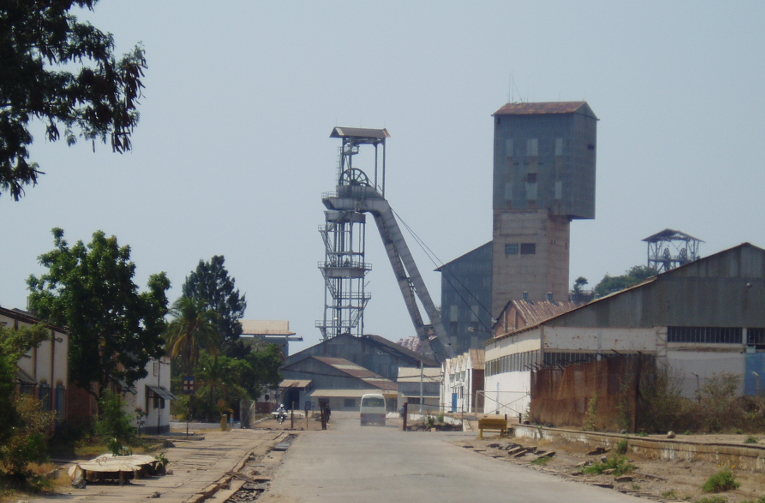
Teaser photo credit: https://commons.wikimedia.org/wiki/File:Kamoto_Mine_-_panoramio.jpg#/media/File:Kamoto_Mine_-_panoramio.jpg




Comments
We changed commenting systems on September 10, 2026 as part of a site-wide functionality and security upgrade. Your past comments have not disappeared, and you can still log in with your old Disqus account credentials if you wish. Contact us with any questions.
If you're an astrophysicist, everything but hydrogen and helium are "metals." 🙂
Bravo on this article. Even if it were not absolutely 100% accurate – and who could ever be – at least it raises awareness on this issue. I’m not entirely convinced that eliminating fossil fuels completely is something that is a valid alternative considering that the world’s population will continue to increase exponentially for a few decades more. And yet there are many around the globe – including those who incessantly preach us about alternative energy – who consume abnormal quantities of energy. What happened to the notion of leading by example?
This s a critical analysis that must be spread widely to decision-makers from local to state to federal governments. It must be understood clearly by the general public, who are making consumer decisions based on a complete misunderstanding of energy realities.
An excellent article, full of inconvenient truths. Still, it should’ve at least have discussed how much recycling metals could help … especially if our spineless lawmakers made it mandatory. Most of the metals in automobiles and heavy machinery do get recycled, for example; that’s not true of the lithium and rare earths in electric cars right now, but once they become dominant I’m pretty sure they will be for purely economic reasons. Same with wind turbines, etc.
“It takes 80 metric tons of silver to generate approximately a gigawatt of solar power”.Fair comment. (Icalculated 50MTs). Missing are two facts. The first that is is a 1GWhour/year (you missed the hour out) amd that panels now last circa 25 years (so 25GWhrs) and soon to be 50 years. Other reality – recycling of panels is possible & desirable – because of the metals in them. The same applies to wind turbines (which most (95%) of the materials by weight) can be recycled. In the case of batteries – moves to sodium (not much shortage there). However, on balance I agree with the main thrust of the article – we need to use less & that needs to be articulated by politicians – who so far have failed to do so.
This was a remarkably valuable and important article. I love it. And yet I know it left out a crucial point, which is that all of the available evidence shows that not only are these other crucial points important, but also there is the fact that in the near term (over the next ten years, at least) a ‘rapid energy transition’ to renewables would result in more, not less, fossil fuel consumption in the mining, smelting, shipping and installing of those electric cars, solar panels, wind turbines, etc. So it wouldn’t even lower greenhouse emissions in the near term–which is the most crucial period in which emissions must be reduced. So nothing about rapid “energy transition” adds up to lowered emissions or environmental harms.
This is why new generation nuclear needs to be included. Like just the current “nuclear waste” has in it over 500 years of current use of energy. As to some of the other materials that you are saying need to be mined to make the new electrical world work the story is not as bad as current addition would seem to entail. There are allot of ways to reduce the materials and types of materials. Like Tesla is going to 0 rare earth materials in their motors. This can also work for wind generators and other stuff. Cobalt and nickel are being eliminated in lithium-ion batteries. The price of lithium has dropped by 70% because it is found that lithium is much more common than originally thought. I think this is true for most of the materials mention in your article. From this information I would say the future does not need to be as bad or austere as your article would imply.
“Fundamentally, we need to talk about a future of less instead of a future of more.” Although I think it could be framed better, that is a valid point, which for sure ought to affect the narrative around the energy transition. But at the same time, it doesn’t justify the near total denigration of renewable energy to which much of the article is devoted. And that because less is not zero, and we (meaning all of humanity, but starting with the rich countries) need to reduce our carbon emissions to zero, which can’t happen solely by reducing—even drastically—our consumption fossil fuels. So while moving away from a culture of materialism and consumerism is a necessary condition for solving climate change, it is not a sufficient one. Renewable energy like solar and wind are also necessary; this is point one. Point two is that in developing his argument against renewables, the author commits at least two logical fallacies (of the informal sort).
The first logical fallacy is that of exclusion of evidence. For example, it is quite illogical to point out the negatives of extraction from the Earth of materials like lithium and REEs (rare earth elements), while omitting the fact that the total amount of extraction required by continuing to rely on fossil fuels would be an order of magnitude greater.
The second logical fallacy is sometimes called the raw-meat fallacy, on account of the fact that the Medieval schoolmen illustrated it this way: “This morning I bought raw meat at the market; therefore this evening I must eat raw meat for my dinner.” In just this way, it is also illogical to assume that just because today’s electric motor and battery technologies rely heavily on things like lithium and REEs, they will continue to do in the future. In fact, businesses are always looking to improve their supply chains, and eliminating the need for the aforementioned elements is an active area of research by the EV and battery manufacturers, as well as by academia and national laboratories, and looks likely to succeed.
I don’t know the reason for the author’s unfounded bias against renewable energy, but I can say that it destroys most of the value of the article.
The technology to power the world with renewables, without destroying the world in the process, doesn’t exist. What is your bias towards consuming less?
I disagree with the energy decline thesis. With Wind and Solar getting so cheap, there will be an abundance of clean energy BUT if I am correct that will be worse for humanity as the additional cheap energy will enable is to build and destroy and consume even more.
The best path forward is to reduce energy consumption through cultural and social change.
Thank you for taking on this topic.
A minor point: the article repeatedly cites concerns about radioactivity. The damages from RE mining and processing result from chemical toxicity, not radiotoxicity. The low level, but easily detected, radioactivity is mostly from thorium’s decay chain. Since thorium has a 14 billion year half-life, the actual radiation dose per unit time is extremely low. Dose rate is what matters. The concern your sources expressed about radioactivity is naivete or fear-mongering.
We will have to start promoting social changes such as public transport, moving from the suburbs back to the city center, multi-family dwellings such as apartments, a return to personal gardening for vegetables, limitations on extreme wealth, drastic changes of diets, political compromise and accommodation, resources spent on space mining instead of warfare, a more practical restructuring of religion, etc. These are all things very few people want to do. This is going to be incredibly messy and contentious.
The article fails to take into account technological progress, as well as recycling. Take for instance the issue of cobalt. LFP batteries, which are more than adequate for most EVs and are growing exponentially, don’t need any cobalt.
The current system is not based on breeder reactors, and uranium (mostly U238, which is not a fuel but readily converted into plutonium in reactors) is as dilute in its ores as many rare earths. In addition, the tailings from uranium mining are even more radioactive than those produced by mining rare earths as a rule. Last but not least, almost all nuclear reactors today use U235, which is far more dilute in the ores than U238 and consequently far more painful to extract.
It’s easier to extract plutonium from nuclear waste than it is uranium from its ores, but it’s still a damn messy (due largely to the radioactivity) process which only France is seriously doing. Also, as you may have heard, both breeder reactors and plutonium extraction have this little “proliferation” problem, which is far more likely to kill millions of people outright than any meltdown (though those can also be pretty bad).
The thorium fuel cycle is better, and there are relatively safe reactor designs that can use it (but have yet to be deployed anywhere); it might keep us going for a few centuries if we did it right, but the investment in infrastructure needed to get there is probably on the same order of magnitude as that needed for a renewables transition — which at least are technologically mature and already being produced on a significant scale.
The naivete of those who think that nuclear is an easy answer to our woes is even worse than that of the “let’s just go renewable” buffs. But at least you didn’t mention fusion!
“The current system is not based on breeder reactors,”
Our future is not restricted to the current system. (Also true for the entire energy sector.) Several teams (Moltex, Elysium, Southern Co. etc.) are already developing molten salt fast reactors.
“and uranium (mostly U238, which is not a fuel but readily converted into plutonium in reactors) is as dilute in its ores as many rare earths.”
But it is water soluble, and chemically much easier to extract and isolate–which is why uranium is far cheaper than rare earths on average.
“In addition, the tailings from uranium mining are even more radioactive than those produced by mining rare earths as a rule.”
There are no tailings piles with in-situ leach mining–which became the dominant form of uranium mining years ago. And once we are able to make use of U-238, we wouldn’t even have to mine it for centuries while we consume the very large stockpile which we already have in storage.
“Last but not least, almost all nuclear reactors today use U235, which is far more dilute in the ores than U238 and consequently far more painful to extract.”
I think there is general agreement that the old-tech reactors we have today do not represent the future of nuclear power.
“It’s easier to extract plutonium from nuclear waste than it is uranium from its ores, but it’s still a damn messy … process”
Some of the molten salt fast reactors are being designed to consume “spent” fuel whole, without separating out the plutonium.
“Also, as you may have heard, both breeder reactors and plutonium extraction have this little “proliferation” problem, which is far more likely to kill millions of people outright than any meltdown (though those can also be pretty bad).”
I’ve heard claims to that effect. These do not appear to be realistic. It is much easier and cheaper to make high-purity weapons-grade plutonium in production reactors that are designed for that purpose than to extract highly-contaminated reactor-grade plutonium and try to make bombs from that. That’s the reason zero atomic bombs have ever been made from spent fuel, even though spent fuel reprocessing has been done for decades. And this would be a moot point anyway for reactors which would both breed and consume the plutonium without separating it from the core fuel.
“The thorium fuel cycle is better,”
It is different. Better depends on what you are trying to do. If you want to consume spent fuel, depleted uranium, surplus bomb cores and some of the wastes from bomb production, it is worthless for those. Thorium 232 is, of course, also not a fuel, but it can be bred into protactinium 233 which will eventually become U-233 which would be a very good nuclear fuel (for bombs as well). The problem is that protactinium 233 very readily grabs precious neutrons and becomes something worse if you leave it in the reactor. But if you separate it out while you wait for it to turn into fuel, then you have the complete working system needed to produce super-weapons-grade U-233, which would be a far worse proliferation hazard than reactor-grade plutonium. But if this problem can be solved, all that would mean is that we’d have another viable form of nuclear power with its own abundant fuel supply.
“it might keep us going for a few centuries if we did it right, but the investment in infrastructure needed to get there is probably on the same order of magnitude as that needed for a renewables transition”
Several molten salt reactor teams are aiming for build costs in the range of $1 to $2 per watt capacity, and are planning various ways for them to be capable of flexible, on-demand output so that they can work in concert with intermittent sources of energy. And they could plug into the existing grid system. It looks like there is at least some potential to reduce the overall infrastructure costs by including some kinds of nuclear in the mix, and nuclear could also provide other services beyond just electricity.
” which at least are technologically mature and already being produced on a significant scale.”
Significant, but insufficient. The problem (and the subject of this article) is the amount that scale will have to be increased.
“The naivete of those who think that nuclear is an easy answer to our woes is even worse than that of the “let’s just go renewable” buffs.”
I don’t see that we have any easy answers here. What I’m saying is that I’m not seeing any resource limitations that would inherently restrict the expansion of a nuclear sector.
“But at least you didn’t mention fusion!”
You didn’t have to either. And yet you did.
Thanks for responding to the specific issues mentioned in the article, Jag.
Thank you for your detailed response. You are clearly better informed than you sounded in your initial comment. Although I could quibble with some of your statements, I do agree that there’s enough fissile and fertile elements around to power our current economy for a few centuries, if we were dead set (as you seem to be) on doing so and despite the inevitable proliferation of swords of Damocles over our heads. Neither I nor I’m pretty sure most other readers of Resilience share your value judgement, however. And once again, it would certainly cost a lot of money or, equivalently, cause a lot of environmental damage, which (as history has repeatedly shown) would likely greatly exceed the initial estimates.
“I do agree that there’s enough fissile and fertile elements around to power our current economy for a few centuries, if we were dead set (as you seem to be) on doing so and despite the inevitable proliferation of swords of Damocles over our heads.”
Our trajectory appears to be one of increasing energy demand. That’s not my preference, but there is a serious possibility that will be our future. In an ideal world, we could unite globally and overcome vested interests to scale down our energy and material consumption, but I have serious doubts that we live in that world. Even if we could somehow unite enough to make that Plan A, it still seems prudent to have a Plan B to develop all of our most promising clean energy options in case it turns out we need them.
And old-tech nuclear power plants consumed and destroyed the bomb fuel from roughly 20,000 nuclear warheads–a larger stockpile than all the deployed nuclear warheads remaining in the world today. Nuclear plants have been one of the most effective anti-proliferation tools we’ve ever had, and molten salt fast reactors could expand on that capability.
“Neither I nor I’m pretty sure most other readers of Resilience share your value judgement, however.”
Are you optimistic that the rest of the world can be convinced to adopt the values of Resilience readers? And that this can happen soon? And that majority opinion will prevail if we get there?
“And once again, it would certainly cost a lot of money or, equivalently, cause a lot of environmental damage, which (as history has repeatedly shown) would likely greatly exceed the initial estimates.”
Initial costs will probably not be market competitive, but that was true for wind and solar too, if you’ll recall. But it wouldn’t take a lot of money to work with private teams in helping them deliver a few demonstration reactors for evaluation. Then we could decide how we feel about them based on some actual performance data. And the metric of interest is not their actual environmental damage vs. how little damage they were trying for, it should be their actual environmental damage vs. the actual damage that would be done by the alternatives they could help to displace. It’s hard to imagine any of them not being a huge improvement over coal.
I don’t understand what you are implying about extracting plutonium from nuclear waste? If you are implying you can make a bomb from this type of Pt that’s not really true. Pt burn up from a nuclear reactor is not suitable, often called denatured, to be in a bomb because it has to much unsuitable reaction killing Pt isotopes in it. In fact, bomb grade Pt is mixed with reactor waste Pt to make a denatured product that is unsuitable for making bombs. This denatured Pt does make a very good nuclear fuel for some types of reactors. This is what this type of Pt is good for.
Just one “trivial” point: As can be found in almost any Chemistry textbook, “Pt” is Platinum; Plutonium is “Pu”. A not-so-trivial distinction: they are by no means similar, except for both being metals!
This has nothing to do with “Nagasaki”. Your’s is is a snide remark. You ignore freeeagle170’s science based argument on Pt isotopic mix from U235 fueled power plants causing it to be inappropriate for bomb use.
Of course plutonium isotope mix in the spent comes out of reactors is not the best for making a bomb (though it could still be done; that is why Pres. Carter, a nuclear engineer, decided we shouldn’t reprocess that fuel). As I’m sure you are well aware, however, it is not at all difficult to do things just a bit differently and fix that little problem. Or why do you think it is that just about every despot in the middle East wants to have a nuclear reactor that will provide only small fraction of their country’s electricity, even though they have oil & gas coming out of their noses as well as some of the best solar and wind resources in the world? In point of fact, once you have any intense source of neutrons, it’s pretty easy to make a bomb, so there is really no such thing as a proliferation-proof source of nuclear energy.
In short, my snide remark was and is eminently justified.
“Of course plutonium isotope mix in the spent comes out of reactors is not the best for making a bomb (though it could still be done; that is why Pres. Carter, a nuclear engineer, decided we shouldn’t reprocess that fuel).”
I don’t know for sure what Carter was thinking, but I’ve read that his advisers felt the main hazard was that if we were to set up a system for plutonium extraction, others could follow suit, and once such facilities existed, they could be used for purposes other than fuel recycling. It’s kind of like how we worry that centrifuges which can be used to make enriched fuel for power reactors can also be used to enrich all the way up to weapons-grade.
As it turned out, other places set up fuel reprocessing facilities anyway, so Carter’s ban turned out to be needless, but uranium proved more abundant than we originally thought, so reprocessing was also not needed. And we may soon have reactors which can consume the spent fuel whole, in which case it will turn out to be a lucky thing that we didn’t break open all that fuel and make a big mess.
“As I’m sure you are well aware, however, it is not at all difficult to do things just a bit differently and fix that little problem.”
Yes, exactly. And the easiest way to do things a bit differently is to build a cheap production reactor to produce the feedstock for extracting high-purity bomb-grade plutonium. The production slugs are much easier to process, the whole process is cleaner and less radioactive, and the end-product is higher quality (easier to handle, more predictable, less damaging to nearby electronics, etc.).
But this problem would be even worse for any molten salt thorium reactors that do protactinium separation. To modify the system so that it could produce very close to 100% pure U-233 (far higher purity than is possible with Pu-239 or U-235), all that needs to be changed is the uranium extraction timing. You wouldn’t even need any modified or supplemental equipment, and spot inspections would not be able to detect the process change. It wouldn’t be as quick as plutonium production (the reason we went the plutonium route in the first place), but it would be very easy at virtually no added cost.
“In point of fact, once you have any intense source of neutrons, it’s pretty easy to make a bomb, so there is really no such thing as a proliferation-proof source of nuclear energy.”
Getting the source of neutrons is the easy part. That’s how we were able to set up production reactors very early, very quickly–long before the first nuclear power plant. For plutonium production it is the plutonium separation facility which is the difficult, messy, and expensive part. And anyone who goes to that expense and bother to make bomb fuel is unlikely to run highly-contaminated junk feedstock through it. Yes, unlikely isn’t perfect certainty (typically unattainable in this world), but against those small odds, you also have to look at anti-proliferation potential. Molten salt fast reactors, for example, would not only excel at consuming and destroying every kind of surplus or decommissioned bomb fuel as well as any bomb-usable isotopes (including some neptunium wastes we still have sitting around from our bomb-production days), any country that had such reactors would also be depriving themselves of a plausible civilian rationale for building a fuel reprocessing facility for plutonium separation.
This is partly true.
However if I put solar on my roof the cost of the panels is less than the labour costs. If I buy Australian made panels from Tindo, the cost isn’t much more. Yes China is driving down Panel Costs but they are still way cheaper than burning Fossil Fuels. I agree they are not clean and not without problems in manufacturing.