

I recently watched a Netflix documentary series about fundamentalist Mormons, exposing along the way a number of beliefs that seem bizarre from the outside, but that are accepted as perfectly normal within their insular community. Though the term “cult” is not used in the series, it is hard not to see the sect in this light. It would be nearly impossible to convince any one of its members that they are deeply in error, in part because doing so threatens the salvation that has been dangled in front of them. If they are pure enough in their faith, resisting external evils that try to knock them off the one true course, eternity is theirs. In today’s world, one need not look far to find other groups whose beliefs are at once bonkers and seemingly immune to attack.
Hearing the perspectives of ex-members of these cults never fails to be fascinating, providing a window into how they could have swallowed all the lies and goofy stories. Also important to know: it is possible to escape, and to suddenly see the magnitude of the deception. Once out, there’s no going back.
Cult beliefs look insane from the outside, so why don’t its adherents detect the lunacy? Why is it so hard to convince them of their folly? One possible answer—as a tangent—is that cults offer a deeply satisfying sense of identity, belonging, and (seemingly) unconditional acceptance/support within its community that we have otherwise lost in today’s society, but that in times past were central offerings of tribal life to which humans are intimately adapted. It is remarkable how quickly tribal cohesion instincts of mutual help resurface as soon as core elements of civilization (provision of food, water, electricity, for instance) fail in a natural disaster. We’ve still got it, underneath the veneer.
Leaving that for another time, let me now condemn myself in the court of civil opinion by making the charge that most people on Earth are members of a dangerous cult whose central beliefs seem every bit as bizarre to one who has escaped the thought prison, but that are seldom questioned and even fiercely defended. This post offers ten heretical statements that seem obvious to me, but tend to produce emotionally charged reactions by members of the cult of civilization. Watch yourself, now.
Let’s start by just unloading them all, in compact form, each point to be briefly unpacked in what follows. Some of the points essentially follow from previous ones, but are powerful (jarring) enough to deserve their own statement.
- Humans are not the reason for all of creation: not the end point or goal in this universe.
- A human life is no more sacred than that of a wolf (as just one example).
- Our civilization is not any sort of destiny: not the only or best way to organize ourselves on this planet.
- We are not building civilization—brick by brick—according to some master plan aiming toward a “better” end: no paradise/salvation awaits on the current path.
- Technology and innovation are slowing, not accelerating.
- Technology (ahem; renewable energy) will not solve our big problems.
- Space colonization is an infantile fantasy that is not part of our future.
- Growth is destined to end: we have hitched ourselves to a losing wagon.
- Monetary valuations badly miss the mark by orders-of-magnitude, so that decisions based on money (i.e., most societal decisions) will be bad ones.
- Malthus was wrong only in his optimism that population will saturate and stabilize.
I don’t expect many to make it through the list without at least a “wait a minute…”
Okay, readers of this blog are perhaps more predisposed to this way of thinking, but that’s a skewed representation of “normal” people—many of whom may find themselves to be offended or even apoplectic. To me, that sort of reaction betrays a bit of…cultishness. Perhaps the best way to explain is for me to state as succinctly as I can why each of the statements seems like obvious dispassionate truth once free of the baggage.
[slide-anything id=’3472166′]
1. Humans are not All That
Humans are not the reason for all of creation: not the end point or goal in this universe. After several billion years of evolution, why would a genus that arose on one of the many branches only 3 million years ago (and our species a tenth of that duration) possibly be an end point? Why would evolution come screeching to a halt now that it has “achieved” homo sapiens? Presumably, a few billion years of evolution lie ahead, and many new ideas will be explored—the vast majority having no lineage from homo sapiens. Evolution tries many strategies for success (and even more leading to failure). Intelligence is just one of those, and not necessarily an optimal one. So it is not at all guaranteed that homo sapiens will have descendants left on the stage millions of years hence. We should get over ourselves. Moreover, Earth is one planet around one star among many billions in our galaxy—itself one of many billions of galaxies. Of course we’re not the raison d’ê·tre for the universe, if you’ll pardon my French.
2. Not Sacred
A human life is no more sacred than that of a wolf (as just one example). In some sense, neither are sacred. This partly flows from the previous point. If humans are not the apex—the whole point of the Earth, Galaxy, or Universe being here—then why is one life within a robust population that important? When an ant colony inevitably experiences a factor-of-ten seasonal reduction in population, it’s no tragedy: they’ll bounce back next spring. When flamingo chicks die by the hundreds in their perilous migration from the drying flats, it’s part of the time-tested cycle. What’s important is the propagation of the species, and the maintenance of biodiversity. The fate of individuals has little grand meaning. Once humans are seen as just one of millions of animal species on the planet, it becomes hard to argue that the life of a (comparatively rare) bear who kills a human is any less valuable than that of the human now eliminated from among 8 billion. Human rights represent a self-promoting construct we just made up for our exclusive benefit. This point is likely to raise some readers’ hackles. Don’t read in more than dispassionate logic: strong objections are the cult talking.
3. Civilization is not All That
Our civilization is not any sort of destiny: not the only or best way to organize ourselves on this planet. Tangled with the sense of human exceptionalism (point 1) is the notion that the civilization we have raised over the last 10,000 years out of the dust bin of prehistory is an expression of destiny. If humans are somehow the ultimate species—the focal point of evolution—then whatever we end up doing is also meant to be. What we have done is so extraordinary in the entire history of the planet (no argument from me here) that it must have some grand meaning and be the right path. But what if it is extraordinarily wrong or a colossal mistake? Humans lived a different way for 3 million years, and that way happened to work long-term (by construction). The current way is untested over relevant time scales, and is so obviously unsustainable at today’s scale that it was most likely a wrong turn. I’m not saying that primitive tribal life is the only solution either: just that today’s civilization isn’t the answer, and perhaps we should contemplate ditching it for something entirely different (built on a foundation of truly sustainable principles, living as subordinate partners to all other life on the planet).
4. No Paradise
We are not building civilization—brick by brick—according to some master plan aiming toward a “better” end: no paradise/salvation awaits on the current path. How could we be building toward perfection when no one has a fully formed architectural design that we know will work? No: we’re just throwing down bricks and mortar in some slapdash fashion and assuming it is going somewhere good. The key problem is that our unexamined foundation won’t support many more bricks, and we run a great risk by blithely slapping more down just because it’s been fun so far. It’s time we stop just doing things because we can in the moment, and ask what long-term sustainability might even mean.
5. Technological Slowdown
Technology and innovation are slowing, not accelerating. The pace of innovation exploded alongside the introduction of fossil fuels and the energy it unleashed. I like to play a mental game of transporting someone from 1900 to 1960 while doing the same for an inhabitant of 1960 popped into 2020. Which is more mystified by “magic” all around? 1960 technology is bewildering to the 1900 resident (surrounded by new things without names, even), while 2020 shows mostly snazzy refinements but few unrecognizable elements of everyday life. As important as energy is to the functioning of our civilization, and as clear as it has been since the 1970s that fossil fuels would not provide indefinite energy, no fundamentally new energy technologies are on the table that were not also around in the 1970s. Sure, they’ve become more efficient in many cases, but are now approaching theoretical maximum efficiency. No transformational revolutions are imminent.
6. Technology Will Not Save Us
Technology (ahem; renewable energy) will not solve our big problems. Faith in technology is actually pretty scary to me. I’m a technologist. I’ve had a career exploiting cutting-edge capabilities and inventing things that work. As such, I feel like I’m in a better position than most to know what it can and can’t do. It won’t defy physics, for one thing. It’s not an unlimited bag of magic beans. It is easy enough to see where the faith comes from (just look in the rear view mirror). But this facile thinking lacks specificity. I have written about how a complete replacement of fossil fuels by renewable technology could actually be a nightmare for the ecological health of our planet. To emphasize this, the following graphic shows the potentially devastating resource impact that renewable technologies could have on the planet. We would shift the current war on the atmosphere (CO2) into a relentless assault on the land that would never cease since components continuously need replacement as the future grinds on. Our planet cannot likely afford to host our technological ambitions for much longer.
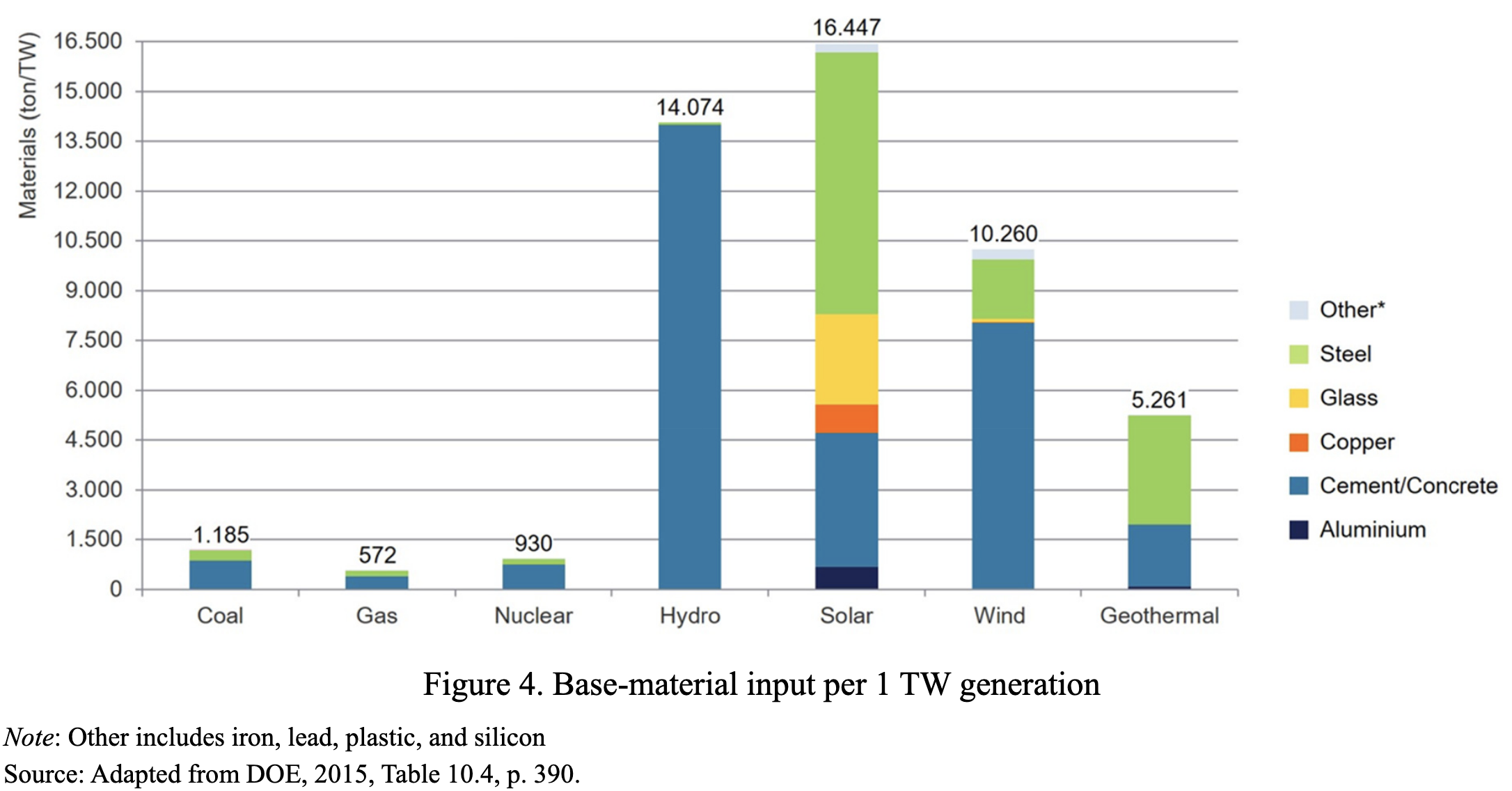
The “good” energy sources are hella taxing on material resources. From https://ccsenet.org/journal/index.php/jms/article/view/0/47241.
7. Space Fantasy
Space colonization is an infantile fantasy that is not part of our future. Provocative wording, for sure, but to me reminiscent of the Mormon idea that the especially devout would inherit their own planet in the afterlife. If you subscribe to the space-faring hope, ask yourself how deeply you understand the challenges: the scale, energetic requirements, the paucity of resources important to sustaining life, the indifferent hostility and isolated unsurvivability of non-earth environments. Mount Everest and the ocean floor are orders-of-magnitude more habitable than any non-terrestrial setting in the solar system: much easier to access and nearer to restaurants. Yet we do not see condominiums in those locations, do we? Nor do we expect to—because it’s obviously silly, just like space colonization. A recent analysis I participated in suggests that one of the fastest ways to destroy Earth would be to consume the unfathomably large amount of resources that leaving the planet would require. So if you are attracted to the notion that leaving the planet is the best way to save it from ourselves, think again!
8. Limits to Growth
Growth is destined to end: we have hitched ourselves to a losing wagon. This one should be easy: exponentials don’t survive long-term in finite settings. Do the Math began on this concept, and I still find the need to make the point. It’s surprisingly controversial, so something very strange is going on in the cultural teachings. Since so many of our institutions are designed around the expectation of growth, our faith in its continuance puts us in danger. Also, it’s this growth train that creates the many hockey stick curves, which spells doom for ecosystems even without any consideration of CO2.
9. Money Sucks
Monetary valuations badly miss the mark by orders-of-magnitude, so that decisions based on money (i.e., most societal decisions) will be bad ones. Two ways to demonstrate this: 1) Estimate the monetary value of a planet—even without considering the billion-plus-year investment evolution has made in forming a complex biopshere—and we learn that the annual global monetary scale is about six orders-of-magnitude smaller than the value of a barren planet. 2) Animals are worth more than their weight in gold, which suggests that a chicken is worth $60,000, not $5. Both approaches are flawed, but at least hint at how grotesquely distorted our financial approach to everything is. We place essentially no value on stuff that is priceless and that we could not live without. How is that a good idea? Because we base most big decisions on financial considerations, we grossly neglect the important things, and will continue to make devastatingly bad decisions for the long term by continuing this deeply immoral practice.
10. Malthus: That Optimist!
Malthus was wrong only in his optimism that population will saturate and stabilize. Thomas Malthus worried that finite land (from which all energy derived via captured sunlight prior to the exploitation of fossil fuels) would translate to a cessation of population growth once saturated. His prediction of when that would happen missed the mark by perhaps a few centuries due to the unforeseen arrival of fossil fuels onto the scene. Economists use “Malthusian” as a derogatory synonym for “wrong,” and bludgeon any similar-sounding suggestion about future limits by employing an expression of (blind) faith that something else as transformational as fossil fuels will surely always come along in time to obviate the concern. The ironic problem here is that the reason Malthus was “wrong” (fossil fuels) will also make him wrong about saturating population at some presumably steady-state peak. The connection is overshoot. What did we do with our fossil fuel bonanza? We exploded population by revolutionizing agriculture. Now when fossil fuels inevitably (and soon?) decline, we’re left with an overhang that can no longer be supported. The resulting population decline will suddenly cast Malthus in a new light: oh what a starry-eyed soothe-sayer! When that day comes, take a lesson from point #2 and realize that it’s no more tragic than the ant colony waning as it must.
Escape the Cult?
If you can see at least glimmers that our civilization has placed us in a precarious predicament and filled our heads with dubious axioms, then I am heartened. This is where I see hope: that we can slough off this cult(ure) and adopt a new start that respects things of real lasting value. Walk away. Where will you go? It’s scary to leave a cult: most don’t or can’t. I haven’t completely left either: I’m just aware that we need to. I may never be free from it as an individual, and neither might you be. But we might recognize our big mistake and prepare future generations in a way that does not fill their heads with damaging notions. Like the dying Darth Vader, it may be too late for us. But perhaps we can help destroy the belief system that would otherwise bind us and countless other species to an unfortunate fate.
Teaser photo credit: From Pixabay/KELLEPICS





Comments
Welcome to the new Resillience commenting system!
We have moved from the former Disqus commenting system to a new system as of September 10, 2026.
We made this change because of privacy concerns regarding Disqus. It's also part of a set of changes to bring more services to the Resilience community under a single login: commenting, (coming September 2026), and online courses (coming 2027). Unfortunately, your old Disqus comments may not reliably link to your account in this new system. Please contact us if you have any questions or concerns.
Well said but I do have some questions. I work a lot with the Amish and really like what they have done. They have a wonderful community and help one another. The kids grow up learning that work is good and helping in the community is worthwhile. It is very difficult for the Amish to work in our society with computers, cell phones and internet unavailable for them.With the shortage of land around here many of the Amish have set up things like cabinet making, saw mills, etc. Life is not perfect but I do admire their way of life. I too use horses to farm along with a tractor too. If there is a future I think the Amish here have a wonderful start.
Yet another great column Tom. Some thoughts about your 10 points
1. Evolution has no plan, no intentions, and if an elephant could talk, she might say that the goal was to create a trunk as fine as her kind have, able to do everything from picking up peanuts to smashing trees down
2 Not sacred…well as an atheist I couldn’t agree more, but in this bizarre USA CULTure, atheists are greatly outnumbered
3 I’ll be sad when our one-time only fossil-fueled civilization ends, the flying to other continents, dancing at rock-n-roll concerts, movies, books…but if we crash, let it be back to hunter gatherers when we were all equal. OK, this is a bit of a rant, but here is WHY I hope we go back to the far more ecological lifestyle of hunting gathering:
Since agriculture began, women have been increasingly second class citizens, unpaid slaves doing the worst work. It is a myth that Man The Hunter was the main Prime Mover of our large brains. Hrdy and others posit that it was probably women, who provided 80% of food on average from gathering since men were often unsuccessful hunting. Women were the first to invent tools, but nets and digging tools have composted so no evidence was found by archeologists. But women must have had woven nets to haul back their fruit, vegetables, snails, grubs, nuts and more as well as one to tie their baby to their back. And they had fire-honed digging sticks to dig up tubers and other tools as well. Meanwhile the men were often not around and often not lucky in hunting. The women and children in the camp developed strong social ties, taught children, helped each other out, and were the main driver of our eusociality and language abilities. Think about it – conversations at camp about schedules, teaching skills, singing, playing games, emotions versus “hey bob you go left and I’ll go right to get the deer”. This is how we probably lived from the dawn of humanity 300,000 years ago until agriculture came along. But until Hrdy and other women evolutionists, anthropologists, archeologists etc came along, it was mainly male humans studying male animals.
In the book “Who cooked the last supper” on today’s major religions (Judaism, Christianity, Muslim, Confucianism, Buddhism, etc) the author cites religious texts that show all of them are misogynist, curse and degrade women, and state that men have the right to dominate and control women, who must obey their husbands at all times. So in most nations for most of history women couldn’t own property, were married off to old men from 8 to 12, did most the boring work plus childcare and cooking. Never learned to read or write. couldn’t vote. Couldn’t get the most interesting, best paying work in crafts or government. Women were prisoners in their homes, so not being able to work with other women, couldn’t organize, form political groups, create female goddesses and culture to counter the patriarchies they suffered from. Team up like bonobo females to prevent male violence against them. Basically after agriculture, women’s culture was smashed out of existence. Women became second class citizens, unpaid house slaves. Except for the richest women who might become queens and have other accomplishments. But that didn’t change the fate of womankind in general.Even male slaves might earn their freedom, but women were always at the bottom, with a few exceptions, like when the plague killed so many people in the Middle Ages that women could be in guilds and earn lots of money doing interesting work to reach their full potential, but that didn’t last. Likewise WWII when Rosie the Riveter and other great well-paying jobs came along briefly for women, who did not want to go back home after the war. Sadly, what progress was made in the 20th century is about to be lost after collapse.
If we’ve messed up the world as much as I think, I hope it forces us back to hunter gatherers again, a much more interesting lifestyle than farming, much less destructive of ecosystems as well. And women should make a point of burning bibles, Korans, and other religious texts to keep from being under the thumb of patriarchies ever again… Sorry for the rant…
6 From “Life after fossil fuels: a reality check on alternative energy”:
Let China monopolize the second most polluting industry on earth. Mining spews out acid rain, wastewater, and heavy metals onto land, water, and air (PEBI 2016). One-fifth of China’s arable land is polluted from mining and industry (BBC 2014). Mining the materials needed for renewable energy potentially affects 50 million square kilometers, 37% of Earth’s land (minus Antarctica), with a third of this land overlapping key biodiversity areas, wilderness, or protected areas. If mined, that would drive biodiversity loss, harm (rain) forests, and poison ecosystems (Kleijn et al. 2011; Hickel 2019; Sonter et al. 2020).Renewable energy is anything but clean and green. And quite a Pyrrhic victory for China!
7 In my post at energyskeptic “Escape to Mars after we’ve trashed the earth?” I cite Ugo Bardi, who says why go to another planet? We’ve exploited Earth so ruthlessly that we’ve already changed our planet into another world.
Anyone on Mars surface will get doses of radiation 900 times higher than on Earth (Viúdez-Moreiras 2021). I don’t know about you, but I doubt I could carry a 3-foot thick lead umbrella around for long.
Go to Mars? Really? Been there, done that on Earth, and it didn’t work out: Biosphere 2
And more…
8 Your hockey stick curves post was one of the best you or anyone else has ever written, genius
9 Libertarian capitalists think that money, not energy, makes the world go round, solves all problems, and with 8 billion brains there are no problems without solutions. In fact, nations with shrinking populations are doomed, just grow the economy to solve all problems! Which reminds me of a couple of economist jokes: Three economists go hiking in the woods. They get lost. It starts to get dark. They are hungry. The wind begins to freeze them. But they aren’t worried. Why? Because as economists, they know that their demand will somehow produce sandwiches, down jackets and flashlights. And how many economists does it take to change a light bulb? None. If it really needed changing, market forces would have caused it to happen.
10 Yep, natural gas fertilizers and the “green revolution”.
Concrete can be replaced with Hempcrete:
https://en.m.wikipedia.org/wiki/Hempcrete
During the past year I have read five volumes of Toynbee’s Study and am now reading Mumford’s City in History concurrently with another book by Moscati; The Face of the Ancient Orient. Civilization has been on my mind, as well as its failures. This article seems to recognize human civilization as a 10,000 year continuous sequence, when historians recognize many civilizations have come and gone during this time frame. Perhaps this a result of the cult of hubris so prevalent with humankind (1, 2, 3 and 4.)
A couple more comments to these theses: No civilization has ever existed that exhibited the sacredness of human life. Historically, civilizations prepared for paradise in the afterlife. Toynbee recognized the discovery of fire and the wheel as greater than any industrial ones. Leaving Earth for Space is the ultimate form of political nihilism. Valuation is the result of markets, whose virtues are exploitation of unrecognized value, resulting in destruction of infinitely more valuable assets. Overshoot is a good observation about how the fall of Western Civilization will be remembered as a catastrophe of unimaginable magnitude if anyone is around to record it.
So I got ready for ten challenging statements–and along came ten obvious truisms. The only ones that made me bristle a bit were #2–but in my defense, if you asked a wolf might it not say that the death of a wolf matters more than the death of a bear, and otter, or a human?–and while I agree that there is no sustainable way out of our overshoot that preserves our current way of life, the chart made it look like solar and wind are much worse ecologically than oil, coal or nuclear, which I don’t believe for a minute.
The first two points are not the same as the rest; they depend on philosophical outlook rather than empirical scientific observations.
Personally, I strongly disagree with the second point. The reason that I’m motivated to build a better and more sustainable future for the human race is because I hold that humanity is sacred, both collectively and individually. That doesn’t mean, of course, that I don’t think the rest of the world is also sacred! I think we are the sacred caretakers of a sacred planet, and have to take our responsibilities seriously. (Even if only because we’re the one species that can look out for the interests of other species. We haven’t done a good job of this yet, but we are theoretically capable of it, unlike wolves, aphids, or elephants.)
No, cannot disagree with any of the 10 points though must admit I had not realised, as per point 6, quite how hungry for materials such as cement and steel all renewables are. “We’re doomed!” as Private Frazer would say (character in ‘Dad’s Army,’ British TV comedy).
We evolved on this planet thanks to the many other creatures which have inhabited it. Even now, we are totally dependent on numerous other species, and without them we would not survive. Biologists are just now beginning to focus on the importance of all this interdependence .
The one thing that technology has provided has been a certain amount of physical comfort–which allowed humans to survive in places that didn’t really want them.. But as for quality of life, I strongly suspect that at this point in history the over-all quality of lives of people are no better than they ever have been–and may be worse–despite the technological advances. Just because things have changed, doesn’t mean that it denotes progress. Just because we can do things doesn’t mean we should. In addition, culture is part of what we are and how we survive, and that too, is a wild card. Without wisdom, awe, and humility, and recognition of our the enormity of all we can never know, humans are no better than than any other species.