

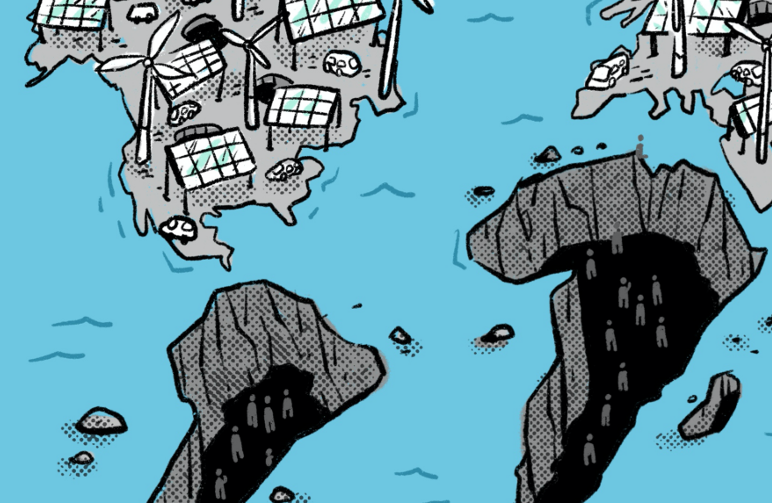
It’s clear that we need to decarbonize our economy as quickly as possible in order to avoid the worst of climate change — but carbon isn’t the only problem we’re facing. As the world moves towards renewables and away from fossil fuels as an energy source, we can’t forget that the technology and minerals behind this green transition need to come from somewhere — and that somewhere is primarily countries in the Global South.
The supply chains which carry the lithium, copper, cobalt, and other minerals essential for renewable technology from the peripheries to the imperial cores — from places like Chile and Bolivia to places like the United States and Europe — are built upon a foundation of colonialism, imperialism, hyper-exploitation, and ecocide: all essential components of our current economic system — capitalism.
In part one of this two-part series on the green transition, Upstream explores what happens when we simply paint capitalism green without addressing its fundamental global operating principles and processes. What is the dark side of the energy transition — particularly for the Global South and Indigenous communities?
In part two they will dive deeper into some solutions, but in this episode, Upstream starts their journey in the Atacama desert of Chile and ends all the way in the Arctic Circle, exploring the global extractive machine and the communities that exist on its frontiers.
You can listen to the full Upstream Documentary below to dive deeper into this topic.
Featured guests:
- Max Ajl — Associated researcher with the Tunisian Observatory for Food Sovereignty and the Environment, postdoctoral fellow with the Rural Sociology Group at Wageningen University, author of A People’s Green New Deal
- Ana Julia Aneise — Youth climate activist with Youth for Climate
- Sergio Chaparro — Colombian human rights activist and researcher.
- Jason Hickel — Economic anthropologist and author of Less is More: How Degrowth Will Save the World
- Beaska Niillas — Northern Sámi traditional handicrafter, hunter and gatherer, activist, Sámi school kindergarten teacher, politician, and the host of the SuperSápmi Podcast
- Thea Riofrancos — Associate professor of political science at Providence College and co-author of A Planet To Win: Why We Need a Green New Deal
- Matthias Schmelzer — Economic historian at the University of Vienna and co-author of The Future is Degrowth: A Guide to a World Beyond Capitalism
A full transcript of the episode is available for your viewing pleasure here.
This article originally appeared on Shareable.net
Teaser photo credit: Bethan Mure/Shareable



Comments
We changed commenting systems on September 10, 2026 as part of a site-wide functionality and security upgrade. Your past comments have not disappeared, and you can still log in with your old Disqus account credentials if you wish. Contact us with any questions.
“The supply chains which carry the lithium, copper, cobalt, and other minerals essential for renewable technology from the peripheries to the imperial cores — from places like Chile and Bolivia to places like the United States and Europe….”
Aren’t these minerals used primarily to manufacture electric cars? And aren’t electric cars, at best, only marginally less carbon intensive when we evaluate them in life-cycle assessment terms? It makes no sense to me to call an electric car part of a ‘renewable’ technology system.
Life-cycle assessment: https://en.wikipedia.org/wiki/Life-cycle_assessment
Lots of folks don’t know this, but there is really no such thing as a “renewable resource” — or renewable technology. That’s because anything we’d call a ‘resource’ can only be ‘renewable’ within use constraints — e.g., fish and wood. If you extract essentially all of the fish from the ocean the ocean ecosystem collapses. If you cut down all of the forests the forests are destroyed. So it’s not the ‘resources’ which can be renewable, but the practices. There are renewable practices, but not renewable resources. A renewable practice is the practice of keeping resource use well below collapse trajectory. None of this stuff is talked about by the general public, and the general public is widely ignorant about it. They are being told utter nonsense, and they tend to believe it.