

A friend sent me a link to this video interview of Michael Raw, an agricultural consultant, about the fragility of Britain’s food supply, which frankly shocked me. The “four meals from anarchy” is a quote to MI5, meaning that Britain could descend very rapidly indeed to large-scale disorder, including looting and rioting in the event of a catastrophe that stops the supply of food.
The UK’s food policy substantially presumes that foreign countries will continue to send us shiploads of food, and currently over half of what is consumed here is imported. This is perilous indeed, especially at a time when many nations are adopting their own protectionist policies, restricting food exports so to feed their own people. Should supply shortages occur, currently high food prices will escalate further still. For example, at an undersupply of 3% a 12% food price increase is expected, at 5% this rises to 20%, while at 10%, food prices would probably double.The implementation of rationing cannot be ruled out, as happened during WWII, although this actually continued until 1954, when the “housewife” had to spend 30-50% of her budget on food. [Now, the food shopping costs more like 8-10% of a household’s total income, whoever actually goes out to buy it, the difference being used in other areas for discretionary spending and overall growth of the economy]. Despite the immense debt borne from the war, the UK government subsidised the nation’s farmers, which guaranteed oversupply, and meant that although prices did increase, the gradient remained within manageable limits, unlike the 21% increase that has occurred in only the past 12 months.
Even though farmers have been calling for food security for a number of years, this has had little effect. Raw avers that a time is very likely at hand when supermarkets will experience massive queues, but merely to get inside the buildings, since with their shelves empty there will be no one waiting in line at the cash tills.
Soaring costs of fertilizers might be taken as an indicator of what is likely to happen to food prices. Thus, a tonne of what is essentially ammonium nitrate, sold at £180 in the autumn (£220 in the spring) of 2020, then increased to £350 in spring 2021, and is now trading at £650, with quotes for spring 2023, i.e. for next year’s harvest, at £1,000 a tonne. So, a farmer who was paying £20,000 for his/her fertilizer in 2020, can expect to shell out £100,000 next year. This is a disastrous situation for many farmers, who could not even borrow this much from the bank, given the huge overall financial loss that this represents.
As a way around the fertilizer problem, some farmers in the South/East of the UK, whose land is intrinsically well supplied with phosphate and potash, have switched to growing leguminous crops, such as red clover and field beans as animal fodder, which naturally fix nitrogen, and so do not need the application of increasingly unaffordable artificial nitrogen fertilizers. Not all farmers are so fortunate, and need to buy and apply phosphate and potash; however, since 33% of the world’s potash comes from Russia-Ukraine, a serious supply shortage seems likely for the foreseeable future.
Hence the availability and price of fertilizers will determine the crops that farmers are able to grow over, say, the next five years. There is much more in this interview, which is excellent, and the interviewer remarks appositely that “we should be making a documentary talk show, but this is actually a horror film…” Raw makes the point that rather than rewilding, more of the available land should be used for food production, although this would cost money, which we don’t have. However, this was exactly the situation during 1945-1954 when the government supported its agriculture, obviously finding the money from somewhere. Controlling exports and securing imports, with farmers producing more food are identified as critical factors, but what can people do individually to make sure they have enough food?
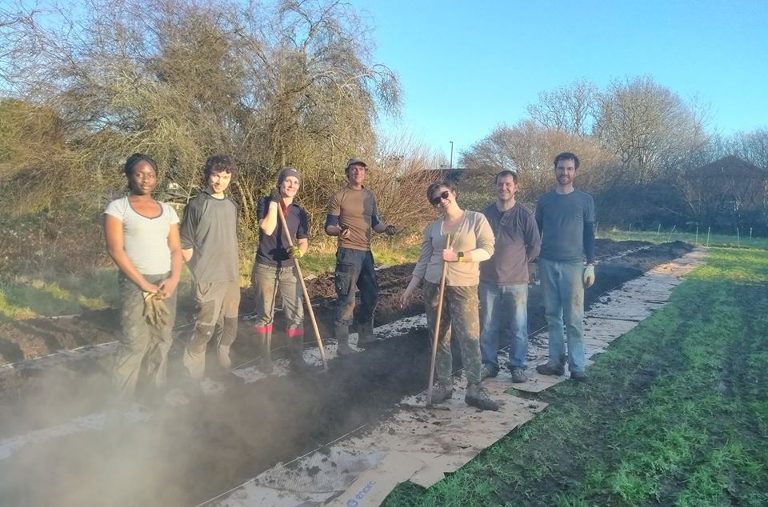
Raw agrees that having a chest freezer is not a bad idea, but stresses the importance of growing your own food, and says that 50% of his family’s food comes from an allotment and some raised beds in the back garden, which they use to stock their freezer. He says that having an allotment ought to be a public right, and we could see legislation go through parliament, which would enact upon parish, district and county councils, so that anyone wanting an allotment can get one in three months, rather than going onto a six year waiting list. This would necessitate a compulsory leasing (not compulsory purchasing), and it should be a public right to be given access to a piece of land to feed your family.
Elsewhere, it has been estimated that 40% of the UK’s fruit and veg (most of which is imported) could be grown in gardens, along with some of the “spare” land in parks, playing fields, watersides and other urban green spaces that are currently overlooked. At a time when allotment provision across the country is vastly oversubscribed, taking a broader view of such neglected sites could rapidly increase the possibilities for local food production. Some changes in our diet would be necessary, to substitute fruits and vegetables that grow well over here, for those currently imported that are not suited to the British climate.
The pandemic and Brexit have provided a taster of how vulnerable our food system is to import supply shocks. Farmland in the UK is already under pressure, not only for agriculture, but from urbanisation and demand for new homes; however, a two year pilot study indicates that urban plots can be as productive as conventional farms. Brownfield sites should not be overlooked either for food growing, by using raised beds to get around problems of soil contamination.
Providing sufficient access to affordable food for its population is an underpinning prerequisite for any properly functioning society, and given the clear risks posed by the UK’s current heavy reliance on imports, far more domestic – particularly locally based – food production must be established as a matter of urgency, i.e. before people begin to go hungry.
Teaser photo credit: Sims Hill Shared Harvest community-supported agriculture project.



Comments
We changed commenting systems on September 10, 2026 as part of a site-wide functionality and security upgrade. Your past comments have not disappeared, and you can still log in with your old Disqus account credentials if you wish. Contact us with any questions.
Comment from Jonas. I’m posting it for him since he doesn’t have a Disqus account. I think he makes a valid point. Even though “anarchy” is often used as a synonym for chaos, it unfairly characterizes the long tradition of anarchism.
– Bart
—————————–
This is about the article by Chris Rhodes with the phrase “Four meals from anarchy” in the
title…. I think he is not thinking about that we are four meals away from selforganizing
and mutual aid? Two suggestions for alternative titles that is probably more in line with what he means: “Four meals from chaos” or “Four meals from collapse”
—————————–
I’m just quoting the phrase coined by the British intelligence agency, MI5 (mentioned in the link), “Four Meals Away From Anarchy”, in regard to a catastrophe that interrupts food supplies (or some other major breakdown in infrastructure) but agree with both Bart and Jonas, and that “chaos” or “collapse” are more accurate. Thanks for the feedback.
Appreciate your response, Chris!
More from Jonas:
David Graeber wrote a short introductury text about anarchism that tends to pop up whenever I see/hear something that equals anarchy with chaos. Heres an excerpt from the beginning of it:
“Many people seem to think that anarchists are proponents of violence, chaos, and destruction, that they are against all forms of order and organization, or that they are crazed nihilists who just want to blow everything up. In reality, nothing could be further from the truth. Anarchists are simply people who believe human beings are capable of behaving in a reasonable fashion without having to be forced to. It is really a very simple notion”
Heres the text:
https://theanarchistlibrary.org/library/david-graeber-are-you-an-anarchist-the-answer-may-surprise-you