

At the beginning of nearly every war including the current one in Ukraine, there are those who loudly declare that it will be over shortly and then business-as-usual can resume. They are rarely right. While no one can say for certain what the trajectory of the Russian-Ukrainian conflict will be, the economic warfare that is going on alongside it is very likely to destroy the current global trading system.
The last time a worldwide trading system was destroyed was just over a century ago. From the late 1800s up to the eve of World War I the dominance of the British fleet on the high seas and the reach of the British Empire created an era of stability and interconnection highly favorable to worldwide trade.
Then, World War I blew that stability and interconnection apart. Later, the Great Depression led to a global trade war that finished off the remnants of the international trading system. The world did not achieve a trading system that spanned the globe unhampered again until the end of the Cold War—which had split the world into two trading blocks for nearly 50 years.
[slide-anything id=’3472166′]
It is unlikely that Russia will simply back down even in the face of crippling economic sanctions. Things have gone too far and the Russian leadership has staked too much on its position that Russia must have its own sphere of influence free from NATO soldiers and rockets. What the Russians have historically called “the near abroad” must not harbor threats to Russian security, they say. Think of this as Russia’s Monroe Doctrine.
The sanctions against Russia are hard to keep track of, ambiguous and ever expanding. Their consequences, however, are clear. Through pressure exerted by the United States and European countries, most of the world will be forced to curtail its trade with Russia sharply.
Russia, however, has potent trade weapons of its own since the country remains the second largest producer of both oil and natural gas in the world behind the United States according the U.S. Energy Information Administration. Russia is, however, the world’s largest natural gas exporter and the second or third largest oil exporter depending on where you look. Europeans are especially dependent on these exports. One would expect any reduction of Russian exports to cause prices to soar. This is exactly what has happen since the war began, complicating Russian deliveries—even though these exports are NOT under sanction and Russia actually INCREASED natural gas exports to Europe.
Russia is also among the top two producers of palladium used most notably in catalytic convertors and also in electronics. The same goes for platinum. In fact, Russian is a significant producer of many metals including nickel, cobalt, uranium, gold, silver, lead, zinc, and iron. A quick look at the “Mining Industry of Russia” page on Wikipedia illustrates just how important Russian production of minerals is in world markets.
One of the key exports Russia is considering withholding is potash fertilizer, something that would surely drive potash prices sky high and, in turn, drive food prices even higher than they already are. Russia is the world’s fourth largest producer.
Any decision by Russia to withhold commodity exports from the world market would have to be carefully callibrated since such move would, of course, further pummel the Russian economy by reducing or eliminating export earnings from the targeted products.
In yet another blow to the Russian economy, foreign businesses are leaving Russia at an increasing pace. Once gone, it is hard to see them returning anytime soon. And, with Russian assets abroad frozen and in some cases being seized, there is fear that Russia will seize assets within its borders belonging to foreign companies and individuals. Foreign patents might also be disregarded to allow Russia to make some its own goods based on patented technology and designs.
Some Russian banks have been excluded from the world’s largest international payments system known as SWIFT which might just push Russia to form its own payment system along with other countries suffering from sanctions such as Iran, Cuba, North Korea and Syria. Don’t be surprised if additional countries including China decide to join—while remaining in SWIFT—in order to continue to trade with these countries including Russia.
Given the ferocity of the response to Russia’s invasion of Ukraine, it is just as hard to imagine a full-scale retreat from sanctions under practically any likely long-term scenario as it is to imagine Russia withdrawing from Ukraine and saying that it is sorry; it was all just a big misunderstanding. And, there is always the possibility that a guerilla insurgency will continue in Ukraine for years to come so that there is no clear end to hostilities.
The result of sanctions and war so far has been to cause prices of practically every commodity to rise significantly, most notably wheat, which is up 50 percent since before the war. (Russia and Ukraine are the number one and number five exporters in the world respectively.) Oil which was already trading at an elevated level is now comfortably above $110 per barrel, up about 25 percent from the start of the war.
Spikes in oil prices have preceded 10 of the last 11 recessions (not including the COVID collapse). It seems likely, though, that a recession following this spike will not be a mild one given the dislocations in the world economy already and the determination of each side in the conflict to exert increasing economic pain on the other. And, we must also remember that oil and wheat prices are not the only ones going up rapidly. Food prices in general are soaring as are fiber prices (lumber and cotton, for example). Rising energy prices, of course, feed into practically every other good and service. Eventually, high prices undermine economic activity as buyers simply stop buying what they cannot afford.
If the next recession is deep and drawn out, as I believe it might be, it may hasten the breakup of current trading arrangements as people around the world seek to protect their home industries from those abroad by restricting trade even further (just as countries did during the Great Depression).
The Russians sought to reorganize the security framework in Europe by making sure Ukraine does not join an alliance hostile to Russia. In the bargain, the Russians may get a reorganization of the world trading system, one that may break up into relatively closed trading blocks with more and more emphasis on self-sufficiency as a prudent bulwark against unexpected disruptions including wars.
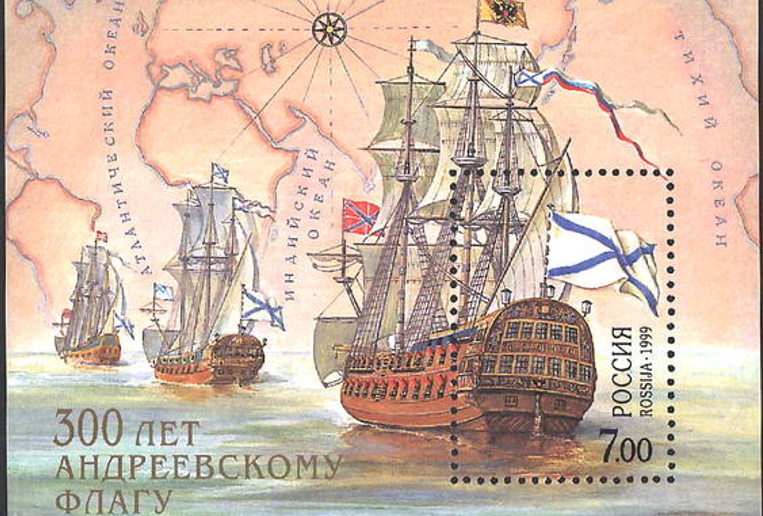
Image: Russian stamps. The 300th anniversary of the Russian Navy flag. 1999. Designer: A. Fedulov. Via Wikimedia Commons https://commons.wikimedia.org/wiki/File:Stamp_of_Russia._300_years_of_Russian_Navy_Flag.jpg




Comments
Strikes me that prices on fossil fuels soaring is a good thing, and environmentalists and greens (faux or otherwise) would be applauding the exact mechanism needed in the consuming world to curtail the use of those nasty liquid and gaseous fossil fuels. So while some might bemoan for the poor Russians and how sanctions might effect them, those worried about the planet should be applauding and trying to figure out other means (perhaps involving fewer bombardment of negotiated civilian escape corridors) to keep all those nasty liquid and gaseous fossil fuels from EVER coming back.
If anyone had bothered to read and act after the “end of growth” then we would be much better off. I read about it and made the decision to become self sufficient and owning a small farm.We have various sources of energy including our four draft horses who do most of the field work and hauling of wood for our wood stove. We grow all of our own food as well as the food for the animals and work diligently on improving the soil health on our farm. WE have very few expenses now with no debts. Was it hard? yes it was but now we are benefiting from our hard work. The only unfortunate things is that we are getting older and not quite sure how to continue the farm if life becomes difficult.
Thoughtful piece. Yes, this may be THE turning. Or not; but it’s coming, nothing surer.
Those of us who have prepped, not because we were withdrawing but because we saw the inevitable coming – we may be swept away. As Chris Clugston wrote in Blip, others who have neither had to foresight nor have the skills, will probably overpower us.
But is was the rightest move we could make. Fostering local contacts is important too – particularly if finance implodes. The change could be very swift.
I’m painfully disappointed to see the Russian line about NATO and “spheres of influence” being repeated here. It’s tiresome. Russia’s desire for lebensraum is just that. NATO isn’t some imperialistic project, it’s a defensive alliance you have to apply to join.
I don’t believe this article took the “Russian line”, one could sum up the expansion of NATO under Clinton and Bush presidencies with similar words. A review of NATO expansion during the Clinton presidency, https://www.wilsoncenter.org/blog-post/new-sources-nato-enlargement-clinton-presidential-library seems clear that Yeltsin wanted Russia to maintain its importance as a great nation if it cooperated with NATO, and Clinton saw the expansion as a way to disarm such plans. Expansion under George W. Bush was reckless and disregarded Putin’s position. It’s clear that Putin is more ambitious than Yeltsin and he wants to recreate a Russian Empire. He has said that nothing NATO can do other than meet his demands to drop members accepted since 2000 will be acceptable. Putin is playing a very dangerous game of geopolitical ‘chicken’. Some may think we could have handled NATO expansion better. Some think there is nothing that would have ever appeased Putin. History supports both views IMO.
The gloom descending upon the world with the reification of 20th century ethnic national violence in Eastern Europe should be celebrated by degrowth doomers. Higher gas prices should reduce consumption. The potential end of dollar hegemony due to new currency transfer schemes already developed to avoid SWIFT means the end of American full spectrum global dominance. An end to the American war machine. Perhaps an end to the capitalist rapine of natural resources. This boiling over of aggression created by America’s blind ambition to bring Russia into the orbit of capitalist finance reveals all the contradictions and horrors of a world trading system based on the values of a free market society. The challenge to nonaligned nations is finally, hopefully, producing a response that will lead to the a real transformation of how humans and their societies learn to live within the limits of what the Earth provides and end the 20th century scourge of nationalist supremacy.