

Earth scientist David Hughes—who is out with a new skeptical report on the future of U.S. shale oil and gas—has two very important things in common with Michael Burry. Burry is the investor made famous by The Big Short, the book that was later turned into a movie of the same name about the 2008 housing crash.
Both men made calls that contradicted an almost unanimous consensus, and both did so after dogged, painstaking research.
First, let’s look at the latest from Hughes, an update on the U.S. shale oil and gas industry entitled “Shale Reality Check 2021.” Then, we’ll return to his previous prescient call.
“Shale Reality Check 2021” seriously undermines rosy long-term forecasts made by the U.S. Energy Information Administration (EIA) for U.S. oil and natural gas from shale deposits. This matters because the EIA’s forecasts are counting on shale for 69 percent of all U.S. oil production from 2020 to 2050 and 77 percent of all U.S. natural gas production in the same period. And, it matters to the world because between 2008 and 2018, growth in U.S. oil production accounted for 73 percent of the entire growth in global supplies. (Oil from shale deposits is properly known as “tight oil,” a type of oil also found in other kinds of rock. Natural gas from shale deposits is typically referred to as “shale gas.”)
Hughes’ conclusions are based on commercially available drilling and production data. Here are his overall findings:
-
- Of the 13 major plays he evaluated, Hughes rates the EIA’s production forecast for five as “moderately optimistic,” five as “highly optimistic,” and three as “extremely optimistic.” The EIA forecast for the Wolfcamp Play, the largest tight oil play, is rated as “highly optimistic.” The forecast for the Marcellus Play, the largest shale gas play, is rated as “moderately optimistic.”
-
- Future production will likely be much lower than the EIA projects—particularly in the latter part of the 2020 to 2050 period as sweet spots responsible for most of today’s production become saturated with wells.
- U.S. energy policy and planning in such key industries as transportation, utilities and chemicals are based on the EIA’s excessively optimistic forecasts. Since oil and gas constitute 71 percent of the current U.S. energy supply, if future oil and gas production disappoints, as Hughes expects, look for serious problems.
Hughes’ prescient call
So, why should we pay attention to Hughes’ latest take on U.S. tight oil and shale gas?
We should because in a move similar to Michael Burry’s prescient call prior to the housing crash, Hughes released a damning and prescient analysis of the Monterey Shale. The Monterey Shale is an underground formation in California that the EIA touted as containing 15.4 billion barrels of recoverable oil. Hughes wrote that the EIA’s estimate was likely to be “highly overstated” for reasons he detailed in a 2013 report.
The following year the EIA stunned the industry, investors and California officials with a 96 percent reduction in estimated tight oil resources for Monterey—a virtual wipeout. Prior to the downgrade Monterey comprised 60 percent of all U.S. tight oil resources.
So, how did Michael Burry and David Hughes both achieve such prescient calls? It turns out that they simply bothered to look.
Burry looked at thousands of individual mortgages tucked inside mortgage bonds. He came to the conclusion that a large portion of those mortgages were poor quality and would default in a housing downturn, something he expected was coming. Burry subsequently shorted the bonds and made a fortune.
[slide-anything id=’3472166′]
Hughes—who assessed Canada’s coal and unconventional natural gas resources during his previous 32-year tenure at the Geological Survey of Canada—analyzed data for thousands of individual tight oil and shale gas wells to see how the U.S. industry has actually been doing. The story his analysis generated in 2013 and the trends it is revealing today tell a far different tale than the one the industry and the government are communicating to the public.
Greatly overestimated
So, why does Hughes believe the EIA has greatly overestimated recoverable U.S. tight oil and shale gas resources? Let us count the reasons:
1. Highly productive “sweet spots” are a small proportion of what are often depicted as very large plays. In his report, Hughes plots existing well locations and looks at initial production rates from those wells, rates which foretell ultimate recovery totals. The geographic concentration of wells with high initial production rates clearly demonstrates that typically only 20 percent or less of the various shale plays comprises the “core areas” or “sweet spots.” Outside those core areas, production rates and recoveries are substantially lower.
In its forecast the EIA makes an estimate of average recovery per well over the entire play or in some cases over broad subareas within a play. In response to emailed questions Hughes wrote, “Assuming that all wells will produce the same over broad areas, as the EIA does, does not reflect the actual geology of typical plays.”
2. Worsening geology ultimately trumps technology. The average oil and gas production rate for new wells has begun to fall in all or parts of several shale plays. Hughes said that “eventually average new well productivity falls in all plays even with better technology as all the well locations in ‘sweet spots’ have been drilled and new wells are moving into poorer quality geology.”
This is a key point. New technologies are not overcoming “poorer quality geology” and the challenge will become steadily greater as drilling moves into progressively lower quality areas of the various plays. At some point the industry will give up. Hughes noted, “Industry has no interest in drilling low quality rock and is very good at avoiding doing this or they go bankrupt.”
3. Wells can only be so close together. The density of wells is reaching the saturation level in many of the core areas. Adding wells will only cause well interference and reduce per well production without increasing ultimate recoveries.
Impressive gains in well productivity have come as a result of technology that allows one tight oil well to access three times the reservoir volume of a tight oil well drilled in 2012. One shale gas well can now access 2.2 times the reservoir volume of a shale gas well drilled in 2012. (These numbers were calculated for a previous report written by Hughes.)
However, as new wells drain a much larger area than wells drilled even a few years ago, those new wells require considerably greater spacing so they won’t interfere with one another. This dramatically reduces available drilling locations, something the EIA has not taken into account in its forecasts to date. In other words, the EIA should not be multiplying its current estimate of total possible well locations by recoveries from these newer wells without dramatically adjusting the number of well locations downward to account for the increased well spacing required.
The 2021 report states that “[a]lthough this [new technology] has increased well productivity and hence economics, it has reduced available drilling locations must faster, raising serious questions about the EIA’s forecasts for production through 2050 if not much sooner.”
4. The rate of technological improvement is slowing. The EIA believes that recovery technology will improve at the same rate it appears to have improved in the past. The agency fails to recognize that better technology cannot make up for deteriorating geology as new drilling moves outside of sweet spots.
Engineering and economic limits appear to have been reached for increased lateral lengths (horizontal extensions of wells) and volumes of injected water and proppant (specialized sand and additives that prop open fractures made by water injected into the reservoir and that thereby facilitate oil and gas flow—a process known as hydraulic fracturing or “fracking”). Observed gains in well productivity are now largely due to high-grading, the practice of exploiting the most productive areas of a reservoir first. Failure to recognize this practice mistakes exploitation of the most productive areas for technological progress.
5. High decline rates will inevitably overcome increased drilling rates and production will fall. As drilling moves out of sweet spots into progressively lower quality parts of the reservoir, well productivity declines. Assuming drilling locations are available, that means more new wells are required than before to offset a given amount of play decline. Eventually, new well productivity drops below the level that makes it profitable to drill new wells. Drilling stops and the play goes into terminal decline.
The 2021 update states: “The nature of tight oil and shale gas plays…is that they decline quickly, such that production from individual wells falls 75–90% in the first three years, and first-year play decline rates without new drilling typically range from 25–50% per year.”
The update later adds: “As sweet spots are exhausted, drilling will, of necessity, have to move into lower quality parts of plays, meaning higher prices will be required to break even. Drilling rates will also have to increase to maintain production, which will consume drillable locations faster….”
Same data, different conclusions
While the EIA and Hughes draw from the same data for their analyses, they come to very different conclusions. Hughes said the EIA “is somewhat political and good news sells, so they are typically very optimistic on long-term production.”
Hughes added, “[The EIA does] the American people no favors by putting out overly optimistic forecasts. Planning for future energy security requires the best possible estimates.”
To get a sense of what the future holds for U.S. tight oil and shale gas, Hughes suggested looking at the Barnett Shale in Texas where the shale revolution began.
He explained: “The Barnett Shale is where ‘fracking’ was developed by [George] Mitchell in the 1990s. It went through the full cycle—drilling off sweet spots, spreading out to poorer quality areas with decline in new well productivity to uneconomic levels, and a gradual fall in overall play production at terminal decline rates as very few new wells were being drilled. Production has declined 60 percent since the play peaked in 2011.”
Hughes thinks we are headed into a future foretold by the Barnett Shale much sooner than the EIA will admit and policymakers and the public realize. We are not ready for that future.
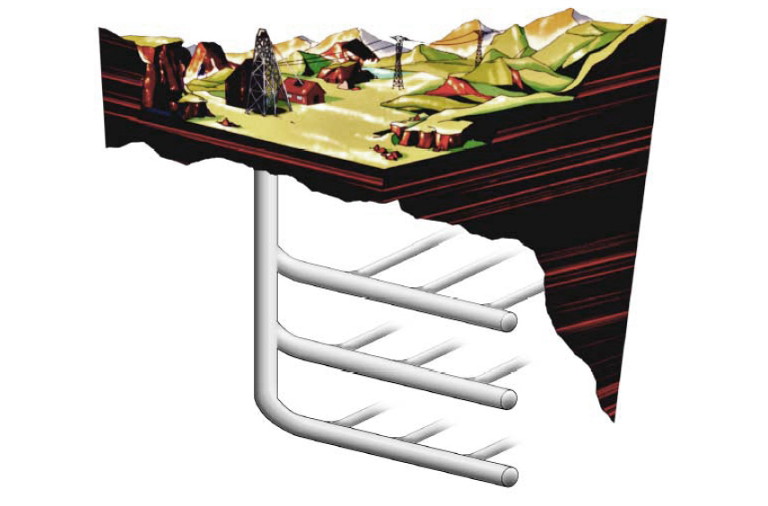
Image: Artist’s rendition of a shale oil extraction process using radio waves. Lawrence Livermore National Laboratory (2006). Via Wikimedia Commons https://commons.wikimedia.org/wiki/File:Oil_shale_radio_frequency_extraction.JPG





Comments
I would have liked this better if it had at least acknowledged that a report which is “optimistic” about how much oil or gas can be extracted is pessimistic about the harm inflicted on living things by the resulting climate change and other environmental damage.
“I would have liked this better if….”
Yeah, me too.
There are two very good reasons for our societies to be getting prepared for a vastly smaller use of fossil fuels, and net energy generally. One is environmental and ecological. The other is social and economic. But I see almost none of this preparation happening where I live, and this has me convinced that humans are collectively as stupid as a box of rocks.
COLLECTIVELY. Something I figured out long ago–that humans may be pretty smart as individuals but as a group we can’t make good decisions. This is partly because we are herd animals, and most of us, most of the time, go along with whatever we perceive those around us as doing, thinking, saying, condoning. And partly because a large-scale society offers the anonymity sociopaths needs to ascend to the top power positions–where they make decisions for us all, based on whatever enhances their own wealth and power.
Easy answer; be counter-cyclical. Do whatever they aren’t; bound to be righter. Scarily, it damn near works…..
You just made the best argument for the primacy of the individual over the group. Those who revere Durkheim would disagree. But sometimes the culture cannot adapt quickly while the individual can.
No. I think a whole lot of the problem is that our culture, particularly in the US, gives individuals way too much power and considers the common good way too little. Indigenous societies look at the common good, even in the case of some North American ones “seven generations” down the line. This is wisdom.
I agree mwildfire. There is an implicit belief in Kurt’s article that it is OK to extract and use the mineral oil and gas regardless of the impacts on the rest of Mankind. This said, I would forward the article on to others with the accompanying caveat about this belief.
I have just read and reread Richard’s article “Energy Reality for the USA”
and found it more dismal with every reading. Richard clearly shares Kurt’s belief. However his article is also framed with Energy Gobbledy-gook and Climate Blah Blah that undermines Dave Hughes’s essential conclusion: the Anglosphere is founded in a fatal delusion. So I could not forward on his article except as an exemplar of very unsustainable language.
Richard did wonderful work early this century in reminding us of the potency of mineral oil and that it is a finite substance. He did much to publicize Hubbert’s work but, for whatever reason, he framed it as “Peak Oil”. People like myself wrote to him and “The Post Carbon Institute” at the time explaining how and why this is unhelpful: no one can know how much fossilized biomass there is on Earth and the price of petrol has nothing to do with its value.
My suggestion was we can only say with some certainty, “The age of cheaply extracted mineral oil/gas is over, folks.”
“Cheaply extracted mineral oil/gas” is much more of a mouthful than “Peak Oil” but it spoke a more enduring truth.
Sure enough, in 2008 the Merchant Bankers exploited “Peak Oil” to provide a market rationale for hiking the price to $US147 a barrel, so generating a “financial crisis” to provide a market rationale for vast money printing, which they then poured into the Fracking delusion.
Here in New Zealand I watched as leading members of Parliament laughed and jeered when Green Party leaders spoke of “Peak Oil” after Richard’s lecture tour here in 2007. The ridicule of “Peak Oil Nutters” became even greater when prices were dropped to $US30 a barrel and US Fracking increased global supply to the rich.
A tragic result is that the money printing has resulted in crippling (officially “unseen”) inflation for all those on low, fixed incomes, especially for those dependent on burning cheaply extracted mineral oil while more New Zealand people are hopelessly addicted to wasteful, polluting uses of mineral oil.
Dave has very intentionally chosen to focus on the production question in these reports, but that doesn’t mean he isn’t deeply concerned about the environmental impacts or the squandered time/resources that should be allocated elsewhere. That’s a chief point in writing these reports.
Now why do you say I don’t man what I say? Because I said first that human have a problem with group decision-making and then that modern societies, especially the US, give too much weight to individual “liberty” and too little to group needs? I don’t think that’s a contradiction. SOME individuals are much wiser than the group as a whole, and invariably wiser than the sociopaths who rise into decision-making seats in our system. No place do all wise individuals collectively and equally make decisions–humans don’t work that way, we are herd animals highly influenced by each other, and invariably there are important decisions to be made by the group–a world in which each individual decides everything for himself or herself is a fictional world. I believe that small groups like tribes can make wise decisions because the most influential people may be the wisest, and because they are not in positions of official, rigid authority where they can just issue decrees impervious to the reasoning of others. No doubt there are sociopaths in such tribes too, trying to get into positions of authority–but in a small tribe they will be scorned, as everyone knows what they are, they’ve been known from birth. In a mass society like ours–or any historical empire, or city-state–ambitious sociopaths have the anonymity they need to rise into positions of authority. They know how to fake psych-normality. In a mass society, there ARE many positions of authority; there are too many decisions to be made to do it loosely, or have all authority vested in one person.
And I disagree that we must either focus on individuals or the group. A healthy society values and balances both. Societies in which individuals have no rights or importance, in which, for example, a girl is expected to marry whoever her parents think is advantageous to make a liaison with, regardless of her feelings in the matter, values the individual too little. One in which individuals are what matters, in which the right to squeeze the last dollar of return out of investments in oil or armaments means the public has no right to freedom from climate change, pollution, or the risk of nuclear war. In which the right of an idiot to joyride loudly up and down a dirt road trumps the right to peace and quiet of all the people in the houses he rides past, and all the dogs stirred up. Of course in a society as large as ours, and as late in the imperial cycle, the right of most individuals are pretty limited too, as a hidden ruling class makes the decisions while a theater or elections and politics is paraded past the public as the circus in bread and circuses…
” … no one on Earth can know how much fossilized biomass [oil] there is on Earth … ”
While this is technically true, we do have very ample evidence which is useful in making a sound estimate of when peak oil has occurred.
We have every reason to believe that we had come to peak oil in relation to the extractive technologies of the pre-fracking boom era. Then technology and changes in investment allowed what Heinberg called “Our Bonus Decade”. https://www.resilience.org/stories/2018-10-29/our-bonus-decade/ The fracking boom could not have been predicted by the analysts who saw oil peaking back before the fracking boom.
It seems highly improbable to me that anything major and new will arise which will surprise us as the fracking boom did. It was a one time event. And it appears to be coming to a close as an epoch in the short history of oil.
“Something I figured out long ago–that humans may be pretty smart as individuals but as a group we can’t make good decisions.”
I guess you don’t mean what you say. Silly me.
Nevertheless, one of the battles raging in the social sciences is which is primary – the group or the individual. You cannot have it both ways. Group paradigm goes one way and generates different research. Individual paradigm goes in a different direction. Trying to hold both at the same time because of the mythical, mystical past gets you nowhere.