

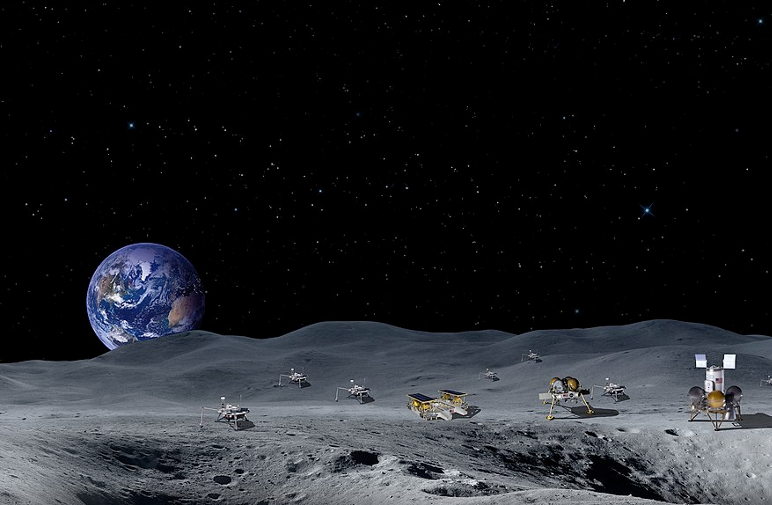
Asia Times tells us that there is a “secret mining war” taking place in space over helium-3, a version of helium which is surprisingly abundant on the Moon. Helium-3 is an isotope of helium with two protons and one neutron. The far more prevalent arrangement is helium-4, two protons and two neutrons.
(For those only vaguely familiar with the periodic table, helium is an element which therefore cannot be manufactured from other other elements and must be harvested from nature.*)
The fascination with helium-3 is as a fuel for fusion reactors. This fuel, it turns out, would produce absolutely no radioactive waste—unlike hydrogen-fueled fusion reactors which produce pesky neutrons that bombard components of the reactor and render them radioactive.
So, let’s get this straight. There is supposedly a “secret mining war” between China, the United States and possibly Russia over potential resources on the Moon, resources that might provide very clean fuel for fusion reactors of which there are zero of the commercial variety. And, the number of commercial fusion reactors is likely to stay at zero until at least mid-century. And, there is no assurance that the type of reactor that could use helium-3—which would require much higher temperatures than the hydrogen-fueled ones being contemplated now—will be commercially available any time soon after mid-century.
Some of the challenges of building such a helium-3 friendly reactor are detailed in this piece. Keep in mind that hydrogen is wildly abundant on the Earth in the form of water. Even the far scarcer isotope of hydrogen, deuterium—which is used in current fusion experiments—is much easier to obtain than helium-3 on the Moon and is commercially available today.
I’m not saying it isn’t possible to get helium-3 or other resources from the Moon. Clearly, humans can retrieve things from the Moon as they have already during missions by humans and probes. It is the cost of doing so which ought to warn us that such schemes are unlikely to succeed.
We have examples of similar challenges right here on Earth. There is somewhere between 45,000 and 1.5 million tons of gold in the Earth’s oceans. But the gold is so diffuse that the cost of extracting it is far above the price of gold.
Likewise, the cost of bringing helium-3 from the Moon would be colossal for reasons of distance and low concentration. Concentrations are believed to be around 20 to 30 parts per billion in the lunar soil called “regolith.” That implies that a huge amount of lunar surface would have to harvested and processed to extract an amount worth transporting. Yes, we might improve our technology over time and make it less costly to do this. But keep in mind that the technology for extracting the alternative, deuterium, will likely improve as well, allowing it to keep its competitive advantage.
[slide-anything id=’3472166′]
The obsession with mining the Moon strikes me as the kind of fantasy that enters into civilizations when they are faced with huge, seemingly insurmountable problems—climate change and resource depletion come to mind—and they want magical solutions that allow them to forego having actually to face those problems.
In the Asia Times story linked at the beginning of this piece, scientists claim that helium-3 is so energy dense as a fusion fuel that “two fully-loaded Space Shuttle cargo bay’s worth of helium-3—about 40 tonnes worth of the gas—could power the United States for a year at the current rate of energy consumption.” A Chinese researcher opines that “the Moon is ‘so rich’ in helium-3, that this could ‘solve humanity’s energy demand for around 10,000 years at least.'”
We humans can produce fusion reactions here on Earth—just not ones that give us surplus energy to use in our society. Humans can bring materials back from the Moon—just not in any quantities that would justify the expense.
We as a society seem to comfort ourselves with the idea that technology will overcome these “small” problems just in time to save us from an energy-deprived future. That belief is likely the worst product of narratives that tell us we can import key things that we might lack on Earth from the faraway reaches of space.
P. S. To read my previous pieces on helium supplies here on Earth, see here, here and here.
*Helium is produced by the decay of radioactive substances, but this process happens at such a slow rate that commercial quantities could not be economically harvested. Particle accelerators and some nuclear reactors also create helium but the amounts are so small and the energy cost so high that these sources are impractical for commercial purposes.
Image: Lunar Gateway – Human Lunar Lander Development (2018). NASA via Wikimedia Commons https://commons.wikimedia.org/wiki/File:Lunar_Gateway_-_Human_Lunar_Lander_Development.jpg
“Under the requested funding for Advanced Cislunar and Surface Capabilities (ACSC), along with other Exploration Campaign activities, NASA will re-establish U.S. preeminence to, around, and on the Moon.”




Comments
We changed commenting systems on September 10, 2026 as part of a site-wide functionality and security upgrade. Your past comments have not disappeared, and you can still log in with your old Disqus account credentials if you wish. Contact us with any questions.
While the helium-3 mining is indeed not an option to fight the current energy and climate crises (as are fusion reactors it is intended for), and we have to phase out fossil fuels with renewables (haha), the author constantly talks about its price. Prices, prices, prices – all of the piece is written from the free market, i.e. the capitalist perspective. All the talk about how expensive this resource is is rendered meaningless if we enter a different economic paradigm, which is based on needs and resources, not on artificial economical metrics, which are purely the constructs of the current social model. It is very easy to make something cheap or even free, if it is necessary. Center all the civilization on obtaining helium-3, and it will be cheap and abundant (that’s obviously reductio ad absurdum, but you get the point).
The first step to make to even talk about our future, is to acknowledge that current “prices” and other metrics like GDP have nothing to do with physical reality.
There is the physical reality of the resource being on the moon and it needing to be transporting here.
Of course, but it is nothing out of sci-fi, technically speaking. The problem is burning fossil fuel to get there (in multiple ways, from construction of the launch vehicles to the actual flights), but if the return is good (clean energy), it would be worth setting aside a very small quota for that (and it is indeed incredibly tiny compared to what some very unnecessary activities emit now).
All of these are theoreticals, again, but just to stress that physically it is very doable.
Seems to me the other problem with fantasies about advanced technologies that might be available in 30 or 50 years is that realistically, we won’t have a high-tech civilization by then because we’re careening toward collapse as a result of our refusal to countenance limits.
Exactly! I call it “blind futurism” – bring the useless, but “futuristic” tech now (irrepairable smartphones, smart-everything etc.) under the market paradigm, turn a blind eye to all the damaging effects of said paradigm, just to left real futurism unfulfilled.
“helium is an element and therefore cannot be created, but must be harvested from nature”
Wrong. In a classical nuclear fusion scenario, and also within the sun, hydrogen is fused to create helium.
This process can be replicated, thus one can create Helium from Hydrogen with enough forces and excitation.
Thank you for your input. It seems to have remarkable potential!
The problem is that yes, Hydrogen and Deuterium are widely available on Earth but most common fusion reactor design today called Tokamak requires Tritium and Tritium is extremely hard to get. Besides Tritium based reaction produces a lot of energy in neutrons which cannot be directly converted to electricity (there will be huge loss in conversion) while He-3 reactions produce electricity directly (with 95% efficiency). Outside its rarity He-3 is almost ideal fuel for fusion.
50 years ago, we put 2 people there, for a few hours. It took how much energy and effort? But no payload.
But the bigger point is that if we can’t solve living sustainably on this planet, no amount of external mining will save us from our stupidity.
I am not sure I follow your arguments, both of them. Like, the US had quite a successful human Moon program with about 300 hundred hours on the moon surface alone, hundreds of kilograms of samples returned and numerous discoveries. The program was a reconnaissance, pioneer type of mission realized in record amount of time in the realm of market economy (which is generally disadvantageous to such undertakings, as we see today). The strawman you constructed only shows that you know next to nothing about humanity’s success in space and is in no position to meaningfully criticize it or its implications. Industrial mining on the Moon is absolutely physically and logistically possible, given the right social conditions.
The second point is moot, as we absolutely can live sustainably – with different economic model, different population level and different energy sources. No theoretical barriers here. In fact, the only thing that has prevented us from the transition is our political and economic mode (growth paradigm married with oligarchy). While its continuous grip may have something to do with the basic social psychology of our species, it is not that society cannot change in large and small ways – we have wonderful examples abound, both historical and contemporary. So, “stupidity” as you put it is in no way a natural, irreparable condition.
That is not to say that I’m optimistic, quite the contrary, but I dislike bad arguments against at least the theoretical possibility that we absolutely can live in a better and sustainable technological world.
I think you need to understand diminishing returns and EROEI
I don’t think you’re listening.
I know about those, but have you done the math?
With respect to EROEI it is especially important not to fall in the same trap as Kurt Cobb, thinking in terms of the market prices and capitalist system.